This artist showcase introduces the work of Darrell Black. Black was originally inspired by space and science, but his creative journey has taken him on a path of simplification and ‘stripping back.’ Keep reading for a Q&A with Black about his work and his life as an artist, as well as a selection of images of his work.
The Promised Land
When did your interest in art/crating begin?
My interest in Art began early in childhood, growing up my parents had a miniature sculpture of artist Rodin’s ‘The Thinker’ and abstract paintings by various artists on the wall. At the time I never took any real interest in it, but what I loved was space and anything to do with science. I created as a child, spacecraft including futuristic worlds and cities using any and all household items I could find: utensils, clothes pins and tools. Anything I could find to feed my fantasy this was my first introduction into art without realizing it but my main focus was always science.
Moonlit Metropolis
What is your starting point for each piece?
When I decide to start on a work of art my mind is clear, free of all worry and thought. I start on a canvas from every direction and within the throes of creation, I am a mere spectator. My advice: let your hands do what they do in the creating process, you the artist are only a spectator. The job of the artist is to clean up the mess left behind by creation, fine tuning the image by adding color, defining lines that make up the painting; fixing things up.
The Sacrifice
Who or what influences your work?
The influence on my artwork comes from traditional and non traditional sources. I take inspiration from everyone and everything incorporating the person or object’s mental or physical state in my creations. For example, learning about the personality of Picasso, researching all the tragedy and agony he caused to friends and family; the personal problems of artists like Rothko, Pollock and Basquiat; the struggles of Winston Churchill to defeat the Nazis and win the war against tyranny; the scientists of the Manhattan project beginning from scratch to create the atom bomb; Dr. Frankenstein’s determination to create a monster – all of this struggle, hardship and commitment to succeed against all odds gives me the incentive as an artist to create new and innovative work.
A Really Bad Trip
What do you hope the viewer gets from your work?
The hope is to confront the viewer with a question, and for each person to come up with the same or a different answer. That for me as the artist is very interesting, since there is no right or wrong answer, just a different perspective or another way of seeing the world.
Formulation of Human
What do you think of the term outsider art? Is there a term you think works better?
Personally speaking I think the term ‘Outsider Art’ is a bit outdated and in some way self-defeating. I think the word creates a secondary class of artists whose creativity is seen by others in the art world as being more infantile than substantive, denying many worthy self-taught artists their rightful place in the pantheon of art along side well-known and established artists. I think the term self-taught artists or creatives works best.
The Path to Sanctity
What are you working on at the moment?
I’m presently working on large canvases in a multitude of languages. They express the problems and hopes of many people in certain parts of the world using mere color and writing in an attempt to show our basic similarities, helping to create mutual respect between cultures, and merging all spoken word into one universal language of understanding and acceptance for everyone.
The State of Europe
Where do you see your work taking you in the future?
My artwork has always been a journey of self-discovery. My images began with simple patterns and colors, resulting in more complex and recognizable objects and figures, but after learning so much about many artists and their approach to art, I realized that stripping away from a work of art – simplifying creation to its vary basic elements – might be the key to great works of art.
This artist showcase brings you the work of Susan Spangenberg. Susan produces work for the process of expression, not the final result, and the act of creating can be painful, but it’s also healing at the same time. The interview with Susan is a moving testament to how powerful creativity can be for some people, and how being an artist – and making art -can be equally a cure and a curse.
Hung
When did your interest in art/creating begin?
I started creating from my earliest memory, the age of three. I didn’t speak or look people in the eye for much of my life. (I lived in fear, coming from an abusive household and then being further traumatized in the mental health system). Art was my voice and form of expressing myself and still is today.
Spirits of the Fire
What is your starting point for each piece?
The starting point of my art work is a thought, a phrase, a joke, an emotion, a fear, an anxiety, an issue I’m trying to overcome personally, the news of the day. Some pieces are done more impulsively than others, like my suicidal, emotional, self-referential work. Other work I am more conscious of creating and aware of, such as my social/political art which tends to be more graphic and takes more time and thought to execute. I’ve learned to embrace the fear, excitement and process of creating. It took me a long time to embrace this desire instead of suppressing it. I now realize the process of creating – the fear of the unknown, letting go and trying new things is my freedom and how I grow and surprise myself. I admit I work quickly and getting it out is what is important, not how beautiful or technically proficient it is. Technique is not my strength. It’s torture when I do not act on my impulses. Even when I try not to create, eventually I must give in, so I can relax and stay sane.
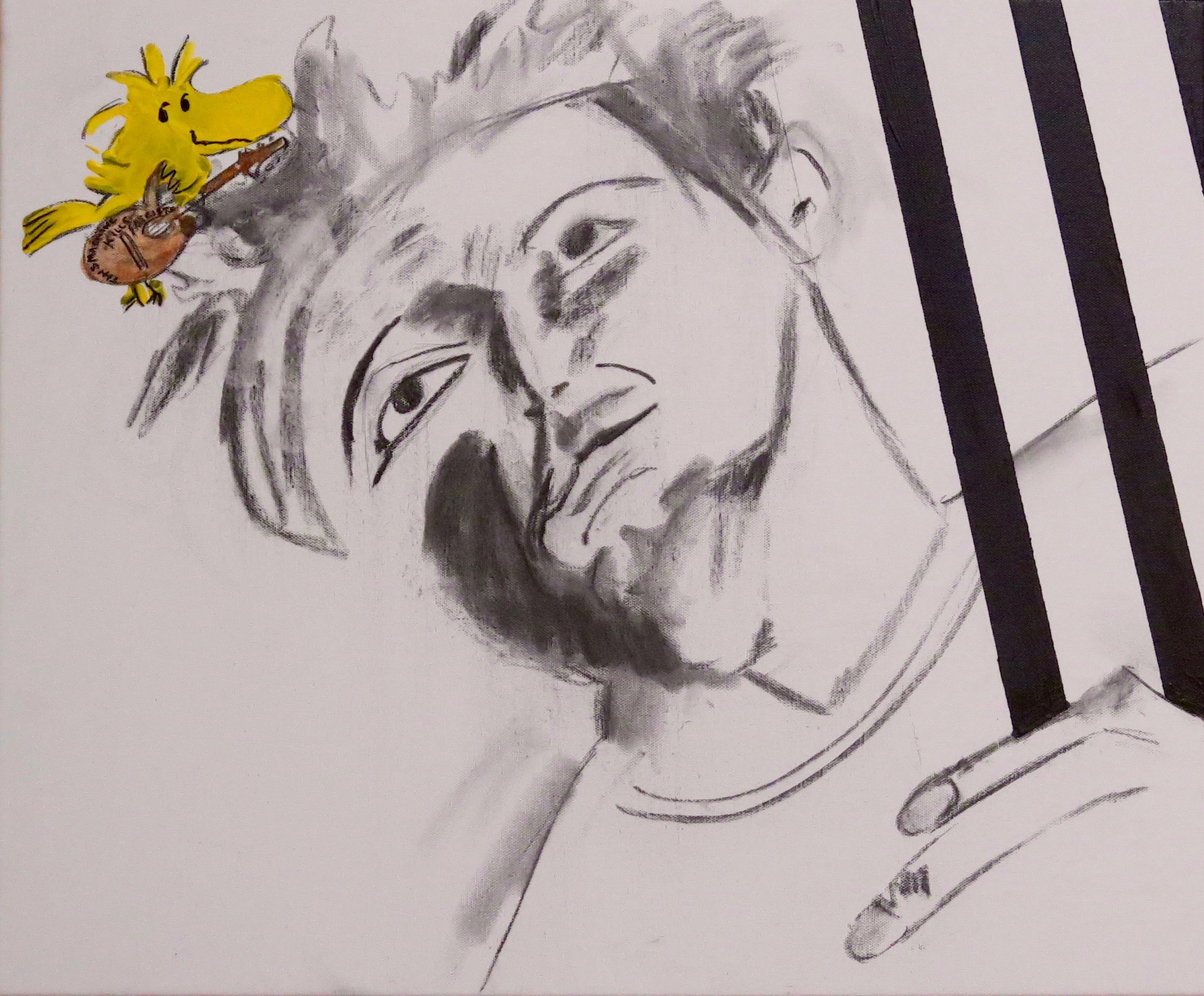
Woody Saves Woody from Creedmoor
Who/what influences your work?
I’ve been influenced by artists overall. However, for the most part they’ve been actors, writers and musicians. Marlon Brando, Rod Steiger, Steve McQueen, Emily Dickinson, Tennessee Williams, John Lennon, Iggy Pop, Johnny Cash, my late great acting teacher, Sanford Morris. (When I was growing up, my dream was to be an actor, not a visual artist).
Mad Women
What do you hope the viewer gets from your work?
I try not to worry what the viewer sees. I have no control over that. The work takes on a life of its own and the viewer I hope has some connection with it. Holding someone’s attention is the most difficult part and quite humbling. If someone bothers to look at my work in this age of information and over-stimulation, I am pleased.
Surfacing
What do you think about the term outsider art? Is there a term that you think works better?
I’ve heard many different definitions over the years for the term ‘outsider art’. Let’s break the word outsider down to the simplest form and I’ll keep this definition without changing it or suggesting anything better or different (I’m not one for labels). Ultimately all artists feel like “outsiders” by definition, in that I believe none of us feel like we fit into society. And non-artists also feel like they don’t fit into society. Isn’t this why we all love art? This tug of war within ourselves individually, that we do not feel we fit into society and yet we all try to fit in because we must live in some form of society is what makes us all outsiders and outsider artists.
Higher Species?
What are you working on at the moment?
I am currently writing my memoir and I hope to publish it.
The Sound of Silence
Where do you see your work taking you in the future?
I don’t know where I see my art taking me in the future. What I would like is for my art to mean something and to leave the world in a better place somehow. Art is work and physically and mentally draining. I wish I didn’t need to create. It is a curse in one sense and also a life saving outlet. I hope one day I don’t feel the need to be an artist or even call myself one. Being comfortable with myself, alone with myself and being in my own skin is very difficult for me. Perhaps if I felt good about myself, I wouldn’t feel the need to be an artist. I do know that art will continue to allow me to heal myself and also connect with others. Connecting with other people is also a difficult thing for me. Perhaps one day I will paint all the pretty boring things in the world, and that wouldn’t be such a bad thing, because it might mean that I’m over all the pain in my life.
Ahead of his upcoming exhibition at the Cavin-Morris Gallery, artist Straiph Wilson talks about his ethereal sculptures that take inspiration from folklore, Scottish nature and alchemy.
When did your interest in art creating begin?
I can clearly remember having one of my paintings exhibited in Osaka Japan when I was only eight years old. This was back in 1980; our school was encouraged to participate in an art exchange programme with Japanese schools with children of a similar age. The painting was called “Jack Frost.” It was my quite naive personification of winter in white paint completely innocent of artistic merit. I was invited to an award ceremony where I met our local Lord Mayor who presented me with a certificate of achievement followed by a group photo of all the other artistic self-starters. I remember the family fuss followed by the pride, a real sense of reaching and curiosity from which I have steadily progressed artistically to where I am now. I’ve developed progressive work that includes sculpture, painting, drawing, sound, film and old Scots poetry.
I recently looked up the legend of Jack Frost and in late 19th century literature he is depicted as a sprite-like character, sometimes appearing as a sinister mischief maker or as a hero. If my artwork rings true then I think that I am the sinister mischief maker rather than the hero.
What is your starting point for each piece?
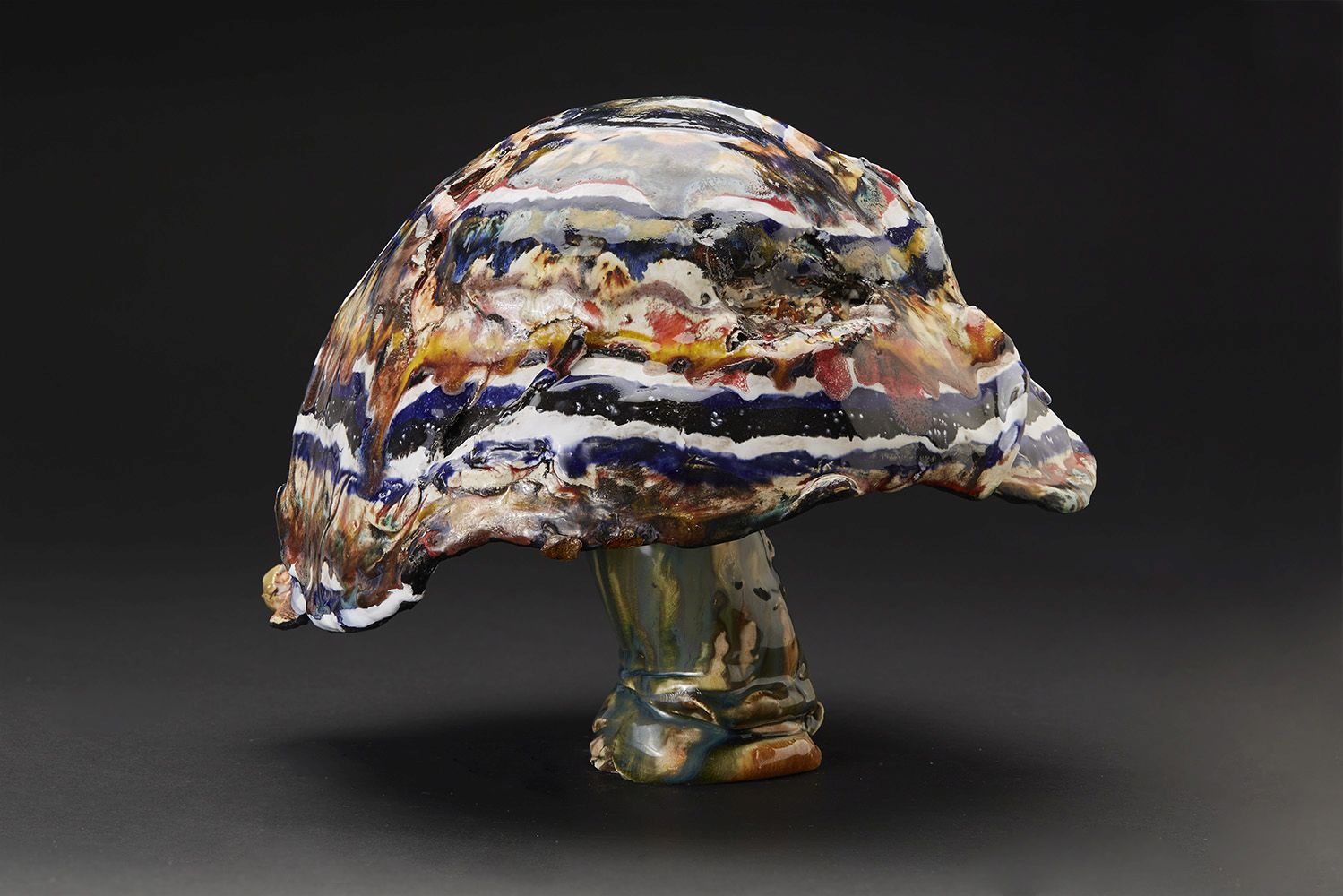
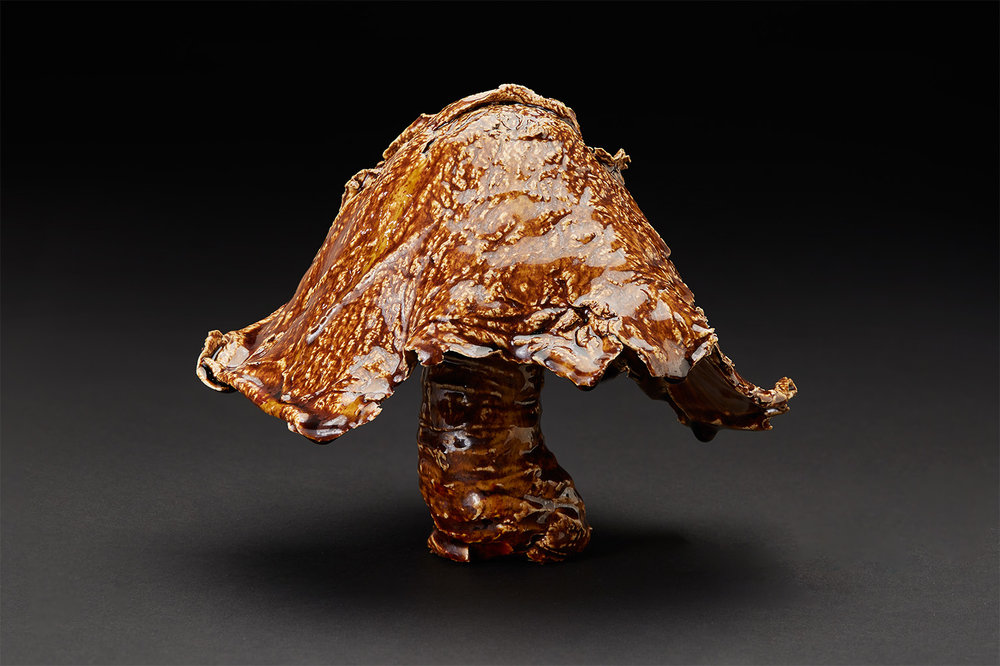
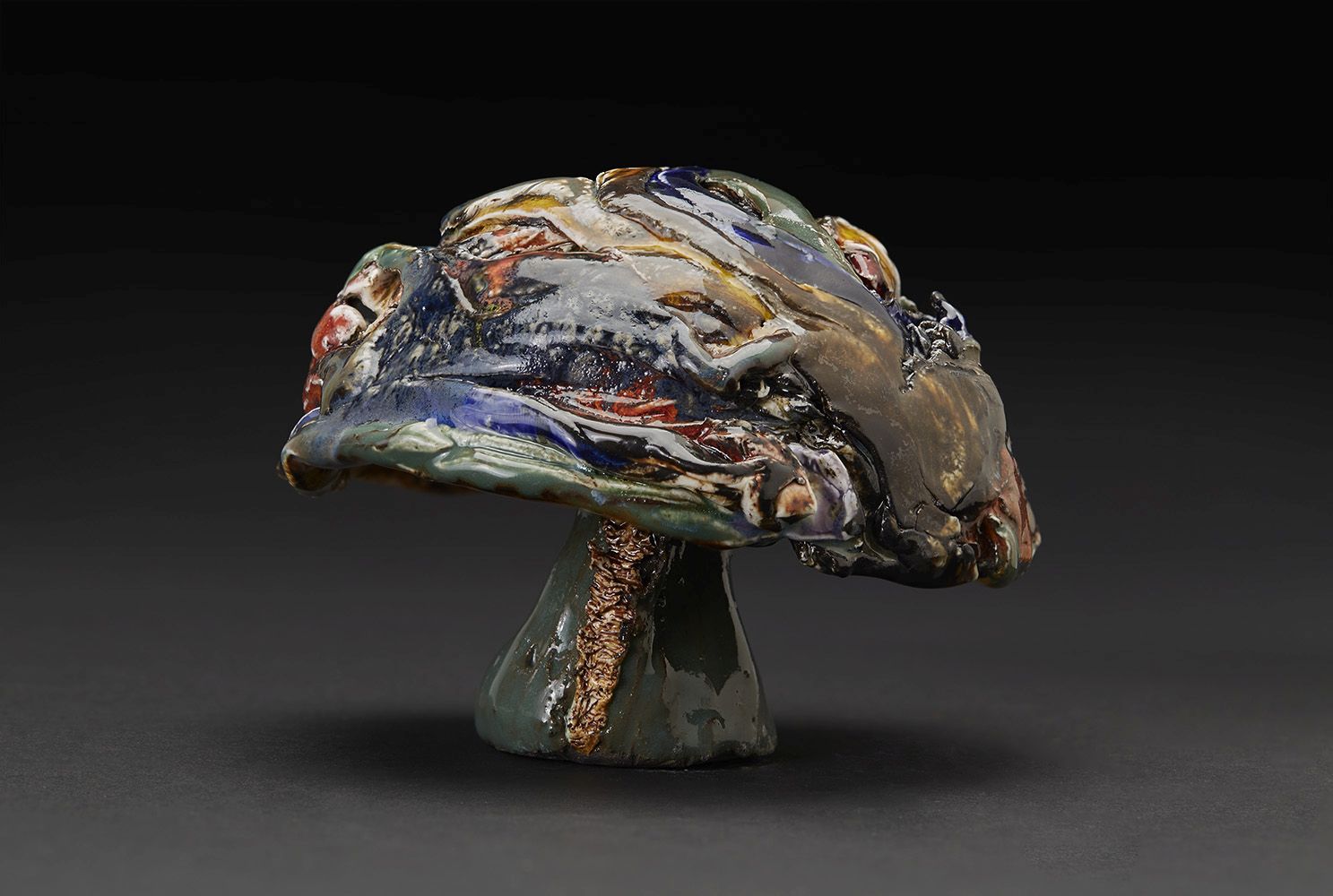
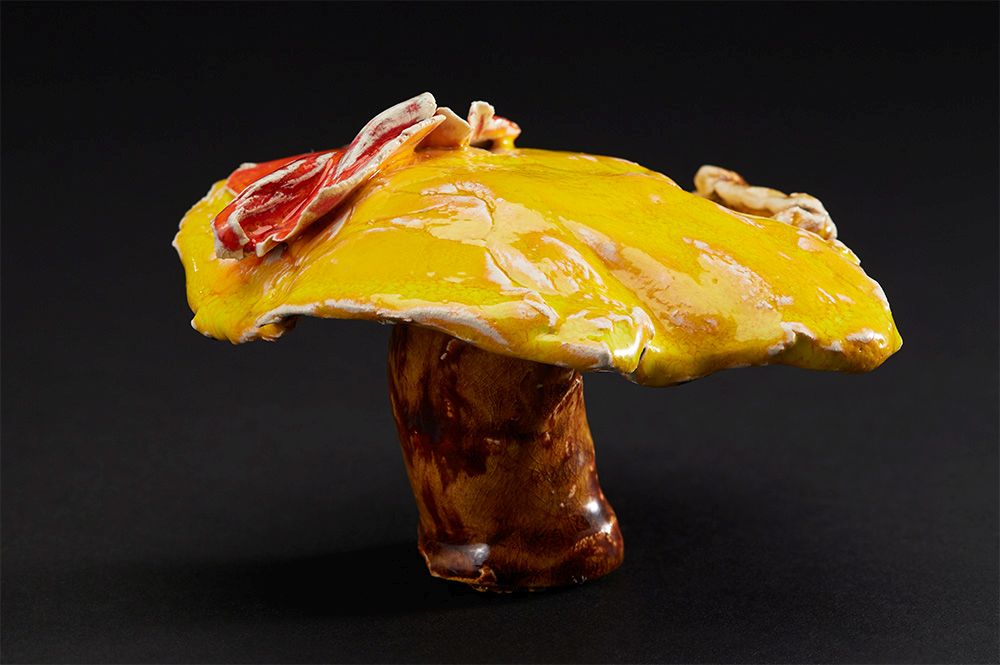
Materials and methods, I experiment with commercially available clays along with local clay from a farmer’s field. I mix Porcelain with Stoneware, Earthenware with fine bone china, and smooth crank clay with the local earthenware clay I’ve named “Aberfoyle.” The Aberfoyle clay is soft as butter and highly porous, not very vitrified and unpredictable when the various clays are all working against each other during the creation process – I like to think it’s like alchemy. The differences in material properties make some of the individual pieces bloat and transform creating more natural looking pieces akin to real fungi. I make the caps of the fungi by smashing the clay onto the ground to densify the matrix increasing the strength of the finished piece. It’s an interiorization of physical and mental undertaking. One which I hope goes towards the aesthetics of the finished work. Although I have to confess that the idea of using ceramic to develop fungi sculptures was secondary. My initial work in the series was cast in liquidised lead in plaster moulds of local fungi I had harvested. Using lead was more true to the theme of alchemist garden but then I started experiencing the sinister side of lead, feeling the signs of poisoning and decided to switch to ceramics.
Who/what influences your work?
For this recent work I’ve unified a combination of poetic imagination and ethereal ideas based on “Taibh Searachd” the gift of second sight (Gaelic). I live in rural location and I get lot of my inspiration from the nature and the linked Scottish mythologies. My cottage which is also my studio sits on the edge of woodland where the silver birch and old oak trees grow covered in bracket fungus (parasitic decomposing polypore). These polypore’s look like living sculptures clinging onto the tree trunk, absorbed in natures recycling. This visual image of the partnership between the unseen cryptic actions and growth of the parasitic decomposing fungi and the host the tree, had me considering Charles Darwin’s concept of the “Tree of life” a perception that he used towards his proof on his theory of evolution. For a long time I have been fascinated how the tree of life appears as a concept in biology, theology, philosophy, and mythology as to me this illustrates interconnection of all life.
Artistically this visual image provided me with a powerful tool to look at the metaphor for common descent in the evolutionary and spiritual sense. It was a challenge to see if I could develop and merge the image of new religious objects from the ground up by acknowledging the symbolism imposed on fungi in fables and paying tribute to my Celtic identity. The outlandishly chthonic ceramic fungi seemed to be a radical enough for this purpose. My practice also tugs on influences from my long working career as a technician in the field of behavioural ecology and evolutionary biology; this encompasses the study of organic diversity, including its origins, dynamics, maintenance and consequences. This has allowed me an inquisitive foundation to build my own Interpretations upon nature as the observer.
In my youth, I was also initiated into the “old religion”; a witch’s coven. I was taught a polytheism practice of the mysteries and worship of a belief in Celtic deities based around our agrarian culture. Through these experiences I have insight into the contrasting worlds of science and belief. The two distinctive or polar opposite groups practice in zones conventionally seen as mutually exclusive; creating so-called “Zones of inhibition” that in practice and theory should be inaccessible to the other group. It just seems right that my art work should walk the tideline between religious belief, folklore and evolutionary behavioural mechanisms and at times blurring these boundaries. Perhaps this is why I have been fascinated by alchemy. Not so far back in history it was a precursor in the development of modern chemistry while the alchemists were strongly connected to mythology and spiritualism. I think that the spiritual and scientific sides share many common interests as through time both have been interested in the essences of things or the ‘inner structure of existence’.
A few years ago, I came across an image of the fresco, Adam & Eve dated 1291 AD (displayed at Plaincourault Abby, Indre France). The forbidden apple from Adam & Eve is historically depicted as the symbol of knowledge, immortality, temptation, seduction, the fall of man and sin. In this fresco, the apple was replaced with Amantia muscaria (Fly agaric), hinting towards mystical powers held by fungi.
What do you hope the viewer gets from your work?
I hope they see authenticity and that visually they appreciate the work as thought provoking. If one of my pieces opens up a conversation about the subjects that influence my work, I will feel warranted, especially if it’s a common langue on symbolism.
What do you think about the term outsider art? Is there a term that you think works better?
I spent a considerable time trying to define my practice and ideas. It really helped when I moved to the next level in looking for a gallery that would best represent my work. When I came across Cavin-Morris last year it all fell into place. All of a sudden I had a generic name for what I was doing (Outsider Art) and an opportunity to display my work.
I am perhaps an outsider in other ways too and have never tended to belong to any mainstream grouping, so if I could establish my own definition I would actually like to call my work “Chthonic Art”. It’s a term that has been used to describe the spirit of nature within the unconscious earthly impulses of the self, which is ones material self.
What are you working on at the moment?
I’ve just finished a series of Fungi for “Rebel Clay” A group exhibition at Cavin-Morris from 7th September to 7th October. I’m currently producing larger elaborate ceramic fungi for my solo-exhibition in 2018. The title of the exhibition is “The Alchemist Garden”. The exhibition will run for three weeks during Glasgow international (20th April – 7th May 2018) which is a world-renowned biennial festival of contemporary art. I’m not part of the festival, just capitalising on an opportunity to showcase my work during the festival at Veneer gallery on Argyle Street.
Where do you see your artwork taking you in the future?
I will be uniting up with my brother next year when he is released from prison. He’s served twenty-four years in jail for murdering a man with an axe. Over the years I have been covertly involving him in various art related projects so hopefully together we can produce some new exciting ideas.
The latest Artist Showcase presents the layered work of Robert Schoolfield. Robert was introduced to art by his grandmother at a young age, and he still counts her as one of his key inspirations. He applauds creativity in whatever shape or form it comes in, noting the higher importance a work’s content and messages than the identity of themaker.
Burning Man
When did your interest in art/creating begin?
My grandmother, who is an artist, introduced me to art at a young age. I can remember doing crafty things at her house and we were there quite a bit. I didn’t really develop my own interest until I was 17 or so. I had always made art up until that point but I never really considered it anything beyond something I just naturally did.
Casual Tendencies
What is your starting point for each piece?
Typically, I start by writing thoughts that are going on with me or something that may have happened throughout the day or something recent. I also save things that I find interesting. For example, I’ve been through a lot of treatment centers for depression and bipolar disorder and they give you a lot of worksheets about how to cope with life. Sometimes I use those worksheets as a layer or I also tear pages from books, just anything that catches my attention. The beginning layers are pretty personal, I write a lot of things that get covered up. But that’s kind of like life, everything is eventually buried in history. From that point I usually repeat the process and incorporate paints and I draw on top and I like to use a lot of layers.
Night Life
Who or what influences your work?
My main influences are my own thoughts and feelings. I try to relate that I am human too and I think and feel things. The people that influence my work can be anyone. Anyone can make you think differently about what you do whether they’re trying to or not. I also really wouldn’t have the same interest in art if it wasn’t for my grandmother, so she’s definitely a big inspiration to me. Some of my favorite artists are Basquiat, Picasso, Salvador Dali, Jackson Pollock and Van Gogh.
Outlet
What do you hope the viewer gets from your work?
I think that if I can provoke a thought or feeling in someone then that’s amazing. Anything else they get from the piece is extra. I don’t have much to offer in this life so I make art to show my appreciation. Its a privilege to be able to be creative and express how we feel and relate to one another. Human connection.. wonder.. I like to let you know that you can be comfortable being yourself.
Room to Breathe
What do you think about the term outsider art? Is there a term that you think works better?
I really like the term Outsider Art. I think it describes new art perfectly, especially those who make excellent work that don’t get any recognition. Most of the greatest people were outcasts and outsiders and just think of all of the people that were just as great but were never known about. I think its a great term.
Space Waste
What are you working on at the moment?
At the moment I’m still chasing the same style that I’ve developed over the years and I’m working on a series called The Signature Series where I sign “Signature” where the signature would typically go because who made the art doesn’t necessarily matter as much as what is being conveyed. All creativity comes from the same infinite well of existence. At least that’s how I think about it in the here and now.
The Happening
Where do you see your work taking you in the future?
I’d really just like to make a living off of what I do and inspire other people along the way. Most importantly though, I want to remain a doorway for creativity to walk through.. to stay true to the art. I’m really not sure how I see it unfolding, I’m kind of just along for the ride and staying opened minded when it comes to opportunities.
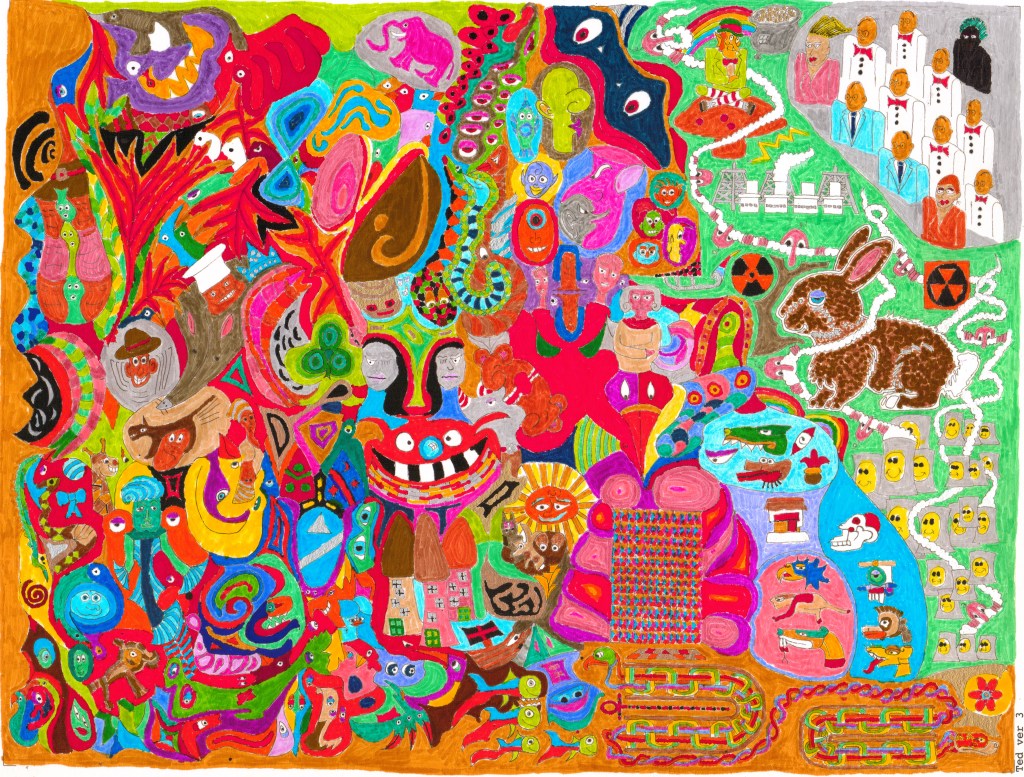
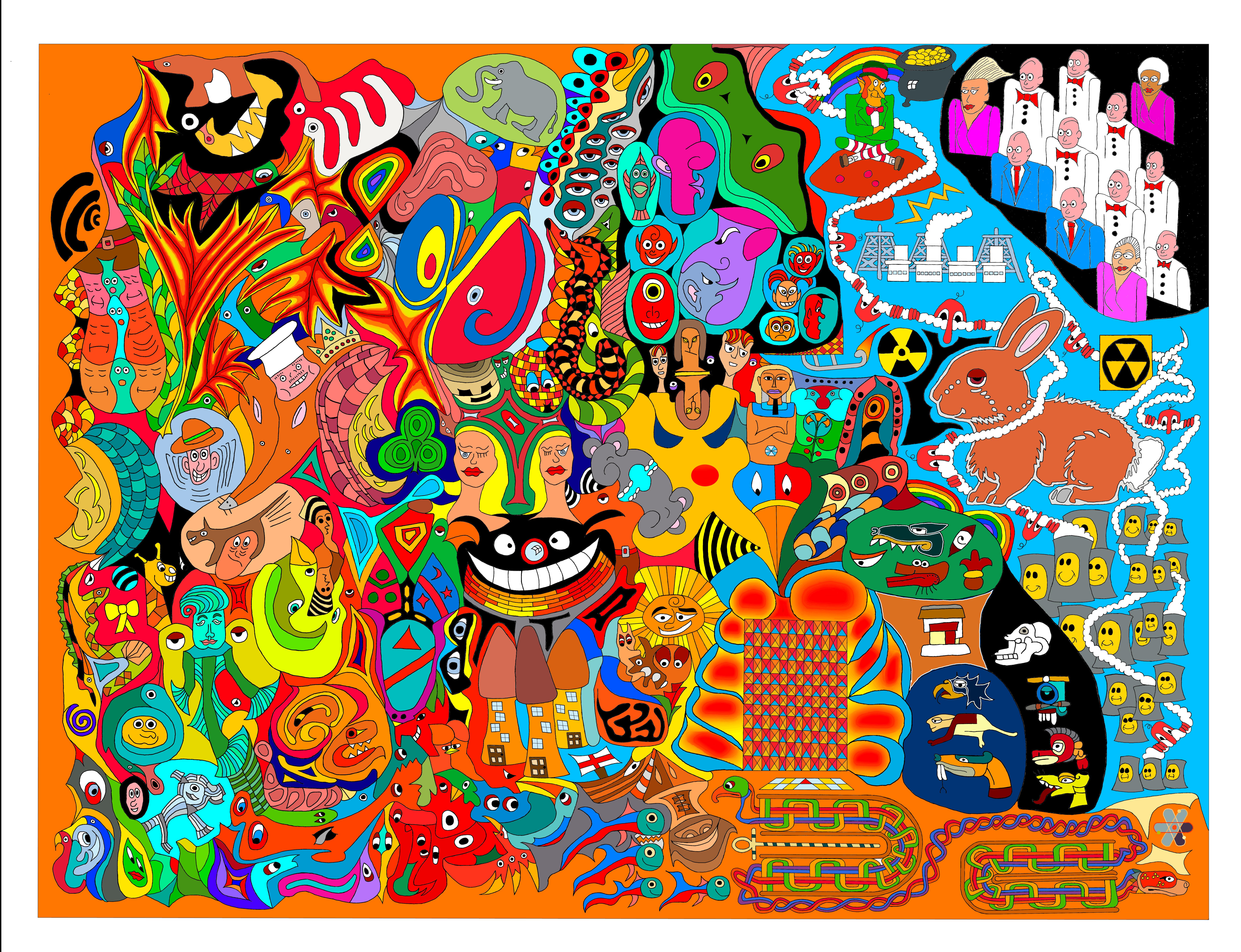
The latest artist showcase comes from Ted Silar, a writer (of music and literature), inventor and artist. In this piece, Ted talks about his ‘Rabbit Dreams’ series – which started as a doodle, but has become an experiment about line and colour.
Ted Silar, Rabbit Dreams 1
When did your interest in art/creating begin?
When I was a boy, I enjoyed reading comic books. (Rue the day my mother threw my collection out.) Not exactly an unconventional pastime. But it inspired me to want tobe a cartoonist. Which is a little more unconventional. I mean, comic-book reading didn’t inspire my buddies likewise. Why, I’m not sure, but I guess it was because I was never satisfied—I was always editing the cartoon—just like I was always editing the book I was reading, or the movie I was watching—in my head, the better to make italign with my own predilections.
But I never really got around to cartooning. The fact that I got glasses at 8 may have subconsciously re-directed my interests from the visual to the verbal and the aural. I seem to remember considering high art, too. But, while I liked high art of the traditional kind, high art in the time of my youth meant nothing if not Abstract Expressionism, which I did not like.Yes, I was one of those Philistines who thought, “A monkey could do that.” Funny how it turned out it was all a CIA plot, rendering all us clueless Philistines right by default! Indeed, it is funny what a grip modernism had on all of us. I wrote reams and reams of incomprehensible stream-of-consciousness poetry for years and years until I got wise, because incomprehensible stream-of-consciousness poetry was the thing one did. I write highly formal poetry nowadays.
Many years later, in San Francisco, I ran across this great book called The Zen of Seeing. Itshowed me a way out of the over-academic, over-intellectualized, fad-mad mentality, a way I could draw things realistically without “studying” how to draw. My college notebooks are full of rather faithful cartoon renditions of teachers and fellow students drawn with the Zen method. I also kept having these ideas, these concepts for works of art, and I was always trying to induce friends of mine who were trained artists to realize my concepts. No cigar of course. They wanted to do what they wanted to do.
Finally, with the advent of the 21st century, I said to hell with this. Do or die. I had this concept in mind—a picture so complex that it would have “scale”—that it would look different from different distances and perspectives. My original dream was to stand on a ladder next to a huge canvas, like Georges Seurat, only doodling away instead of dabbing away. I also imagined my huge canvas up on blocks and me rolling around doodling away beneath it on an old-fashioned, wooden mechanic’s creeper like a supine Michaelangelosplashing on the Sistine ceiling.
I soon discovered that a regular old sheet of 18 x 24 coldpress and a sagging barcalounger was more than sufficient. Do you realize how long it takes to fill up just one sheet with doodles? I don’t know about you, but it took me years.Yes, I didn’t work on it every day. But even if I had, I am sure it would have eaten up the days like gangbusters.
I found working on it almost therapeutic. Whenever I couldn’t concentrate on anything else, I could always take up my pad and doodle. It seemed to use a different part of my brain, a part of my brain where there was no pain, where everything was just jigsaw puzzles or motorcycle maintenance or something. Even the more difficult sections, sections that, unlike strictly-defined doodling, required care and pre-planning, like drawing Celtic knots or leprechauns, didn’t seem to cause me the kind of anxiety everything else could.
I used to think things like art therapy were just a bunch of psychobabble. Personal experience has re-vamped my view wholesale.
Ted Silar, Rabbit Dreams 2
What is your starting point for each piece?
My inspiration for Rabbit Dreams was totally conceptual. Long ago, I read James Gleick’s book, Chaos: Making a New Science, and, instead of inspiring me to make new science, it inspired me to make new art. While most of the book is about science and math, it does discuss art at a certain point. Gleick suggests that older art has more going for it than strict modernist art:
“A Beaux-Arts paragon like the Paris Opera has no scale because it has every scale. An observer seeing the building from any distance finds some detail that draws the eye. The composition changes as one approaches and new elements of the structure come into play.”
He compares the Paris Opera House to a New York skyscraper. The skyscraper, he contends, has no “scale.” It is so simple that it looks the same whether you look at it from near, far, or yonder. “Simple shapes are inhuman,” asserts Gleick. “They fail to resonate with the way nature organizes itself or with the way human perception sees the world.”
Such passages inspired me to create a “fractal,” “scalar” artwork, a work inspired by natural organization and human perception, a work of such complexity that it would look different on different scales.
That was my starting point—simple complexity. Later on, my doodling in my college notebooks gave me a way to work—I would simply pile little doodle upon little doodle until the whole, fortuitously, without malice aforethought, generated its own overall structures, structures you can only see if you step back.
It started out as just that and nothing more—a fractal/scalar doodle. But gradually,it became madness. I started in the lower left hand corner and worked up and right. As you can see, the lower left is the most abstract, formless, inchoate, doodlish. But at some point, as I worked my way to the right, the idea of the Rabbit came to me. The idea of all of this warped chaos emerging out of the dreams of a Rabbit. I thought of how the innocent little bunny-rabbit had plagued, almost destroyed Australia. All that mindless generation and creation and multiplication. Which reminded me of all that mindless human generation and creation and multiplication that has brought us to the present sorry state. At some point in the process, Fukushima blew up. And thus was the right third of the painting decided for me, fortuitously. The right third of the doodle had to become representational. I discovered I had worked my way backwards through time, first drawing the horrible, monstrous nightmare, and then, at the end of my process, drawing that which had first engendered it. The Rabbit. The mindless people. The nuclear generators. Fukushima. Kilroy.
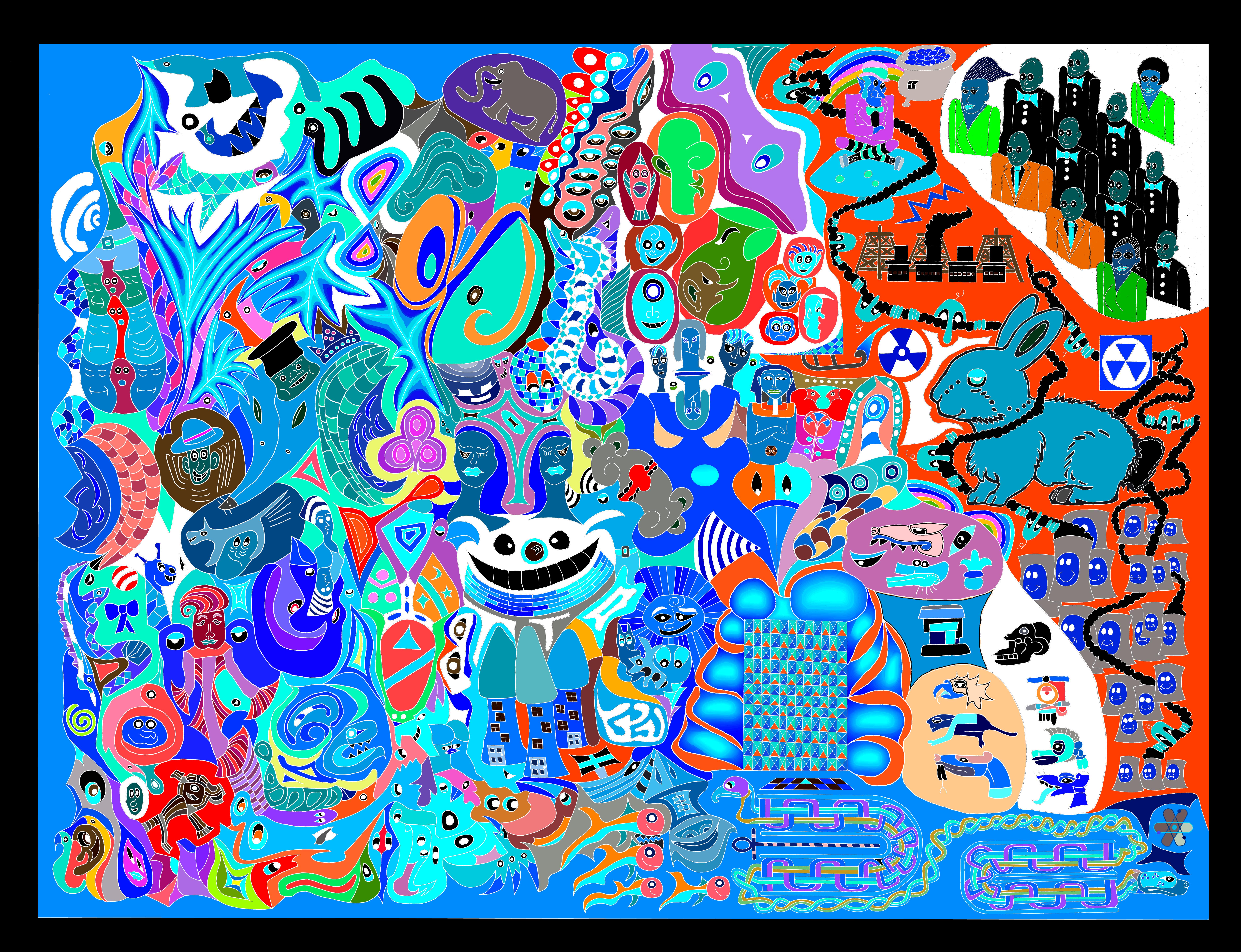
After I had finished my 18 x 24 drawing, I had it scanned and printed out 8 1/2 by 11 prints on some nice, thick, but tragically absorbent paper. Step two. Coloring. Trying to figure out how to color the thing made me envy those cartoonists who have their own colorists. “You do it!” I would cry in my sleep. But, once again, I found this work therapeutic, choosing the pens, testing them out, choosing the colors, trying to keep in between the lines. In my first version, Rabbit Dreams I, I had two rules for coloring: Don’t put two areas of the same color next to each other and color things the color they should be (i.e., rabbit=brown, sky=blue). It wound up chaotic. The eye has trouble making sense of so many random colors all mixed promiscuously together. Rabbit Dreams II ended up with a preponderance of redness, and that seems easier on the eye. In Rabbit Dreams III and IV, I tried to limit the palette, in III to black and grey and white, and in IV to shades of purple that ended up looking mostly pink. Now I understood why movie directors use “color palette.”
Unfortunately, these versions only exist in digital form now. When I came back to my folder of inked-in prints after a few months, what did I find but the colored ink had all faded away into the paper. Thank goodness for scanning. Oh, well. Live and learn. I now know what kind of paper not to use.
In my recent, wholly digital versions, Rabbit Dreams V and VI, I went back to my first two rules, which should have resulted in a rainbow kaleidoscope of color, and yet somehow they came out predominantly orange-ish and blue-ish. Beats me why.
Ted Silar, Rabbit Dreams (Paint Net)
Who/what influences your work?
Chaos theory, of course, as I have already adumbrated. Also, I like pure, traditional designs, Islamic and East Indian carved latticework screens, Minoan pottery and fresco, Neolithic cave painting, Anasazi and Mimbres pottery, American Indian drawing, painting and design. There is a “who” behind this kind of art, but her name has always been “Anonymous.”
Ted Silar, Rabbit Dreams 3
What do you hope the viewer gets from your work?
There must be 200 eyes in Rabbit Dreams. I am not sure why. It reminds me of La Maesta, which I actually saw one time in person in Siena. All those figures’ eyes have these rich brown pupils staring out at you. It’s hypnotic. I think they are made of blobs of brown paint that stick out from the canvas kind of like what Van Gogh does with his flower petals. (I saw a show of Van Gogh flower paintings at the Met a long time ago, and, if you look at them from the side, they look like molded, three-dimensional relief maps of mountain ranges.) It is probably not an accident that theMaesta came to my mind, because it is a very complex painting, full from one end to the other with figures and decoration and illumination. Someday I would like to illuminate Rabbit Dreams with gold in classic Sienese fashion. I am joking, of course, although I did use gold- and silver-colored paint-pens on some of the versions, trying to get that illuminated effect.
I want all those eyes to hypnotize my viewers. I want the variety of colors and shapes to overwhelm them, inundate them, terrorize them, in a way reminiscent of Schiller’s concept of the sublime.
I also want them to appreciate the visual jokes. For the record, I would like to state that, although I did take the images of the rabbit and the leprechaun and the Celtic knots and the Aztec hieroglyphs off of the internet, I drew them freehand, Zen of Seeing–style, I did not trace them or copy and paste them.
Much as the work is obviously ridiculous, ludicrous, patently absurd, goofy, laughable, nevertheless, I hope that viewers at the same time see the deadly serious point.
I think Fukushima is the most horrible thing that has ever happened to the world. Ever. And the laughter that I express in the work is the insane laughter of utter despair and utter futility.
Ted Silar, Rabbit Dreams 4
What do you think about the term outsider art? Is there a term that you think works better?
Well, on the one hand, I am more than happy to fit into any category at all, as one of my biggest problemshas always been that people don’t know how to categorize me—and you need people to categorize you, or they just don‘t know what to make of you, and if they don’t know what to make of you, they end up standing there staring at you with glazed eyes like they just saw a hippogriff without a clue as to what a hippogriff is. I don’t blame them, I guess. My resume is somewhat diverse. I make outsider art; I write and play rock and roll, garage band, reggae, blues, soul, country, jazz, classical (among other genres);I write poetry, short stories, novels, literary criticism, history, essays (among other genres). I am a college professor, but I know the low-life, the working-man’s life, just as intimately. I have been a cab driver, a bricklayer, an auto-worker, a typist, a data enterer, a janitor, an accountant, a ticket-taker, a dishwasher, a chauffeur, a ditch-digger (among a raft of other bottom-of-the-feeding-chain jobs).
Such a polymorphous gallimaufry, it must be conceded, does not readily lend itself to abbreviation. (Another category I probably fit in is “People WhoUse PhrasesLike ‘Polymorphous Gallimaufry’ Too Much.”) So if people want to see me as “Outsider,” and suddenly that makes me (and more importantly, my work) clear and graspable and sensible and accessible to them, then “Outsider” I gladly shall be, and I am commissioning t-shirts to the effect as we speak.
On the other hand, “Outsider Art” is somebody else’s concept. (I would never have called it that. If it was up to me, I’d change the name every week: “Rebel Art,” “Whoozit Art,” “Art for Regular People” “Mxyzptlk Art,” “”Anti-anti-art,” “Art Linkletter.”)
Which reminds me of something. How I hate how my life,in this, the latter day,revolves ever more relentlessly around trying to resign myself to aligning myself with rules, standards, formats, concepts, made up by somebody else—with constantly struggling to fitmy round self into somebody else’s square holes. Take computers, for instance. (I’d rather not. I am one of those Luddites who is always on a computer,trying to make a mark, cut a shape on the air, find an audience, for god’s sake, on the only outlet available under the current dispensation.) I just spent the whole last year desperately funneling the free-floating, unbridled, untamed, rampant panoply of my art, my music, and my writing into the bone-crushing and mercilesswhalebone corsets, er, I mean “formats,” demanded by whoever it is who makes the confounded official internet rules thou shalt not break on pain of low hit-counts or worse.See me as I am, sitting there bleary-eyed in the wee-est of hours, shaking my head to clear it, trying to make sense of some egregiously counter-intuitive software no person in his or her right mind would ever have written that way were they not a reclusive, robotic Silicon Valley software hack laboring under a hard deadline. Unfortunately, the better I get at thinking and doing things this engineer’s way instead of my own way, the better I get at squeezing myself kicking and screaming into some faceless engineer’s grotesque, trackless, feckless, clueless Grand Guignol of a mindscape. In other words, the better I get at operating the stupid software, the more my own unique personality rots into little dripping pools of palpitating deracinated sludge.
On the third hand, there is the vexing question of whether you can be an outsider artist when you are a college professor with a Ph.D.
I think that, when most people try to envision “outsider artist,” something involving the Ozarks and learning disabilities often comes to the fore. While I like the kind of art that comes out of Ozarks and learning disabilities a lot, I do think that maybe mine could stand rightfully beside it, if given a chance.
I am, in my defense, though, an English professor, not an art professor. More to the point, I am an adjunct professor, which is an outsider if there ever was one. A form of madness.
And I’m 64 and only starting now. And I have no connections in the art biz whatsoever. And I never took a drawing or painting or any kind of art class. Although I did take art history courses. So I can talk the art history talk a bit.
I feel like an outsider, that’s for sure. That ought to be enough, I should think.
Ted Silar, Rabbit Dreams (Paint Net)
What are you working on at the moment?
I have been working with Paint.net, sucking the color out of all my drawings, tracing out all the outlines in black, and making a coloring book. That way I don’t have to do the coloring!
I am also creating digital versions of my work. Rabbit Dreams V and VI are digital coloring book versions colored in using Paint.
Digital painting is a mixed blessing. On the bright side, you can fix mistakes easily, clean everything and sharpen everything up, keep earlier drafts, etc. Also, you can get an almost infinite series of “color gradients,” or subtle variations in color. You can also sample the color of any picture you can find. I have been enjoying looking up a photo of a green lizard or a red robin or a lapis lazuli necklace or a chestnut Rembrandt background, sampling the color, and pouring it into a “puzzle-piece” segment of my coloring book.
On the dark side, Paint.net is very absolute. When you fill in an area with color, it is utterly and completely that color. No variation from one end to the other. None of the infinite gradations you can effect with pigment within an area of basically the same tint.
Likewise, you can’t get physical texture: everything is flat. And some of my favorite colors are impossible. Silver and gold come out dull grey and greenish-yellow. Whereas, in the snail world, you can buy shiny, glittering gold and silver paint at Walmart and illuminate your real-life painting—like a Sienese master!—if you so desire.
One other really annoying thing about Paint.net.
As I have said, I start out with coloring-book style, jigsaw-puzzle-style outlines, black outlines. But when I accidentally touch a black outline or area with that paint-bucket tool, I have to wait for half an hour while that little “Computer-At-Work” circle churns away, slowly re-coloring every single black line and area in the composition. Watch out for the black! I have to keep reminding myself. And then I always forget. And then I have to go out for a sandwich while it churns. Oh, well.
Ted Silar, Rabbit Dreams (Paint Net Negative)
Where do you see your work taking you in the future?
First of all, I’d like to paint in the large 18 x 24 drawing of Rabbit Dreams, using oil paint or acrylic on paper, something substantial. But, as usual, I can’t decide on the color scheme. When I just put any color anywhere, as in Rabbit Dreams I, it’s just chaos, the barrage of different colors makes no sense to the eye. It’s a visual nightmare. Which is kind of what it was supposed to be I guess. But then I can’t make up my mind on how to limit the color palette, either, as inRDII, III, and IV (and to some extent, V and VI),none of which I find entirely satisfactory.
Things like Rabbit Dreams take so long. Intricate designs like that just seem to take forever.I would like to find a way to speed up the process. The thing is,the next thing I want to do is to start drawing human figures, using Zen of Seeing techniques.I can draw anything if I have enough time. But I can’t draw representational figures facilely. And so, there goes huge blocks of time again. When you are my age, time being, as they say, of the essence, you don’t want to devote too much of it to hopeless causes or endless projects.
In particular, I am thinking of making a big doodle 18 x 24 drawing along the same lines as Rabbit Dreams, but all of faces taken from real life. I imagine sitting by the side of a well-traveled street and doing one quick drawing of a face after another. I will probably have to scale back my aspirations, as usual, when push comes to shove. But something along that line is my plan, at any rate.
I would also like to do some realistic oil paintings, using classic techniques, of unconventional subjects. I have two ideas right now. There is a trailer in a trailer park I like, and would like to immortalize. And I would like to paint a bunch of very old people visiting a very very old person in an old folk’s home and call it “Mother’s Day.”
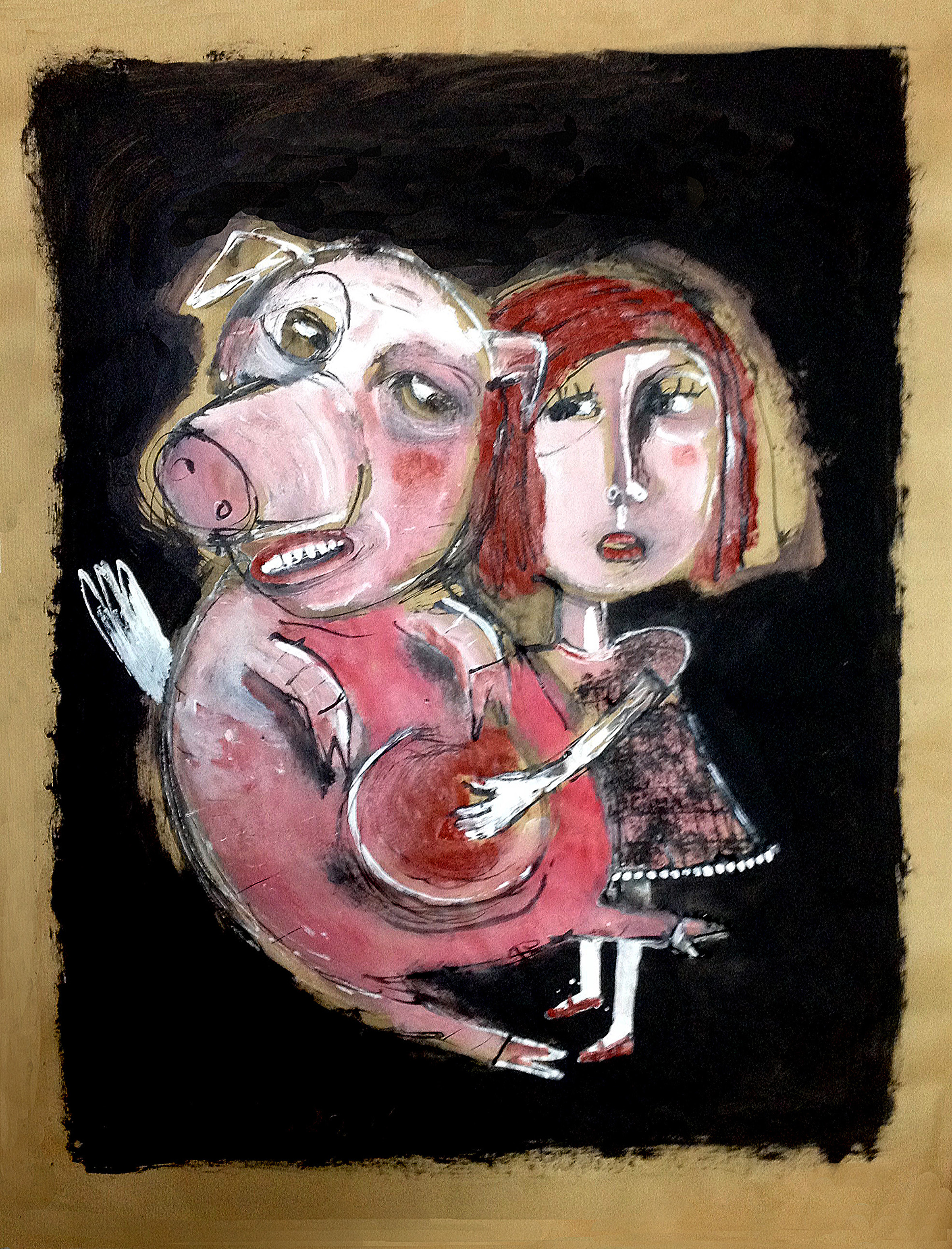
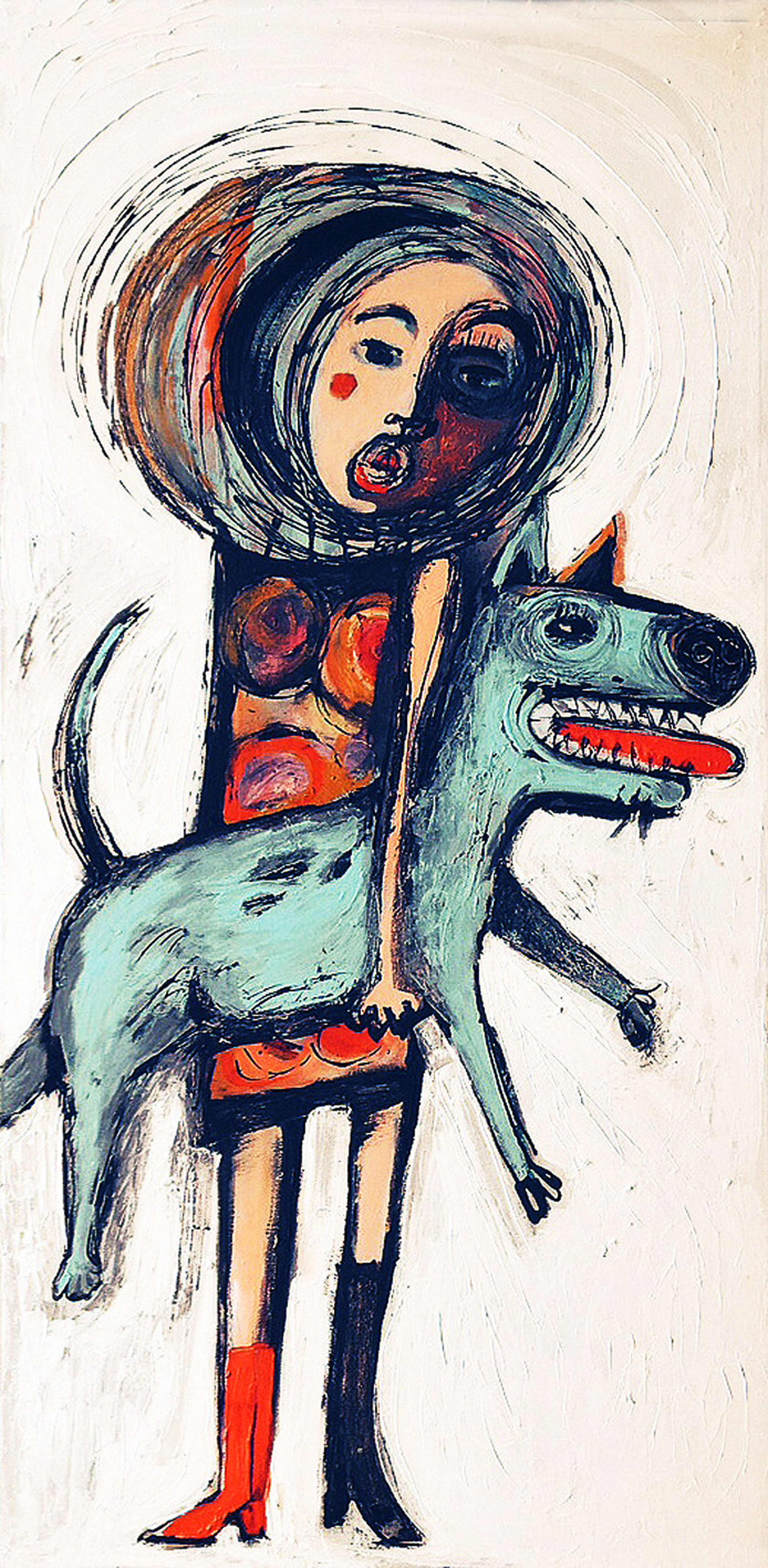
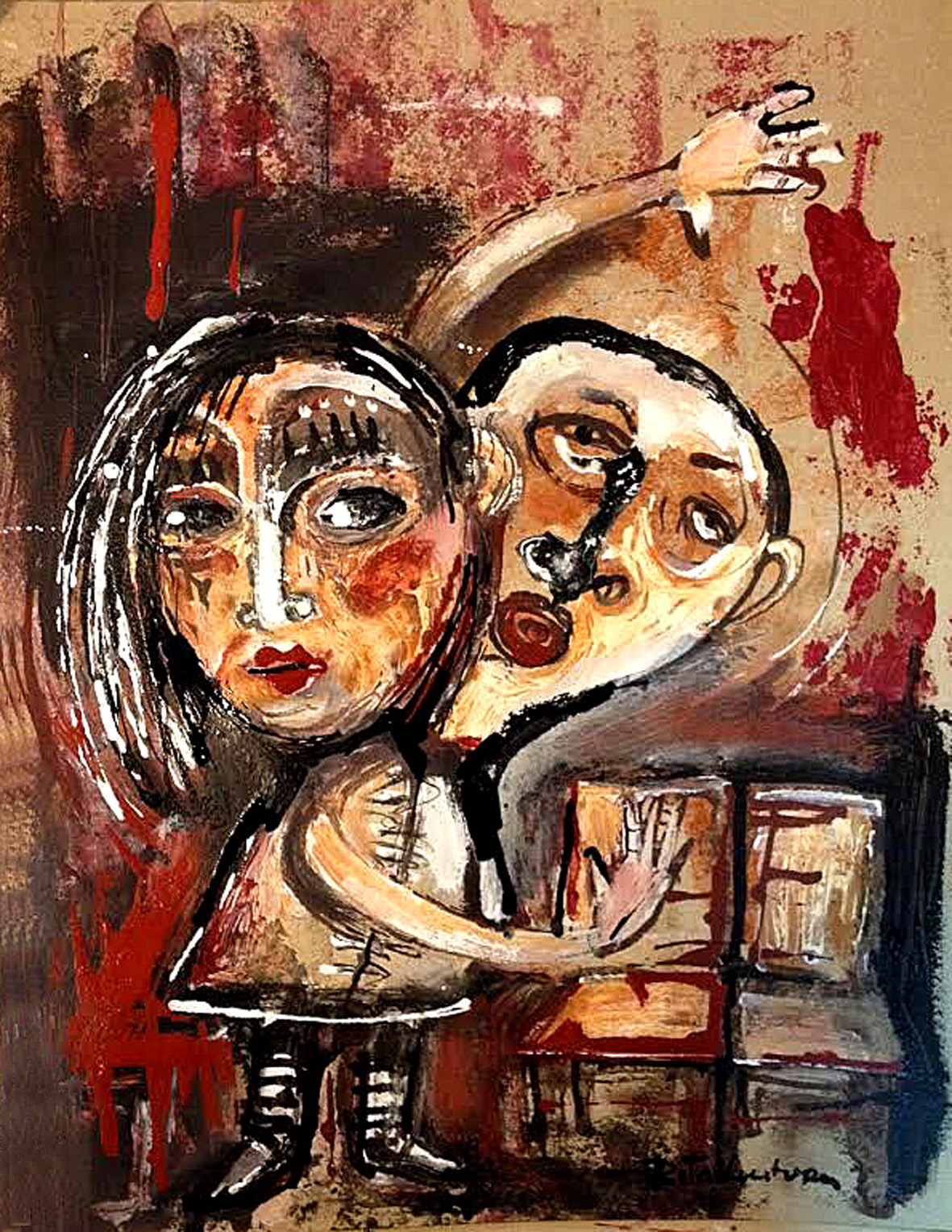
This Artist Showcase comes from Portuguese artist Rita Ventura, who starts each piece without rationalization – a few spots on the page, and then a wait to see what emerges. Is the figure happy, sad, anxious, is it a creature rather than a person? Find out more about her unique universe below.
Rita has responded to the questions in both English and Portuguese.
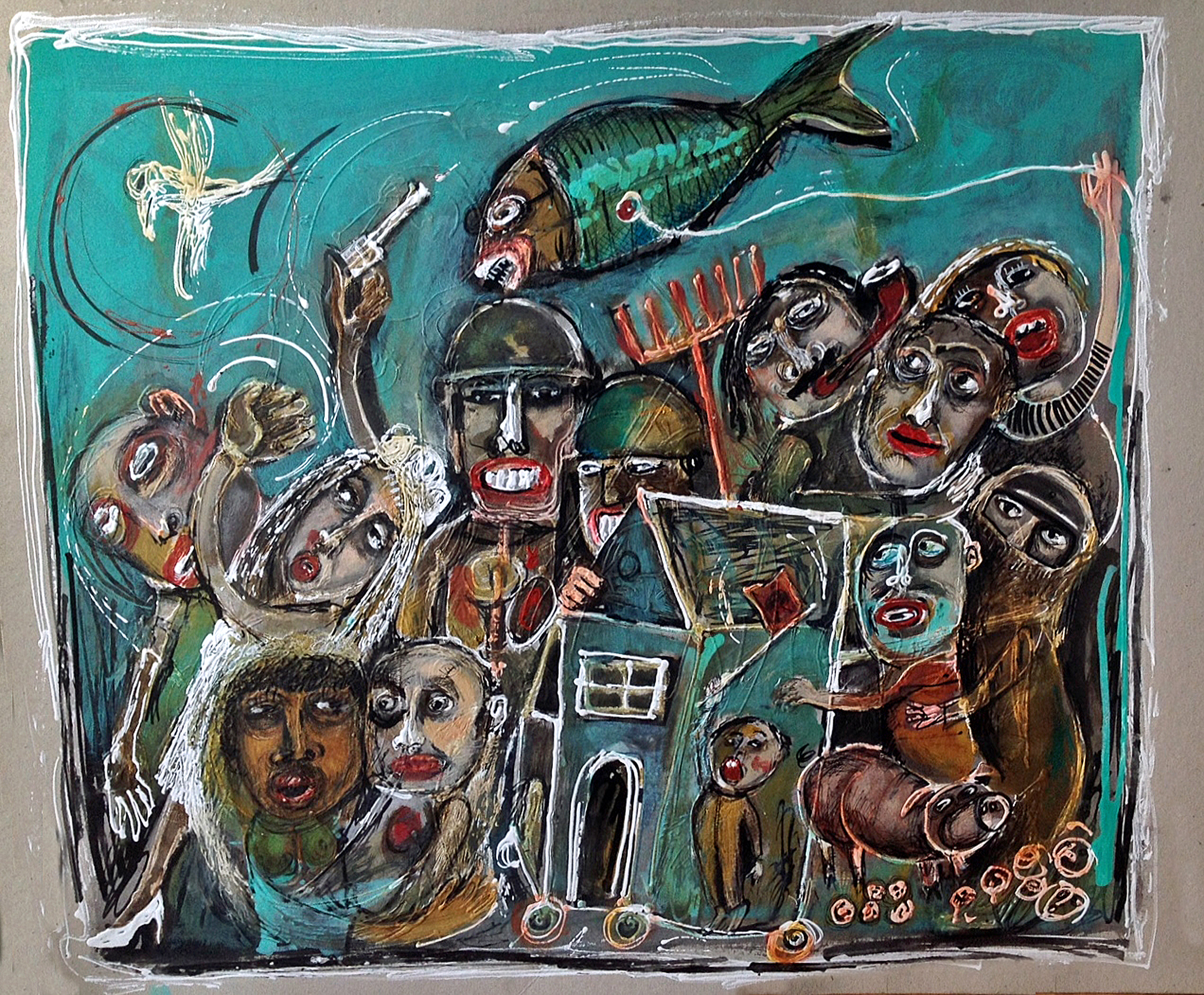
Romula e Remo
When did your interest in art/creating begin?
As a child, I never liked to play with dolls. Although everybody around me insisted and offered me several – and their only movement was to open and close their eyes, which were made of expressionless glass, I never took any pleasure or teaching from them. On the contrary, the best gift I could get was a box of paints, pens, pencils, and anything else that could stimulate my imagination.
At the age of three I entered the Lycée Français Charles Lepierre, whose curriculum included fine arts, and won my first painting prize at the age of five.
[Desde pequena nunca gostei de brincar com bonecas. Apesar de insistirem e de me terem oferecido várias, cuja única habilidade era abrirem e fecharem os olhos, feitos de vidro inexpressivo, nunca delas retirei qualquer prazer ou ensinamento. Pelo contrário, o melhor presente que me podiam dar era uma caixa de tintas, canetas, lápis e tudo que pudesse me estimular a imaginação.
Aos três anos ingressei no Lycée Français Charles Lepierre, cujo ensino promovia as artes plásticas, e aí ganhei o meu primeiro prémio de pintura aos cinco anos.]
Pig Love
What is your starting point for each piece?
As a rule, my starting point is not thinking about anything, not rationalizing. I do not start with any previous studies or drawings. I choose a color that pleases me and I start by making a few random spots. Then I look at them and start discovering shapes, people or animals, causing them to ‘pop out.’ Only when I draw their eyes, I can tell by their expressions that they are trying to say something. Some are angry or evil, others play and laugh, but they all seem to interact. I am only the vehicle for them to tell their stories or concerns. Almost always very subtle and ironic, which amuses me a lot.
[Por regra, o meu ponto de partida é não pensar em nada, não racionalizar. Não faço estudos prévios, nem desenhos. Escolho uma cor que me agrade e começo por fazer umas manchas de forma aleatória. Depois olho para elas e começo a descobrir formas, pessoas ou bichos, fazendo-os “saírem cá para fora”. Só quando lhes desenho os olhos, percebo pelas suas expressões que estão a querer dizer algo. Alguns estão zangados ou são perversos, outros brincam e riem, mas todos parecem interagir. Apenas sou o veículo para que eles contem as suas histórias ou inquietações. Quase sempre de forma muito subtil e irónica, o que me diverte muito.]
Mulher Traçada
Who/what influences your work?
All that surrounds me, the environment, society in general, injustices, indignation in the face of moral or social problems (especially in the feminine universe) serves for my characters to highlight or to denounce current situations.
[Tudo aquilo que me rodeia, o ambiente, a sociedade em geral, as injustiças, a indignação face a problemas morais ou sociais (sobretudo no universo feminino) serve para os meus personagens alertarem ou denunciarem situações actuais.]
Mulher Com Cao Azul
What do you hope the viewer gets from your work?
It is very gratifying for me that people identify with my universe. A universe that makes you think or try to figure out what message I’m conveying.
Since language is not always direct (I like the nuances of the not so obvious), I find it very interesting that each person has his own reading, even if it is diametrically opposed. In fact, that’s what makes my pictures dynamic.
[É muito gratificante para mim que as pessoas se identifiquem no meu universo. Um universo que as faça pensar ou tentar descobrir que mensagem estou a passar.
Como a linguagem nem sempre é directa (agrada-me as nuances do não óbvio), acho muito interessante que cada pessoa tenha a sua própria leitura, mesmo que ela seja diametralmente oposta. Na verdade, é isso que torna os meus quadros dinâmicos.]
Europe
What do you think about the term outsider art? Is there a term that you think works better?
There has always been controversy surrounding the exact definition of Outsider Art. This has been happening since the awareness of the phenomenon. (As an English synonym for art brut Jean Dubuffet along with others, including Andre Breton, formed the Compagnie de l’Art Brut in 1948).
I think at the moment this term no longer makes sense only to refer to those who suffer from mental illness, isolation, those who are self-taught, or those who create compulsively and without rules.
In fact, I identify more with the term ‘intuitive artists’ or ‘intuitive art.’ Art produced by creators free from the influence of official styles, including the various vanguards, or the impositions of the art market. Often these artists produce in a very short time, difficult and complex works, often of great quality, never responding to the official art powers that be nor obeying previous studies (rough sketches, drawings, great reflections, etc.).
[Sempre houve controvérsia em torno da definição exacta de Outsider Art. Isso acontece desde que há consciência do fenómeno. (as an English synonym for art brut Jean Dubuffet Together with others, including Andre Breton, he formed the Compagnie de l’Art Brut in 1948 ).
Penso que actualmente esse termo deixou de fazer sentido apenas para referenciar aqueles que sofrem de doenças mentais, de isolamento, autodidatas que criam compulsivamente e sem regras .
Na verdade, identifico-me mais com o termo “artistas intuitivos” ou “arte intuitiva”. Uma arte produzida por criadores livres da influência de estilos oficiais, incluindo as diversas vanguardas, ou das imposições do mercado de arte. É frequente esses artistas produzirem em tempo muito curto, obras fortes e complexas, muitas vezes de grande qualidade, não respondendo nunca a canônes da arte oficial nem obedecendo a estudos prévios (esquissos, esboços, grandes reflexões, etc).]
Emocional Inteligence
What are you working on at the moment?
My job now is to explore mixed techniques on less noble supports, such as wrapping paper, crafts, etc.
Since I am impatient and afraid that my characters will run away, I like more and more to use fast and definitive materials. Often, instead of brushes, I turn to instruments invented by me where I make my cocktails of paints. I like the unpredictability of joining materials. There is a bit of magic or alchemy in the middle of it all…
[O meu trabalho consiste agora em explorar técnicas mistas em suportes menos nobres, tais como papel de embrulho, crafts, etc.
Como sou impaciente e tenho receio que os meus personagens fujam, gosto cada vez mais de materiais rápidos e definitivos. Muitas vezes, em vez de pincéis, recorro a instrumentos inventados por mim onde faço os meus cocktails de tintas. Agrada-me a imprevisibilidade da junção de materiais. Há um pouco de magia ou alquimia no meio de tudo isto…]
Brinquedo a Pilhas
Where do you see your work taking you in the future?
Where my work will take me in the future is unknown, but I hope I can continue to paint or create. That’s what gives me pleasure and peace. But also an uneasiness to rediscover myself more each time.
Just as I do not question the color of my skin, I also do not question the fact that I am a plastic artist and where it can lead me. It was not a choice but an acceptance of an often unforeseeable life. Whether this is comfortable or not, especially in the country where I live, where Outsider Art is not much publicized or valued, is another question. Luckily nowadays, with globalization, there are no longer insurmountable barriers and blogs like this can be a good window of opportunity.
But what would life be without this risk and the ability to reverse it when it suits us? For many it will be insecurity. For me it’s called Freedom.
[Onde o me trabalho me levará no futuro é uma incógnita, mas espero conseguir continuar sempre a pintar ou a criar. É isso que me dá prazer e paz. Mas também uma inquietação de me redescobrir cada vez mais.
Assim como não questiono a cor da minha pele, também não questiono o facto de ser artista plástica e onde isso me pode levar. Não se tratou de uma escolha, mas sim da aceitação de uma vida frequentemente imprevisível. Se isso é ou não confortável, sobretudo no país em que vivo, em que a Outsider Art não é muito divulgada nem valorizada, já é outra questão. Felizmente que hoje em dia, com a globalização, já não existem barreiras intransponíveis e blogues como este podem ser uma boa janela de oportunidades.
Mas o que seria a vida sem este risco e a capacidade de a reverter quando isso nos aprouver? Para muitos será a insegurança. Para mim chama-se Liberdade.]
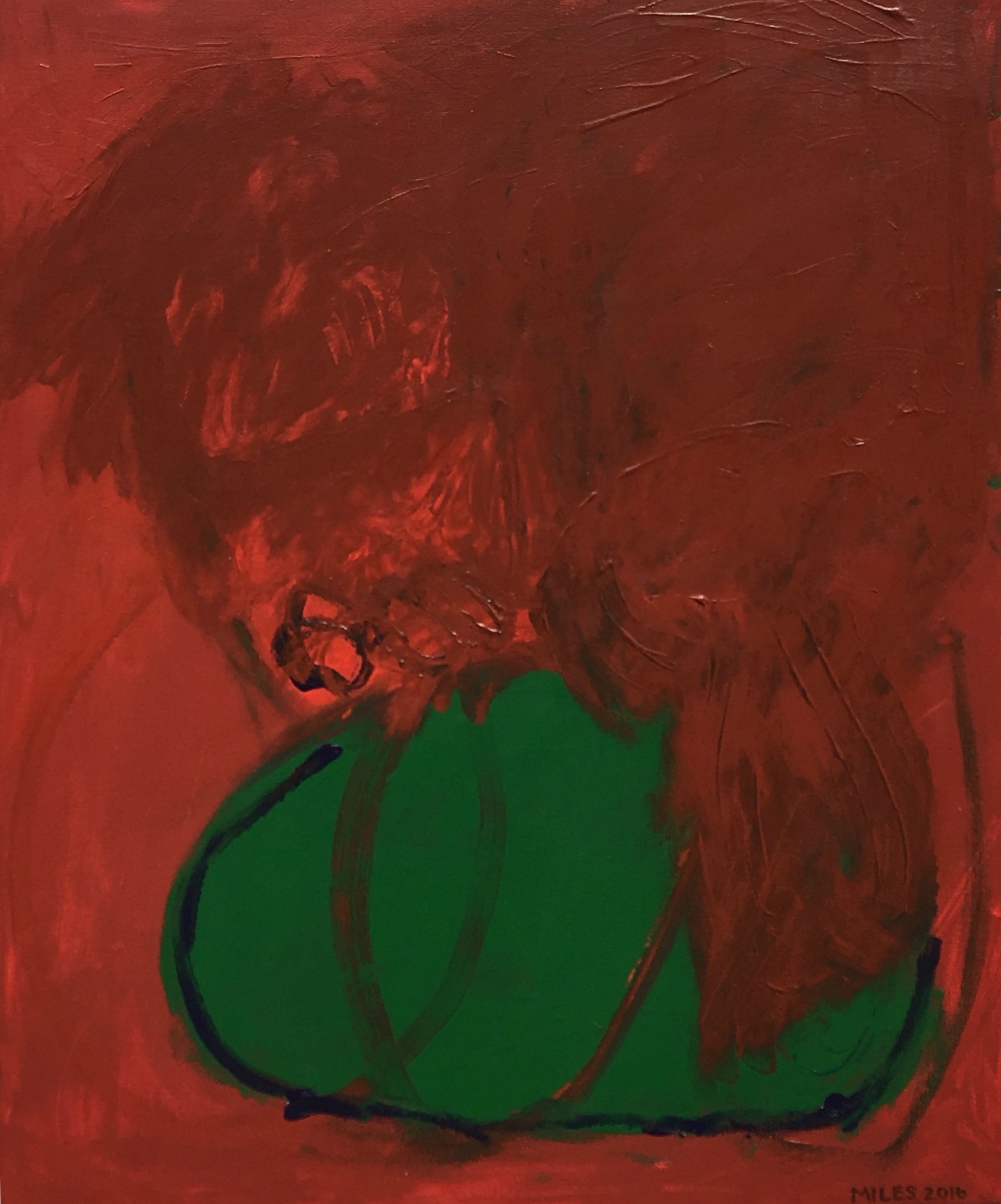
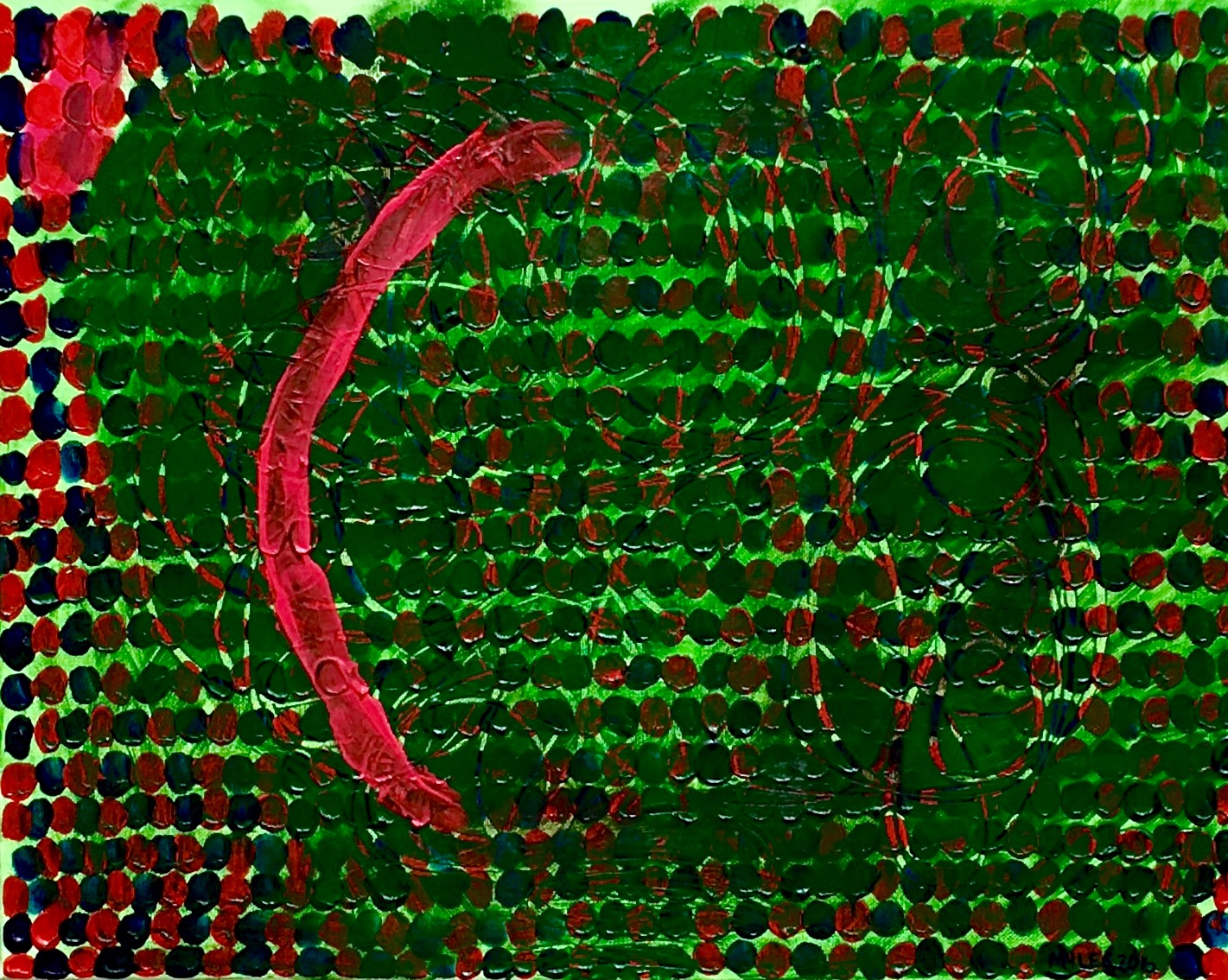
Following the blog’s 5th anniversary celebratory exhibitions and all they encompassed, I am very pleased to bring you the first Artist Showcase of 2017! This time, we get the chance to hear all about artist Luciana Mile’s work.
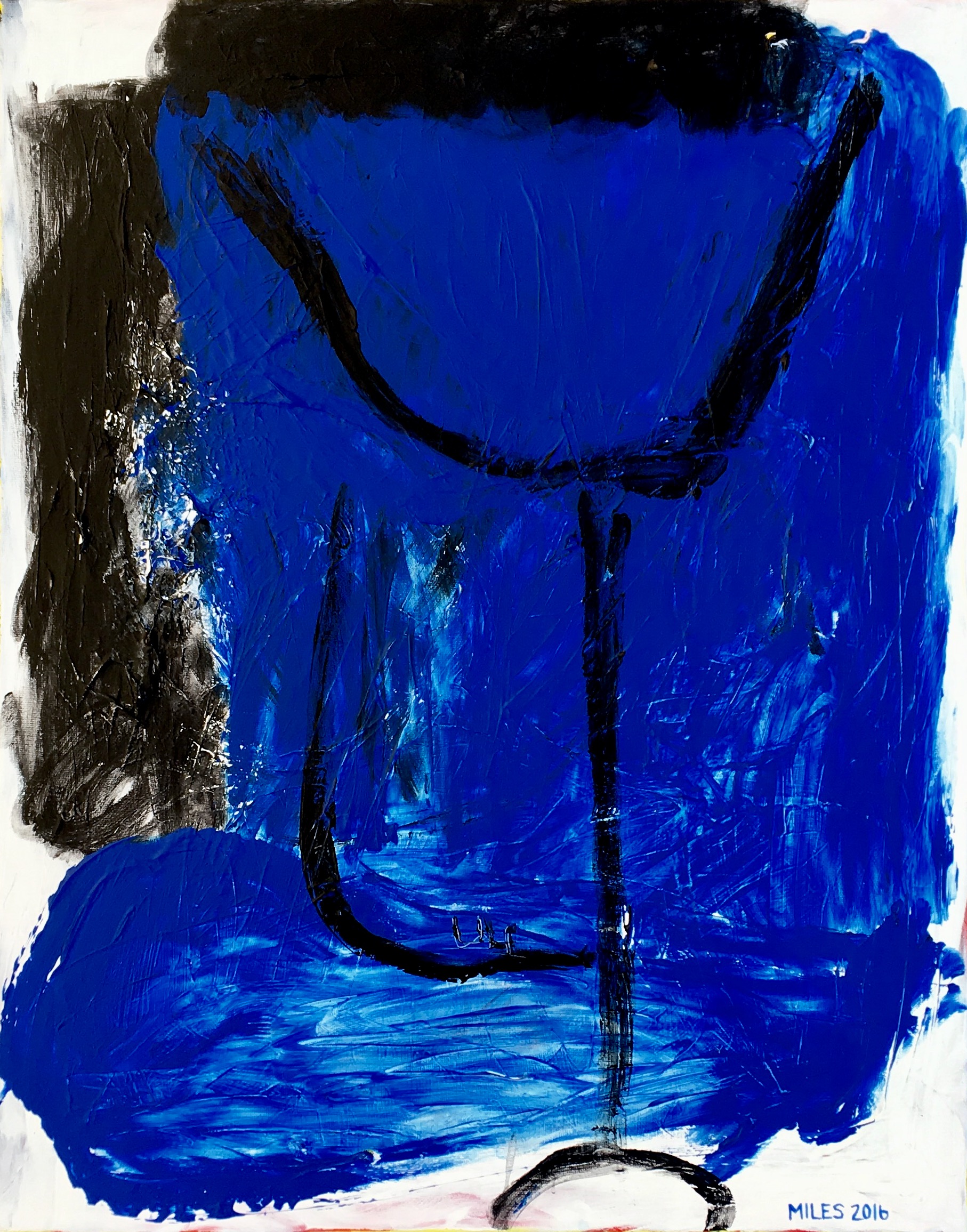
Luciana Miles, Untitled
When did your interest in art/creating begin?
I’ve always been interested in some form of art. I spent a good amount of my life in the theatre. My interest in visual art began in middle school, but didn’t really come into fruition until 2010 or 2011.
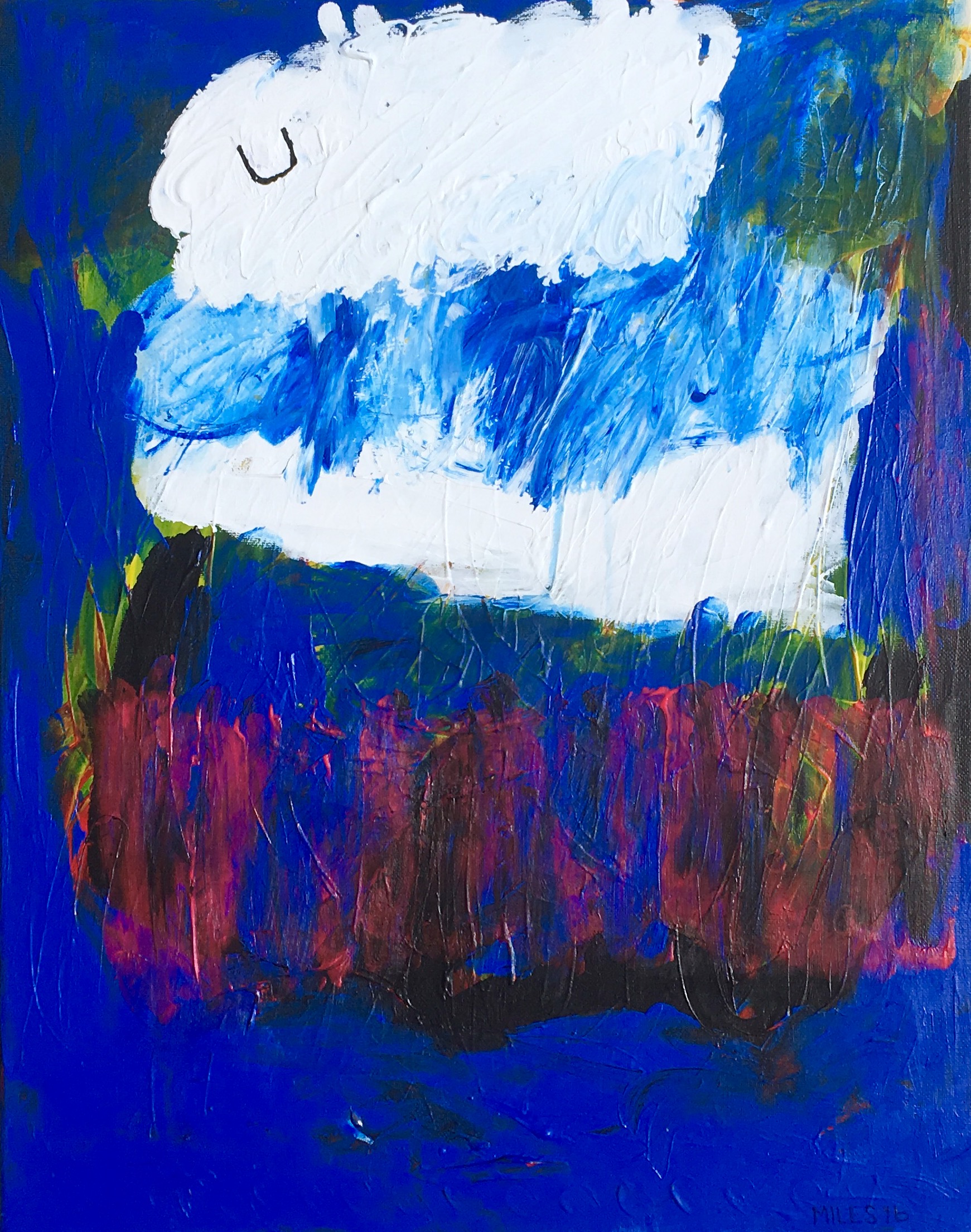
Luciana Miles, Untitled
What is your starting point for each piece?
My starting point is a blank canvas.
Luciana Miles, Untitled
Who/what influences your work?
I think everything in my small universe influences my work, but I really love Dada.
Luciana Miles, Untitled
What do you hope the viewer gets from your work?
I don’t really look too far past the completion stage. Once a painting is done, I no longer consider it mine.
Luciana Miles, Untitled
What do you think about the term outsider art? Is there a term that you think works better?
I think it’s fine. I don’t generally like labels but I understand their purpose.
Luciana Miles, Untitled
What are you working on at the moment?
The next painting.
Luciana Miles, Untitled
Where do you see your work taking you in the future?
If you’re a follower of this blog, you may know that we opened an exhibition of work by Scottish artist Steve Murison last night (1st February) at Gallery Lock In, Brighton (UK). The exhibition so far has been a huge success, with a new record for Gallery Lock In for the number of people who attended the opening night. If you haven’t seen it already, it continues until 5th February, 1-7pm daily, with a special ‘Werewolf Swap Shop’ taking place on Saturday 4th February. Read on for more!
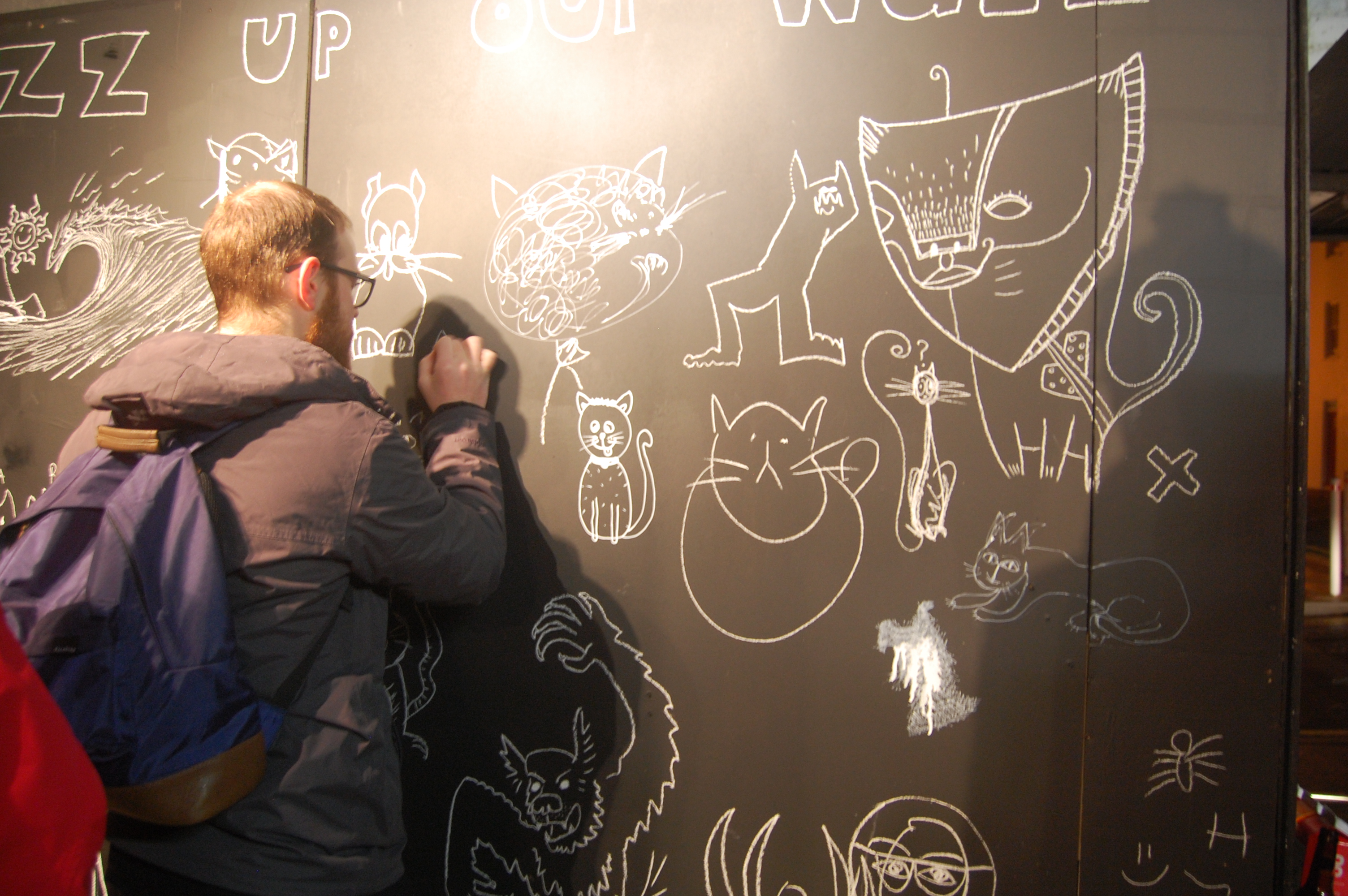
The Cat Cave, Jazz Up Your Lizard at Gallery Lock In
The exhibition is the second physical exhibition I have co-curated on behalf of kdoutsiderart.com, but the first solo show, and the first where I have been working very closely with the artist during all stages of the project.
I have wanted to exhibit Steve’s work for a number of years, but often timing hasn’t been right, or practicalities have got in the way. However, the five year anniversary of this blog, and the kind donation of gallery space from Beth Troakes (Gallery Lock In) provided the perfect combination of right timing and most importantly – a venue!
The interactive chalk cat wall, Jazz Up Your Lizard
The initial idea came about in late 2016, which gave us quite a short schedule to work to. We agreed that Steve would travel down from Aberdeen with his work, and we would hang and open the show on the Wednesday – quite a risk! But it was a risk that astronomically paid off. On the opening night, the show was incredibly well received, with people eager to see Steve’s curious works in the flesh and, sometimes more importantly, meet the artist behind them.
Although Steve’s ethos is incredibly humbling – he is adamant anyone should be able to own good art, regardless of how much money they have – we managed to sell six pieces on the first night. But there was a part of the show that wasn’t for sale – the Cat Cave. To take away one of his ‘Cats of the Roman Empire’, Steve asks for a drawing of a werewolf in return. To honour this tradition, we are holding a ‘Werewolf Swap Shop’ on Saturday 4th February, inviting people of all ages to join Steve in the gallery, draw their own interpretation of a werewolf, and leave with one of Steve’s characterful cats.
Cats of the Roman Empire, Jazz Up Your Lizard
Jazz Up Your Lizard has so far been very well received, with press coverage in the Brighton Argus and Viva Brighton (click here to read the article). Thank you so much to everyone who came along on the opening night, and if you haven’t yet seen the show, there’s still time! But most of all, I want to say a huge thank you to Steve for his unstoppable and uninhibited creation of amazing work, his incredibly helpful and laid back approach to the exhibition, and for agreeing to take part in the show in the first place!
Werewolf Swap Shop The Werewolf Swap Shop is taking place in the gallery space on Saturday 4th February. Come along and exchange a drawing of a werewolf for a Cat of the Roman Empire! You can also be creative and leave your mark on our chalk cat wall.
Jazz Up Your Lizard: an exhibition of work by Steve Murison continues until Sunday 5th February (1-7pm) at Gallery Lock In, Little Western Street, Brighton, BN1 2PU.
Alongside a physical exhibition of work by Scottish artist Steve Murison in Brighton in early February, there is also the opportunity to see work by many of the artists who have featured on the blog since its inception.
Danny Sumbler, Alchemical Romance
‘kdoutsiderart: 5 Years‘ is an online showcase of work by 21 artists who have had an artists’ showcase at some point on kdoutsiderart.com.
The work is diverse and varied: from a textile piece by Anthony Stevens, to Jenifer Renzel’s futuristic totem pole painting. There’s an intricate monochrome drawing by Red Tweny and mosaic ‘savage’ 3D figures by Pamela Irving.
Judy Shreve, The Bird Listener
The online exhibition is a big thank you to all of the artists who have shared their work on the blog at some point, for letting us into their world and enabling us to enjoy their unique creativity.
As part of the 5 year anniversary of kdoutsiderart.com, an exhibition of vibrant works by Scottish artist Steve Murison will open at Gallery Lock In, Brighton (UK), on 1st February.
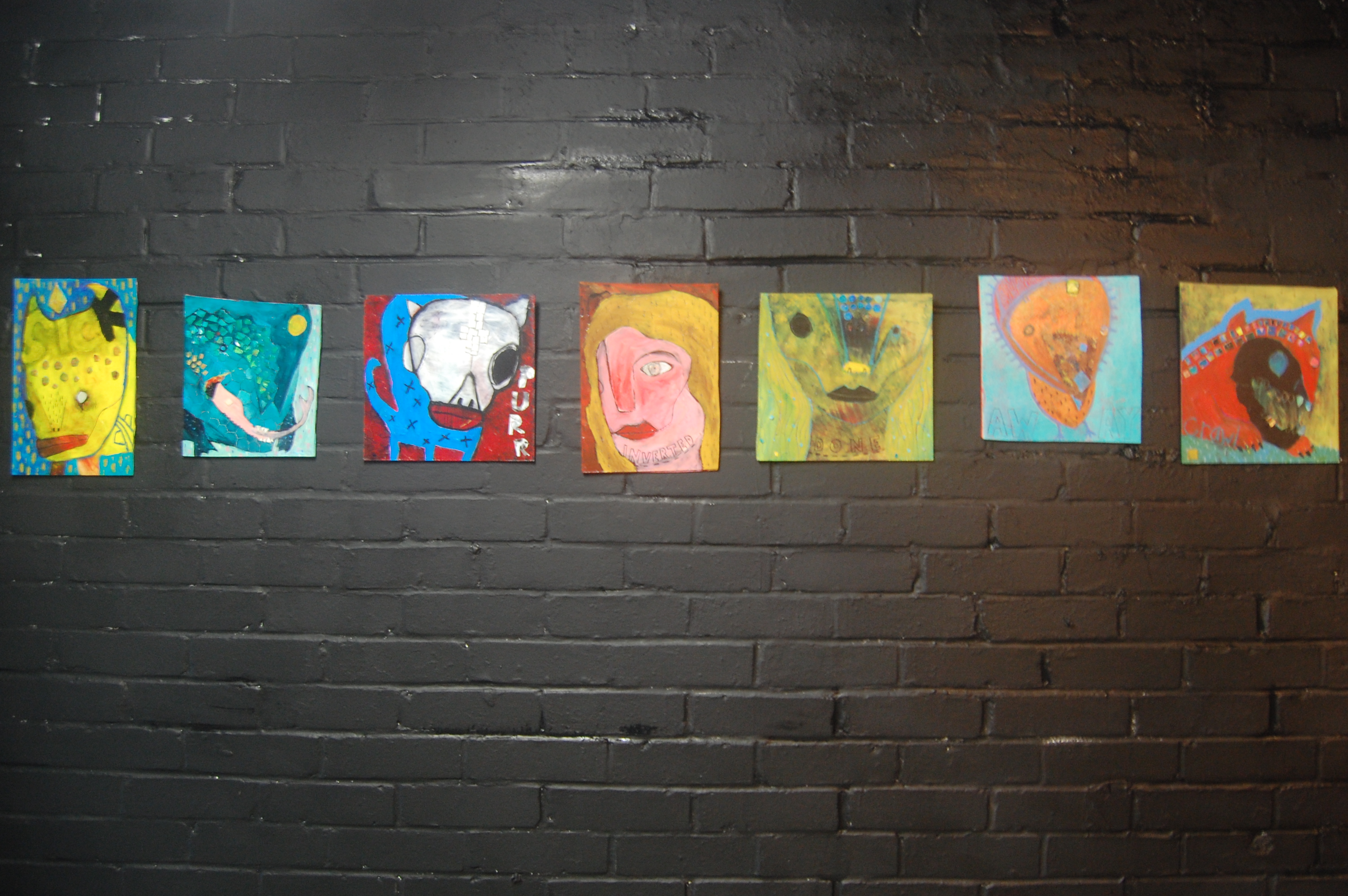
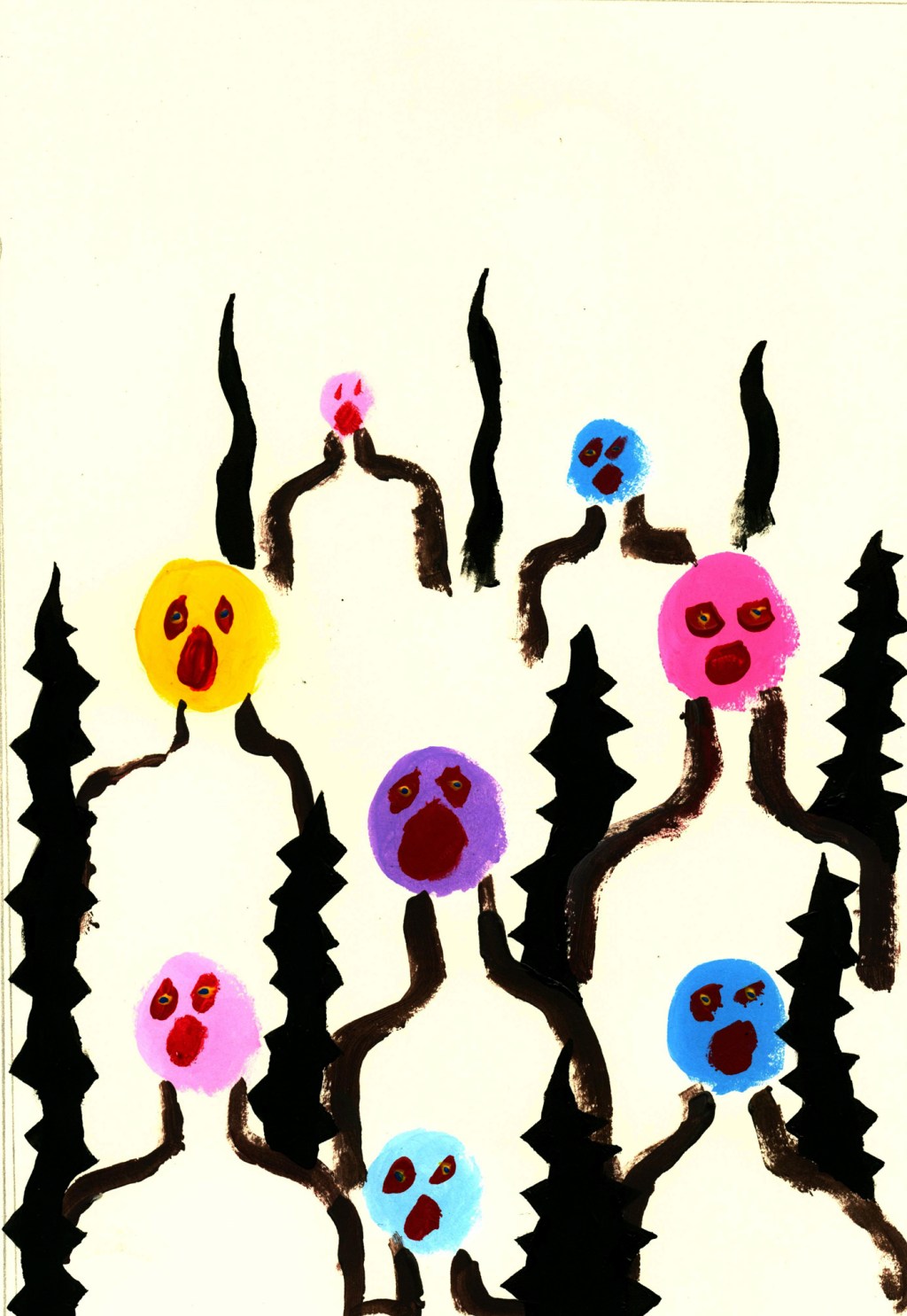
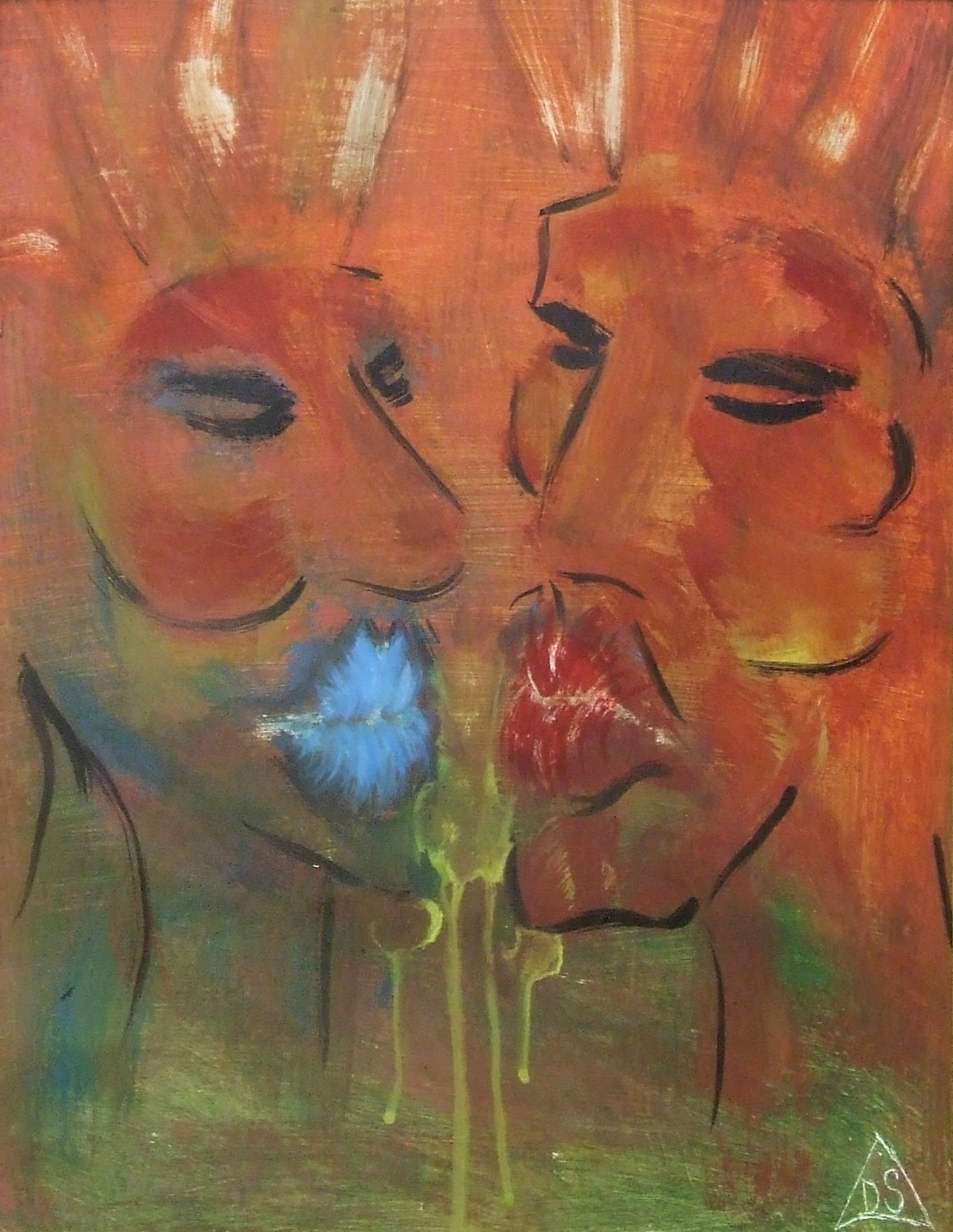
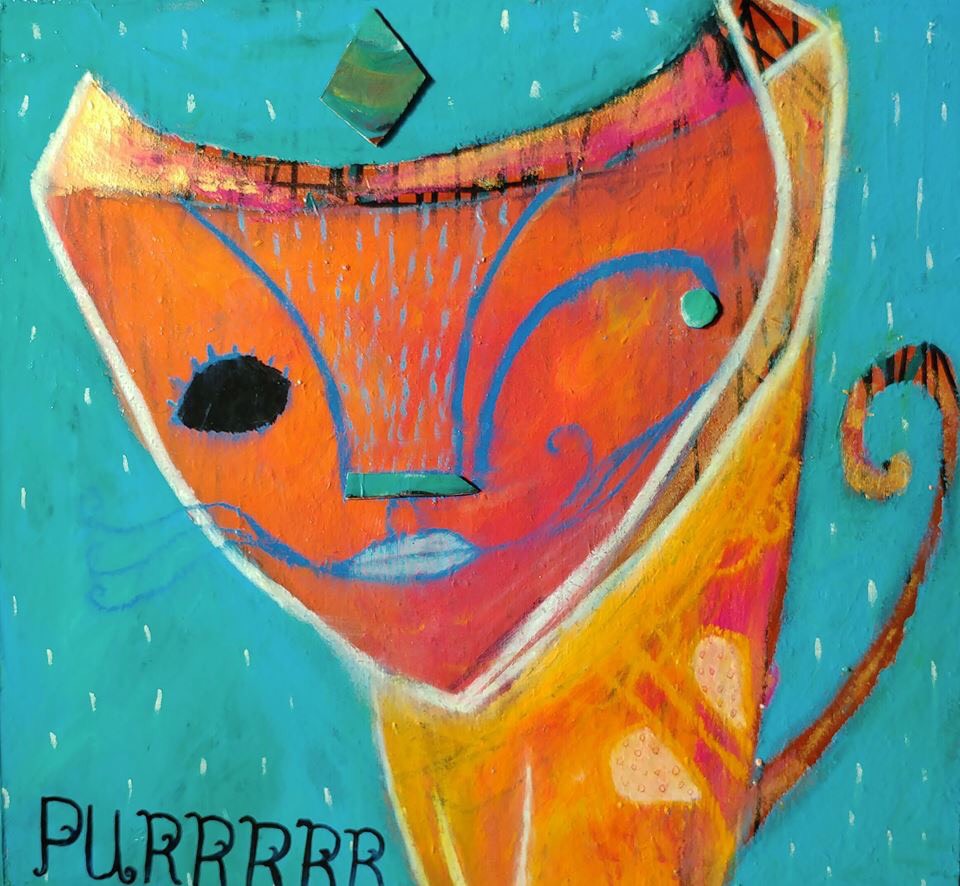
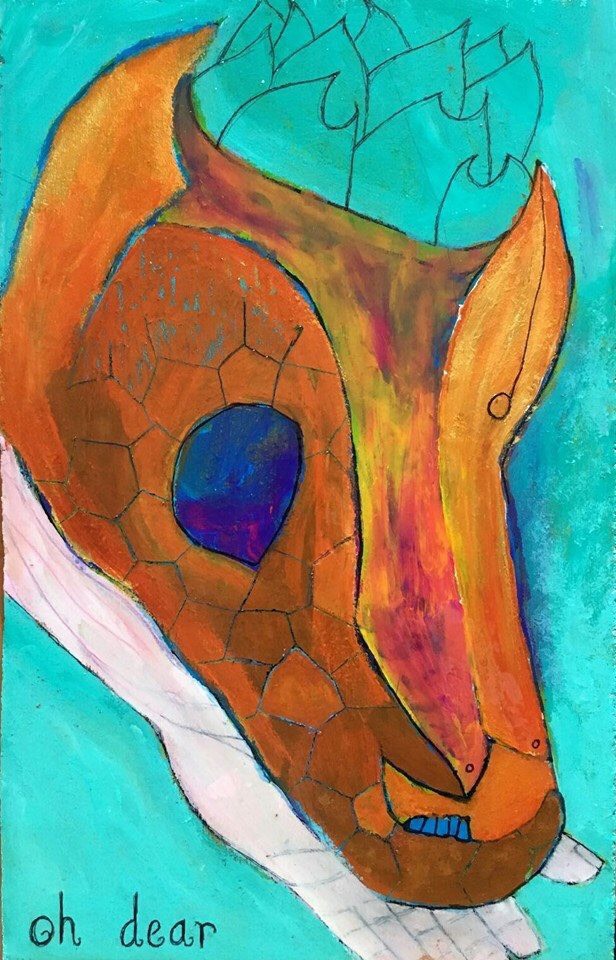
“I think about skulls all the time, inverted crosses, mouldering decay. I picture burning beasts howling with intricate jewelled crowns. Have you ever witnessed something go horribly wrong? I haven’t looked at much of other peoples art for a few years, my simple line is unfurling and my cerulean blue stained hands give a hearty wave your way. Rum and coke. Violent Science fiction. The folk I love. Endless coffee on Sunday mornings. Bukowski. McCarthy. Tool. All my days smeared across ragged boards.” – Steve Murison
It’s Never Just a Cat
Steve has had work exhibited as part of Creative Future’s Impact Art Fair in London in 2013, and as part of previous kdoutsiderart exhibition, Miraculous Urgency, in Brighton in 2015.
A Lizard Hung By Sickly Moon
I first posted about Steve Murison back in August 2013, after seeing his work at the Impact Art Fair. His work is vibrant, somewhat naive in form, but incredibly deep in content. His characters take the form of animals – real and fantastical, and his pieces are tagged with comical but relatable titles – think We Found Your Idiot Skull in a Volcano, or A Petrified Heart in a Splintered Box.
We Found Your Idiot Skull in a Volcano
The exhibition space will also include a Werewolf Swap Shop, where you can bag yourself a unique cat painting by Steve in exchange for your own interpretation of a werewolf. Steve collects drawings of werewolves, so this is an exciting opportunity to share your work with Steve and take away your own little piece of his creativity.
Whisper Some More You Sweet Devil
Jazz Up Your Lizard will open on 1st February, 7 – 9pm, and will continue until 5th February, opening 1 – 7pm daily.
Gallery Lock In
Little Western Street
Brighton
East Sussex
BN1 2PU
































 KDOA
KDOA 