Tag: nick moss

  • Book Review: Artaud the Moma by Jacques Derrida

    Book Review: Artaud the Moma by Jacques Derrida

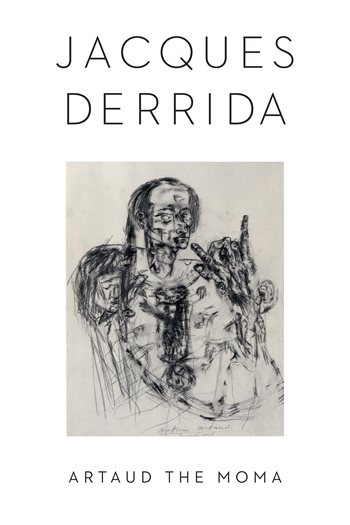
    In this extended post, writer Nick Moss reviews Jacques Derrida: Artaud the Moma (Columbia University Press, 2017). Moss critically examines Derrida’s writings about what it means for an artist – and subsequently their work – to exhibit in various institutions. 

    artaud the moma

    Jacques Derrida engaged repeatedly with the work of Antonin Artaud throughout his life. His best known essays on Artaud are collected in Writing and Difference (Routledge 2001 2nd ed.) As he states in the text reviewed here (a lecture given at the Museum of Modern Art in New York in 1996 on the occasion of the exhibition of Antonin Artaud: Works on Paper), Artaud represented for him “a sort of privileged enemy, a painful enemy that I carry and prefer within myself.” Derrida states that he is bound to Artaud by “a sort of reasoned detestation.” He is resistant to “what might be called, thanks to a certain misunderstanding, the philosophy, politics or ideology of Artaud.” The resistance to Artaud, though, is ultimately a resistance to Michel Foucault/Gilles Deleuze’s romanticisation of Artaud, “everything in this work that, in the name of the proper body or the body without organs, in a name of a re-appropriation of self, is consonant with an ecologico-naturalist protest.” For Derrida the re-appropriation of self is a myth, as is the privileging of some kind of end to alienation, especially if this is to be realised through any form of “schizo-politics.” As he makes explicit in his essay “Cogito and the History of Madness,” madness is always already internal to reason and thus privileging “madness” actually reinforces the divide that Foucault and Deleuze would seek to overcome.

    artaud paule with ferrets 1947
    Antonin Artaud, Paule with Ferrets (courtesy of ArtStack)

    Nevertheless, in the text given at MOMA, Derrida enters into a strategic alliance with Artaud, in order to save Artaud from the “museographic institutions” which, 100 years after his birth, seek to recuperate his work, to commodify that which was intended as resistance to “technical reproduction,” these works which sought to deliver a coup, a blow struck against “the Christian West, the god who steals my body, the spirit, the holy spirit and the holy family, all the forces-ideological, political, economic-that are one with this thief of bodies.” The “thief of bodies” is that “machination…the social, medical, psychiatric, judicial, ideological machine, the machine of the police, which is to say, … a philosophico-political network that allied itself with more obscure forces so as to reduce this living lightning to a body that was bruised, tortured, rent, drugged, and above all electrocuted by a nameless suffering, an unnameable passion to which no other resource remained than to rename and reinvent language.”

    artaud-self-portrait2
    Antonin Artaud, Self-Portrait (courtesy of ArtStack)

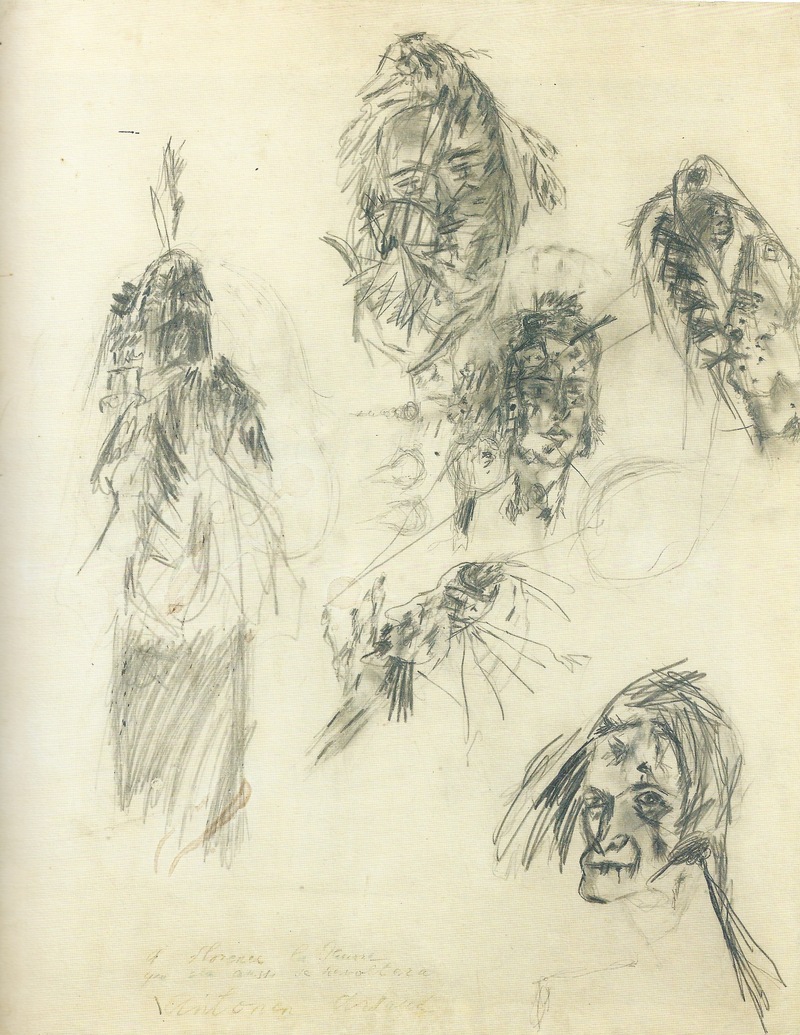
    The drawings on display at MoMA were the sketches and drawings Artaud made while detained in the psychiatric hospital at Rodez. The works are, Artaud states, “deliberately botched, thrown on the page like some scorn for the forms and the lines, so as to scorn the idea taken up and manage to make it fall.”  It is in this ‘fall’ – in the art’s failing – that Artaud’s coup is struck. Yet every blow leaves a trace, a bruise, and so it is here – the works are ‘maladroit,’ they are ‘ill-fashioned,’ scorched by flame, but they survive to be archived and displayed. Artaud intended the drawings to be “not that of a man who does not know how to draw, but that of a man who has abandoned the principle of drawing and who wants to draw at his age, my age, as if he had learned nothing by principle, by law, or by art.” For Artaud the works are intended as weapons, not commodities, but they become commodified in any event. How then to restore, to protect, their existence as “gestures, a verb, a grammar, an arithmetic, a whole Kabbalah…that shits on the other,” to maintain their endurance as “a machine that has breath”? How to preserve the destructive essence (and we should be clear Artaud’s intent was destructive, not merely critical) of Artaud’s project against “the museographic management of its surplus value.”  As Derrida puts it: “Will it be possible to do what I am trying to do, to say ‘Merde?’ Will it be possible, either with or without blasphemy, to read and to cite ‘Shit,’ ‘Shit to art,’ to do it then as it must be done, in this great temple that is a great art museum and above all modern, thus in a museum that has the sense of history, the very great museum of one of the greatest metropolises in the new world?”

    Autoportrait-Antonin-Artaud-1946
    Antonin Artaud, Autoportrait (courtesy of ArtStack)

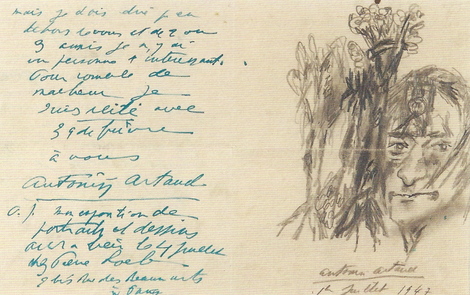
    One of Derrida’s oft-deployed strategies of resistance was to introduce an element of slippage, or wordplay, puns, double-meanings, into his own texts, so that the text could never be reduced to a single canonical reading. He does the same here, with his punning on Artaud-momo (“idiot” as he referred to himself”) Artaud-MoMA, and on glyph/glyphe/hieroglyph/electroglyph. The words of the Derrida-text begin to echo the “glossolalic or glossopoetic rebirth of language” sought by Artaud. And we should not forget that  in these ‘botched’ works, which Derrida tells us were intended to do no less than “change the eye with the drawing,” produced in the period described by Artaud as “ten years since language left,” that language-as-writing is essential to these works – that words are strewn across their surfaces, inseparable from image. ”And ever since a certain day in October 1939 I have never written without also drawing.” (In this of course, Artaud stands as a precursor to Twombly, and to Basquiat – for all three, word and image can only exist side by side, so that the works become, as Katharina Schmidt has described them, a ‘meta-script.’) In this museum devoted to the commodification of the image, Derrida insists we go back to the words carved, hacked, scrawled, on to the surfaces. To hear the questions Artaud asked: “And who today will say what?” “And what do you yourself say?” – to hear, within the works, “Artaud interrogating a ghost of himself.”
    Scan_2
    Antonin Artaud, Untitled (courtesy of ArtStack)

    Derrida battles with the “agony of an art that nevertheless, at the instant of its death, will perhaps survive its own apocalypse.” He seeks to retrieve Artaud’s project of anti-art, to cry “woe to whoever might consider them as works of art, works of aesthetic simulation of reality.” More than that – he uses the museum as archive against itself, and refuses to have Artaud’s voices silenced, so that the images are all that remain. It is Derrida’s determination to restore “the event as event.” And thus he seeks to allow Artaud’s words to come back, to haunt, but also, the sound of Artaud’s voice – at the beginning and the end of the lecture, from a recording of “To Have Done With the Judgement of God.” The ranting, scatological Artaud, “starving, drunk with rage against America.” The intent is to have the drawings address the viewer again “as if they were conducting a trial.” Such that “never before, when finding myself faced with drawings or paintings…never have I heard so many voices, never have I felt myself called, yelled at, touched, provoked, torn apart by the incisive and lacerating acuteness of a broadside of interjections so justly addressed to their addressee.”
    Scan_5
    Antonin Artaud, Autoportrait (courtesy of ArtStack)

    As to whether the strategies Derrida employs can succeed when Artaud is already entombed in the gallery space of MoMA – “especially MoMA in which Artaud the Momo would have right away identified the malevolent figure of the great expropriator”- we have to ask whether allowing the voice of Artuad-Momo to be heard can ever be enough, when Artaud himself declaims -against accusations of mysticism -that he has “always been body.” Can the body of Artaud-Momo – the anti-artist, the beaten, broken, electrocuted body (body of artist/body of work) stand in the way of “this great march of the symbolic market, from Paris to New York, from capital to capital, metropole to metropole?”

    le pendue
    Antonin Artaud, Le Pendue (courtesy of ArtStack)

    There is a further point to take up. In the book’s afterword, Kaira M Cabanas, associate professor of global modern and contemporary art history at the University of Florida notes that Jean Dubuffet presided over the Societe des Amis d’Antonin Artaud, and that he rejected Artaud’s work as Art Brut: “I find Antonin Artaud very cultured, not at all Art Brut.” There is much truth in this. Artaud’s rhetorical/scatological manoeuvres were pathologized as a way of neutering the content of his lacerating attacks on Church and State. But Cabanas seeks to take this as a prelude for a discussion about the purpose of outsider art more generally:

    “Often the inclusion of outsider art is read as a progressive move within the modern and/or contemporary art institution, and in the early 2010s one witnesses how the art of ‘madness’, ‘outsider’ and ‘self-taught’ became the ‘new’ in the contemporary global circuit….this legitimation…occurs at the expense of what we might learn from the specificity of the work’s contemporaneity vis-a-vis the historicity of the psychiatric institution.”
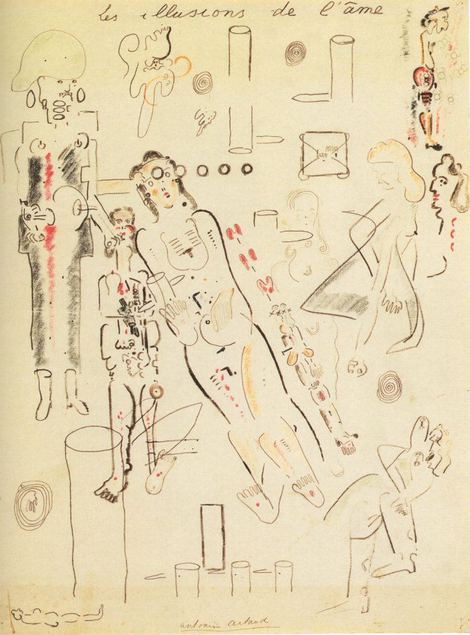
    les illusions
    Antonin Artaud, Les illusions de l’ame (courtesy of ArtStack)

    This is, I think, specious. I write as someone who is more than happy to adopt and preserve the perspective of outsider as a vantage point from which to view the contemporary art world. Nevertheless, I think Cabanas’s argument is crassly reductive and presumes a) that ‘outsider’ art has no aesthetic merit beyond its ‘specificity’ as art produced within a particular institutional context, and b) that the works’ ‘original meanings and values’ i.e. their place as works produced within/symptomatic of said institutions is diminished if displayed outside such institutions, so that the critical content of the work can only have effect within the context of its own production.

    It strikes me that the opposite is true – that the exhibition of works produced outside the cycle of art-world luxury commodity production, which contain the ‘auratic’ to which Walter Benjamin refers as an auratic ‘trace’ of an originary trauma, might more likely impact on their audience as the lightning-strikes Artaud aimed towards, if shown outside their institutional context. When we encounter, for instance, Luc Tuyman’s Gas Chamber painting, do we dismiss all save the aesthetic, or does the political not there intrude on and shadow the aesthetic?

    la boulabaise
    Antonin Artaud, La Bouillabaisse de formes dans la tour de Babel (courtesy of ArtStack)

    Artaud referred to “the innumerable necrophages that fill churches, police stations, army barracks, prisons, hospitals, university faculties.” We might note one of the many reasons for such complaint would be the determination of some academics to determine for themselves “who today will say what.”

    By Nick Moss

    For more information on Jacques Derrida: Artaud the Moma, please click here.
  • Review: Koestler Voices, New Poetry from Prisons

    Review: Koestler Voices, New Poetry from Prisons

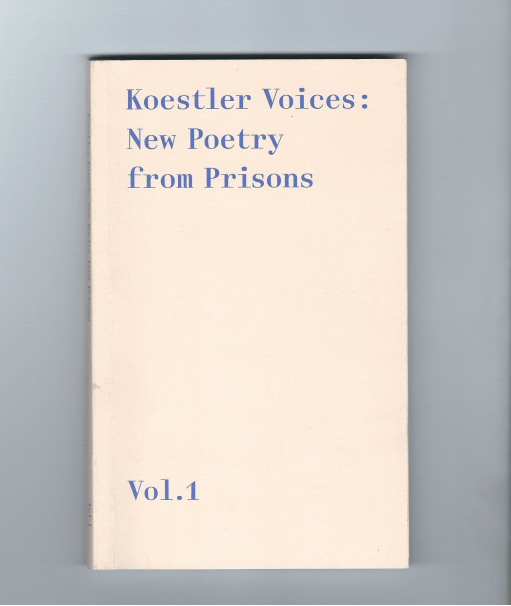
    In this post, writer Nick Moss reviews the Koestler Trust’s latest poetry pamphlet, Koestler Voices: New Poetry from Prisons. The collection was published to coincide with the Koestler Trust’s latest national exhibition, ‘Inside,’ which appeared at the Southbank Centre until 15th November 2017. The Koestler Trust is an arts charity that supports prisoners, ex-prisoners and detainees to express themselves creatively.


    koestlervoices

    “I should declare an interest at the start, insofar as I have 2 poems in the book. However, all the other works are new to me and I have no personal knowledge of any of the authors.

    This volume was prompted by the reaction of exhibition visitors to the poetry curated by Benjamin Zephaniah in the 2016 Koestler Trust exhibition. The essence of the poems is captured by Benjamin Zephaniah in his introduction, where he comments that “These poems are absurd and strange, they are light and heavy, they are intense, intellectual and playful. They are honest.”

    In a recent Guardian article on the Teach First and Unlock projects to introduce graduate prison officers (The Guardian 9 November 2017) one of the graduates interviewed reported his first time on a wing: “I’ve never come into contact with people like this before.” I think it’s important therefore to recognise how important it is to have these poems described by Zephaniah as “intellectual”. We, the ‘people like them’ who fill the jails, are capable of critical thought and reflection. If ‘intellectual’ simply connotes a level of prestige acquired through academic qualification then it has no essential meaning. If it applies to anyone engaged in a critical analysis (in this case of the institutions which contain us) then prisoners such as the writers here are more deserving of the label than the blinkered, knee jerk civil servants who draw up Ministry of Justice policies.

    address-book-2246444_1920

    The book is divided into 4 sections – Inside, Outside, Portraits/Pictures, Letters/ Confessions – and this review can only attempt to give a snapshot of each section.

    The poetry covering Inside moves from despairing to defiant. One writer focuses on the song of a nightingale he hears at Dartmoor Prison, another gives us a picture of ‘the weans runnin riot/ mair interested in sweets’ in the visiting hall. ‘Networked Gym-Fit Recidivist’ captures the ‘nonchalant callousness’ of ‘a prison officer bellowing’ and is scathing about the standards of prison healthcare and the point of it all, concluding, ‘It’s just a  scam, the wrapper’s off.’ Many of the poems in Inside are about looking out; the view of outside from the cell window. Outside can be a strange place. I remember standing in the yard at Belmarsh looking at the block of flats in Plumstead I’d lived in 10 years ago. Outside is where time hasn’t ground to a halt. Outside is the ‘sweet remembered earth’ that Bob writes of in Lockdown. From outside Leslie tells us ‘sunshine shone/through the window casting/ a shadow of bars / unto his appeal papers.’

    The Outside section opens with the brilliant ‘Killie Bus Tales’- written in Scottish dialect – ‘drinkin cans a Super n Frosty Jacks (ah wish ah hudnae sat as close tae the back.)’ There are several poems that experiment with Scottish dialect. They are written with a confidence and dry wit that suggests the authors have been enjoying Irvine Welsh and James Kelman along the way. We also get to see the impact of jail time on the families left behind. Graham’s heart-breaking ‘Empty Chair’ is a cool, carefree ode to summer madness, until we reach the end:

    empty chair, warmth of sun

    cold beer, the clink of ice in mum’s spiced rum

    barbeque smoke mixing with skunk

    tapping of feet to Fool’s Gold Funk

    children laugh splashing without a care

    daisies and bluebells in their hair

    but no one mentions that empty chair.

    Some of the poems are playful, like Jacinda’s ‘Animal School’, where ‘Wonger drank from the toilets/ And everyone was late,’ and Jonathan’s ‘I Built a Rocket Ship.’ Others have a real fury; ‘See Nothing, hear nothing, speak nothing’s’ tale of ‘smart uniforms and shiny boots/ dragged and kicked and took me away/where no one will hear and no one will see/ and now, I am nothing.’

    adult-1850177_1920

    Portraits and Pictures is perhaps the most powerful section, with the poets digging deep to capture aspects of their friends and families, building narratives of lives where people come and go, stand, fall, fail and stand up again. ‘The Piano Player,’ with ‘hooch fuelled/ male voices/full of angry/jobless depression,’ Guiltfoot Ron: ‘He’s got an angry knee/ and an eyeful of fear,’ Dys-Leg-Sarah who sees ‘Words squirming like wriggly squiggly worms on a page.’ These are wonderful poems, capturing the essence of vulnerable, raw lives in just a few lines.

    Letters/ Confessions contains work which is heart-breaking, and work which is disturbing (in its proper sense of disrupting ordinary perception, shaking the reader’s view of things.) These are poems of loss, ‘Tortured/By Wondering how you are’; ‘…eager to forgive/ In the midst of our own little dust storm.’ Poems also of defiance: ‘You rained your fists on me/ endless thumps you hoped would break me/They are now my bricks.’ One of the strongest and strangest poems is Leon’s ‘Understand Me,’- ‘Understand me arresting the terrorisms of the night/over breakfast I’ll let them loose in the kitchen.’  Leon’s poem has the down-at -heel surrealism of Adrian Henri, but, most importantly, when it says ‘Understand Me,’ it does so on its own terms. ‘Understand me locking the door at midnight/throwing the key away. Later I will climb in/through a window.’ This poem could stand for the book as a whole; prisoners saying ‘Understand me – but understand me as I am, not as some caricature of a prisoner you have as an idee fixe.’

    Koestler Voices shows prisoners thinking hard about who they are and where they are. As prisoners and ex-prisoners, we have no choice but to do so. Perhaps this volume will stand as proof that we might also be worth listening to.

    By Nick Moss


    Koestler Voices: New Poetry from Prisons is available for £10 from the Koestler Trust, 168A Du Cane Road, London, W12 0TX. Click here to visit the Koestler Trust’s website

  • Nick Moss: Curatorial Ethics and Outsider Art

    Nick Moss: Curatorial Ethics and Outsider Art

    In this post, writer Nick Moss reflects on the curatorial issues facing outsider art curators – and curators more widely. 

    curating5


    What follows are simply observations on issues arising from curation practices in relation to outsider art. They follow on from discussions with Kate Davey, further to my earlier reviews of the Ida Applebroog exhibition at Hauser and Wirth and Susan Te Kahurangi King at Marlborough Contemporary. Each of us separately visited the exhibitions and subsequently identified issues which the original reviews did not address. The issues are not unique to those exhibitions and so merit further consideration, towards which this is intended as a brief contribution.

    A simple point arising from the Applebroog exhibition relates to the extent to which the ‘white cube’ of the contemporary commercial gallery can trap and repress the unique, auratic element of non-professional art. The Applebroog paintings at Hauser and Wirth were displayed in a continuous line that ran throughout the gallery – one small watercolour or pastel succeeding another. The strength, the vitality, of these works is en masse, as a defiant ‘fuck you’ to psychological trauma, and the form of curation employed undermined the statement. It appeared that the curation was unable to take sufficient inspiration from the work to break from rote practice.

    Brian O’ Doherty contends that the white cube “is the single major convention through which art is passed.”[1] Jens Hoffman goes further and argues that the white cube “increases the aura around an object, it separates an object from its ‘real world’ context, and yet it is a ‘real world’ in itself.”[2] The implication, necessarily, is that alongside the gallery space, the artwork requires curatorial intervention to establish its meaning – a point of view that will be addressed below. But this notion of the ‘white cube’ in and of itself attracts, as O’ Doherty has recognised, “some of the sanctity of the church, the formality of the courtroom, the mystique of the experimental laboratory (joined) with chic design to produce a unique chamber of aesthetics.”

    For the philosopher of art Peter Osborne, “Contemporary art produces (or fails to produce) the non-place of art space as the condition of its autonomy and hence its ability to function as ‘art.’ Art cannot live, qua art, within the everyday as the everyday. Rather it necessarily disrupts the everyday-ness of the everyday from within. Since it is both ‘autonomous’ and a ‘social fact.'[3] To the extent that Osborne’s position is coherent at all, it amounts to saying that art’s autonomy is conditional on its validation by the art-space -and that anything within the art-space is art (a rehashing of Duchamp). Thus, art’s uniqueness, its capacity to intervene in and disrupt the everyday, becomes conditional on its separation from the everyday.

    All of the critics and curators referenced thus far make use of the concept of ‘non-place’ as developed by the French anthropologist Marc Auge. By ‘non place’ Auge means “ a space which cannot be defined as relational, or historical, or concerned with identity.” This non-place is made up of “transit points and temporary abodes…where the habitue of supermarkets, slot machines and credit cards communicates wordlessly, through gestures, with an abstract, unmediated commerce.”[4]

    curating1

    For Auge, then, the non-place is conceived negatively. However, for Osborne, “The gallery itself, however, in its classical modern form as the ‘white cube’ is a self-enclosed, self-insulating space. And it is in its specific character as a self-enclosed, specialised place that the gallery appears as an exemplary non-place, in Auge’s sense.” Or, as Hoffman puts it, the white cube is a ‘blank slate,’ which allows “for guilt-free looking…(an) investment of time and attention.”

    What this misses is that for Auge the non-place is, in effect, a ‘retail space’ – and the ‘white cube’ is then no more than the art-space which generates that mode of attention best suited to the consideration of art as financial investment. This is the case even if the curatorial intent is otherwise. The form the space takes dictates the form of validation bestowed on the artworks on display.

    Particularly in relation to outsider art, this represents something of a missed opportunity. Much non-professional art is, for want of a more effective construction, self-curating. If we take as examples Luang Phor Khom’s Wat Phai Rong Wua, Ferdinand Cheval’s Palais Ideal, JP Dinsmoor’s Garden of Eden, the works of Nek Chand; not only are they conceived on a  vast scale, they are planned by their creators to exist in and impact upon their environment in ways which are thought through, they are pre-planned.

    The same is true of non-professional art which is conceived on a smaller scale. Pascale Verbena says of his work “I don’t just take any old piece of wood, I gather them in winter at river mouths and on beaches when no one is around. I work on experience. I invent, that’s my way of discharge. They’re bottles thrown into the sea with messages inside.”

    Such being the case, I’d contend that there is, then, an ethical duty which falls upon the curator of ‘outsider art’ – however broadly conceived, and however crude and containing a descriptive term it is. Given that this is art produced by people who, whether because they are not sanctioned and validated by the art education production line, or because they produce art in situations of confinement, struggle to be heard; the duty of the curator is to ensure that it is the artist’s voice that predominates – to step out of the way and allow the messages in the bottles to be fully understood.

    curating2

    There is an assumption that the non-professional artist has no preconceived idea of how their work should be displayed. The opposite is the case. The patron saint of curating, Hans Ulrich Obrist, at least, acknowledges this, in a more general sense. “Alighiero Boetti told me that if I wanted to curate exhibitions then I should under no circumstances do what everybody else was doing – just giving artists a certain room and suggesting that they fill it. What would be more important would be to talk to the artists and ask them what projects they could not realise under existing conditions. Ever since, this has been a central theme of my exhibitions. I don’t believe in the creativity of the curator. I don’t think that the exhibition-maker has brilliant ideas around which the exhibition maker must fit. Instead the process always starts with a conversation, in which I ask the artists what their unrealised projects are, and then the task is to find the means to realise them.”[5]

    It is certainly the case that many of Obrist’s curatorial acolytes have never moved to embrace the idea of curation as conversation. We are told instead that the role of the curator is to “orchestrate and encourage novel ways of looking” and that the curator has become “author, choreographer, and director, asking the works to come together, and coaxing them to broach subjects that might be beyond their individual scope but well within their breadth” (both of these  from Hoffmann).

    I’d suggest that the ethical position the curator of outsider art ought to adopt though is not that of author, but that of translator. If we are dealing with artists who, whether because they lack ‘qualification’ or are excluded by confinement, go unheard, we have a duty to bring their voices forward. If the curator as author drowns out the voice of the socially-excluded artist, then the curator, simply, takes a place within that hierarchy of oppression/exclusion which defines the artist as ‘outside.’

    This duty stands whether the artist is living or dead. If the artist is no longer living then the curator should engage with and research the work such that the artist’s subjectivity remains alive through the artistic legacy brought to display. In relation to the curation of outsider art, we might take a pejorative review and invert it to one of approbation. One of the reviews of the Hayward Gallery’s 1979 ‘Outsiders’ exhibition described it as bringing “the lunatic into the city square.”[6] If we assume instead of ‘lunatic’ the artists grouped in the show are ‘excluded,’ then the role of the curator ought properly be precisely to prise open the “self-enclosed, self-isolating space” of the white cube, and work with the excluded to invade the city square. First injunction – listen to the artist!

    curating3

    The second point is a simpler, but crucial one. In a Guardian review of the Susan Te Kahurangi King exhibition, we read the following :-

    “It is (freelance curator Chris) Byrne, with Petita (Cole-the artist’s sister)’s assistance, who selects the works for exhibition; Susan herself has no understanding of the concepts of either ownership or selection, Petita says. Initially the family rule was that the drawings could be shown but not sold, though they have since relented. ‘Think about it,’ Petita told her sisters after seeing Byrne’s careful framing for the Miami exhibition last year. ‘When the show is over are we going to say, get them out of those frames, send them back here, they belong in the clear files on my shelves?'[7]

    This was displayed without comment by the Marlborough Contemporary gallery as part of its selection of press cuttings. It raises a major concern, though. If Susan has no understanding of the concept of ownership and the drawings are all to be sold – who benefits from the sale and what happens to the monies raised? (We make no judgement in this regard – the monies may well all be properly accounted for and used to Susan’s  benefit). The point is that neither The Guardian nor the gallery thought this issue worthy of comment or explanation. The issue of safeguarding, though, ought to be central to any ethical curatorial practice in relation to artists who are in some form of confinement, have communication difficulties, or some other form of vulnerability. The potential for exploitation is obvious. The Indigenous Art Code produced to intervene in and prevent the exploitation of indigenous artists in Australia by commercial dealers perhaps provides some useful points to consider:

    “Dealer Members Must Act Honestly – Dealer Members must at all times act fairly, honestly, professionally and in good conscience when dealing with an Artist, whether they are dealing directly with the Artist or dealing with the Artist through an Artist’s Representative. Examples of conduct that would not meet the required standard include, but are not limited to: (a) unfair or unreasonable conduct; (b) undue pressure or influence, including threats; (c) not acting in good faith; (d) paying an Artist by means of alcohol or drugs; (e) unfairly taking advantage of, or exploiting, an Artist; and (f) paying or agreeing to pay an Artist an amount or other consideration for the Artist’s Artwork that is, in all the circumstances, against good conscience.”[8]

    It is not to doubt the ethical practice of the galleries discussed herein to acknowledge that the commercial art market is, potentially, a field of rapacity and disillusion for the ‘outsider’ artist. This fact acknowledged, the ethical curator has a duty both to ensure that the voice of the artist is heard on the aesthetic terms agreed with the artist, and that all business conducted with the artist is done so within a set of agreed ethical practices which it falls to the curator to ensure is carried out. After all, if as Hoffmann has it, the curator-as-author wants to make “new modes of being and thinking evident,” it would be unfortunate if what lay behind these were old rituals of rip-off and exclusion.


    References

    [1] Brian O’ Doherty, Inside the White Cube : The Ideology of Gallery Space, University of California Press, 1999

    [2] Jens Hoffmann, (Curating) From A-Z, JRP/RINGIER 2014

    [3] Peter Osborne, Anywhere or Not At All, Verso 2013

    [4] Marc Auge, Non-Places: Introduction to an Anthropology of Super-Modernity, Verso, 1995

    [5] Hans Ulbrich Obrist and Asad Raza, Ways of Curating, Penguin, 2014

    [6] John Maizels, Raw Creation, Phaidon, 1996

    [7] The Guardian, Silent Witness, 31 May, 2017

    [8] Indigenous Art Code [availble online: http://www.indigenousartcode.org/wp-content/uploads/2011/06/Indigenous-Art-Code.pdf%5D


  • Review: outsider art comes to Mayfair

    Review: outsider art comes to Mayfair

    In this blog, writer Nick Moss reviews two Mayfair exhibitions showcasing work by artists who could be considered ‘outside of the mainstream.’ In the post, he contemplates the implications of these displays and considers what we can learn from their curation and interpretation.


    Two current Mayfair exhibitions appear to suggest that the Chinese wall between outsider art and the mainstream art world is beginning to crumble. We should perhaps then bear in mind that a Chinese wall is intended to protect the interests of both parties. Is what Jean Dubuffet characterised as a world of ‘competition, acclaim and social promotion’ the most suitable environment for encounters with art which is the antithesis of these? We can contend that what the art world hides behind its side of the wall is its exposure as an industry based on the commodification of artistic singularity, but we ought to consider whether preserving a space outside this might be a necessary strategy to maintain artistic autonomy at a  distance from what Dubuffet called the art world’s ‘fallacious parade.’ Or can art produced ‘intuitively’ survive its incarnation in a mainstream gallery setting?

    Ida Applebroog: Mercy Hospital

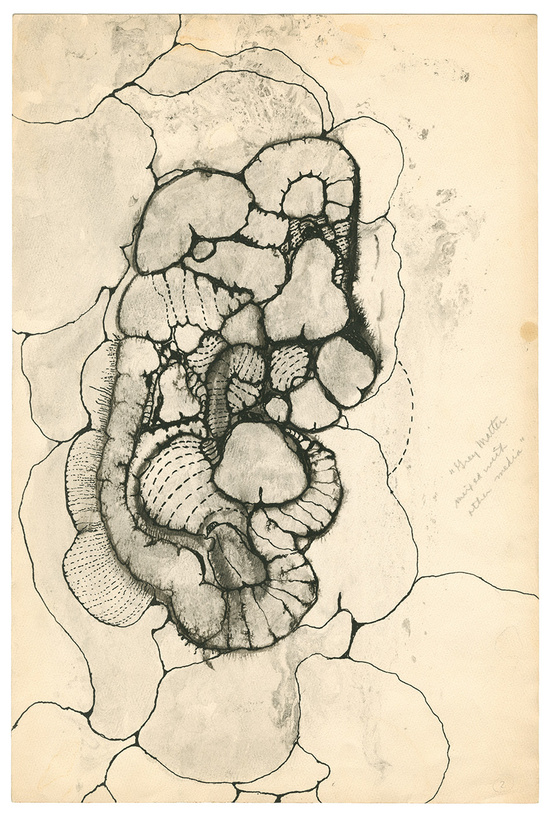
    ida2
    Ida Applebroog, Mercy Hospital (courtesy of Hauser & Wirth)

    Hauser and Wirth (23 Savile Row London W1S 2ET) are showing Ida Applebroog’s Mercy Hospital drawings.  In 1969, Applebroog was struggling with her mental health and chose to withdraw from day-to-day engagement with the world – the drawings helped negotiate her return. The Courtauld’s Jo Applin comments in the press release, “The Mercy Hospital drawings allowed her to draw herself back to life, back to herself, leading from catastrophic breakdown to a creative, personal and political breakthrough.” The work stands then as a record of  psychological crisis, and is described as belonging “to the long history of art created at a moment of ‘breakdown’, a period very often linked with creative ‘breakthrough’.” While it is clear that the work does reflect  a time of personal trauma, there is a danger that we are encouraged, as so often, to see the work solely in relation to this, and outside any aesthetic frame of reference – as if the art is no more than a crude clue to the artist’s psyche. 

    ida4
    Ida Applebroog, Mercy Hospital (courtesy of Hauser & Wirth)

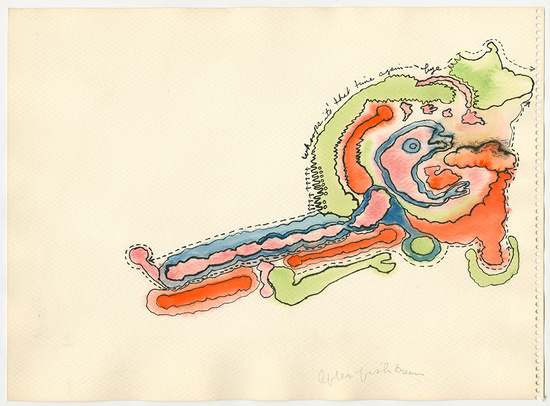
    The Mercy Hospital drawings make use of a range of materials – black India ink, pencil, watercolour and pastel. Some are figurative, and depict bodies or partial figurative shapes and coils. Others are entirely abstract. Throughout, there runs a theme of shapes – seemingly intestinal or umbilical – curling protectively around other such forms. Some of the drawings have text inserted within – which far from simply illustrating “disorientation and isolation” as claimed, actually suggest that Appelbroog approached her circumstances with her sense of humour intact. “I’m just waiting for this to dry,” reads one inscription. One of the watercolours shows a group of figures standing in what appears to be a state of abjection, suggesting that withdrawal and isolation for Appelbroog was a positive choice. Other drawings have “Whoops! It’s that time again… bye,” in a scene where one shape seeks to feed from another. In a pastel sketch, a series of shapes appear to form a precarious tower. The writing reads:

    ‘OVER
    THE
    BRINK’

    ideabig2
    Ida Applebroog, Mercy Hospital (courtesy of Hauser & Wirth)

    For all they are the product of crisis, there is something comforting about the softness, the intertwining of the shapes in the drawings. Colours blend rather than jar, and the shapes, while seemingly evidencing the artist retreating into and starting to use her art to dissect the forms of her own body, demonstrate a sense of unending curiosity rather than body-horror. This is work that is both unflinching and beautiful.

    Ida Applebroog’s  Mercy Hospital drawings are on show until 29 July 2017

    Susan Te Kahurangi King

    susan ke
    Susan Te Kahurangi King, Untitled (courtesy of Marlborough Contemporary)

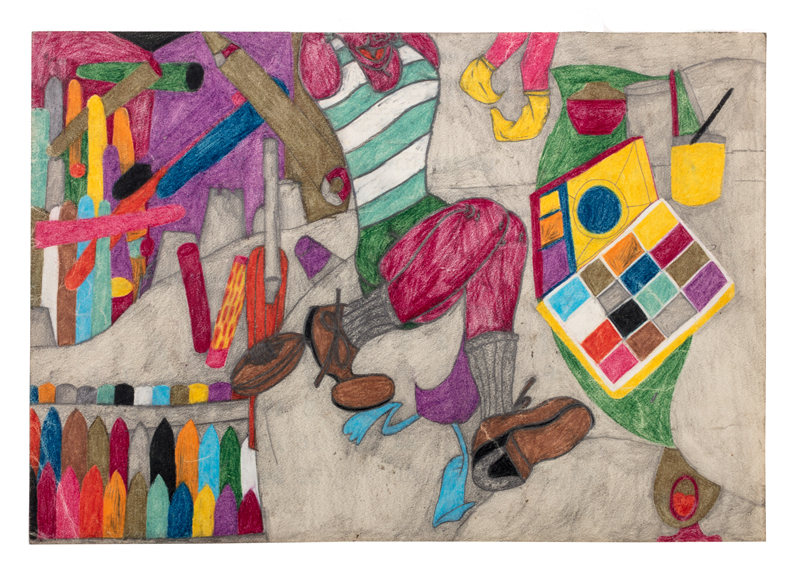
    Marlborough Contemporary (6 Albemarle Street London W1S 4BY) is showing a range of drawings, including early works, by Susan Te Kahurangi King. These are, simply, a joy. One of the things that strikes you immediately is the continuity of drafting skill and of imagery and characterisation from the work of her youth to now. Susan’s world – its themes and personalities – have been there from the start. The work is also reflexive. Figures appear armed with paints and giant crayons, commenting on the production of the work, and perhaps showing the artist mocking her own pretensions. This can also be a comedically malicious world – characters are bitten and have their tails pulled. Meanwhile, others happily eat ice lollies and dance.

    susan te kahrungi
    Susan Te Kahurangi King, Untitled

    One of the refreshing points to note in the Marlborough Contemporary presentation is that the work is simply shown as the work of one of the gallery’s artists, who happens to choose not to speak. The gallery has hosted a ‘Drawing with Susan’ event, an interactive silent group drawing session with the artist on-site. If so-called ‘outsider art’ is to receive the recognition its artists deserve, then both these exhibitions show ways in which the art can be curated respectfully and imaginatively without stigmatising the circumstances of its creation.

    Susan Te Kahurangi King’s works are  on show until 1 July 2017

  • Nick Moss: Insider Art

    Nick Moss: Insider Art

    In this post, writer Nick Moss responds to Cornelia Parker’s current installation at Frith Street Gallery and reflects on how, in opposition to Parker’s ‘insider art’ – which feeds us messages of unquestioned assumption – outsider art has the power to contain the multitude of voices that go unheard in the art world.


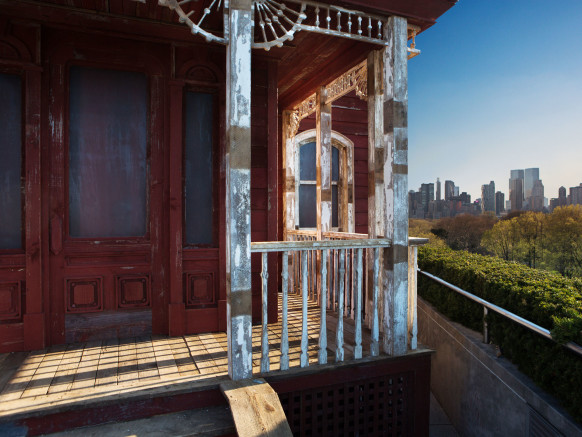
    The first reaction of anyone who sees themselves as “progressive” when first encountering Cornelia Parker’s current installation at Frith Street Gallery (28 April 2017-21 June 2017) will doubtless be euphoric.  All the right boxes are ticked- it’s a mocked-up nightmare of  the USA under President Donald Trump. In 2016 Parker was commissioned by the Metropolitan Museum of Art to create a site-specific installation for the museum’s roof garden. The ensuing work, Transitional Object (PsychoBarn) was apparently inspired by the paintings of Edward Hopper and by the Bates family’s mansion from Alfred Hitchcock’s 1960 film Psycho. According to the press blurb “PsychoBarn loomed on the city’s skyline as a harbinger of things to come – signalling that all was not so well in the American psyche.”

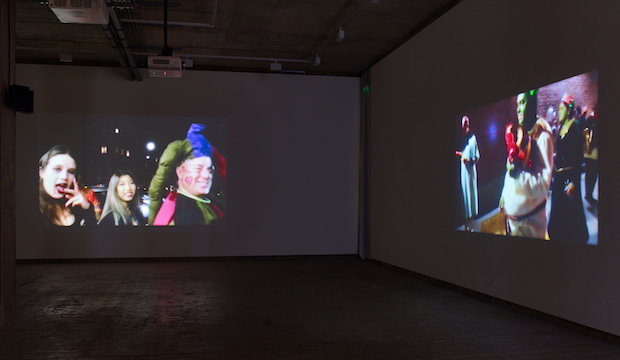
    Parker visited New York at the end of October 2016 to give lectures about the PsychoBarn prior to its de-installation. Its closing date was Halloween, “the old festival of All Saint’s Eve, which has been famously elevated in the USA to a theatrical celebration far removed from its folkloric and religious origins.” Parker and her husband used their iPhones to film people dressed up on the streets. The resulting video American Gothic 2017 “captures ghoulish revellers having their last hurrah, mingling with the crowds of the un-dead. On All Hallows night in Greenwich Village every American archetype, good and bad, seemed to be out promenading the sidewalks, from superheroes, vampires, clowns, ghouls, trolls, Freddie Krueger and Hannibal Lecter, Uncle Sam, Dorothy and the characters from The Wizard of Oz.” The scenes are displayed in slow motion  and accompanied by a slowed-down location soundtrack, which provides a low drone as background noise. On a 4th screen is footage of Trump supporters outside Trump Towers, celebrating his election. This is shown in real time, but without sound.

    HouseClose-582x437
    Cornelia Parker, PsychoBarn (Image courtesy of wired.com)

    I have no axe to grind against Cornelia Parker. I have been moved by some of her previous work-Anti-Mass particularly. This is therefore not a critique of her work per se. It is, however, written as Parker takes up her role as 2017 official election artist, and reflects therefore, necessarily, on the politics inherent to American Gothic, and what they say about “progressives’” responses to the Trump election.

    The first thing to note is that, were the Halloween scenes to be played in real time they would show happy, pissed revellers looking to dress up and party. This is no pre-apocalyptic “last hurrah” , no mournful parade-it’s a time when the streets are taken over by ordinary people, masking themselves and taking advantage of their anonymity to get absolutely wasted ! In slowing down the footage Parker is passing judgement on the revellers purported departure from the “folkloric and religious origins” of the festival. I’m always bemused by the fact that people who describe themselves using that mealy-mouthed  epithet “progressive” stop seeing  the liberatory element of the  abandonment of “tradition”, when said liberation involves working class people behaving riotously in the street. George Orwell , in Down and Out in Paris and London, contends that “Fear of the mob is a superstitious fear. It is based on the idea that there is some mysterious, fundamental difference between rich and poor, as though they were two different races.” Parker manipulates her footage of the crowd and in doing so her fear of  that crowd (and eo ipso that of her presumed audience) is made apparent.

    So the procession of ghouls is manipulated to meet the need of another crowd-that embodied in disillusioned progressive opinion- who want to see their passive despair reflected back at them in the comfort of the gallery space. And on the 4th screen they get to stare open-mouthed at the crowds of ecstatic Trump supporters. As already noted, this footage is silent. This is a shame-as we see groups such as Blacks for Trump and Latinos For Trump  actively explaining their motivations to the camera, but are denied the chance to hear them. Presumably we are supposed to be already part of a consensus that they have nothing to say worth hearing. It is worth noting though, that the primary claim  of the working class and poor people who voted for Trump, for Le Pen, for Brexit, was that thy were “the forgotten”-the casualties of deindustrialisation whose voices now counted for nothing. A working class vote for A right wing politics that in the long run are against the voters’ interests is,in essence, an expression of powerlessness. It is a gesture against the political Establishment, for sure, but more than that, it demonstrates a belief that change can no longer be effected by solidarity-that you can only , for instance,get new housing stock   by driving out the family next door. It is the beginning of the war of the poor against the poor. Such being the case, we might want to consider how “progressive” is an artwork that actively erases the voices of those who are already “the forgotten.”

    american gothic
    Cornelia Parker, American Gothic (Image courtesy of culturewhisper.com)

    In his Outline of a Theory of Practice (1977) Pierre Bourdieu noted that “The most successful ideological effects are those which have no need for words, and ask no more than complicitous silence”. American Gothic demonstrates this precisely by engaging us in the act of “complicitous silencing” of the voices of the Trump supporters. We are seduced again into the act of ignoring those who feel themselves “forgotten”, while the parade of slow-motion grotesques goes on around us.

    What we have then is the opposite of what first appearances lead us to believe. Once all of the manipulation of footage, all the technological mediation is stripped away, the 4 screens show the raucous celebrations of Trump supporters, and the Halloween debaucheries of the costumed revellers of New York. What we have in fact is a 4 screen technological effacement of the voice of the working class, a 4 screen installation that doesn’t challenge its anticipated audience , doesn’t provoke, but tells them just what they want to hear. Trump is bad, and these are frightening times. We can agree. We can accept that it’s not Cornelia Parker’s role to point us towards a way out of the Bad Times. But we should surely expect more from art than a (perhaps unconscious) reproduction of Bourdieu’s “complicitous silence”-in this case in fact a “complicitous silencing.”

    As much as we might flinch at the difficulties inherent in the use of the descriptor “outsider art”, we might best see the logic of the term  in relation to those art forms antonymous to it.  There is a sense in which much art now-the Hirsts, the Quinns etc-by virtue of their cost, their materials, their intended audience, might best be called “oligarch art.”  But if outsider art has an antonymous counterpart art form, then that must be, logically, something like an “insider art”-and American Gothic is insider art paradeigma. It does nothing other than offer platitudes to an audience who will already agree with the point it so clumsily makes. Outsider art, then, must be the opposite of this. It will contain the multitude of voices that go unheard in the art world. The loud, the ugly, the distressed, the vicious,as well as the sublime, the beautiful, the soothing. It will admit all that is excluded from the discourse of the mainstream. It may do this therapeutically, as pharmakon, as celebration. What it will not do is silence, look away from or exclude. In that sense then, as opposition to insider art, we might still make positive usage of the term.