Blog

  • Outsider Art under Analysis: Part One (Speakers)

    Outsider Art under Analysis: Part One (Speakers)

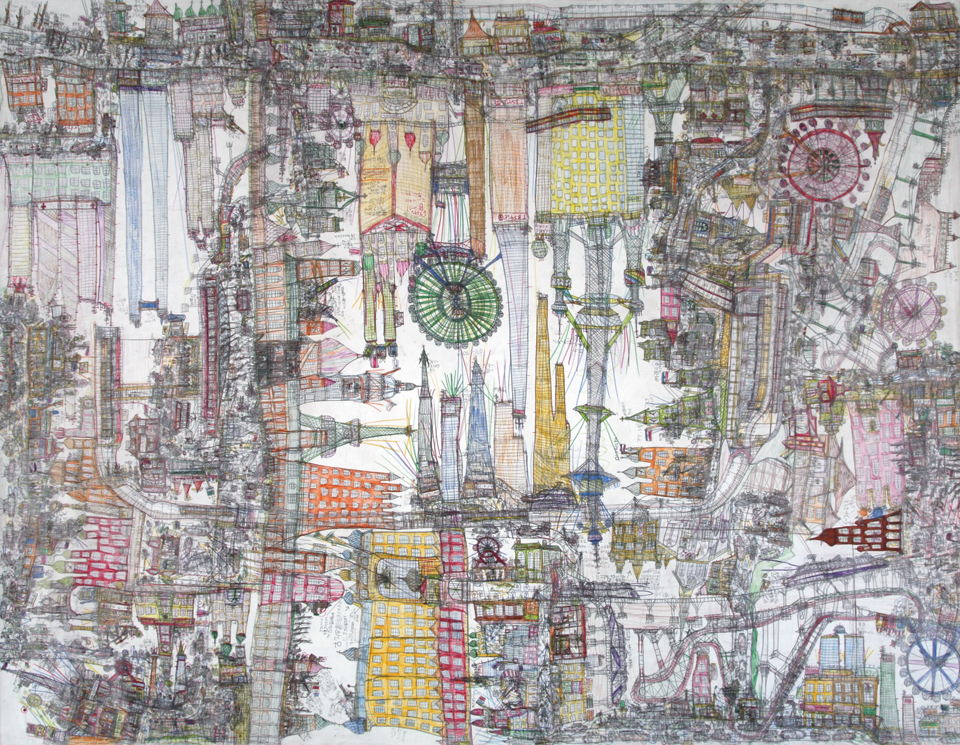
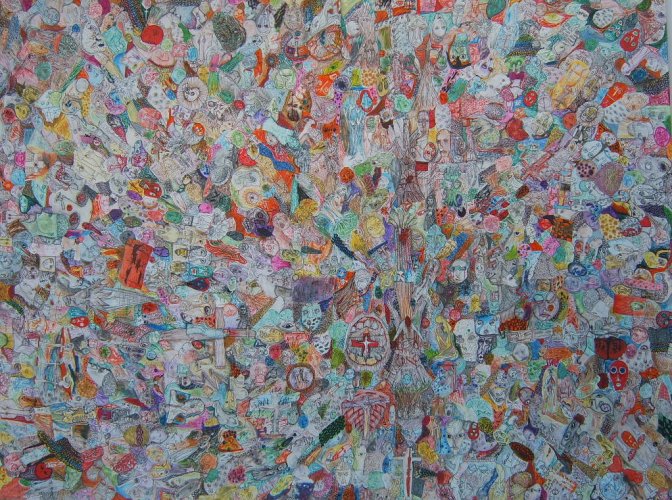
    Above Image:  ‘The Economically Booming City of Tianjin, China’ by Norimitsu Kokubo


    On Saturday 15 June, I visited the Wellcome Collection for a talk on the history and development of ‘outsider art’; an event accompanying the current ‘Souzou: Outsider Art from Japan’ exhibition. Here, I have outlined the main points covered by each of the speakers, and highlighted a few of the questions raised during the discussion. I am hoping to come back to these questions in ‘Part Two’, and answer them for myself. 


    The panel consisted of Roger Cardinal; art historian and ‘coiner’ of the term ‘outsider art’, John Maizels; editor of Raw Vision Magazine, David O’Flynn; consultant psychiatrist at the Lambeth and Maudsley Hospitals, and Shamita Sharmacharja; curator of the current Wellcome Collection exhibition.

    John Maizels chaired the event which aimed to explore the history of ‘outsider art’, right from its early days as a diagnostic tool for psychiatrists to the growing popularity of visionary artists in the present day. Each speaker gave a presentation on their specialist area, followed by a chance for questions and a discussion with the audience.

    Roger Cardinal spoke first, defining work aligned with the term as anything ‘outside the spheres of normal art making,’ before going into detail about the three highly influential characters who really shaped the beginning of what we now know as ‘outsider art’: Jean Dubuffet, Hans Prinzhorn, and Andre Breton. Roger discussed how early on in its development, ‘outsider art’ was merely a diagnostic tool within the asylums of 19th- and early 20th- century Europe. It was Prinzhorn’s interested in the work that really encouraged a much more creative and aesthetic stance, rather than a continuing pathological one.

    The point I found most interesting during Roger’s talk was his stating that ‘outsider art’ is categorically not a movement – it is not a school, a style, or a political movement – instead, it is a ‘movement of one’ in the sense that each artist should be looked at separately. It is a ‘movement of individuals.’ This was great to hear, as it is something I have been trying (and seemingly failing!) to put into words… until now!

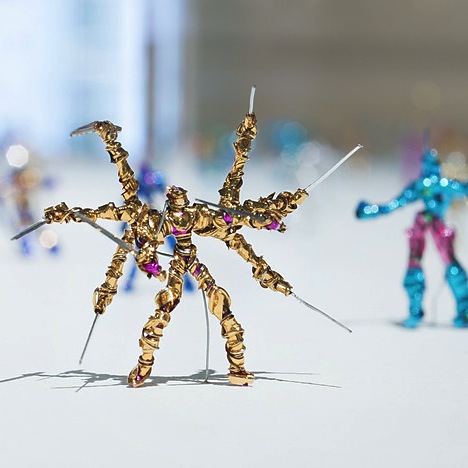
    'Untitled', by Shota Katsube
    ‘Untitled’, by Shota Katsube (source: careersuicideblog.wordpress.com)

    Next to speak was David O’Flynn. Having a psychiatrist on the panel was something I found really interesting, and I really wasn’t sure what to expect. I continuously advocate that work aligned with ‘outsider art’, or (for want of not using the term) work created by those on the margins of society, should not in any way be associated with the backgrounds or biographies of the artists, so to have a psychiatrist on the panel was something I questioned – would it take away from the focus on the aesthetic? Would it again pathologise the work?

    David, however, is not only a psychiatrist, but also manages the Adamson Collection – a collection of art founded by Edward Adamson, the ‘father’ of art therapy (I am definitely not an endorser of art therapy – and was pleased to hear David say that he was also extremely ‘anti-interpretation’). He spoke about the change in European mental health care in the mid 20th-century, and how this had a huge impact on the emergence of ‘outsider art’. There was a move from psychiatrists ‘discovering’ or ‘finding’ work created by patients to them actively setting up creative spaces where patients were encouraged to create.

    David also raised a few interesting points with regards to the Adamson collection – and to psychiatric collections more generally. Who has ownership of the work? They were created in a hospital environment during the process of healing; are they art objects or tools for healing? Should the creators be named? What are the copyright issues? David argued that the artists’ names should be shown, afterall, they were denied an identity in the asylums; they shouldn’t be excluded a second time around.

    Although I’m not sure how I feel about psychiatrists talking about ‘outsider art’ (or, actually, just art in general), I do think it was important for David to be there as the emergence of ‘outsider art’ relied quite heavily on the influence and encouragement of certain psychiatrists.

    'Mother', by Toshiko Yamanishi
    ‘Mother’, by Toshiko Yamanishi

    The final speaker was Shamita Sharmacharja, who focused on her curating of the ‘Souzou’ exhibition. Shamita said she had chosen to go for an ‘object-led’ approach rather than a heavily biographical or health focused interpretation – something which I think is very important when displaying ‘outsider art’. It means that the artists’ talents are not simply pushed to one side in favour of their medical history. Shamita quite rightly stated that the artists’ works were  art – she would not focus on the biography of other artists she was displaying, so why would she for this exhibition?

    After the introductory speeches, it was time for audience questions. The questions were wildly diverse, and came from people who worked with artists outside of the ‘mainstream’ art world, and from those who knew fairly little about the subject.


    The Questions

    1) Can ‘outsider artists’ talk about their work meaningfully and coherently? 

    2) Why do we feel we have to label people? Why can’t outsider artists just be called artists?

    3) Why is there so much interest in Japanese ‘outsider art’ at the moment?

    4) Did ‘outsider art’ exist before the 1930s?

    5) What is ‘outsider art’? In simple terms – has it become outdated?

    6) Not everyone is an artist, and not everything is art. People have to go to art school and study what has come before to become an artist.

    7) Why is ‘outsider art’ not taught as part of the art historical canon? 

    In Outsider Art under Analysis: Part Two, I will return to these questions and answer them for myself. I would be really interested to hear other people’s responses to the questions as well.

  • Relationships: Alfred Wallis and Ben Nicholson

    Relationships: Alfred Wallis and Ben Nicholson

    ‘Outsider art’ in the traditional sense – i.e. Jean Dubuffet’s description – alludes to an isolated artist, working on the periphery of the mainstream art world. Contrary to this controversial belief, many of the most notable ‘outsider artists’ of the twentieth century were supported, encouraged and ‘outed’ by some of the most famous ‘mainstream’ artists of the same century. This series of blog posts will highlight a few of these relationships, in the hope of rectifying the general thought that artists that often sit under the umbrella of ‘outsider art’ were completely immune to and separate from the twentieth century ‘mainstream’ art world.  In fact, many of the ‘masters’ of modern art were hugely influenced by these relationships.

    #1 Bill Traylor and Charles Shannon
    #2 Alfred Wallis and Ben Nicholson


    # 2: Alfred Wallis and Ben Nicholson

    Meeting: Alfred Wallis and Ben Nicholson (Tate)
    Meeting: Alfred Wallis and Ben Nicholson (Tate)

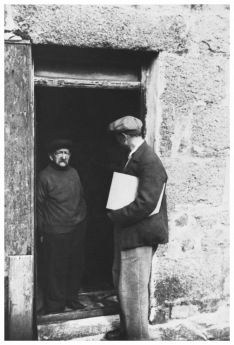
    In St. Ives in 1928 came another chance meeting of two celebrated twentieth century artists – that of self-taught Cornish fisherman Alfred Wallis (1855 – 1942) and modern favourite, Ben Nicholson (1894 – 1982). This union occurred when Nicholson and a friend, Christopher Wood, came across Wallis’s paintings nailed to a wall beside an old fisherman’s cottage during a visit to the area. Nicholson saw in Wallis’s work what he wanted to achieve in his own – a certain fresh naivety.  Nicholson documented their meeting: “On the way back from Porthmeor Beach, we passed an open door in Back Road West and through it saw some paintings of ships and houses on odd pieces of paper and cardboard nailed up all over the wall, with particularly large nails through the smallest ones. We knocked on the door and inside found Wallis, and the paintings we got from him then were the first he made.”[1]

    Much like Bill Traylor, Wallis is another artist who discovered his creative side later on in life, at the age of 68 after the death of his wife. In his earlier years, it is thought that Wallis went to sea as a fisherman – possibly even from the age of nine. Taking up painting after his retirement from a shop selling salvaged marine goods in St. Ives, Wallis used old torn boxes and ship paints to create his masterpieces.

    In an article authored by Nicholson in 1948, the artist compared Wallis’s style of working to that of Paul Klee:


    “He would cut out the top and bottom of an old cardboard box, and sometimes the four sides, into irregular shapes, using each shape as the key to the movement in a painting, and using the colour and texture of the board as the key to its colour and texture. When the painting was completed, what remained of the original board, a brown, a grey, a white or a green board, sometimes in the sky, sometimes in the sea, or perhaps in a field or a lighthouse, would be as deeply experienced as the remainder of the painting.”[2]

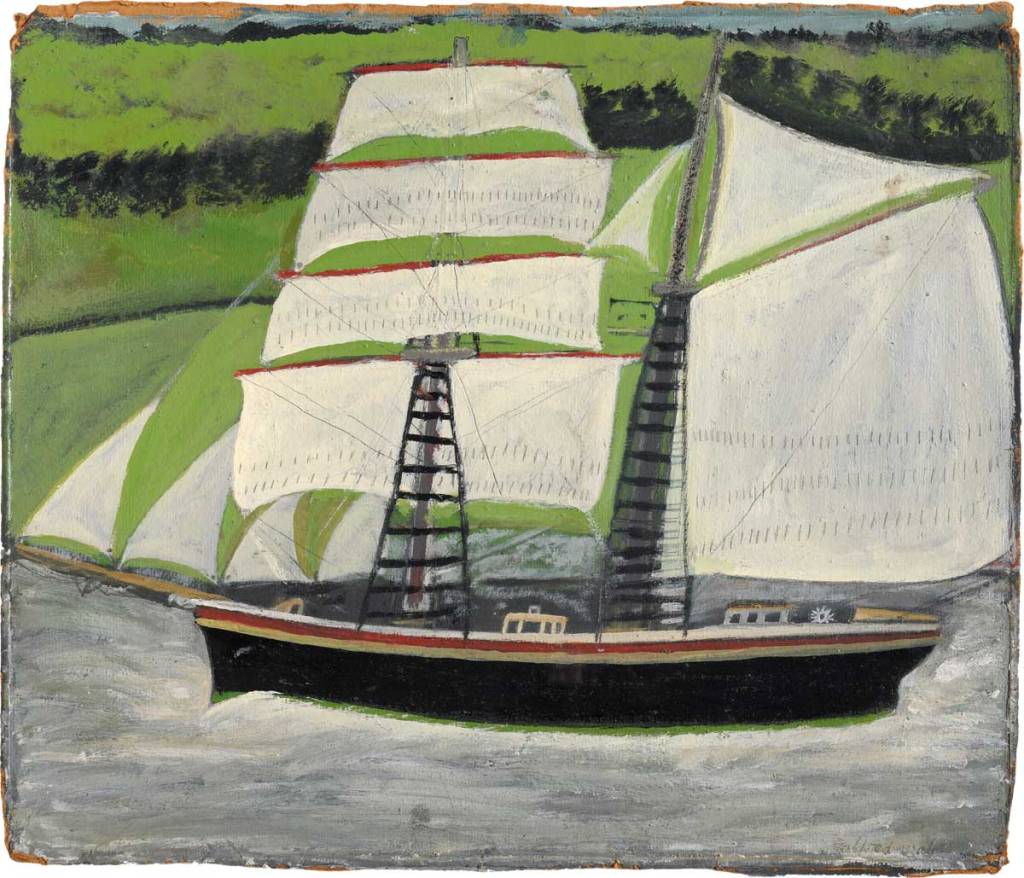
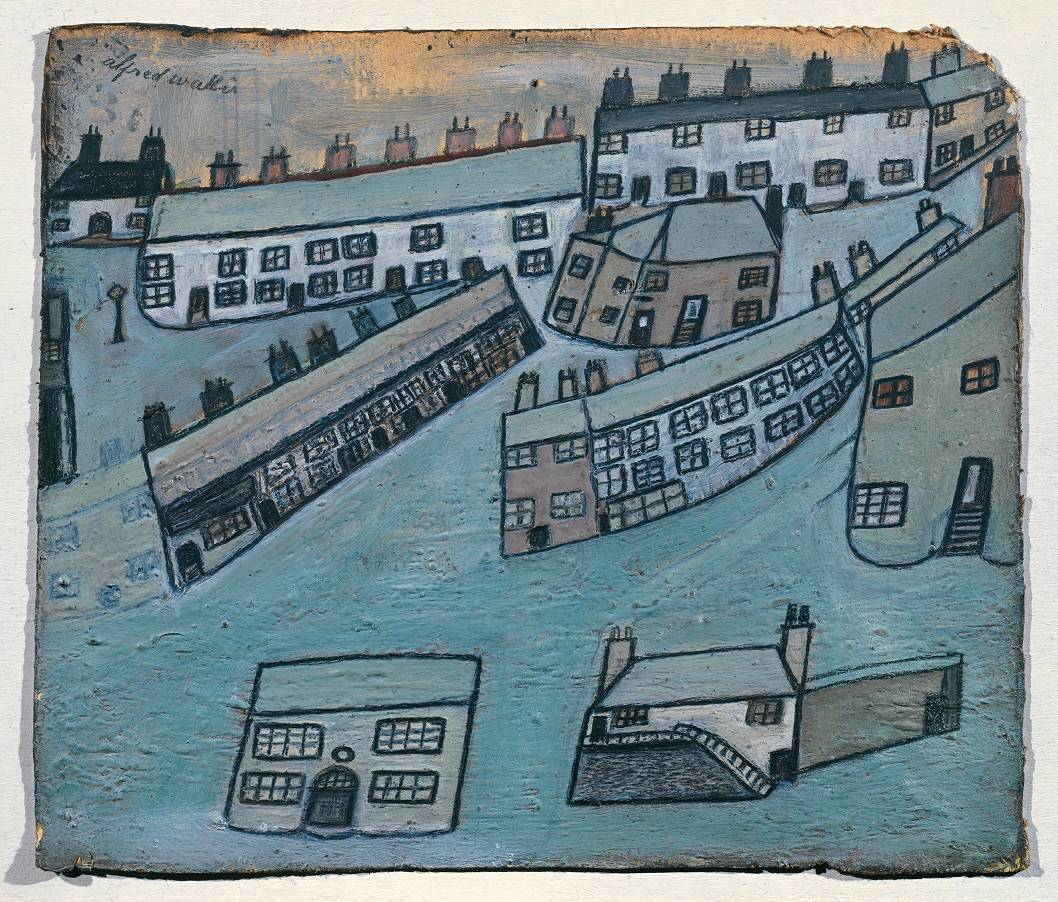
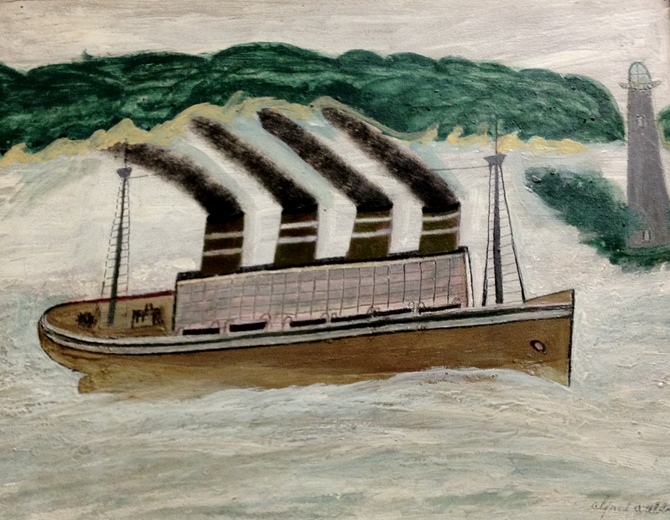
    Wallis’s works are incredibly evocative of what we now see as a self-taught, uninhibited, and untutored style. He largely ignores perspective and often, the objects depicted will vary in size depending on how much importance the artist gave to them.[3]

    Michael Glover, writing for the Independent during a joint exhibition celebrating the works of both Wallis and Nicholson at Compton Verney in 2011, speaks of Nicholson’s behaviour towards the older artist: “He began to patronize the old man, and to buy his paintings for the price of a meal or two. After he returned to his smart home in London, Wallis continues to send him batches, bound up with string and brown paper. Nicholson’s friends bought them too. Wallis began to be lionised a bit by the London avant-garde – Herbert Read and his friends.”[4]

    Nicholson’s interest in Wallis didn’t bring his work great recognition during his lifetime – Wallis continued to live in poverty after the meeting, despite Nicholson’s valiant attempts to promote the self-taught artist’s work and bring it to the attention of the burgeoning modern art scene. We know now, however, that that fateful chance meeting between the two – patronising aside – would in fact set the older artist up to become recognised as one of the most prolific and original 20th Century British artists. His unique ‘primitive’ portrayal of boats and ships provided inspiration to many artists, and his work is undoubtedly considered highly influential in the development of British Modernism.


    Alfred Wallis, 'Harbour Scene'
    Alfred Wallis, ‘Harbour Scene’

    Alfred Wallis, 'House at St. Ives'

    Alfred Wallis, ‘House at St. Ives’
    Alfred Wallis, 'The Blue Ship'
    Alfred Wallis, ‘The Blue Ship’
    Alfred Wallis, 'The Steamer'
    Alfred Wallis, ‘The Steamer’

    ‘Relationships’ series:

    #1 Bill Traylor and Charles Shannon

    #2 Alfred Wallis and Ben Nicholson


     References

    [1] Cornwall Calling

    [2] Ben Nicholson, ‘Alfred Wallis’ in Horizon, Vol. VII, No. 37, 1943

    [3] After Alfred Wallis

    [4] Michael Glover, ‘Alfred Wallis and Ben Nicholson, Compton Verney, Warwickshire’ . 31 March 2011 [Available Online]


  • Anthony Stevens

    Anthony Stevens

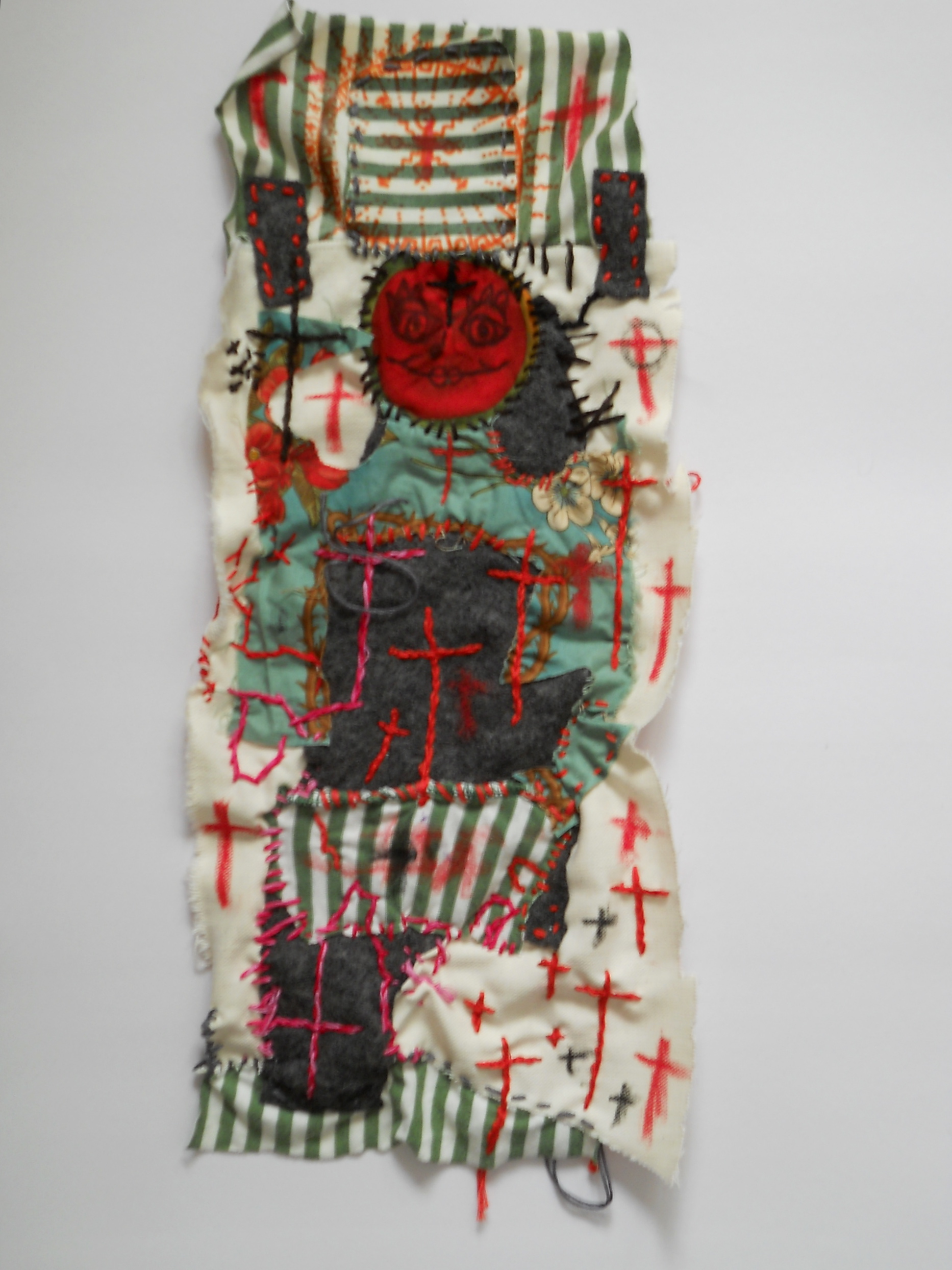
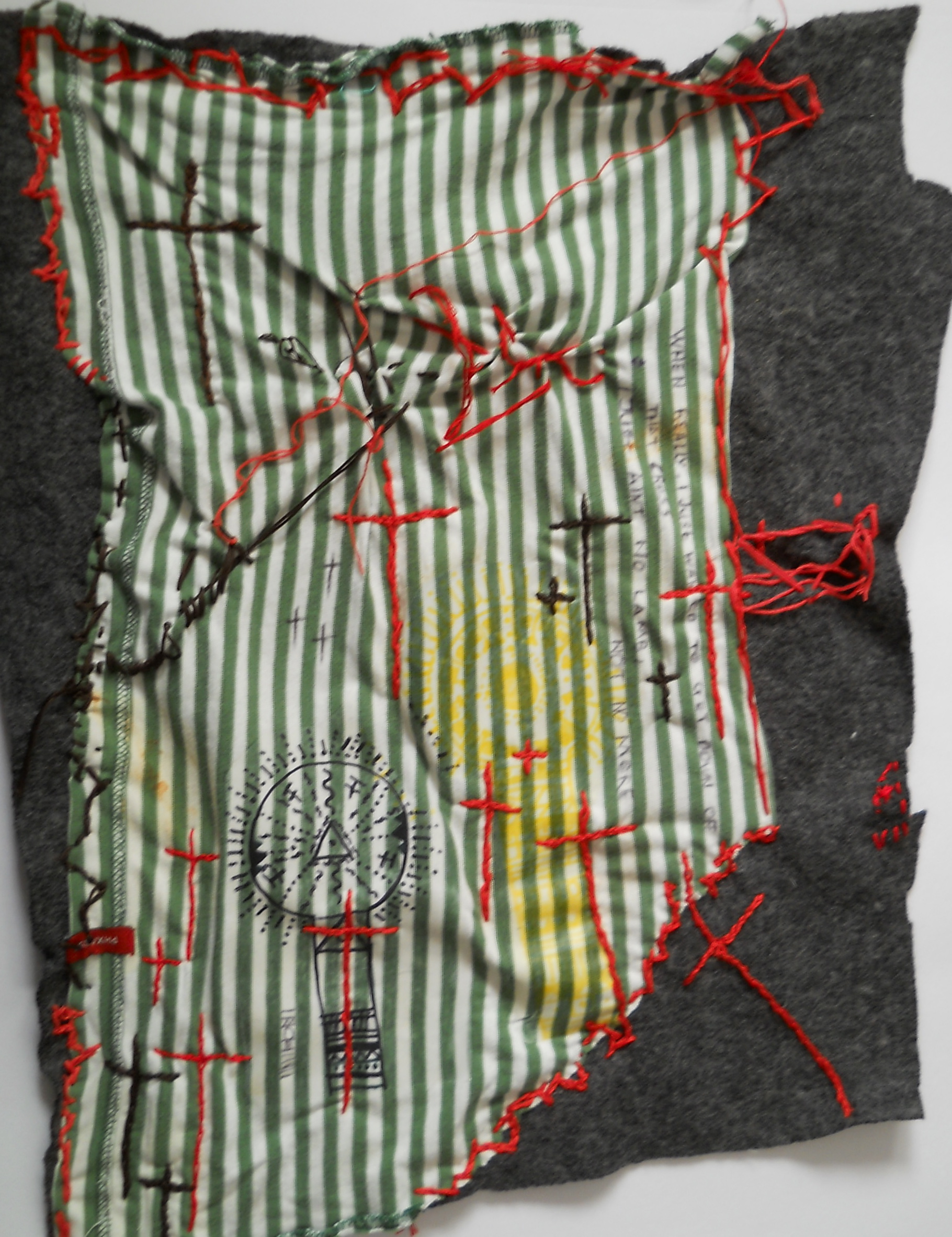
    Anthony Stevens is a self-taught artist whose work is inspired by life experience. His work could be said to be a narrative that he uses to process previous traumatic life events and the after-effects of these. He works predominantly in fabric and hand stitching, or marker pens and card and has been avidly creating for the past three years; however, the urge to create has visibly strengthened in the last four to five months.

    Although Anthony’s work tends to be about externalising inner dynamics, he quite often uses art alongside his Buddhist practise to understand and re-frame his life experiences so that he is able to use them as a source of value and growth. He says of his recent practice: “It feels like I am entering a new phase of life, one that is self-created and which I am happy to step into..I feel very much alive.”

    Below, Anthony talks through some of his more recent work.


    Anthony Stevens, 'Things are getting better'
    Anthony Stevens, ‘Things are getting better’

    “‘Things are getting better” is about my (or humanities) habit of listening to all of those negative inner voices that stop us enjoying the freedom and goodness inherent in each moment.”


    Anthony Stevens, 'There aint no flys in the chicken bone jar'
    Anthony Stevens, ‘There aint no flys in the chicken bone jar’

    “This piece is done in marker peens and oil pastels and was inspired by a memory I had. It is my version of ‘ignoring the elephant in the room’ syndrome.”


    Anthony Stevens, 'Catholic chanting to Gohonzon'
    Anthony Stevens, ‘Catholic chanting to Gohonzon’
    Anthony Stevens, 'Catholic chanting to Gohonzon'
    Anthony Stevens, ‘Catholic chanting to Gohonzon’
    Anthony Stevens, 'Catholic chanting to Gohonzon'
    Anthony Stevens, ‘Catholic chanting to Gohonzon’

    “The series entitled ‘Catholic chanting to Gohonzon’ is heavily influenced by my Buddhist practise and represent how the past and things that lay hidden in the mind can interfere with us being able to see how things ‘really are’.”


    Anthony Stevens, 'Ambivalence Towards the Mother'
    Anthony Stevens, ‘Ambivalence Towards the Mother’

    “This piece is about a period in my life when I was trying to gain control over myself and the general chaos of my life by engaging in disordered eating. Living with this part of the psyche in control is like living with a  dictator whose will must be obeyed at all costs! Ambivalence towards the mother figure is often regarded in Psychoanalysis as a major contributory factor in disordered eating, hence the title.”


    Anthony Stevens, 'Untitled'
    Anthony Stevens, ‘Untitled’

    “This work is about psychosis and how the voices that I thought were God actually came from a far more ‘earthly’ place. This is about me examining the origins of delusion and the role psychosis has in trying to tell a valuable story, and understanding its language. I used marker pen and card to create this.”


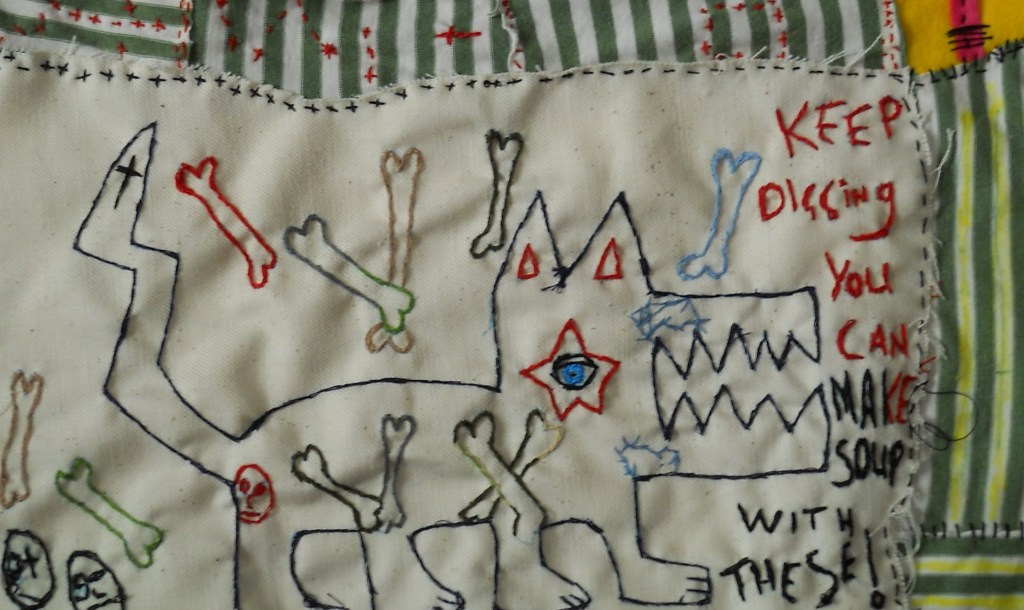
    Anthony Stevens, 'Making soup'
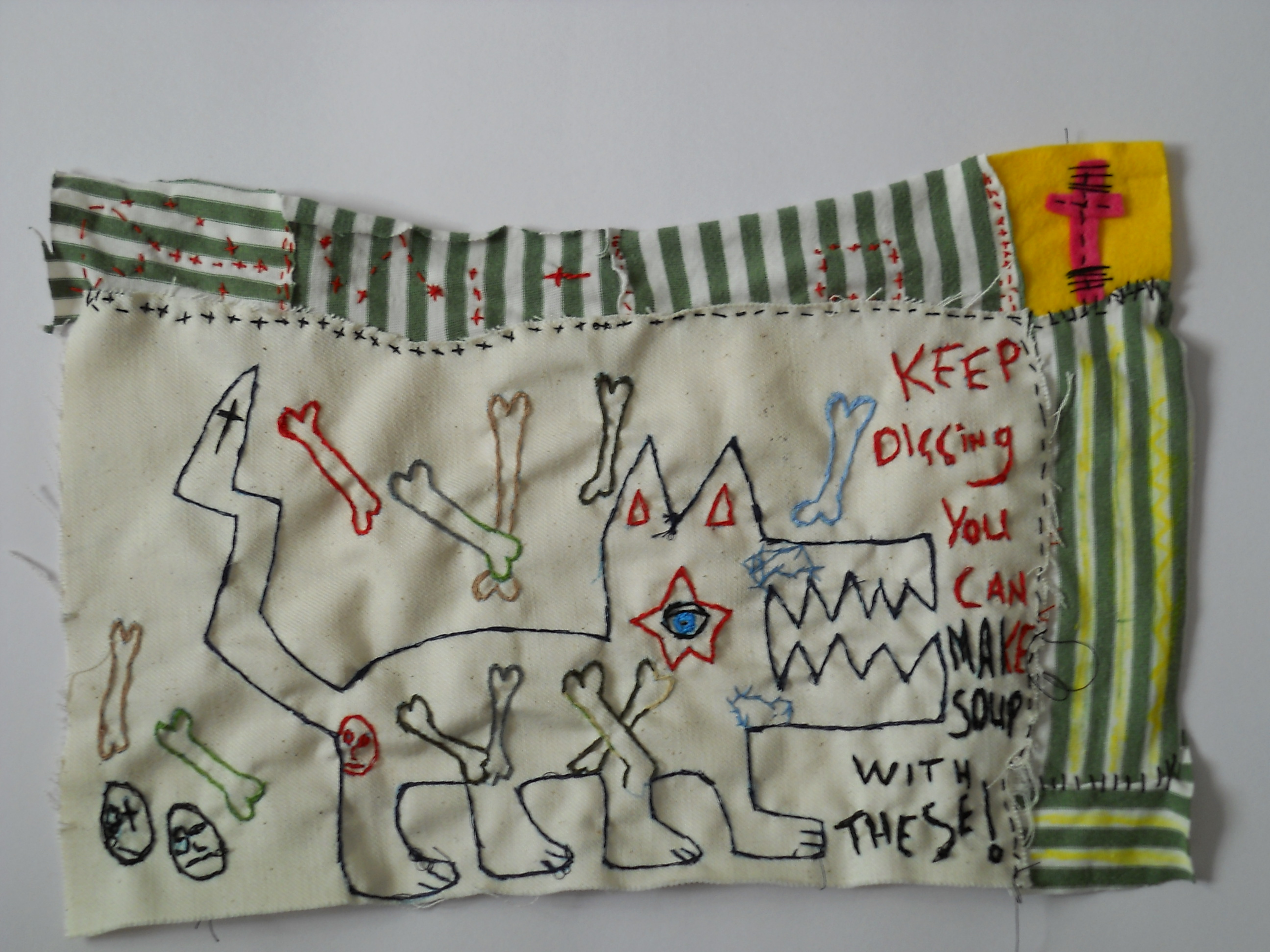
    Anthony Stevens, ‘Making soup’

    “‘Making soup’ is about searching within for all the things we need to make our lives rich and nourishing. The different fabrics used represent differing aspects and influence from personal and social culture (the pink and yellow is about punk ‘DIY’ culture, and the stripes represent duality, sleep/waking, life and death.”


    Click here to see more of Anthony’s work


    Click here for information on Anthony Steven’s exhibition ‘Making Soup’ at Prick Your Finger, London (until 20 August 2014)

  • Double Review: Face to Face with the Outsiders… and The Gravy Train

    Double Review: Face to Face with the Outsiders… and The Gravy Train

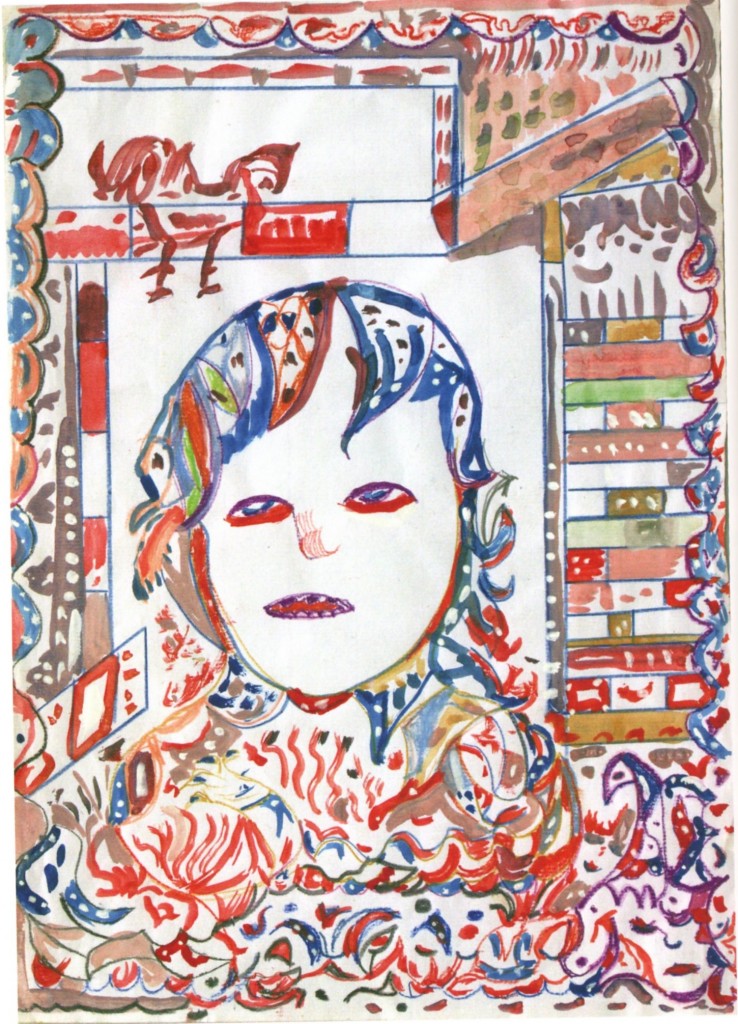
    (Image Credit: Nick Blinko – not from exhibition)


    Recently, I participated in a bit of a London exhibition marathon. I had been planning the day for a while, hoping to fit in a third visit to the Wellcome Collection’s fantastic ‘Souzou’ exhibition, as well as popping in to various other smaller shows whilst I had possession of a London Travel Card.

    The first stop was ‘Face to face with the Outsiders’ at the Julian Hartnoll Gallery just by Green Park tube station. The Gallery, I found, is a tiny treasure amidst the corporate, expensive world of Old Bond Street and Jermyn Street; both just around the corner. The exhibition beautifully brought together a vast and varied range of portraits created by those considered to be on the ‘margins’ of the art world. Amazing matchstick men, carved and coloured by Pradeep Kumar, required a (thankfully supplied) magnifying glass to experience the intricacies, and Tim Holliman’s portraits of well-known celebrities and sports stars encouraged a who’s who guessing game. However, I was particularly taken with a piece by Nick Blinko: a monochrome ink drawing made up of hundreds and hundreds of tiny – but perfectly formed – faces.

    Madge Gill (not from exhibition)
    Madge Gill (not from exhibition)

    There was also work from renowned ‘outsider artist’ Madge Gill, whose female faces peer pensively from the depths of the pen shrubbery, and up and coming ‘outsider’ superstar Kate Bradbury, as well as a colourful splash of Ben Wilson’s chewing gum pieces. The monochrome works by Blinko and Gill – amongst others – were set off perfectly against the bright, whimsical figures produced by Martha Grunenwaldt, whose ethereal people almost swim, or float, through an array of colours.

    The gallery was so intimately tiny, but it seemed like the perfect place to be surrounded by these beautifully curious faces. The contrast of bright, electric colours (Wilson, Grunenwaldt, Holliman, and Shafique Uddin) and moody ink drawings (Blinko, Gill, and Bradbury), all depicting the same thing – the human face – perfectly highlighted the huge variety of work produced by ‘outsider artists.’

    Martha Grunenwaldt (not in exhibition)
    Martha Grunenwaldt (not in exhibition)

    Next, I visited the ‘Souzou: Outsider Art from Japan’ at the Wellcome Collection for the third time. Still amazing. Still would like to have the twist-tie figure display cabinet as my dining table. You can read my previous review of this exhibition here.

    The third – and final – exhibition on the day’s agenda was ‘The Gravy Train and Roads to Recovery’ in the Conference Centre at St. Pancras Hospital. This exhibition was an eclectic mix of work by Service Users at the Margarete Centre and Kate Bradbury’s dervishes (and, of course, some of her much-loved black and white inks). Organised by The Arts Project, the exhibition aimed to highlight the idea that whilst treatment for substance misuse historically focussed on harm reduction and substitute prescribing, other recovery methods emphasise equality, opportunity and equal access to society. The Arts Project say of the show:

    “The artwork in this exhibition has been made by service users who, of their own volition, and without necessarily involving training or teaching, replace problematic substance use with creativity. This exhibition showcases outsider art work covering a range of years and artists reflecting a broad spectrum of style and creativity. This work combined with the visionary creativity of Kate Bradbury makes for a fascinating multi-layered experience.”

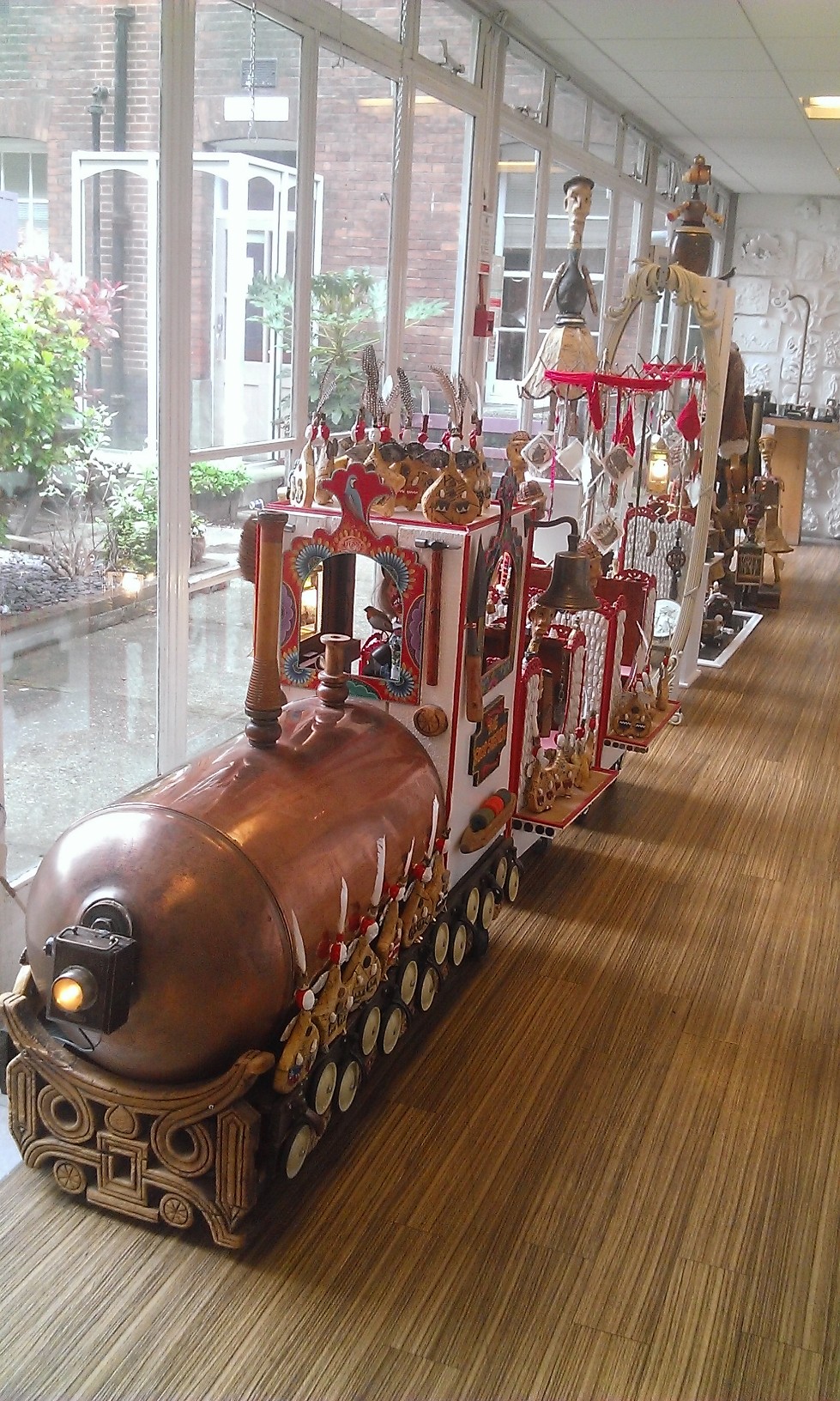
    And that it certainly was. Bradbury’s Gravy Train was in situ, looking magical as it transported a selection her dervishes down towards the reception area. I actually got to meet Kate at the exhibition, which was fantastic. She spoke a bit about her work, telling me that The Gravy Train had recently been displayed in The Crypt Gallery, St. Pancras, where it had visually resembled a train travelling through a tunnel. In fact, The Gravy Train quite aptly symbolises the journey to recovery experienced by many of the artists from the Margarete Centre – “where art becomes a skill with which to embrace opportunity and achievement,” The Arts Project say. The resulting exhibition is a fascinating installation exploring the very nature of journey.

    Kate Bradbury, 'The Gravy Train'
    Kate Bradbury, ‘The Gravy Train’

    These three exhibitions highlight the fact that 2013 is a big year for ‘outsider art.’ Of course, there’s the blockbuster Wellcome Collection show, but these smaller exhibitions were well worth a visit, highlighting the huge variety and overwhelming talent of ‘outsider artists.’ The tone seems to have been set for the rest of the year with two much anticipated solo shows coming up at Pallant House Gallery in Chichester to look forward to; Phil Baird in August and Kate Bradbury in November as well as a Madge Gill exhibition at Orleans House opening in October.


    ‘Face to Face with the Outsiders’ finished on 11 May, but you can visit the British Outsider Art website for more information. Click here.
    ‘Souzou: Outsider Art from Japan’ is on until 30 June 2013, for more information click here.
    ‘The Gravy Train and Roads to Recovery’ is on until 22 June 2013, for more information click here
  • Visionary Environments: Pamela Irving

    Visionary Environments: Pamela Irving

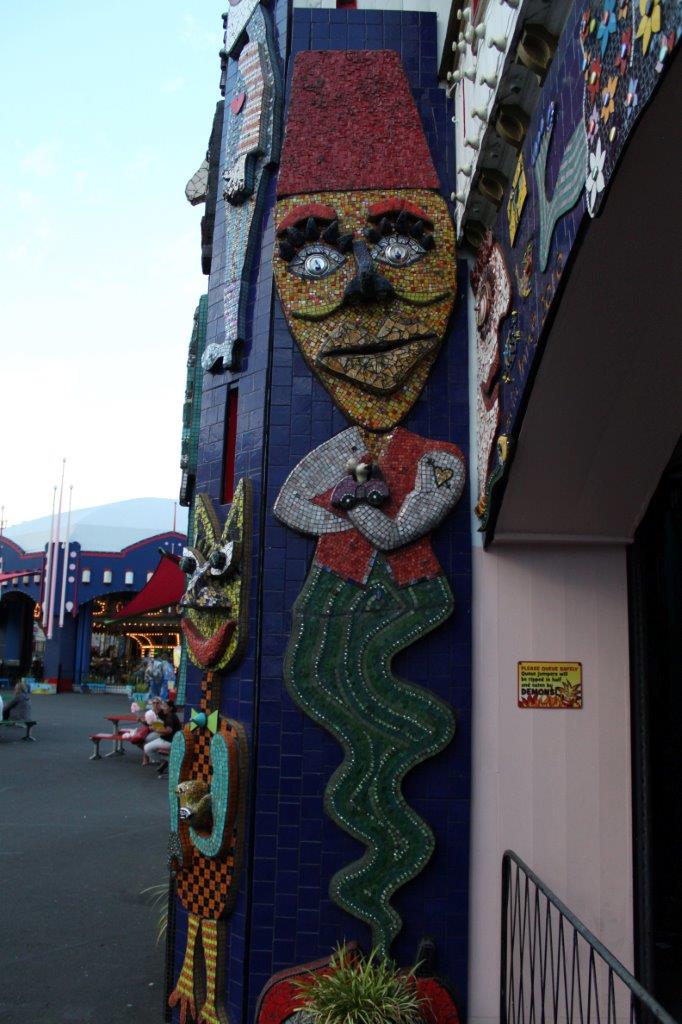
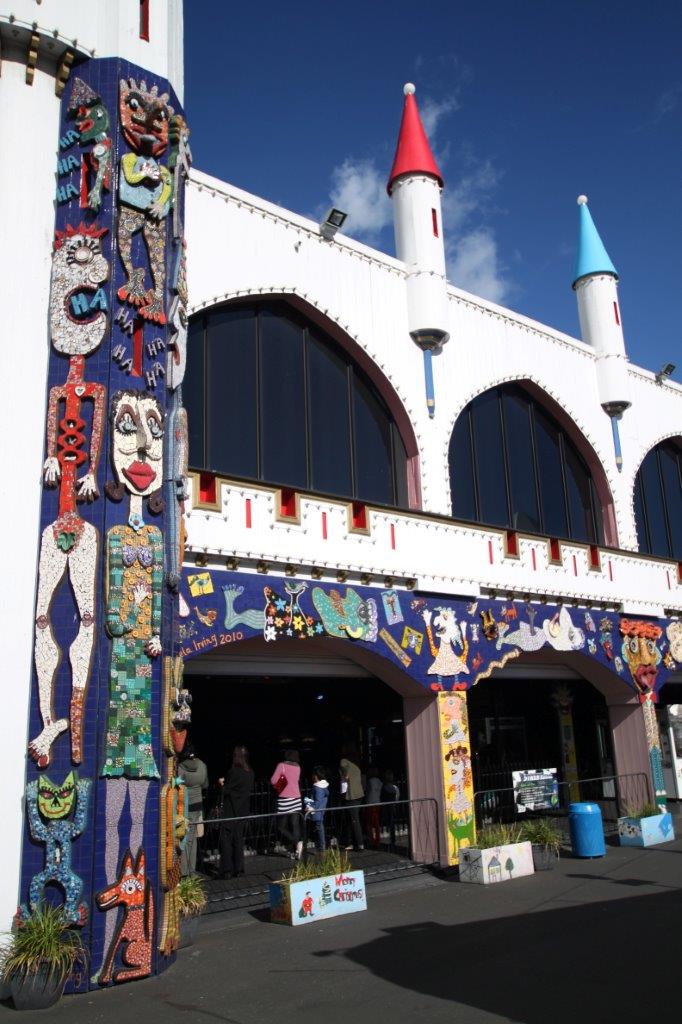
    ‘Dreaming with Open Eyes’ – a sculptural mosaic installation at Luna Park, Melbourne, by Pamela Irving.

    Dreaming with Open Eyes is about serendipity and destiny.


    “For years I had fantasized about creating a large scale installation in Melbourne. My aesthetic has developed over three decades. It reflects interest in myth, bold use of colour, whimsy and the figurative and narrative traditions. This has culminated in the creation of my own cast of quirky characters. My inspiration has been taken from diverse sources and gathered from extensive travels. These include “outsider” art environments and the legacy of ancient Roman mosaics.

    Early in 2010, by chance, Mary Stuart the CEO of Luna Park visited my studio/gallery in Bentleigh, Melbourne. Mary loved my bird encrusted courtyard. The courtyard is totally covered in mosaics and bird figurines. She invited me to create something quirky like the courtyard, for Luna Park. Hence the commission to commence work on the Luna Palace Building.

    Luna Park is one of Australia’s oldest tourist attractions. It has been thrilling children and adults alike since 1912.

    The title “Dreaming with Open Eyes” is descriptive of my process, as I work in my studio, as I walk down the street I am dreaming and imagining my works.

    This commission is a dream come true. To create a large scale mosaic installation on one of Australia’s most iconic tourist attractions. The commission is now in its 4th year. Another large section will be added by the end of this year.

    Entrance to Luna Park is free so if you are in Melbourne please feel free to visit.”

    – Pamela Irving 
    'Dreaming with Open Eyes', Pamela Irving. Photo credit: Jake Griffin.
    ‘Dreaming with Open Eyes’, Pamela Irving. Photo credit: Jake Griffin.
    'Dreaming with Open Eyes', Pamela Irving. Photo credit: Jake Griffin
    ‘Dreaming with Open Eyes’, Pamela Irving. Photo credit: Jake Griffin
    'Dreaming with Open Eyes', Pamela Irving. Photo credit: Jake Griffin
    ‘Dreaming with Open Eyes’, Pamela Irving. Photo credit: Jake Griffin
    'Dreaming with Open Eyes', Pamela Irving. Photo credit: Jake Griffin
    ‘Dreaming with Open Eyes’, Pamela Irving. Photo credit: Jake Griffin

    You can also visit Pamela’s studio/gallery by appointment. Details can be found on www.pamelairving.com.au and
    www.facebook.com/pamelairvingart


  • Relationships: Bill Traylor and Charles Shannon

    Relationships: Bill Traylor and Charles Shannon

    ‘Outsider art’ in the traditional sense – i.e. Jean Dubuffet’s description – alludes to an isolated artist, working on the periphery of the mainstream art world. Contrary to this controversial belief, many of the most notable ‘outsider artists’ of the twentieth century were supported, encouraged and ‘outed’ by some of the most famous ‘mainstream’ artists of the same century. This series of blog posts will highlight a few of these relationships, in the hope of rectifying the general thought that artists that often sit under the umbrella of ‘outsider art’ were completely immune to and separate from the twentieth century ‘mainstream’ art world.  In fact, many of the ‘masters’ of modern art were hugely influenced by these relationships.

    #1 Bill Traylor and Charles Shannon
    #2 Alfred Wallis and Ben Nicholson


    # 1: Bill Traylor and Charles Shannon

    Born into slavery on a plantation in Alabama, Bill Traylor is perhaps one of the best known self-taught artists of the twentieth century. Working on the plantation he was born onto for many years of his life, Traylor moved to Montgomery in 1928 where he worked as a labourer until he became physically unable to continue. Only beginning to produce art when he was 85 years old, Traylor used mainly modest, everyday materials to create a unique portfolio of his experiences – both past and present. He recorded events from the everyday, of life in Montgomery, which he attempted to sell to passers-by on a sidewalk. It was on this sidewalk that a unique meeting would change the fate of his artistic career.

    Bill Traylor
    Bill Traylor

    Charles Shannon – a painter and teacher – discovered Bill Traylor in 1939, as Traylor was perched on a box, drawing in the street near a fish market in his native Montgomery. Shannon supported the artist financially, and provided Traylor with materials as well as his first exhibiting opportunity at the New South Gallery in 1940. Despite full recognition of Traylor’s career as an artist not occurring until the 1980s (long after his death in 1947), Shannon is credited as having contributed significantly to the artist’s support network and therefore his later recognition.

    Shannon was fascinated by the seemingly innate creativity that Traylor had discovered at such a late stage in his life, despite having never drawn or even been able to write beforehand. Shannon, in his article ‘Bill Traylor’s Triumph’, published in Art and Antiques in 1988, speaks of his experience of Traylor as an artist: “He worked all day; some evenings I would drop by around ten o’clock and he would still be there, his drawing board in his lap, a brush in his hand. He was calm and right with himself, beautiful to see.”[1]

    Bill Traylor
    Bill Traylor

    Traylor was not known for talking about his work, but Shannon noted that he talked almost continuously whilst he worked – but, regretfully, he only recorded a very small number of these comments: “Now, I sometimes wish that I had [asked him questions]. I only knew what he volunteered to tell me.”[2]

    After Traylor’s death in 1949, Shannon continued to be an advocate for his work despite the lack of public attention and interest. Many members of Traylor’s family in fact had no idea that he had been an artist, they were not aware of Shannon’s support of the artist, and they were not aware that it was Shannon who had saved his work. It wasn’t until 1979 that Shannon – in possession of 1200 – 1500 works by the self-taught artist – managed to secure an exhibition at the R. H. Oosterom Gallery in New York. Today, Traylor’s work is often considered as an important part of the development of twentieth century art – despite the Museum of Modern Art, NY, offering Shannon one dollar per piece in 1942; something the advocate was incensed by, returning the cheque and taking back possession of the works himself.

    In 1986, when Michael Bonsteel asked Shannon what he thought made Traylor’s work great, he responded: “What made his work great is like trying to answer ‘what is grass?’ The rhythm, the interesting shapes, the composition, the endless inventiveness – it all reflects such a wonderful joy of living. His whole sense of life comes through. It was just the man. I think he was a great man. It’s not so much how he depicted or what he did. It was just the soul of the man.”[3]

    Bill Traylor
    Bill Traylor

    ‘Relationships’ series:

    #1 Bill Traylor and Charles Shannon

    #2 Alfred Wallis and Ben Nicholson


     References:

    [1] Charles Shannon, ‘Bill Traylor’s Triumph,’ in Art and Antiques, 1988, p 88.

    [2] Mechal Sobel, Painting a Hidden Life: The Art of Bill Traylor, (Louisiana State University Press, 2009), p. 6

    [3] Op. Cit., p 130

    General References:

    New York Times

    Petullo Art Collection

    High


  • What’s On: Spring/Summer 2013

    What’s On: Spring/Summer 2013

    Image above: Impact Art Fair 2011

    Below you will find some excellent and inspiring exhibitions that are taking place (mainly in the UK – sorry!) this spring and summer. From the Wellcome Collection to the Impact Art Fair; a dedicated art fair showcasing work by those facing barriers to the art world due to mental health reasons, disability, substance misuse or other social circumstances, there is bound to be something for everyone. I’m going to try and keep doing these ‘What’s On’ posts regularly to keep you all updated – and as 2013 seems to be a big year for the outsider art world! *(Click on the titles of the exhibitions to visit the webpage)*


    Souzou: Outsider Art from Japan
    Until 30 June 2013

    This exhibition showcases more than 300 works for the first major display of Japanese Outsider Art in the UK. With 46 exceptionally talent artists represented; all of whom are residents and day visitors at social welfare institutions in Japan, this exhibition consists of an excitingly diverse range of ceramics, textiles, paintings, sculpture and drawing.

    Toshiko Yamanishi, 'Mother'
    Toshiko Yamanishi, ‘Mother’
    Image from http://www.wellcomecollection.org

    The Gravy Train and Roads to Recovery
    Until 22 June 2013

    This exhibition at The Conference Centre presents artwork from Service Users at the Margarete Centre and highlights equality, opportunity and equal access to society as treatments for substance misuse. Alongside work by participants of the Margarete Centre are works by upcoming visionary artist Kate Bradbury.

    Image from 'The Gravy Train and Roads to Recovery' Facebook Page
    Image from ‘The Gravy Train and Roads to Recovery’ Facebook Page

    Outside In: On Tour
    Until 3 January 2014

    This touring exhibition consists of the work of 20 artists facing barriers to the art world selected through an open national competition. The tour features the six Award Winners from the Outside In: National exhibition: Kate Bradbury, Manuel Bonifacio, Matthew Sergison-Main, Michelle Roberts, Nigel Kingsbury and Phil Baird.

    The four venues the exhibition will be touring to are: The Museum of East Anglian LifeRoyal Brompton Hospital,  Salisbury Arts Centre and The Public.

    Regina Lafay, 'Convert' Image from www.outsidein.org.uk
    Regina Lafay, ‘Convert’
    Image from www.outsidein.org.uk


    Outside In: Regional

    On the back of the success of Outside In: National, the work of Outside In artists will be popping up all over the country in 2013 – from The Museum of Somerset in the South West and Hastings Museum and Art Gallery in the South East right up to Perth Museum and Art Gallery in Scotland, and everywhere in between. For information on all of the dates and venues, visit Outside In’s website.


    I Ar You at Large Glass Gallery
    Until 24 May 2013

    I Ar You: Portraits by Self-Taught American Artists features an intimate selection of important artists from the Deep South and beyond, presenting self-portraits and anonymous figures alongside images of celebrities, presidents and cowboys.

    Image from www.largeglass.co.uk
    Image from http://www.largeglass.co.uk

    The Alternative Guide to the Universe at the Hayward Gallery
    11 June – 26 August 2013

    An exhibition surveying the work of individuals who create alternatives in art, science and architecture. Focusing on self-taught practitioners whose work is generally produced outside of  established channels and official institutions, The Alternative Guide to the Universe features a range of contributors from fringe physicists to the inventors of new languages, from artists who map cities of the future to others who design imaginary technologies.


    The Impact Art Fair at Block 336, Brixton
    26 – 28 July 2013

    This will be the second Impact Art Fair organised by Creative Future, which showcases work by highly talented artists whose access to the mainstream is limited by mental health issues, disability, chronic ill health or social circumstance.

    *N.B. If you are an artist, you can still enter work for selection for the Impact Art Fair up until 23 April 2013.

    Heidi Aldous Image from www.impact-art-fair.org.uk
    Heidi Aldous
    Image from www.impact-art-fair.org.uk

    “Great and Mighty Things”: Outsider Art from the Jill and Sheldon Bonovitz Collection at The Philadephia Museum of Art
    Until 9 June 2013

    In this innovative exhibition, the power of self-taught artistic talent, the drive of the human spirit to create, and the wonders of highly original inner worlds are revealed. This show surprises and challenges museum goers, forces examination of the conventional definition of the word ‘artist’, and shows that good art is good art regardless of the maker’s resume.


    Gods, Devils and Dreams by Peter Harry Lewis White at Bethlem Gallery
    Until 17 May 2013

    This is an exhibition of large-scale paintings and detailed pencil drawings by Peter White. His work depicts visions and dreamscapes that take the viewer on a journey into abstracted landscapes, figures and happenings. “My exhibition reflects my experiences and my creations. There are some windows into my memory and mind, but the rest is just colour and form.”

    Peter White Image from www.bethlemgallery.com
    Peter White
    Image from www.bethlemgallery.com

    Steve Wright’s House of Dreams
    Museum open days: 11 May, 8 June, 6 July, 3 August and 7 September 2013

    This amazing world of discarded objects has been created by artist Stephen Wright, who uses everyday objects to create mosaics: milk bottle tops, broken dolls, crockery and the rich pickings of car boot sales. The museum is open by appointment, but there are open days on 11 May, 8 June, 6 July, 3 August and 7 September 2013.

    Stephen Wright's House of Dreams Image from www.stephenwrightartist.co.uk
    Stephen Wright’s House of Dreams
    Image from www.stephenwrightartist.co.uk

    To keep up to date with other goings-on in the ‘outsider art’ world, follow me on Twitter: @kd_outsiderart


  • Heartside Studio and Gallery

    Heartside Studio and Gallery

    The Heartside Ministry was founded in 1983 in Grand Rapids, Michigan, as an outreach to the homeless and disenfranchised people of the streets in a neighbourhood abandoned by businesses and avoided by many. In 1993, in response to the needs of the community, the Ministry developed a programme of one-on-one adult literacy classes, further expanding in 1997 to include a computer centre that offered help with resumes, desktop publishing and web access. The Art Studio and Gallery was established along with a pottery studio and a weaving programme, allowing the Heartside community to express themselves, discover their talents and produce saleable items.

    The Art Studio and Gallery represents a large part of what Heartside does, existing as a “safe and catalysing environment for the expression of the emotions, ideas, creativity and spirituality.” The art programme space consists of large storefront windows, high ceilings and a supportive atmosphere that is “especially conducive to artistic endeavour.” The studio space is open to the public throughout the week, providing the opportunity for creation, learning and socialisation, and the gallery is open for special neighbourhood and city functions, and also showcases the work of artists participating in the programme.

    Under the guidance of the Arts Coordinator, the often self-taught artists have produced a prolific body of work spanning various mediums, styles and subject matters. The Coordinator works to “encourage the intuitive and spontaneous artistic tendencies within each individual artist.”

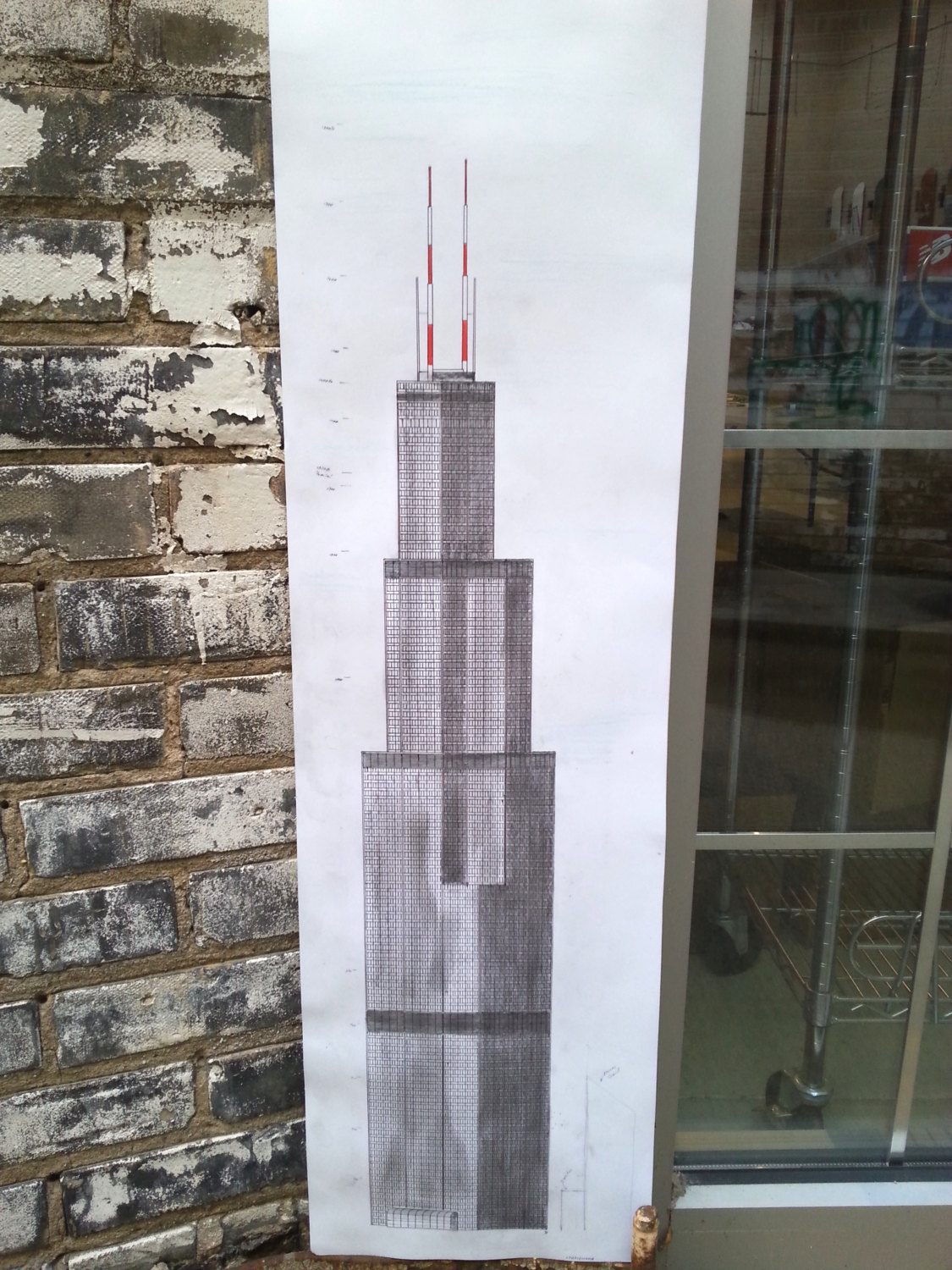
    Tom Salazar, one of the Heartside artists, has been interested in art from a young age. His to-scale intricate impression of the Sears Tower is hand-drawn, with not a computer programme in sight. Sears Tower impressively has every window and is draw foot for foot completely to a smaller scale. Tom also makes miniatures of some of his designs, and takes inspiration from architecture, cars and landscapes, as well as building his own furniture when needed.

    Tom Salazar, 'Hand Drawn Sears Tower'
    Tom Salazar, ‘Hand Drawn Sears Tower’

    Art for another participant of the Heartside programme, Katalina, began as a hobby, before quickly becoming part of who she is as a person. Speaking of the kind of work she produces, Katalina says: “I am a self-taught, mixed-media artist. I use acrylic paints, chalk, pastels, coloured pencils, water-colours, ink, found objects and a wide variety of other media that I come across.” As an artist, Katalina doesn’t limit herself – “any medium or found object can be used in creating art.” She uses vintage photos, and is interested in creating narratives with collage. Katalina adds a final thought: “Art for me is a very healing power. Not only do I create something, but I can also express how I feel at that particular moment by telling a new story.”

    Katalina, 'Family Album'
    Katalina, ‘Family Album’

    Katalina’s Family Album is a mixed-media collage made from magazine photos on book board with the addition of buttons and beads to add texture.

    Katalina's work on display at Heartside
    Katalina’s work on display at Heartside

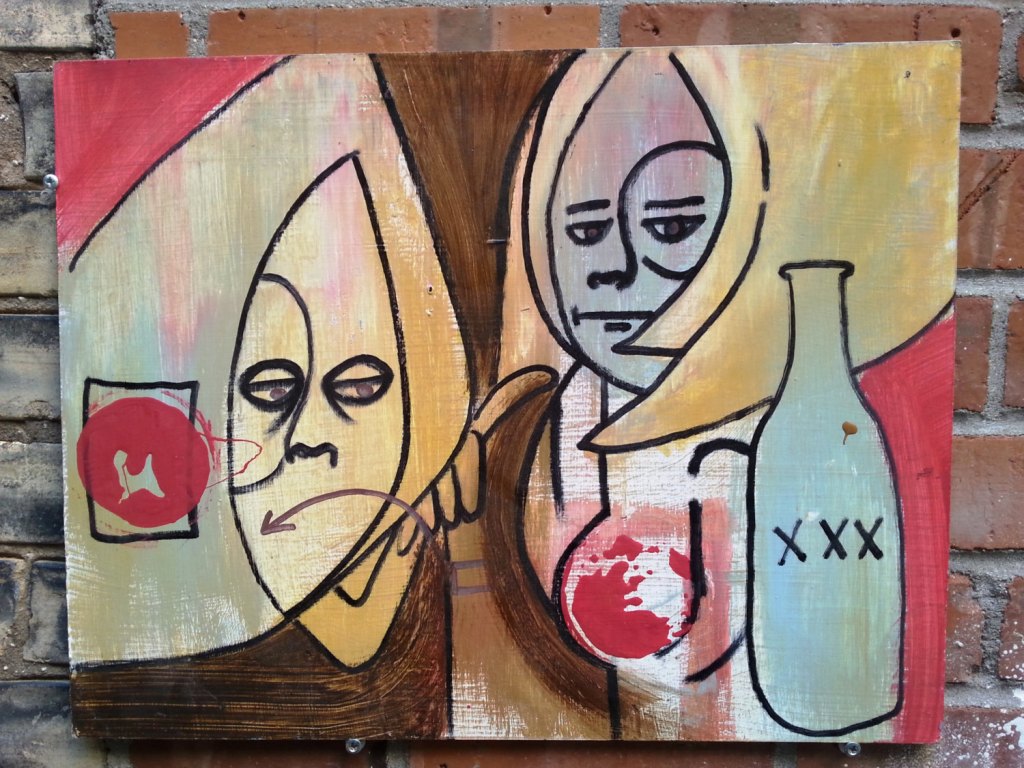
    Scott Robinson, a former street artist, grew up skateboarding – “and when I got too old to do that I traded it in for paints,” he says. Scott adds about his progression from skateboarder to artist that “it’s all connected anyhow – skateboarders just look at the world differently. When I see a bench I don’t see a place to see, I see it as an object. The lines in my paintings reflect that.” Don’t Do It was created by Scott after he became sick of the graffiti scene and the threat of incarceration, instead choosing to bring his work to canvas. It is a piece that initially had no meaning, before Scott noticed a pregnant woman and alcohol within the piece. The title came from an intuitive sense of what the image was; a pregnant mother being tempted by the alcoholic drink.

    Scott Robinson, 'Don't Do It'
    Scott Robinson, ‘Don’t Do It’

    These are just three of the very talented artists working at Heartside Studio and Gallery. For more information on the organisation, click here.
    Most of the art created on the programme is for sale via Heartside’s Etsy gallery, and is priced between $10 and $40, with proceeds directly benefitting the individual artists. To visit the Etsy gallery, click here.
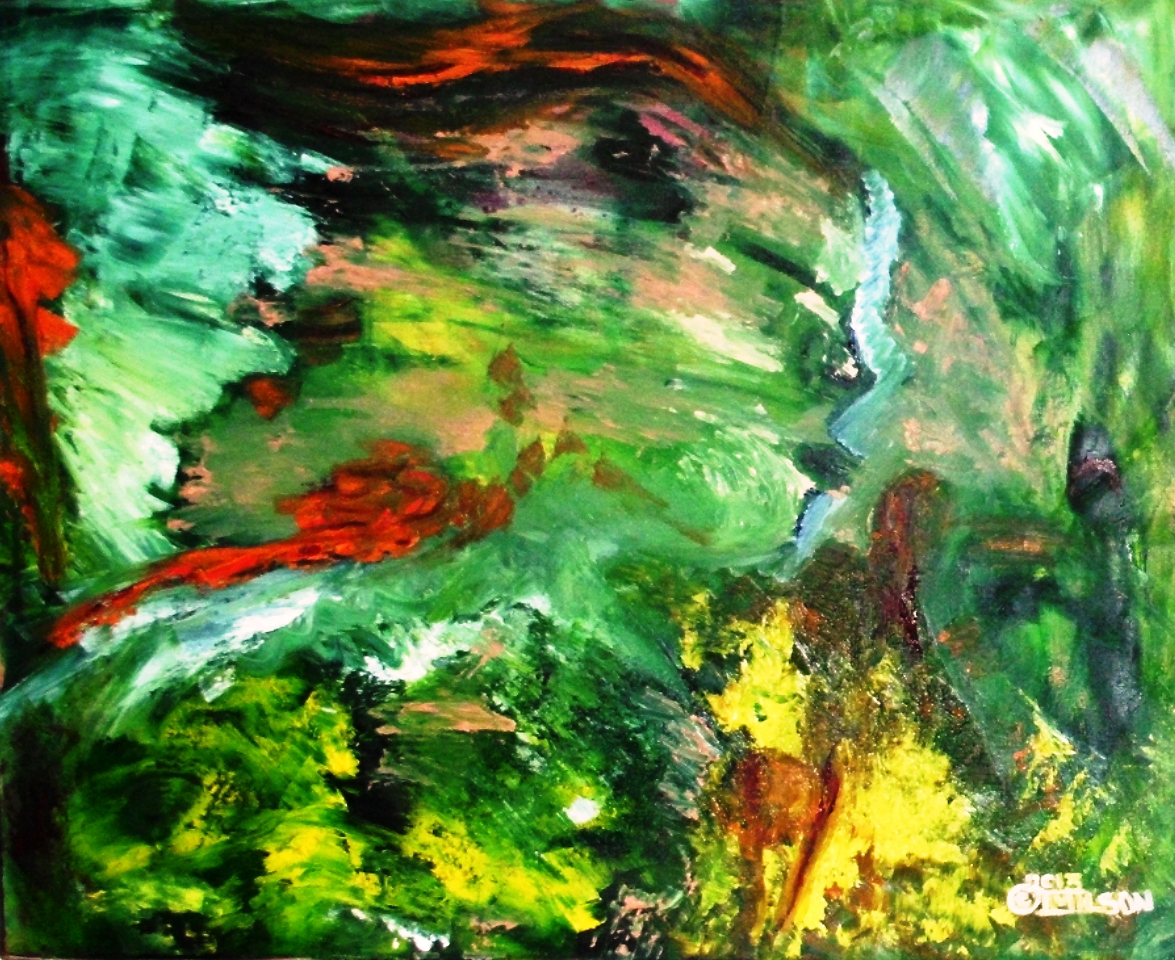
  • Iva Milson

    Iva Milson

    “The heart beats in a rhythm synchronized to the ebb and flow of cosmic energy that has no pre-conceived ideas, thoughts, or expressions. And it is that rhythm that inspires me to paint.”Iva Milson


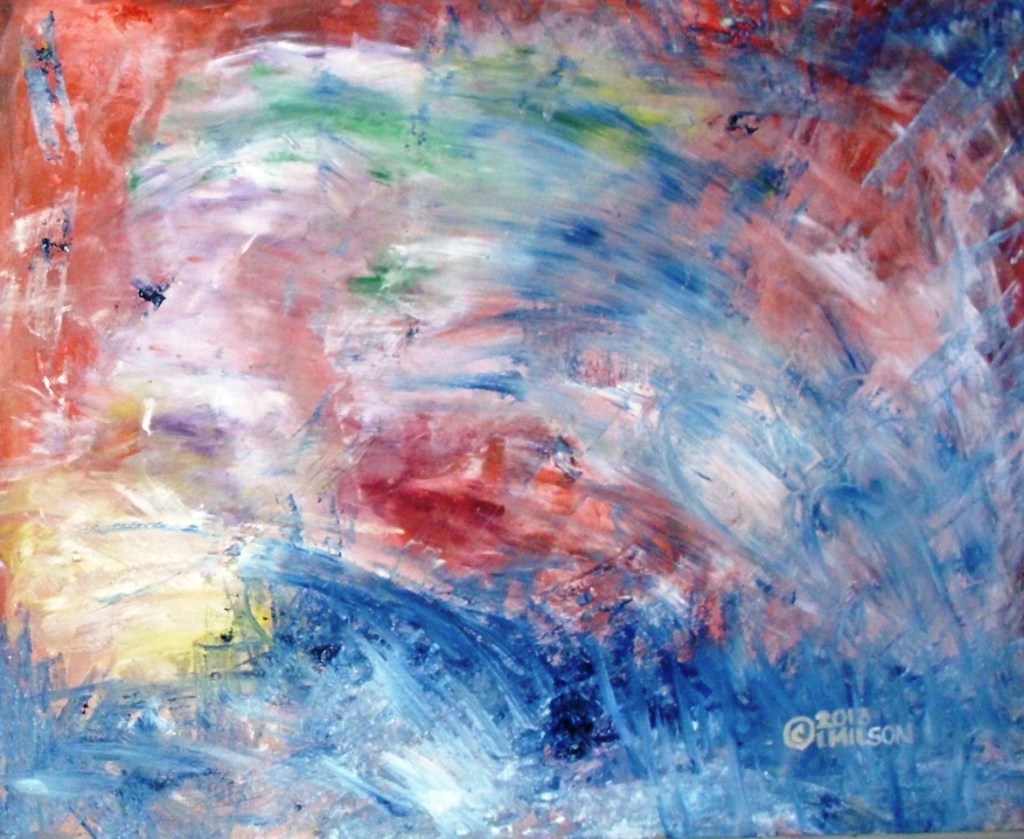
    Iva Milson,  'Duplicates'
    Iva Milson, ‘Duplicates’
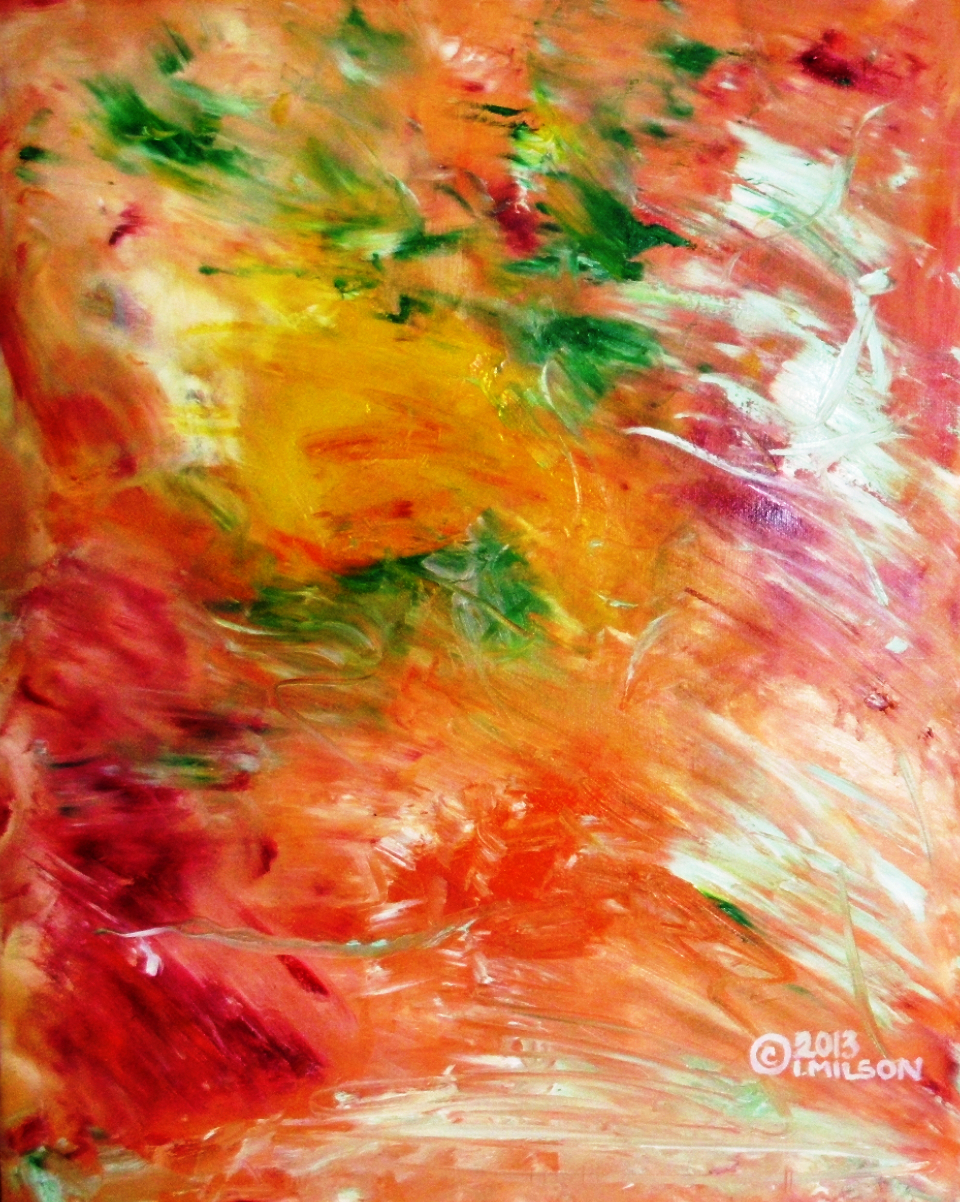
    Iva Milson, 'Throught Time and Space'
    Iva Milson, ‘Throught Time and Space’
    Iva Milson, 'Floating in the Waters of Love'
    Iva Milson, ‘Floating in the Waters of Love’
    Iva Milson, 'Dream-in the Dream'
    Iva Milson, ‘Dream-in the Dream’
    Iva Milson, 'Memories'
    Iva Milson, ‘Memories’

    To see more of Iva’s work, visit www.ivasart.yolasite.com. You can also follow Iva on Twitter: @IvasArt
    If you would like to see your work on KDoutsiderart, you can contact me by emailing kdoutsiderart@yahoo.com 
  • ‘Side by Side’ Exhibition and Symposium

    ‘Side by Side’ Exhibition and Symposium

    On Friday 22 March, I visited the ‘Side by Side’ exhibition in the Spirit Level at the Royal Festival Hall; a collaboration between the Southbank Centre, The Rocket Artists and the University of Brighton. The exhibition, pioneering in its promotion of inclusive arts in such a high profile institution, features an array of multi-disciplinary works including drawings, sculptures, paintings, film and music, and brings  together a whole variety of inclusive arts groups from all over Europe.  
    Photograph taken at the 'Side by Side' exhibition
    Photograph taken at the ‘Side by Side’ exhibition

    The exhibition is a warren of inspiration and awe; from modelled horses’ heads from Amsterdam, to glass jars filled with individual responses to a medical conference. One of my favourite parts of the exhibition is what I have called ‘the cardboard box area.’ This space consisted of a cardboard box tower with canvas works placed at various points around the sculpture – waiting to be discovered – as well as film projection and video. The rest of the works in the exhibition are equally exemplary, and are a treat for all of the senses. There is a sensual hanging piece, which invites you to be a part of it, paintings; black and white, colour, sculpture and tables and tables of beautiful creations, all displayed in a bright, spacious gallery.

    Jars filled with individual responses to a medical conference
    Jars filled with individual responses to a medical conference
    Sculptural heads from Amsterdam
    Sculptural heads from Amsterdam
    Hanging piece by Linda Bell
    Hanging piece by Linda Bell
    Table adorned with works by various artists
    Table adorned with works by various artists

    The exhibition was accompanied by a Symposium, which I was lucky enough to be able attend. The Symposium was concerned with current inclusive arts practice and its progression, and provided a forum space in which both artists and their colleagues could discuss best practice and consider ways of thinking about art that aren’t directly related to written or spoken language. The outcome of the day was a collaboratively produced manifesto on what inclusive arts can and should be.

    There were brief talks from Alice Fox (Rocket Artists, University of Brighton), Sue Williams of the Arts Council (who spoke about the Creative Case for Diversity) and Andrew Pike from KCAT (Kilkenny Collection for Arts Talent, Ireland), after which the group split up to participate in different workshops facilitated by various inclusive arts groups: Action Space, Corali Dance, Intoart, Project Volume, Stay Up Late, StopGap Dance Company and Rocket Artists. Each workshop covered a different ‘art’ e.g. visual art, dance, music…

    I attended the Rocket Artists’ ‘Say it with Bags’ workshop, which aimed to look at the use of language with regards to inclusive arts practice. For this workshop, we were asked to have a look around the ‘Side by Side’ exhibition and choose a piece that we were drawn to. Once we had decided on a piece, we then chose a word, movement and sound and created a drawing in response to the piece. This activity was designed to help us think about art in a more practical way – not just with words (whether spoken or written).

    After the workshops, everyone reconvened to show/tell about the manifesto points that they had collaboratively created in the various workshops. Our group created two films to get our points across. Other groups used performance, dance, music or drawings to help illustrate their points.

    What I understood the term ‘Side by Side’ to mean in the context of the Symposium and exhibition, was that the creation of this concluding manifesto was collaborative – a joint effort by the artists and those working with them. It was predominantly about creating a space to discuss/think about art in a more practical way – particularly for those who find traditional forms of communication difficult. It was about raising the status of the artist to the same level of those working with them.

    Conducting some research into the project has highlighted the aims it is trying to achieve – these are:

    • To establish a platform in a mainstream art space for leading and best practice organisations.
    • To present a range of inclusive practices that span visual art, performance, music and film.
    • To build a picture of what constitutes good/innovative practice with reference to Inclusive Arts.
    • To highlight the process of collaboration as creating a space for equality.
    • To create a platform and catalyst for future artistic collaborations between artists and groups.

    The symposium really acted as a forum about the current state of Inclusive Arts in the UK and how this can be moved forward. The main questions we were encouraged to think about were:

    • What lies at the heart of the experience of the creative, collaborative process?
    • What conditions are necessary to enhance the collaborative process?

    It was very much about everyone being involved in the workshops on the same level – both the artists and those they work with. So, overall, I think the phrase ‘Side by Side’ was used to express the idea of collaboration, and to eliminate the idea of there being a difference between the ‘teacher/workshop leader/arts facilitator’ and the artist.


    I would be really interested to hear from others about their views on inclusive arts practice, so if you have any thoughts, please leave them below.

    The ‘Side by Side’ exhibition is running at the Royal Festival Hall until 5 April 2013. For more information, click here. For more information on the project itself, click here.