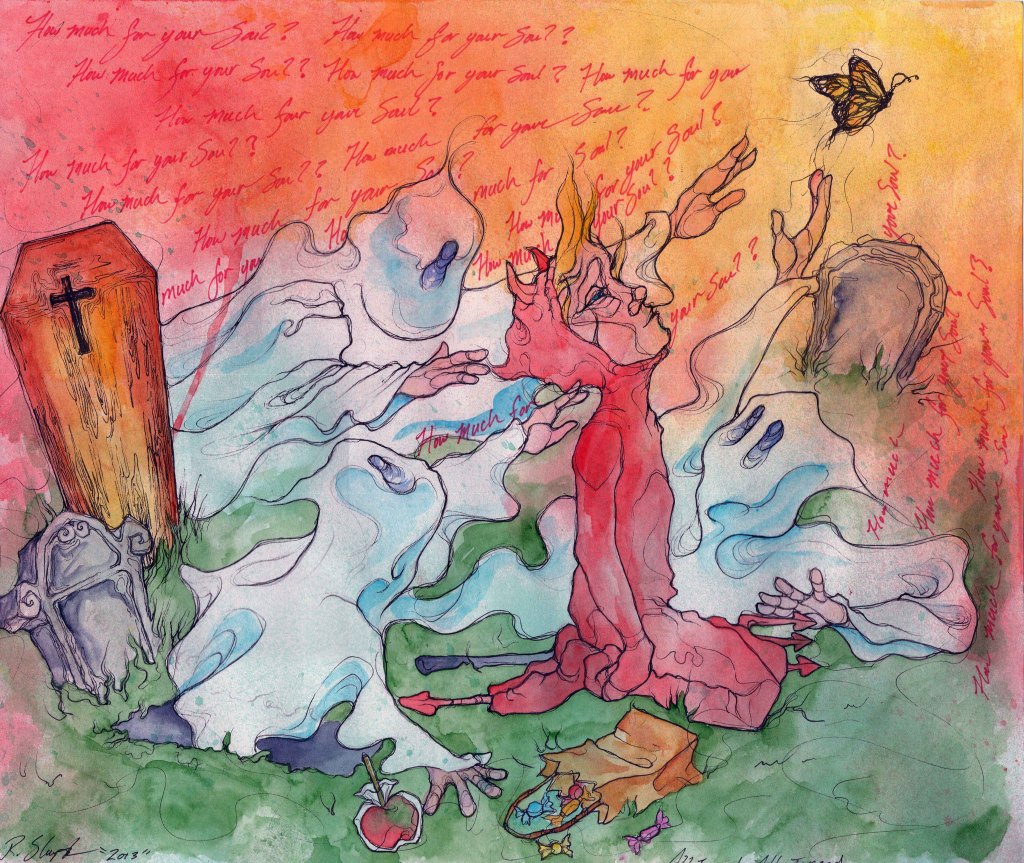
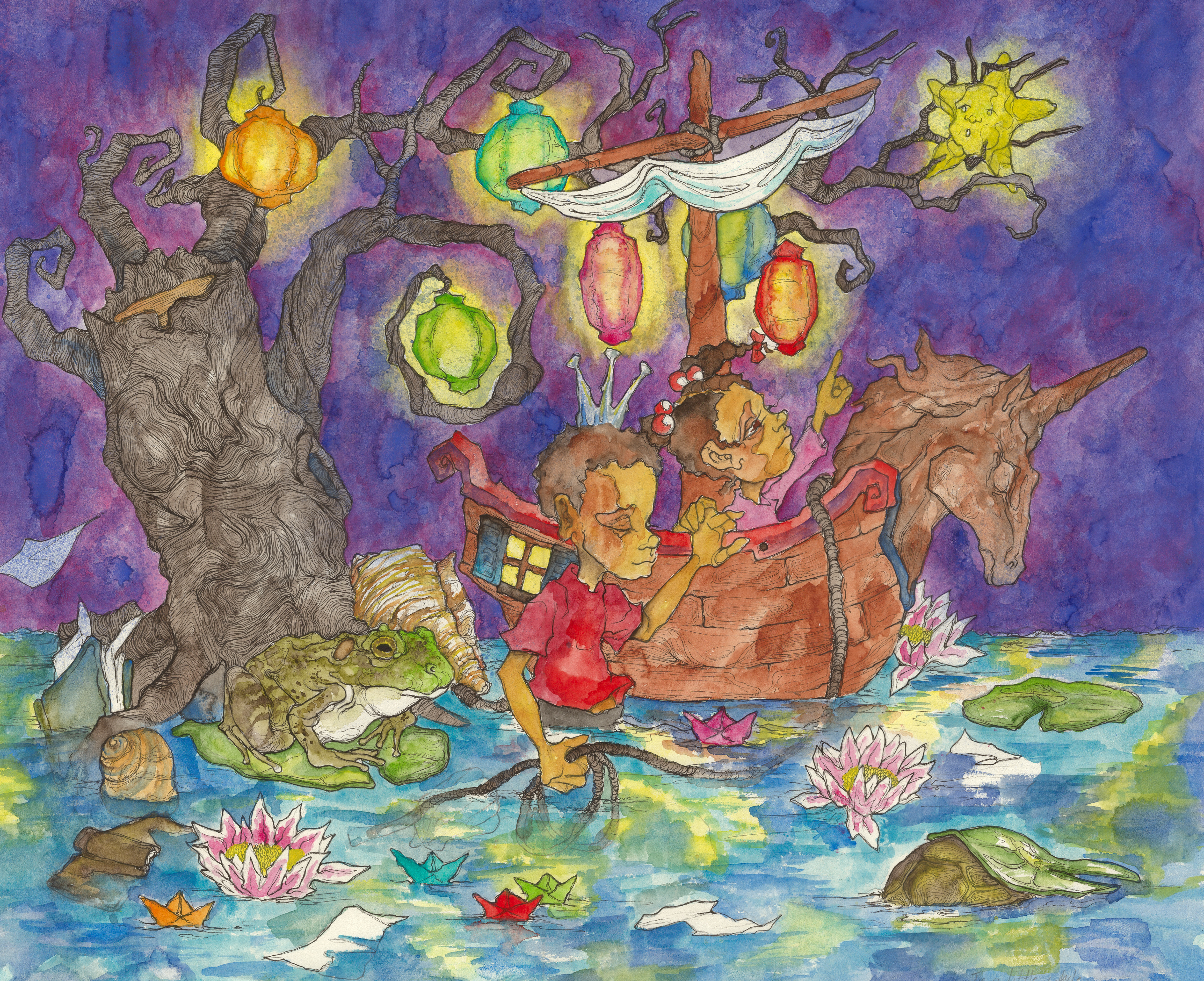
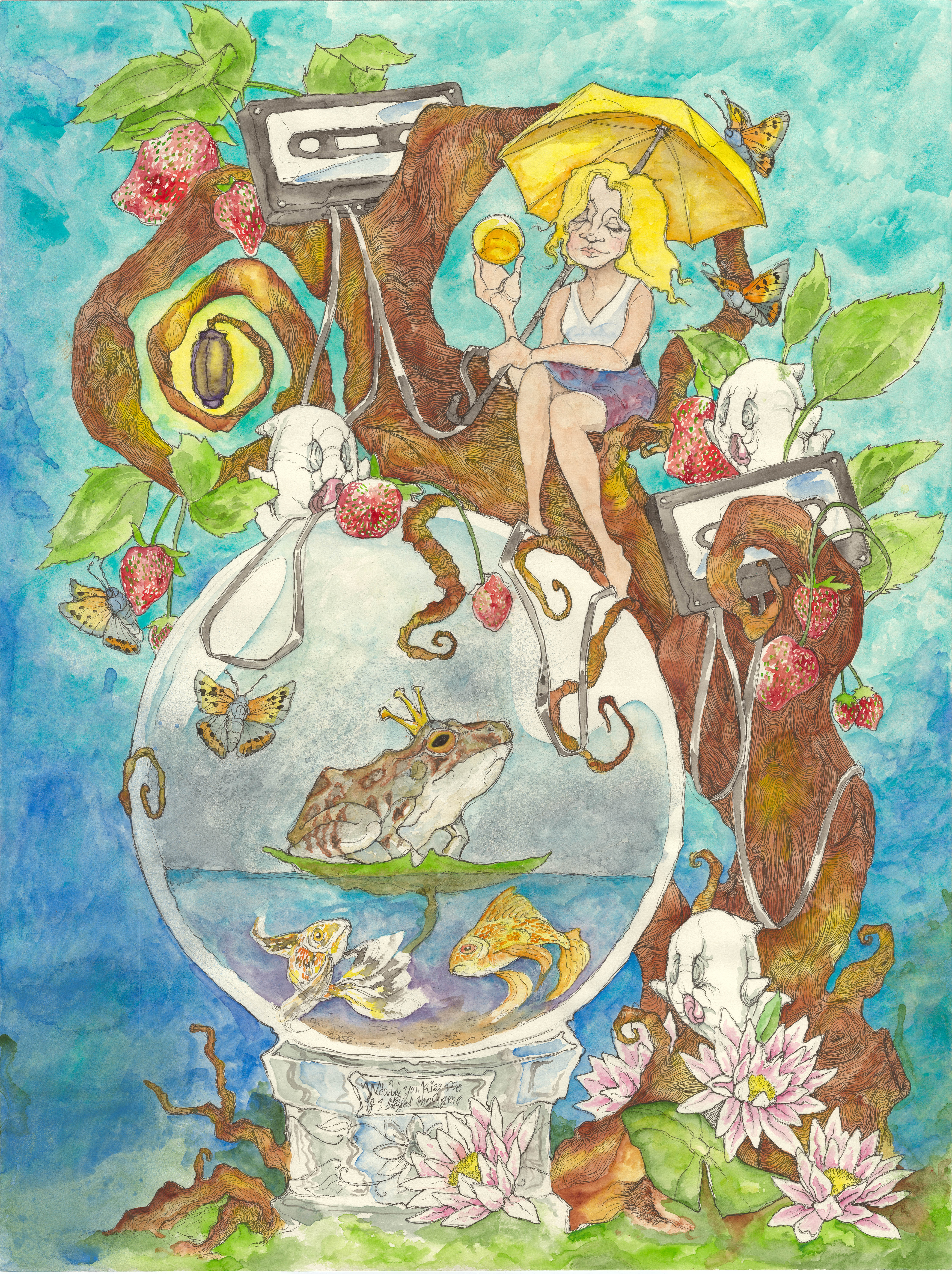
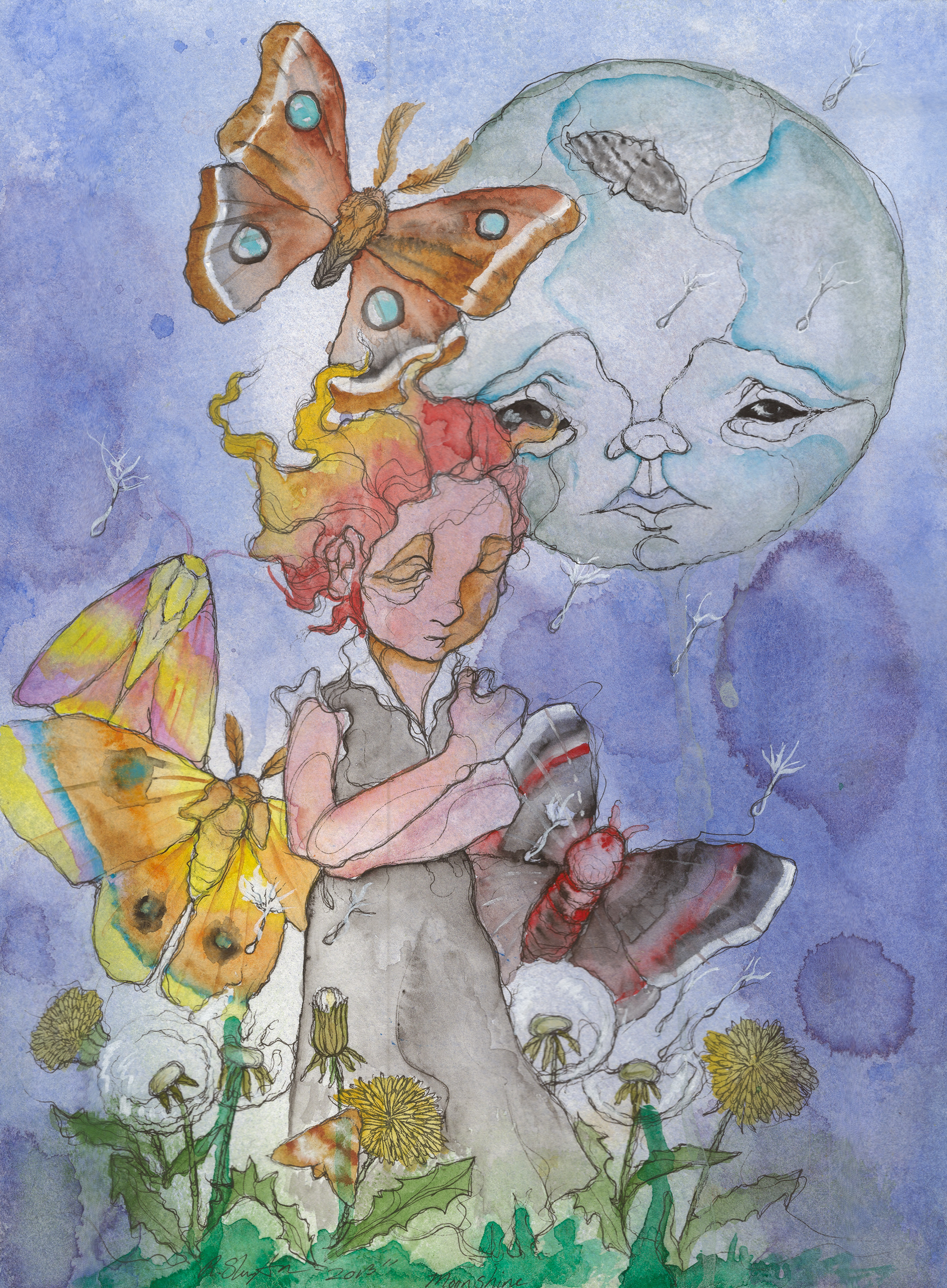
The artist showcases on kdoutsiderart.com introduce you to new, emerging and established artists who align themselves with the term ‘outsider art’ in some way. This time, we show you the work of Royston Slayton, who is influenced predominantly by his own personal life experiences.
In a Little While
When did your interest in art/creating begin?
Since I was a child, I have always been interested in a person creating something that wasn’t there before.
Something I Can Never Have
What is your starting point for each piece?
That’s a hard question. I mainly start in one of two ways: I either have a loose idea and I just start to sketch it out, or I have no idea where it’s going to take me whatsoever. I am not a fan of Jackson Pollock, but I do like the way he worked. I think it’s more interesting when a person sits down and just lets their hands take over.
Me and Her
Who or what influences your work?
My main influence is myself. A lot of my pieces are based on memories or people I have met. A large part of it is also my childhood. Somethings I create and I understand where the idea or inspiration for them came from, others I have no idea what they are, where they are or who they are. If you study one of my illustrations, at some point you will probably find yourself wondering why in the world I put something in there.
All That I Want
What do you hope the viewer gets from your work?
Honestly nothing. I know that sounds weird – or harsh – but it’s the truth. I am not trying to connect with the viewer or leave a lasting impression, or make a statement. I was once told that the viewer wants to feel like a part of the art or creative processes, and I couldn’t help but think ‘why?’ They weren’t there when I created it, and they weren’t there when whatever event in my life happened to inspire it. If someone does get something from my work, that’s great, but if someone just sees a bunch of children and trees and nothing more, I’m OK with that too.
Moonshine
What do you think about the term outsider art? Is there a term that you think works better?
I think it’s just a term – human beings like to label things. It makes us feel comfortable. I think the term ‘art’ works better, but who am I to rock the boat? I mean, what’s the difference between Henry Darger and Rembrandt? A label and dollar signs, basically. Their styles are different, but both are artists. I don’t see why someone has to be put into a category.
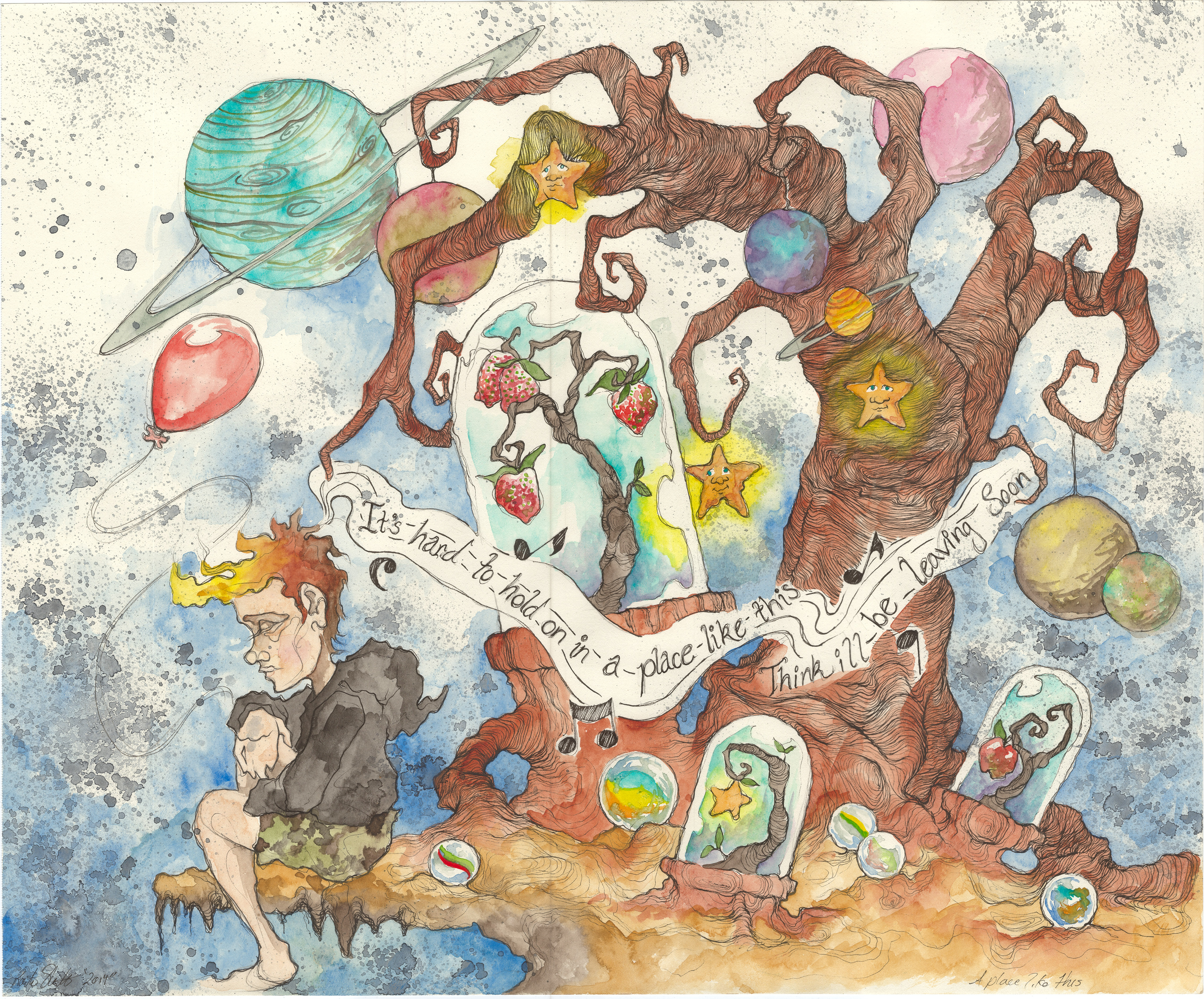
A Place Like This
What are you working on at the moment?
I am working on smaller pieces at the moment. I am finishing some watercolour illustrations and I will be doing a lot more graphite drawings this year.
Where Did All the Fire Flies Go?
Where do you see your work taking you in the future?
I really don’t know. I know where I’d like it to take me, but knowing where you want to go and actually getting there seem to be two different things. I just hope I can continue to have success in the art world and build on it.
In light of his two current exhibitions in London, Julio Cesar Osorio talks about finding inspiration in the darkest of places and his want to portray his own unique journey, inviting the viewer to jump in and join him – not unquestioningly – on his travels to a more vibrant world.
Elephant
When did you first start making art?
Looking back at my life I can honestly say that I have always been very analytical about my surroundings. I have always looked for the beauty within things; even at a microscopic level, like when I looked at an onion skin under a microscope for the first time in biology class and thought that the shapes and patterns looked lovely. I have always visually admired things, but it wasn’t really until I landed in prison that I took up art. From the word go I was over taken by the therapeutic power of painting; it became my passion and provided an escape from where I was.
What originally inspired you, and what inspires you now?
I did a degree in photography and digital imaging 15 years ago and during that time Dali became my inspiration to create surreal work; to carve one’s own story to illustrate what’s on one’s mind. This was exactly what I did when I discovered that I could paint in prison. This would be the tool I would use to create – even in the environment I was in.
To this day, surrealism has been the genre I have chosen to work in and a surrealist is the type of artist I wish to be classed as.
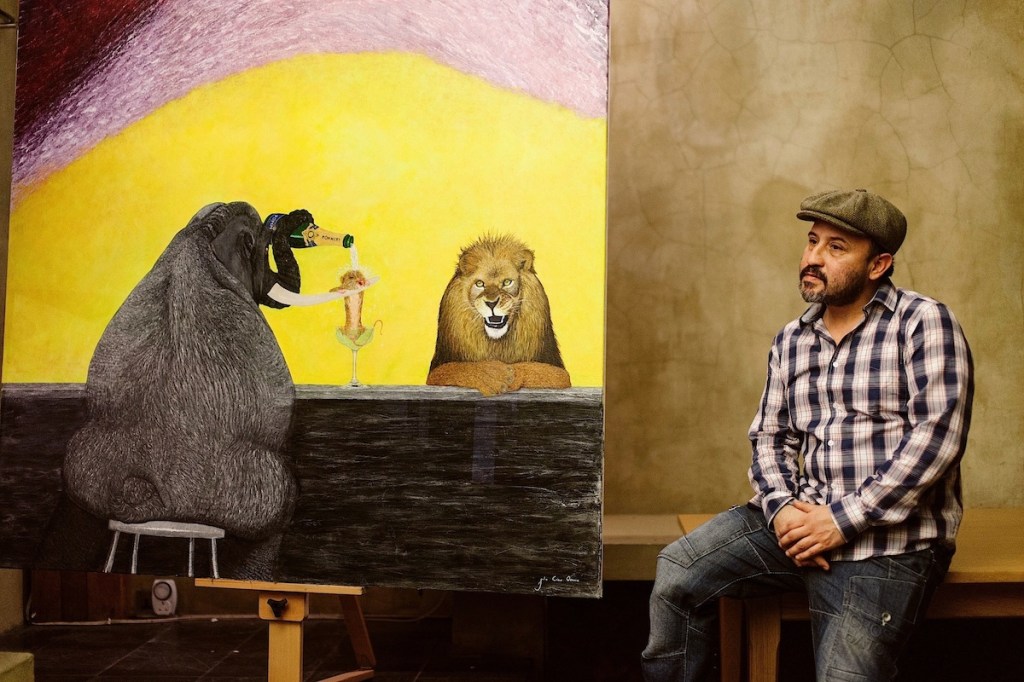
Julio with his Lion Portrait
What is your process – from starting to finishing? How long does it take?
I write down ideas or do small sketches of what the idea involves, and then look for relevant imagery; photos, magazine cuttings, etc., that I think might work in my painting and then I’ll start by painting the background. Then I’ll move on to sketch the subject matter, making sure it’s all in the ideal place and when I’m happy with the layout, I’ll go on to paint them.
Each piece has varied in the time it’s taken to produce. Most of my work was produced in prison, where I became so prolific that I would work at least 10 hours a day seven day a week. As a result, I would produce at least two pieces a month. Since my release in September 2013, I have only produced one 190 x 190cm painting completed over a period of one year.
What do you hope viewers get from your work?
I produced all of my work and honed my skills in prison. I used the medium of painting to transport my mind with the goal of taking the viewer on my journey, encouraging them to place themselves in the work, to read and question all the thoughts and feeling that I used in every one of my pieces.
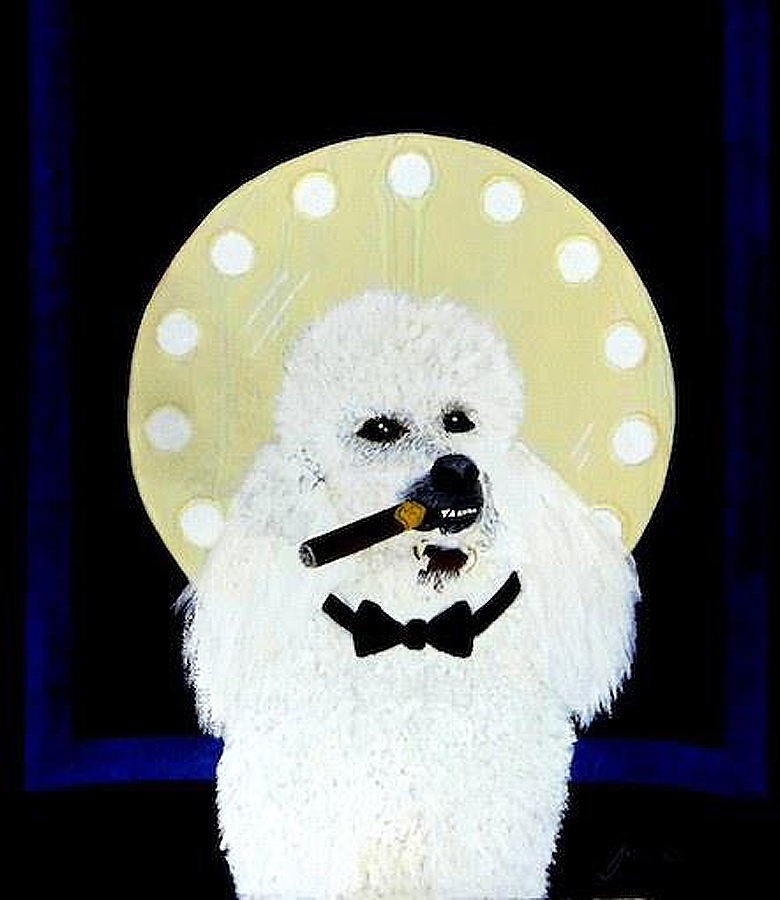
Fat Dog
What are you working on at the moment?
At present I am working on promoting my work and my name through social media, and I am preparing a marketing strategy to generate sales.
I am also working on a series of photographs that I have of body painting on females. I am adding paint to these so they become mixed media pieces.
Tell us a bit about your current exhibitions?
At present I have got two exhibitions running concurrently in two different parts of London looking at two different themes.
See Julio Cesar Osorio’s work in London…
The Communication of Colours from a Very Dull Place
Until 31st January at Coffee Wake Cup, 14 Clapham Park Road, London, SW4 7BB. Open daily from 7am – 7pm.
Concentrating on the use of colours in the works on display and how Julio used them vibrantly whilst in prison; a very dark and dull environment. Julio wanted to show the polar opposite of what he was experiencing at the time.
The Artist’s Subconscious
Until 31st January at Freud Bar/Gallery, 198 Shaftesbury Avenue, London, WC2H 8JL.
“The liberty of the individual is no gift of civilisation. It was greatest before there was any civilisation.” – Sigmund Freud.
This exhibition concentrates on Julio’s works that evolved from his inner thoughts during his time in prison.
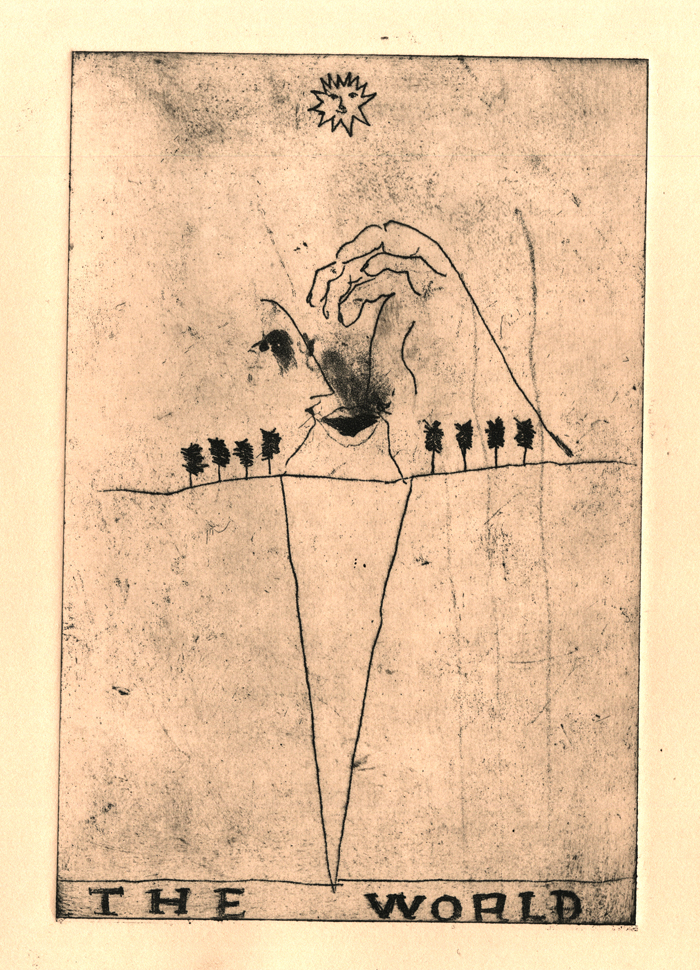
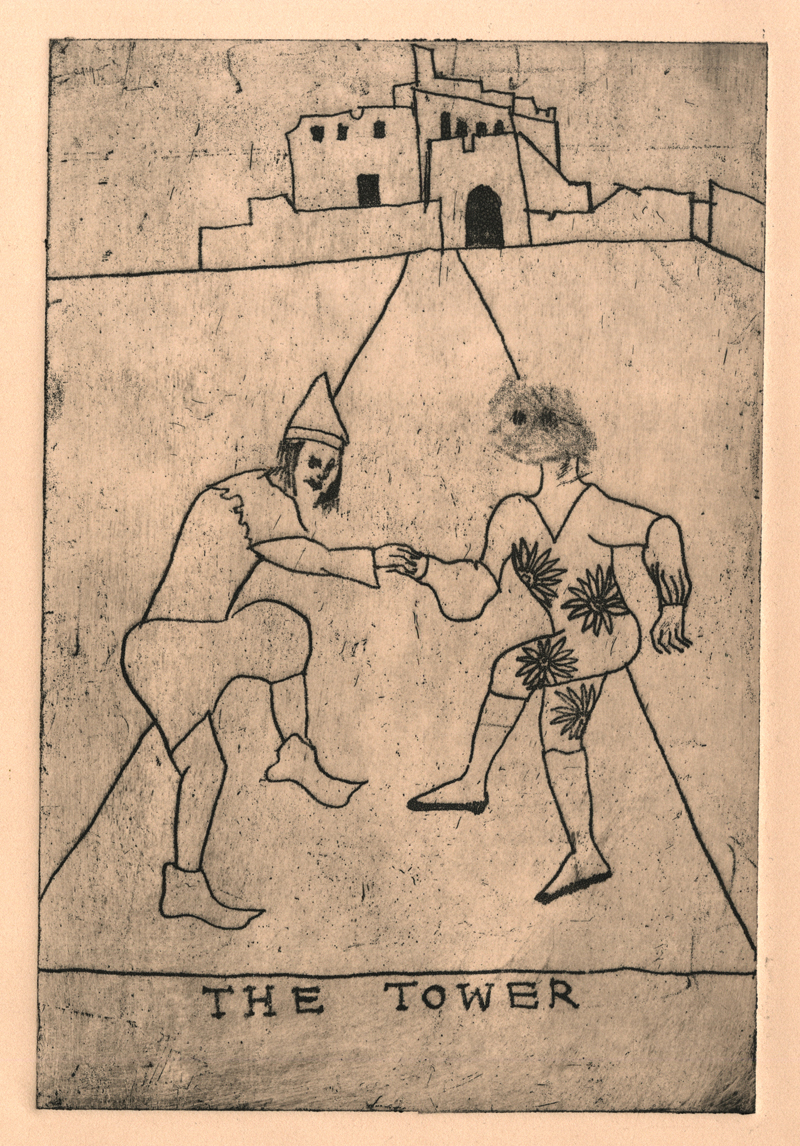
This Artist Showcase comes from Boeeuen Choo, who is inspired by the design and template of original tarot cards.
The Queen
I always have been drawing – ever since I was young. And then I decided to pursue art as my career. My interest is in the design and template of original tarot cards, and that’s what made me decide to turn my drawings into versions of tarot cards – although some titles are made up and do not exist in the original tarot form.
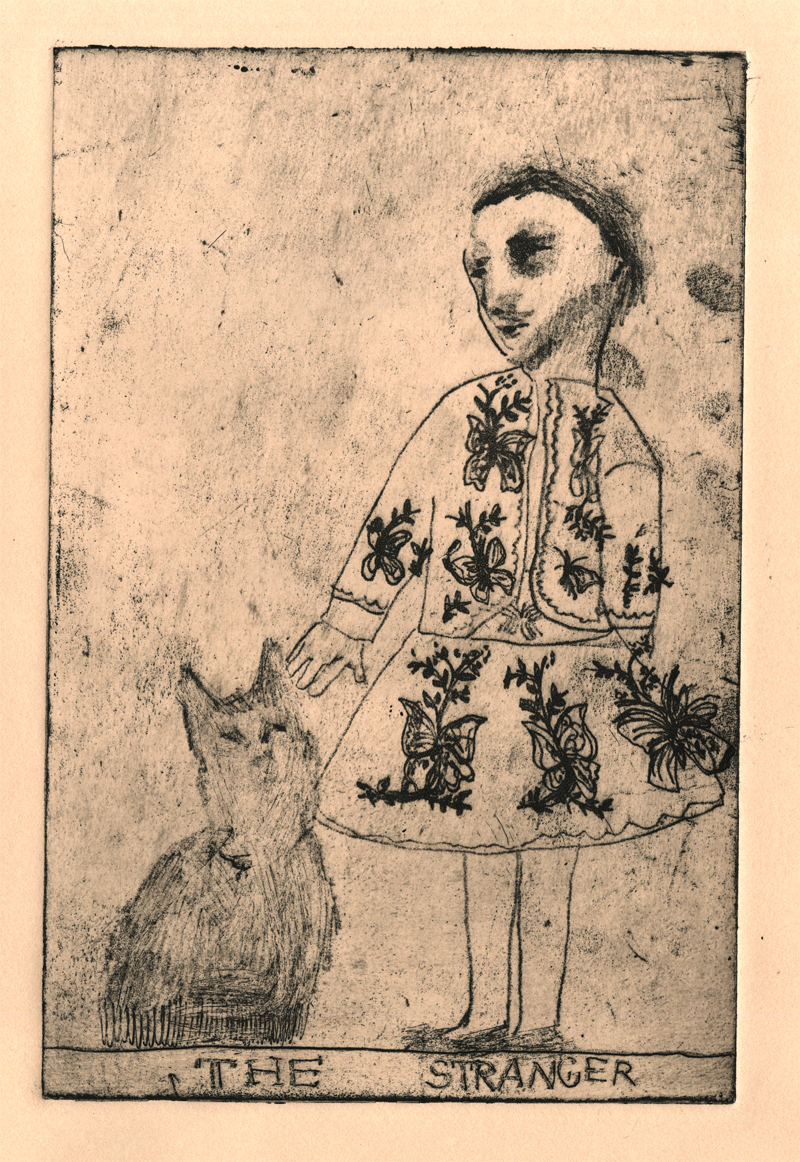
The Stranger
Initially, I decide what title I’m going to work from, and then I’ll draw something from my imagination that connects with that title. I believe that being in a different country to my family, friends and culture really influenced my work. I was originally born in South Korea and I moved to the US when I was fifteen years old. I was young and alone in another country, with my family back in Korea. I think this experience influenced my view on everything, including art.
The Dystopia
I hope that my work evokes emotion from the viewer. My goal is for the viewer to interpret the piece in their own way, as if they were looking in mirror.
The World
If I were to choose a term other than Outsider Art, I think I would choose ‘spiritual art’. I think this term more accurately describes what I do.I like to work on different things at the same time, and more recently, I have been concentrating on pattern work.
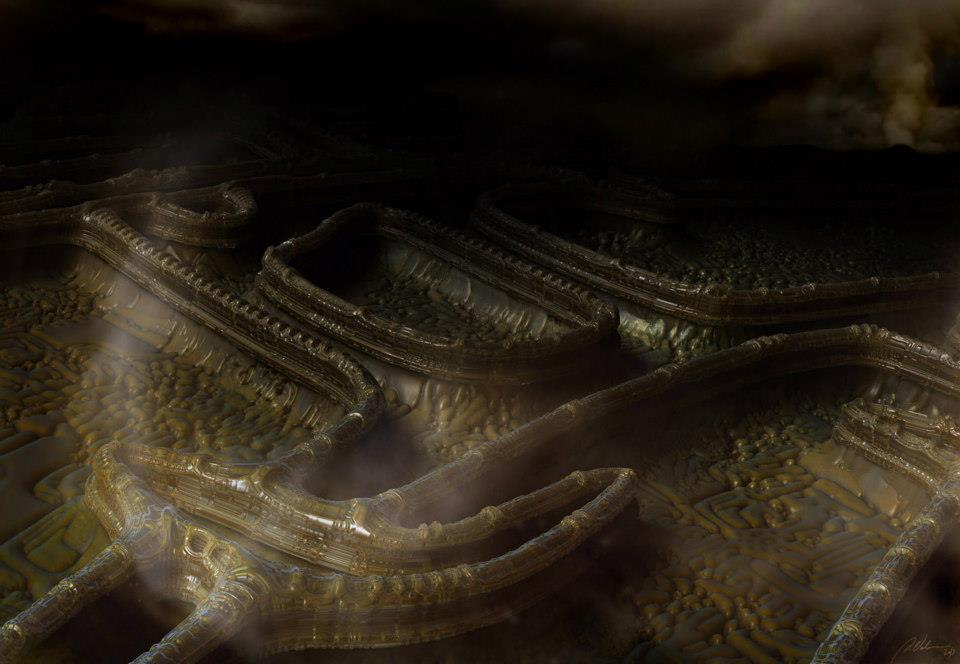
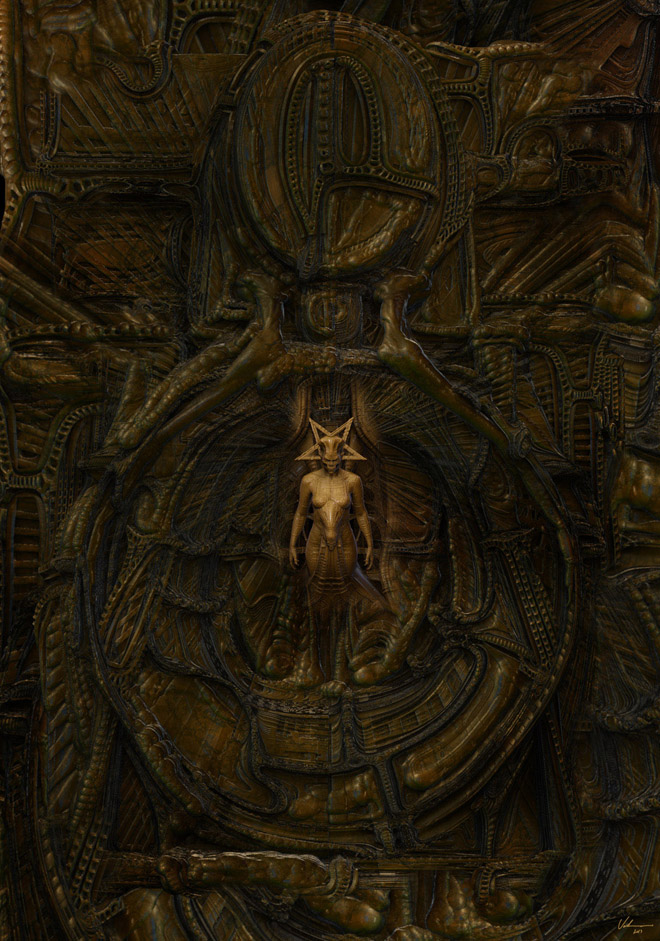
This artist showcase features the work of Daniele Valeriani, whose works have always been focused on the wonders of nature and science fiction. Describing his work as ‘Dark Surreal Art’, he has created work for some well known bands, including Dark Funeral and Dissection.
The Lake
When did your interest in art/creating begin?
In my childhood. My father was a Surrealist painter and I loved so much watching him while he painted. I could say I followed in his footsteps from an early age. My games were pens, pencils and paper – til now! It’s therapeutic for me to scribble on paper although with time I’ve moved entirely onto digital art. I feel more comfortable with it because it’s more immediate – not that it’s more easy, but I can understand sooner rather than later if an illustration has a certain potential or not. I remember when I was a just a child that I literally ate a couple of my father’s books about Bosch and Salvador Dalì. I still keep those books full of doodles here and there. Not only the Flemish painters and Surrealists have inspired me; I’ve lost myself in books about nature (minerals, insects, shells, plants) as well. The contemplation of nature was my main thrust and then then it was music. I can confidently say that art chose me when I was born and the same influences of the past are still present today.
Vanitas 1
What is your starting point for each piece?
Usually I start from some very coarse sketches on paper or maybe even a raw digital work, just playing with splashes of colour until the work emerges. Even for my 3D works I don’t use an orthodox approach, leaving everything dictated in the first instance until a more rational part of me emerges to dictate a certain order.
Vanitas 3
Who/what influences your work?
As I mentioned before my father’s influence was crucial due to the many inherited interests but if I had to mention some artists in particular of course HR Giger, as well as Bosch, Dalì, Beksinski and the great Master Agostino Arrivabene with whom I have had the luck and honour to work in more than occasion.
Landscape 1
What do you hope the viewer gets from your work?
In general, not indifference. I do what I do because it is vital for myself. My mind is too crowded to be the home of so many different fantasies and realities that I would end up exploding. It’s a way to exorcise and exercise my fantasies, my dream journeys. Sometimes I have different reactions once the work is done so it’s hard to answer properly. I wish my works inspire other artists too. Appreciation from other masters and cultural exchange with them is what satisfies me more. The more you grow the more you learn each time, this is my main goal.
The Portal
What do you think about the term Outsider Art? Is there a term that you think works better?
I could consider myself an outsider for sure due to the fact that I do not care about fashions or easy solutions. In fact what I create is not conditioned or calculated but simply what I like the most. I don’t care about judgments except from other artists I admire, and only then so that I can learn or increase my technique or cultural view. In my case Dark Surreal Art is the term that I find more akin to my art because better emphasizes my style and themes. Outsider is a broader term.
Garden of Delights XV
What are you working on at the moment?
I’m always working on new ideas and tests to realise my visions. Even the study of new digital tools is essential; I’m constantly updating. I started working on my portfolio / catalogue that I will distribute along with limited edition prints for those who want to buy them. I’m receiving lots of requests at the moment (and that’s great!)
Landscape 9 – Towers
Where do you see your work taking you in the future?
It would be nice to enter into the good graces of some enlightened gallery that doesn’t disdain digital art. I’d also like to realise my own sculptures, starting with my three-dimensional work. I also want to continue collaborations with other artists to create unique, valuable works of art.
Every now and then I like to twist myself up into knots thinking about the term ‘outsider art’; what it means in today’s context and whether we should even be using it anymore. You can find some of my thoughts under the ‘Outsider Art: Theory and Thoughts’ category (or by clicking here), but in this blog post I wanted to share some of the thoughts of artists who have recently featured on the blog. A while ago, I started asking artists what they thought of the term outsider art, and, if they didn’t think it was appropriate or relevant, was there a term better suited to describing their work?
I’ve had some really interesting responses, and some equally interesting new terms. Maybe it’s time we listened to the artists we are categorising under this term.
Daniele Valeriani, Vanitas 1 (detail)
Daniele Valeriani: Dark Surreal Art
“I could consider myself an outsider for sure due to the fact that I do not care about fashions or easy solutions. In fact what I create is not conditioned or calculated but simply what I like the most. I don’t care about judgments except from other artists I admire, and only then so that I can learn or increase my technique or cultural view. In my case Dark Surreal Art is the term that I find more akin to my art because better emphasizes my style and themes. Outsider is a broader term.” More of Daniele’s work is coming soon on the blog
Mario Soane, Que horas son corazon
Mario Seoane: Symbolic Automatism “I’ve been an outsider all my life and in every aspect it. If there is a place in art for me, I guess it would be on the outside. But I like the term Art Brut better (not sure if it is because of the French sound to it or what). I believe that art is about brutality, even if it’s about hiding it. We are all animals, brutes. All our actions, as much as they are masked under the shroud of civilization, are brutish in nature. Art is no exception.” Click here to see more of Mario’s work
Anonymous, A Cold Heart Melts
Brendan Liam: Nomadic Art
“Nomadic Art is closer to street art than fine art. It is always artist-less, or by Anonymous. This is partially because knowing the name attached to a piece of visual art arguably clouds one’s ability to objectively view the art. Naturally some artists are so unique they may not need to sign and thus may not avoid the subjectivity issue addressed normally by anonymity. The thing to note is the credentials attached to the art here – which are none. No artist means no resume, and all that goes away with that.” Click here to see more on Brendan
Frank Heiler, Don’t Look
Frank Heiler: Dark Surrealism
“I think outsider art fits well with some of my work, especially my more experimental pieces. Although I do draw influences from other artists, I always try to keep a foreign, outside element to my art, something chaotic and new, with my own influence. Dark Surrealism is probably a better term to describe what I do, however.” Click here to see more of Frank’s work
Mr Bartle, The Cellist
Mr Bartle
“Like all art classifications it’s useful in grouping together work with similar characteristics, but the term is defined differently in different places. If outsider art is art created by untrained artists, then that’s not me. If outsider art is only art created by people on the edge of society, then that’s not me. Why I feel comfortable with the term and am happy with it as a classification regardless of other people’s ideas of what it should mean, is that I ‘feel’ like an outsider. I’ve never known where I’m supposed to fit into everything. So much of it doesn’t make sense to me – the way I’d like to live, depression.” Click here to see more of Mr Bartle’s work
Beatrice Roberts
Beatrice Roberts
“Well, due to my own life experience, I feel like an outsider most of the time. I’m not a ‘people person’ and some of this is, I’m sure, due to my past. I was bullied for many years and my self-confidence was eroded to a massive extent. I still have anxiety issues because of it. I was also isolated from family, friends and any support networks, so I got into the habit of being self-reliant. These days I have a wonderful partner and I am slowly but surely healing, but as my art is me, and I feel like an outsider, it is probably a reasonable term to use for my art.” Click here to see more of Beatrice’s work
Let me know what you think. Do any of the terms above resonate with you? What do you think of the term outsider art? Do you like being referred to as an ‘outsider artist’? Post any thoughts in the comments below.
A new qualitative study, commissioned by Axisweb, focuses on how artists receive validation for their work outside of the ‘traditional’ gallery setting. I think this is particularly poignant for all artists including self-taught artists and those who are not or do not wish to be aligned with the gallery agenda.
The researchers working on the study interviewed producers, commissioners and artists, seeking views on how different people receive validation for their creative endeavours, and whether the existing structures have – or had – an impact on how they seek or receive validation. The main findings are outlined below in a brief summary:
“The findings reveal an ad-hoc and informal approach to validation in the field. The commissioners, producers and artists interviewed agreed that the responsibility for seeking and maintaining validation falls largely to artists. While this was accepted as the norm, the majority of artists perceive a lack of support structures to help those operating outside the gallery system achieve and maintain external validation.”
There a few interesting things to take away from this in terms of thinking about validation and how artists receive it, seek it, and ultimately whether they need it at all. Traditionally, one of the key characteristics of the ‘outsider artist’ is their ability to create for themselves; because they need to, because they want to, rather than creating a saleable object or a commodity item. So where do they get their validation from? It may even be more difficult for them to find validation, with many not having not had the ‘rite of passage’ that is art school.
Does validation come with a price tag? Is work of a higher monetary value confirmation of a valid and successful artist? It, thankfully, seems not. In the report, artist Joshua Sofaer is quoted as saying: “Amongst me and my peers, we might consider somebody that goes towards gallery representation, starts making discrete objects, as somebody who has sold out.” Although he does go on to say that “other people might think they’ve arrived.” Additionally, many respondents felt that gallery backing was “more meaningful to others than to the artists themselves,” with many claiming that “the commercial numbers-led art world was potentially detrimental to the development of a high quality and original artistic practice.”
It is refreshing to see that although gallery representation is often sought after, many of the respondents did not “view gallery validation as a good fit for their values and practices.” Increasingly, it is perhaps true to say that artists are needing gallery representation less and less; for many, it is no longer the gold at the end of the rainbow. With the burgeoning use of the internet for self-promotion, artists can market and sell their work without the middle man, creating and selling on their own terms. This does, however, require the artist to have some knowledge of utilising internet marketing tools, a hurdle to overcome if you’re working towards self-representation.
Although it is comforting to see the findings highlight the differing value systems amongst artists “from those they see underpinning mainstream galleries and the work shown there,” to me it seems there is still some way to go. Take, for example, the difference in status between community and educational art and a ‘national gallery commission,’ the former is still looked upon as lesser form of art than the latter, despite the inclusion of community and learning programmes in most major national and regional art galleries and museums. Worryingly, artist Ania Bas acknowledged that “A lot of artists that I know… don’t talk about any work that they would do for the education department… In fear that this would mean that they would never… be invited to do a show in the gallery.”
So it seems from the report that whether validation is based on monetary value, visibility or gallery representation, there still seems to be an apparent separation, in terms of both support and funding, between work traditionally included in the ‘gallery agenda’ and art produced by socially engaged artists or those working outside of the mainstream. How do we overcome this? There certainly needs to be some sort of reform in terms of what high quality, valid art looks like, and in terms of who gets to decide. Rather than a sellable end item, perhaps a focus on process and idea needs to come to the fore. After all, if the only art seen as valid is the art that ‘sells’ and the only successful artists are those with a nose for business, we will continue to miss out on so much rich, unique and meaningful creativity.
The concluding paragraph of the Axisweb report mentions that to encourage a rethinking of current validation systems, any new provision should be artist-led, because “without this, artists could be disenfranchised through external values being imposed on them in ‘top down’ regulatory ways. This in turn might undermine the existing quality and nature of artists’ work occurring within the broad category of socially engaged or non-gallery art.”
I’d be interested to know what validation looks like to you. Does it come from the art world, does it come from yourself, and how do you go about finding it? Please post any responses you might have in the comments below – thank you!
Axisweb commissioned Validation beyond the gallery (June 2015) from Manchester School of Art, focusing on artists working outside of the gallery system. The report was written by Amanda Ravetz and Lucy Wright. You can read the full report by clicking here.
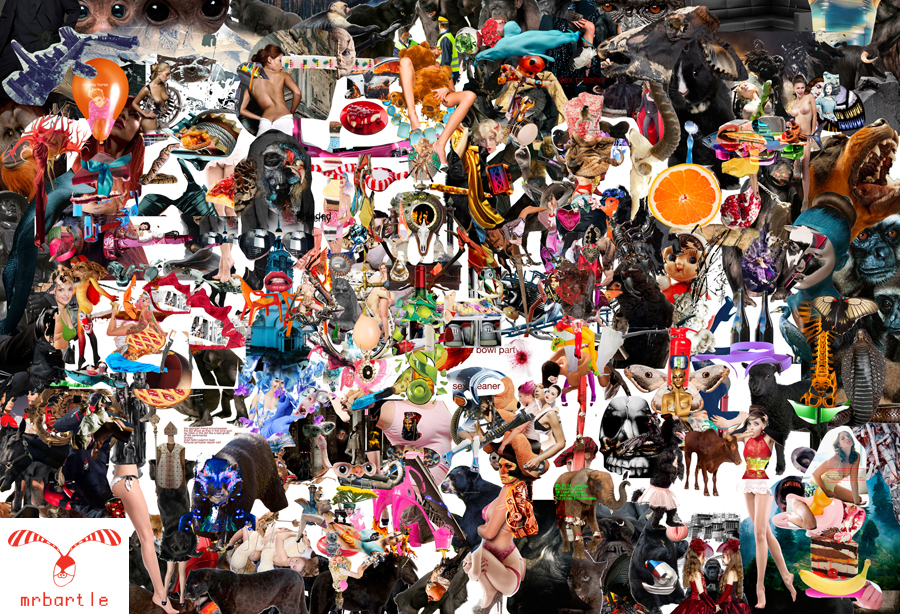
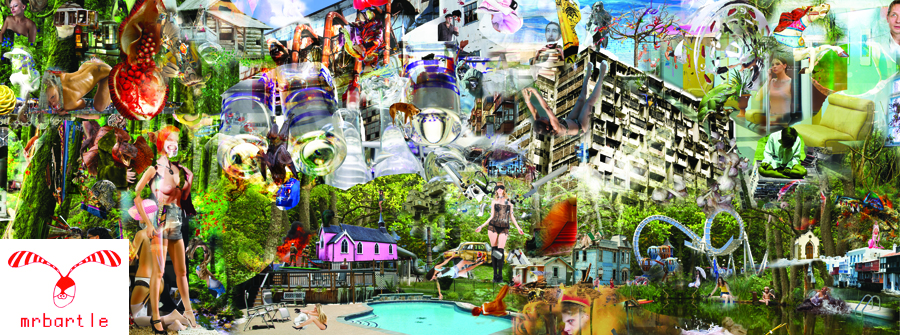
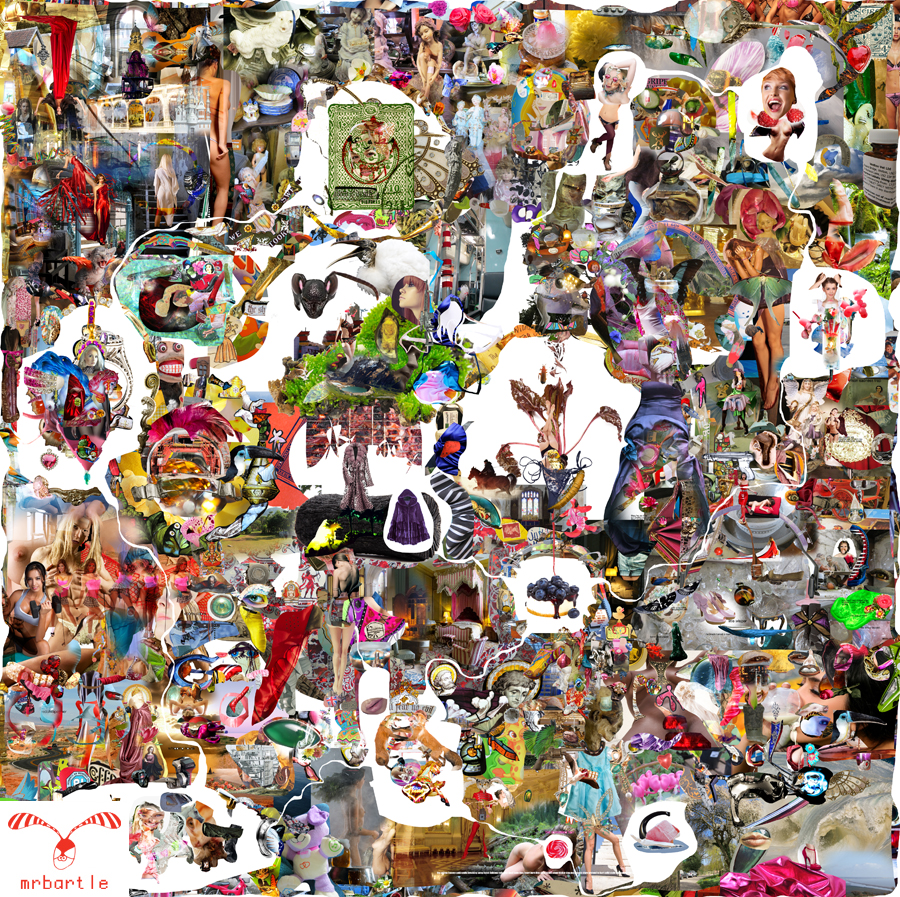
Mr Bartle uses collage – both paper and Photoshop – as an almost therapeutic process to put his thoughts down ‘on paper.’ Inspired by pop art and creating from a very early age, mr bartle has answered a few questions about his work and his life as an artist.
Mr Bartle, Angel in the Woods
When did your interest in art or creating begin?
Since day one really, I remember drawing skeletons at primary school, making spacemen out of papier mache. I wanted a pet sparrow after having a dream about one – so I drew one. At that age I was really interested in robotics and anything space related: other worlds, bringing things to life. I think that theme has just continued. I like to create, to make worlds.
What is your starting point for each piece?
The starting point is whatever springs into my mind when I sit down to make a new piece. This is inevitably influenced by my mood; what’s been happening in my day; things that have been on my mind. So the starting point is usually a single photograph. This image will then spark a connection with another subject – I’ll get a feeling of what the next image should be. This may lead to one more image or while I’m searching through my image library something else may pop up. Once I have my canvas open in Photoshop with one or two connected images I may go off on a few different paths creating small clusters of images over the page or in separate documents that are then brought together or cut apart. I try and allow the process to be naturally evolving, not censoring thoughts, images, or trying to purposefully DO something with them. As the image comes together I may create something like a building out of sweets and car parts, so there is some control in what is happening, but that stage of the process is still open to change based on mood or a new avenue of thought. The endpoint of each piece just happens, it is out of my control, it’s like the pieces are half alive, they finish themselves when they’re ready. It’s like a realisation, like the pieces are saying “Right, now I’m finished, stop working on me.”
Mr Bartle, The Gods
I started cutting out little bits of images very roughly maybe 6-8 years ago. The technique came about because of my frustrating with trying to emulate other image makers by very carefully joining images to try and make the end result a very realistic scene, or portrait, whatever the subject was. It just wasn’t quick enough for me, so I started chopping images up like this from scanned images, in Photoshop. The results soon became something that I liked, that suited the way I thought, joined images and ideas, rough round the edges, mistakes, accidents. Photographs for me are my raw material and I think that I paint with photographs, they’re not sacred, they can be cut up, used simply for their colour, their texture or allowed to remain whole.
Although my work naturally evolves there are definite themes that keep coming back, including Christian symbols, women, water, and buildings and structures.
Mr Bartle, Nosebleed Jesus
Who or what influences your work?
Everything influences my work, it’s part of me and all my experiences, thoughts, everything I read, see, do, research, friends I talk to, dreams. Some other artists that have been a big part of my work include Warhol, Richard Hamilton – pop was an early favourite. The collage side of things came about originally by seeing a set of images that my dad’s friend did. When I was younger I made a lot of traditional collages with old magazines like the Sunday Times magazine. Other influences include Hockney, JG Ballard, Tom Waits, Burroughs, the beats, Bukowski, Daniel Johnston, David Lynch, Edward S Curtis, Dali, Kerouac, Jake and Dinos, Polly Morgan, Robert Crumb – the list goes on.
Depression, The Black Dog. Such a big problem in my life. It’s being following me round since I was about 12, and although I’ve got a better understanding of it now it’s a hard one to live with. There’s nothing heroic about depression, it’s not the wonderful thing that makes me an artist. Alcohol and drugs were something else that I’ve now beaten – they were a way of almost instantly changing my thoughts, of escaping. I found it generally better to ‘do what I was supposed to’ while dealing with these issues as a very personal and private problem. I managed to stop drinking about five years ago with thanks to friends and other means of support, along with smoking and drugs. That continues to be the best thing that I’ve ever done for myself.
What do you hope the viewer gets from your work?
That’s quite a difficult one, because it’s not my intention to tell the viewer anything. I don’t start off with an idea of what I’d like people to see, it’s more an almost therapeutic process for me, to get all this ‘stuff’ – these thoughts – out of my head. I’d hope that people would see my work and it would fire their imagination, start a conversation. I think they’re quite hard pieces to sum up in one viewing, and i think they need to be seen more than once. I would hope that people find them interesting and can make their own connections with the images.
Mr Bartle, The Cellist
What do you think about the term outsider art? Is there a term that you think works better?
Like all art classifications it’s useful in grouping together work with similar characteristics, but the term is defined differently in different places. If outsider art is art created by untrained artists, then that’s not me. If outsider art is only art created by people on the edge of society, then that’s not me. Why I feel comfortable with the term and am happy with it as a classification regardless of other people’s ideas of what it should mean, is that I ‘feel’ like an outsider. I’ve never known where I’m supposed to fit into everything. So much of it doesn’t make sense to me – the way I’d like to live, depression. The work I create is a reflection of this confusion. It’s not something that really matters to me anyway, I’ll do my work and if there’s different places for it to exist where like minded people would like to see it, then that’s just fine with me.
What are you working on at the moment?
A few pieces. I kind of stopped the large photo-montages for a while; I got a bit overwhelmed by the process – all those images – knowing that each time it would be a long and often difficult process, so I have half finished pieces that I am slowly looking at anew. I’ve printed one of my unfinished pieces called ‘Prison Sleep’ with holes in it; large open white spaces. I reached a point with the piece that I didn’t know what to do with it, it reached a kind of stalemate, so I broke it apart (in Photoshop) and had it printed with these big spaces in it. The work is now on the table downstairs and I’ve being drawing on top of it, adding diary entries, drawings, text.
I’ve also being making ‘real’ collages again using old french art magazines and material found in charity and junk shops. They’re progressing quite slowly. Sometimes I feel really inspired to work on them, a lot of the time I’d rather be in the Photoshop environment, where I find it quicker to get ideas and images together. I recently started a couple of pieces where I’m making machines and robots, I’d like to do some spaceships. Just sketches right now. I’ve started getting my images printed onto T-Shirts also. Back to Andy Warhol and mass production side of things, I like the idea of art permeating through everything and am planning some wallpaper pieces. I have plans to source different images from many different sources. I generally have quite a lot of things going on, which makes it easier to be inspired to get on with work if I can pick different pieces up depending on how I feel.
Mr Bartle, The Stage
Where do you see your work taking you in the future?
I’d like to make a living from my artwork full time and be represented by galleries here in the UK and abroad as part of a happy, connected and inspiring lifestyle.
In a bid to showcase more great art by talented artists on the blog, this month, I asked artist Beatrice Roberts to answer a few questions about her influences and inspiration, and share with us a selection of her fantastically vibrant works.
Where did your interest in art/creating begin?
When I was about 10 my family started going to a holiday camp every year and there was always some pastel portrait artists there. I would stand there for hours and hours watching people have their portraits done, while other kids went to the fairground or did crazy golf or something. I would disappear for hours to go watch them – my mum and dad would always come to the artists to find me. They knew I would be there, absolutely fascinated by the process. I then started drawing portraits of pop stars and my friends and family, and I’m still interested in portraiture and figurative art all these years later.
What is your starting point for each piece? And what is the subsequent process?
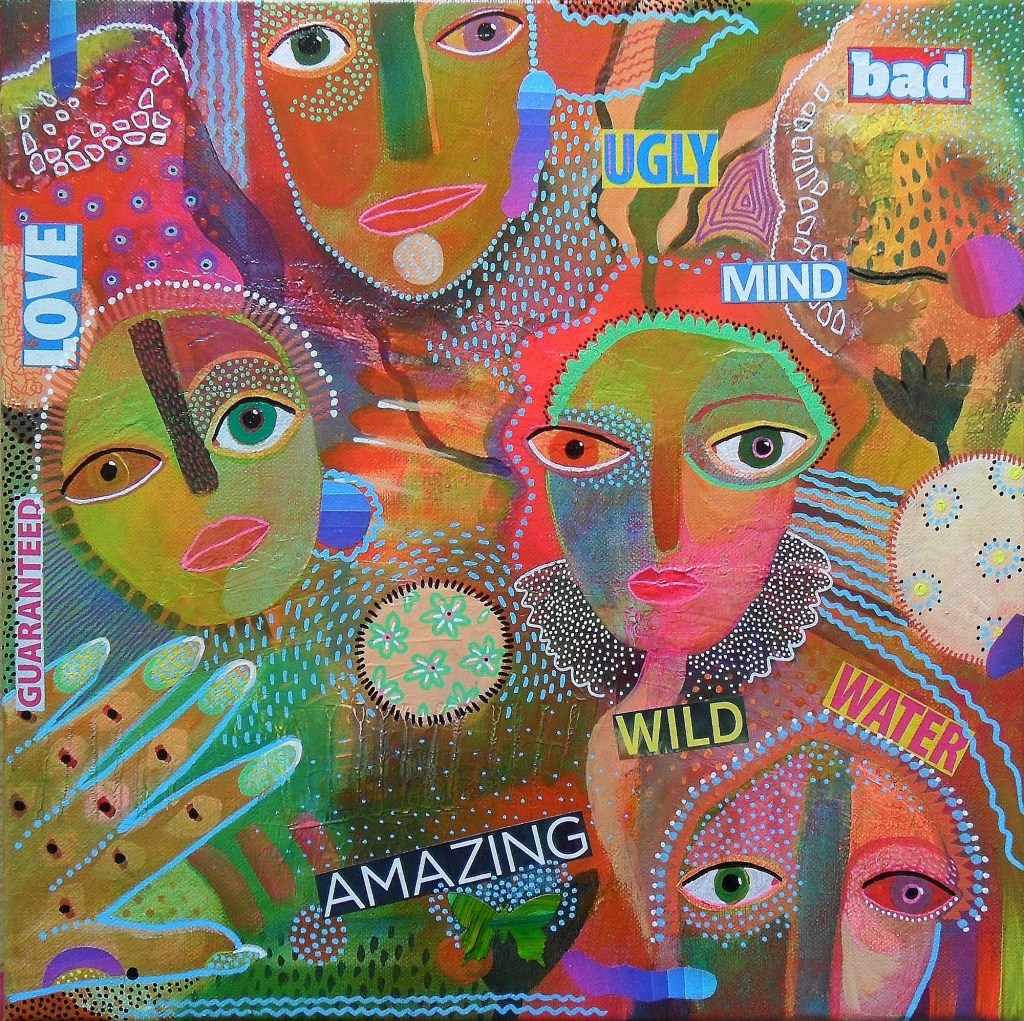
Most of my pieces start off with a monoprint. I lay down a shape in thick acrylic on perspex or paper and make a simple print onto another sheet of paper. That shape becomes my subject. I enjoy this process because it’s – perversely – out of my control. I have to work with what is there – with the print I am left with. This makes for a bit of a challenge as I have to ‘bring the work round’ into something recognisable. My animal paintings are also done this way. A large proportion of my work is produced in this manner and I never know what I am going to end up with as I rarely plan. I work spontaneously and my paintings grow organically as I am creating them. I also like to use foam shapes to print with and I often use the stick end of the brush to apply paint to the surface to give raised, impasto lines sections. I love the rawness I get with this technique.
I use a lot of bright colour in my work, which makes me happy. I build up a great depth of colour by adding several coats of acrylic and which gives a rich, jewel like appearance. I use drawing pens a lot too, adding dots, dashes and outlines with these. Oil pastels also make an appearance sometimes giving another dimension to artwork as they form a kind of ‘resistance’ which the water based paint skates over.
Who or what influences your work?
I enjoy raw art (outsider art?) mostly and I have many favourite artists who all must influence me subconsciously, in one way or another. The list would probably be too long to mention. I have been told that my work is kind of ‘edgy’ or slightly disturbing and I would sort of agree with that – I wouldn’t say my life’s been easy. I got myself into a very bad, long term situation which was incredibly difficult to get out of. I have noticed that recently themes have been coming through my work which relate to the trauma I and my children endured throughout this terrible time. I am sure that being a survivor does have an influence in what I paint and the way I paint. I am finding that being able to refer to these awful times , in my work, is helping me to heal in a way.
On a lighter note, I do tend to include quite a lot of humour in my art and I am particularly fond of collaging ‘gutter press’ magazine headlines into my pieces to add some sort of weird dimension to which the viewer can add their own thoughts and perceptions.
The other theme that runs through quite strongly is animals. I am a great respecter of the bird and animal kingdom and I paint a lot of animal, bird and underwater creature subjects, although these are often just for my own enjoyment. I was given a book for my birthday about Ernst Haeckel, the philosopher, biologist and artist and I have been greatly influenced by his beautiful illustrations.
What do you hope the viewer gets from your work?
I hope that they see the voice of a woman with a past, with lots of life experience, who has suffered ups and downs, who has a story to tell. However, I hope they also get my humour, positivity and personality coming through in my work. I had a very bad experience, I lost many, many years, when I was isolated and turned into a non-person, but I am making up for lost time. I am bruised, but my spirit is absolutely not broken.
What do you think about the term outsider art – is it an umbrella you’re happy to be under? Is there a more preferable term?
Well, due to my own life experience, I feel like an outsider most of the time. I’m not a ‘people person’ and some of this is, I’m sure, due to my past. I was bullied for many years and my self confidence was eroded to a massive extent. I still have anxiety issues because of it. I was also isolated from family, friends and any support networks, so I got into the habit of being self reliant. These days I have a wonderful partner and I am slowly but surely healing, but as my art is me, and I feel like an outsider, it is probably a reasonable term to use for my art.
What are you working on at the moment?
I have started work on some nude figures. As I mostly focus on heads in my paintings, this is going to be really interesting for me. I am also preparing some pieces for the Nottingham Castle Open, which is for emerging and established artists in the Midlands. I didn’t make it last year, but I am going to give it another go!
Where do you see your art taking you in the future?
I would obviously like more people to see my art. I have a website at www.bearoberts.co.uk and I would ideally like gallery representation further afield than my own county. To be represented by a London gallery would give my art credibility and would enable my work to be seen by serious art collectors. Meanwhile, I will continue to submit to as many exhibitions as I can and hopefully gain some collectors. I would also like to possibly create some larger works as I do work on quite a small scale currently.
You can see more of Beatrice’s work by CLICKING HERE. Additionally, you can follow her on Twitter: @BEATRICEMARTIST.
For this post, we’re passing the writing baton to Ana Cortez, who will talk about her very talented father, C.J. Freeman.
Growing up I always adored my dad, C.J. Freeman. He was my hero. But as I got older, I began to slowly understand why all the other adults I knew were pissed off at him most of the time. He just couldn’t bring himself to do anything ‘normal’.
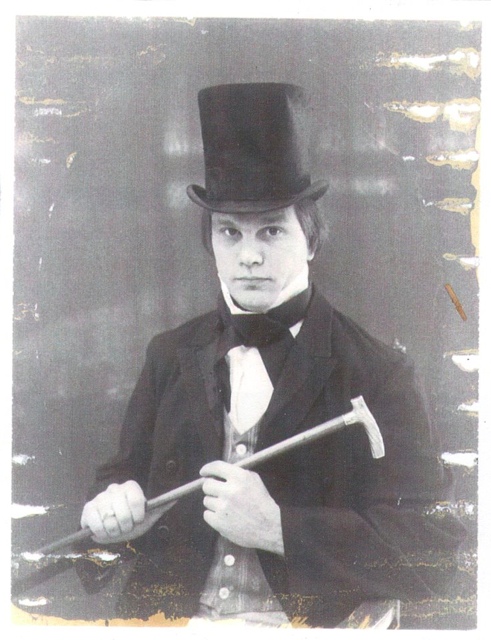
C.J. Freeman
Dad led me into worlds and ways of thinking and looking at the world that I remain eternally grateful for. He spent time with me, doing things most adults don’t make time for. Like by the age of 5 or maybe 6 years old he had taught me how to play a decent game of chess. I remember thinking I was pretty rich, earning a quarter for for each line memorized in Lewis Carroll, and I’ll never forget learning how it was so much better to sit at the back row of the circus, where you could fold the pages of your program into paper aeroplanes and send them flying over everyone’s heads in the front row.
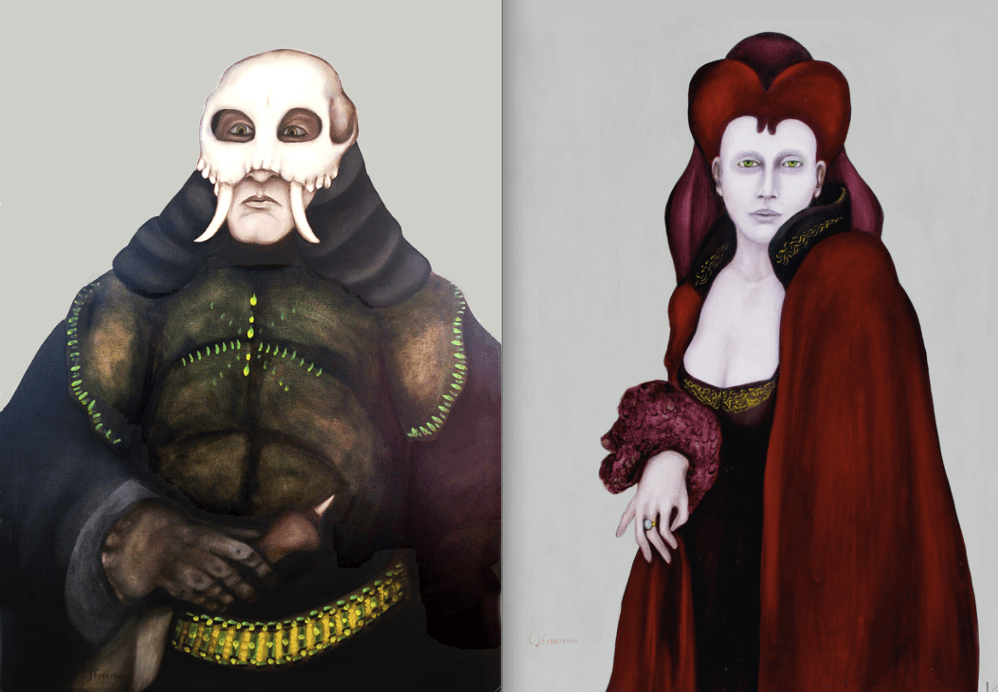
Dad had been collecting really weird antiques from as far back as I can remember. No matter which corner of the house you came around, you knew some bizarre gorgon or another would be waiting for you. So when dad started painting, of course, it wasn’t nice landscapes or flowers or anything like that. It was Dracula, and people who were half animal with purple skin – reminiscent of figures from the weird fairy tales he had told me as a child.
Dad got bored really easily. Ordinary life was intolerable for him. So he would assign himself projects that kept his interest. So even though he had no formal experience in art, he had given himself the task of illustrating the playing cards. This was what the paintings were about – one for each of the 52 cards plus jokers. Little did he realize this little “project” would kick off an obsession lasting for the rest of his life.
So what began happening on the canvas surprised even my dad. As he painted, he became more and more curious about playing cards themselves – which led to another self assigned project. He began researching – hunting through old book stores in search of information about cards. To quote my father, “There is little with such cultural significance we know less about than playing cards.”
Over time, dad had just about every obscure book that could be had about playing cards. He was writing letters and corresponding with the authors that could be contacted and basically became a playing card detective. A playing card freak. He wanted to know the theory about cards, their mutations over time, and what they could have possibly been created for. He had a few ideas of his own. And he started writing.
He couldn’t get over the fact that playing cards were a natural calendar (52 cards = 52 weeks of the year, 4 suits = 4 seasons, 13 cards in a suit = 13 weeks in a season,) and he felt he had a mystery to solve. He wrote an entire novel on the subject of fortune telling with playing cards. He claimed it was the spirit of an old black woman that dictated it to him, but I could never tell if he was actually kidding around or not. I don’t think so.
He wrote several screen plays on the same subject, a television series pilot, and an outline for an interactive theatre experience, all centred around his ideas about playing cards and the way they speak. After mailing out manuscripts and walking his portfolio around New York City, and hitting a lot of brick walls, his feverish passion began to wane.
He became disappointed and disenchanted, although the flame of his obsession was still quietly burning. “Card people” still hung on large canvases around his Victorian style apartment, and he was quietly teaching girlfriends how to “read,” using Polaroid photos of his paintings cut up and glued onto regular bicycle playing cards. He would coach them, dress them up, and help them get “gigs” reading cards. One of his girlfriends took the time to show me what she had learned, and that was the beginning of my own involvement in this whole crazy project. I had just graduated high school at the time, and it was really just a curiosity, although a fascinating one.
Years later, I got serious about picking up and learning my dad’s way of looking at the playing cards. I was living in Boulder, CO, and dad was in Denver. Cards gave us more reasons to hang out together, and we started spending lots of time on the phone. Hours at a time in fact, sometimes days, talking about cards. Dad had stopped making art since the completion of his original assignment, but this was rekindling his interest. He started illustrating cards again.
It was fascinating to watch as his style progressed and mutated over the years that followed. He drew hundreds of images for cards. What began as a wood block type style progressively became sleeker and more sophisticated, but always what showed up was original. There was always something unexpected on the kitchen table, which was his work space. He said he liked to “let his hand move” and see what came out.
At the end, Dad was very sick. You knew he was sick if he was watching TV. He hated TV, but now it seemed to be always droning on in the background. He was in bed almost all the time. He told me “a voice” was visiting him, telling him stories. He called it “the story teller.” He said the stories were fabulous, detailed, on subjects he had little or no previous knowledge of. Stories he could never recount. He told me, for example, of a particular story about a ship told from the viewpoint of a sailor, detailing wondrous specifics about ropes and knots of all sorts. He said the stories were so good, he would clap when the voice was finished, there alone in his bed.
To date, there are 2 published versions of C.J. Freeman’s art work for playing cards, and snippets of his writing in our collaborate work, “The Playing Card Oracles.” For further information, please click here.
This week, I’m focusing a blog post on the work of American artist Karen Sorensen. Karen got in touch with me via email, and we have since been to-ing and fro-ing with our thoughts on the art world and its perception and perceived value of women artists and their work (in both the monetary and aesthetic sense). This is particularly poignant seeing as we celebrated International Women’s Day on the 8th March (in the UK at least). I was, of course, also very taken with Karen’s work.
Karen Sorensen, End of Life
One of the focal points of Karen’s conversations with me, was her choice between art and motherhood. Karen told me that she had chosen creativity, as to pursue both would have left her completely exhausted. To put this into more of a context, Karen was hospitalised during a prodromal phase of schizophrenia when she was nineteen years old, after which she began to see the world in exquisite detail and colour.
During the particularly bad stages of her illness, Karen makes art as a reward or to make herself feel better, which inevitably results in complete exhaustion to the point where she is no longer able to lift her arms. This process of invigorated creation lasts for about four hours, after which Karen knows her day’s work is done – and done to the absolute limit of human ability.
Karen Sorensen, Love is Complicated
Karen also notes the limiting effect that many anti-psychotic drugs can have on her ability to produce creative work. Because of this, Karen understandably has a strong affinity with British ‘outsider artist’ Nick Blinko. Similarly to Blinko, Karen’s work changes depending on what sort of medication she is taking. Her own favourite work was made, she adds, at the very beginning of her artistic journey, when she needed very little medication.
Over the course of our email correspondence, Karen and I spoke about Madge Gill and Aloise as examples of two well-known female outsider artists. Both their work, Karen noted, is fairly ‘feminine’ in its aesthetic appearance, with both artists using the female figure as their focal point. In contrast, Karen’s work – for me anyway – contains some more masculine themes, such as male genitalia and ejaculation. Even Karen has noted this herself.
Karen Sorensen, Spooky World
Motifs regaling ideas of reproduction are dotted throughout Karen’s work – and are what I seem to be drawn to the most. The twisted legs of female characters are perhaps indicative of the baby versus creativity dilemma that Karen has faced throughout her life. For example, in ‘End of Life’, we can see the tight twist of legs on the female character at the bottom, in contrast to the ‘loose legs’ of the male figure she is holding the hand of. Above this couple, a pregnant goat pulls a flying cart which holds the severed heads of grey-face women.
In ‘Zoo Train’, Karen’s most recent work, a king and queen bring up the rear of a train carrying animals – presumably a sort of touring zoo or circus. Again, the woman’s legs are wound tight, as she holds the hand of her king, whose penis hangs below his clothing. The ejaculation of the male character reaches a small bowl (which brings to mind a garden bird bath) in the bottom right of the piece, another familiar motif in Karen’s work.
Karen Sorensen, Zoo Train
Life, reproduction and creation feature most commonly in these bright, fantastical pieces; umbilical cords, bald-headed baby faced characters, pregnant creatures and ejaculation. Although the content of Karen’s work is not explicitly feminine – something we might be able to say for Gill and Aloise – the repetitive issues seem to be focused on the constant choice between bearing children or a life a creativity. Through her work, Karen has born new life. Her work is her offering to the world, and it is no less important than the offering of another human being.





















 KDOA
KDOA 