Tag: outsider art

  • Art Therapy vs Art AS Therapy

    Art Therapy vs Art AS Therapy

    In the recent Spring 2012 edition of Raw Vision, there is an article by Randy M. Vick which discusses the possible difference between what we might consider Art Therapy and what we might consider Art AS Therapy. Vick writes on the subject:

    “I have seen community studios run by both art therapists and artists, and have observed some important differences as well as clearly shared values and approaches. Almost without exception, I have been politely yet firmly told by the artist facilitators that what was being done was not art therapy.”[1]

    Similarly, in previous issues of Raw Vision, Sue Steward has been seen writing about the history of ‘progressive studios and workshops’.

    This is the beginning of what is quite a complex subject. Often it is assumed that the work that is created in these ‘progressive studios and workshops’ is the result of art therapy; but, generally, this is not the case.

    Running parallel to Dubuffet’s collection and coining of the term Art Brut was a new discipline – art therapy; which is, if we can define it, a focus on the interpretation of ‘unconscious material.’ There is, it seems, a continuum that begins with art therapy and ends with art as therapy. At the one end of the continuum, art therapy “employs an exploratory give-and-take between client and therapist with the goal of achieving psychological insight and beneficial change,” and at the other end sits art as therapy; “which places the benefit in the process of making and de-emphasises verbal exploration of the psychological meaning of the product.” [2]

    Those who use these ‘progressive studios’, which are often run by pracitising artists, are often “not driven by the need to share or to communicate, but rather to make tangible unspoken worlds with their own inherent logistics.”[3] Mind’s website (on the page which discusses art therapy), touches briefly upon the difference between the two ends of the continuum:

    “Creative arts may of course be very helpful, and for some people, the very fact that their creativity is art in its own right, rather than therapy, is one of the most important things that give it value.”[4]

    The artists who often work in these  ‘progressive studio’ environments aresometimes those we might define as ‘outsider’ – (again, see my post on the vagueness of this term!), and often exhibiting their work is an extension of this importance of creating and creation to their wellbeing. It is the creating of the artwork that provides the therapy, not the interpretation of it.

    [1] Raw Vision Spring 2012, p 24

    [2] Raw Vision Spring 2012, p 25

    [3] Engage Magazine 23, p 24

    [4] Mind website: http://www.mind.org.uk

  • Defining ‘Outsider’ Art..

    Defining ‘Outsider’ Art..

    Recently, I have found myself becoming more and more interested in the actual term ‘outsider’ art, and what it really means. Originally coined by Roger Cardinal as an English equivalent to Jean Dubuffet’s Art Brut (or ‘raw’ art), the term has grown to encapsulate a huge variety of works. There are many offshoots of the term, and it has become a sprawling label that many find difficult to define (including myself!)During the ‘golden age’ of ‘outsider’ art; which occurred between 1880 and 1930, the term was predominantly retrospective in that it defined the works of those who were now dead. It mainly included those who were incarcerated in some form or another, or those who suffered from severe social exclusion and the inability to access the commercial art market. Today, the term is more of an ‘umbrella’ for a variety of styles, works and artists. Under this umbrella we might see ‘Contemporary Folk Art’, ‘Marginal Art’, ‘Naïve Art’, ‘Self-Taught Art’ or ‘Visionary Art’. In this post, I hope to try and define some of these offshoots; if they are in fact definable in a black and white sense.

    My understanding of the term ‘outsider’ art itself keeps changing; every time I read more about it – so I am sorry if this post seems confusing or the terms seem to overlap – I am trying to work out where I stand with regards to what the ‘label’ means to me.

    Self-Taught Art:

    Self-Taught Art is probably one of the more common offshoots of ‘outsider’ art that we see used. The term itself is quite self-explanatory; it describes those artists who have not received any formal professional art training. This would insinuate an exclusion (by choice or not) from the commercial or professional art market. But, to some extent, aren’t all artists self-taught? They all have their own unique style and choice of subject matter, despite where or how they receive their formal art training. To describe self-taught artists as ‘outside of the art historical canon’ seems somewhat of a generalisation. Just because an artist has not received professional art training does not mean to any extent that they are not aware of current art trends or the flow of art history.

    Folk Art:

    Folk Art, I think, is a little easier to define. It describes a more traditional, indigenous style that is characteristic of a particular culture. I think I have said it myself already here – it is a style. Self-Taught Art and ‘outsider’ art (however we choose to define it) do not describe a specific style. Some may disagree with me, but I think that ‘outsider’ art far from describes a style. It is not akin to, say, Expressionism or Impressionism or Pop Art. It has become more about labelling the artist, rather than the work itself. Back to Folk Art – Folk Art is in fact the perfect example of how these offshoots of ‘outsider’ art overlap and intermingle. Folk Art itself is often characterised by a unique naïve style (Naïve Art will be discussed later) – perhaps I am getting confused here – if Naïve Art is the style, does that mean that Folk Art is not a distinct style?

    Image
    Thornton Dial – Folk Artist?

    Marginal Art

    Marginal Art describes the work of artists who are on the ‘margins’ of society for numerous reasons. But wait… Isn’t this one of the definitions of ‘outsider’ art? Some describe Marginal Art as that ‘grey’ area which sits right between ‘outsider’ art and the art of the mainstream commercial art world. So, for example, the scale would be as such: Mainstream Art – – – – Marginal Art – – – – Outsider Art?

    Naïve Art

    Naïve Art – I think – can be said to be a style. It is often produced by untrained artists (there’s the overlapping again), who depict realistic scenes combined with fantasy scenes in often bright, bold colours. Often defined by childlike simplicity with regards to the composition, subject matter or colour, present day Naïve Art is often created by those who have received formal art training – in fact, there are now even academies for Naïve Art. Does this mean it is no longer an offshoot of ‘outsider’ art?

    Image
    Grandma Moses – Naive Artist?

    Visionary Art

    Visionary Art is another umbrella term – a term which can avoid the specifics and the confusion created by the label of ‘outsider’ art. It encompasses all of the above; Naïve Art, Folk Art etc. Visionary Environments, however, are slightly different (please refer to my previous blog post for more on Visionary Environments). These environments are created by intuitive artists and describe spaces that have been re-created in an extremely creative manner; often they are ‘fantasy worlds’ into which we can escape. It seems, however, almost ignorant to group these Visionary Environments under the umbrella of ‘outsider’ art – as often, the artists who create this amazing spaces are very much an integral part of their local community; they are by no means on the margins.

    ♦♦♦♦

    I hope I have got you thinking about what the term ‘outsider’ art means to you – it is confusing, I know! The more I think about it, the more questions it raises for me. I am not sure it is really an appropriate label in terms of where the art of marginalised people stands today in the twenty-first century. Today, many an art work is undefinable – it doesn’t fit specifically into the art historical canon, but just putting artists into the ‘outsider’ art category seems to reduce the impact of the label itself. What I enjoy about ‘outsider’ art is the rawness of it; and the diversity – something which seems to be almost characteristic of such a broad title! Let me know what you think about ‘outsider’ art..

  • Visionary Environments

    Visionary Environments

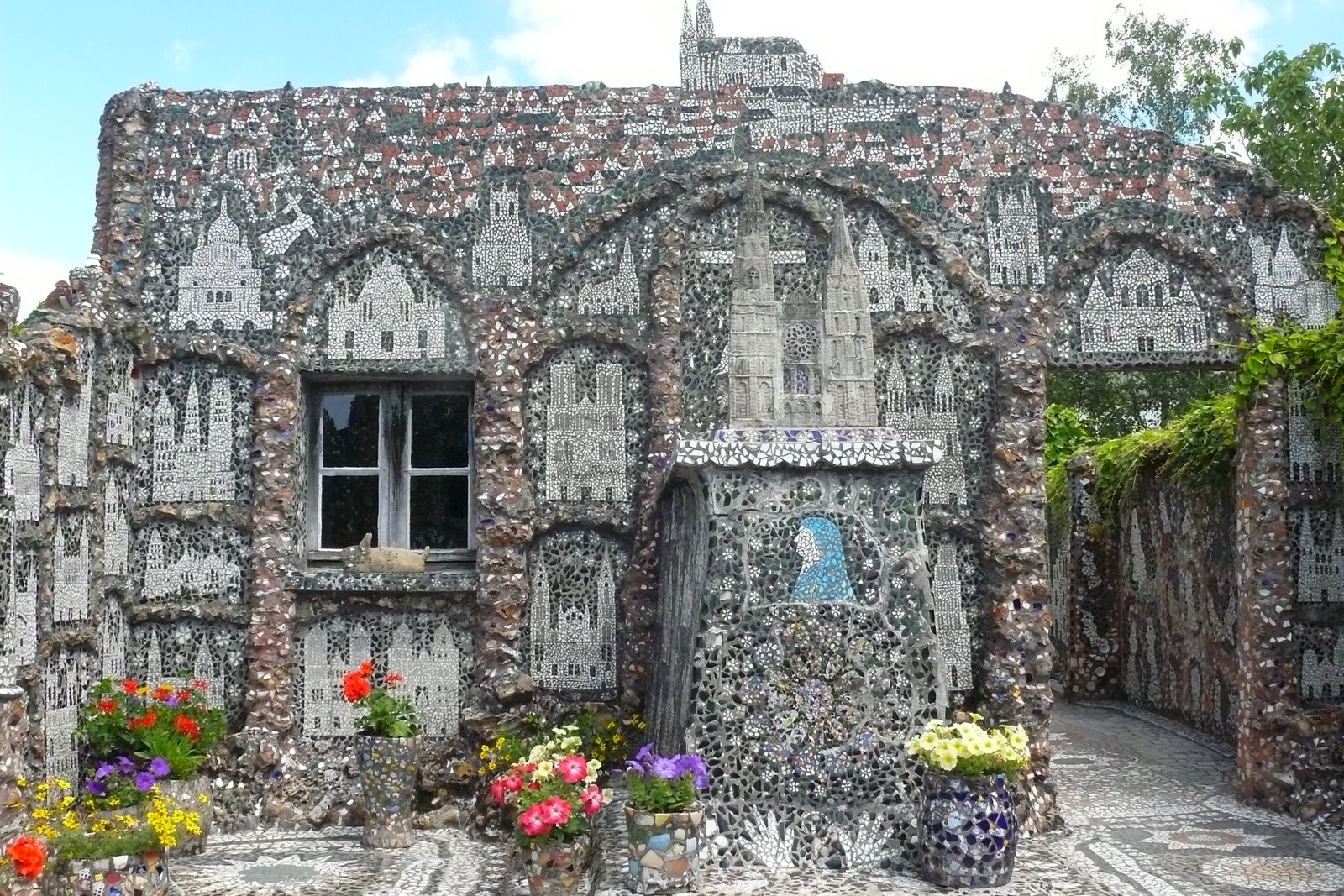
    Raymond Isidore’s La Maison Picassiette

    Often, when we first think of ‘outsider’ art, we imagine 2D paintings or collages made from recycled materials, rather than fantastical landscapes and installations in the wild. Visionary environments are huge scale artistic projects that are inbued with a sense of personal involvement and subjectivity; two characteristics which result in these dreamlike spaces being most closely associated with the work of ‘outsider’ artists.

    Some of the greatest work ever attributed to ‘outsider’ artists has been in the form of these visionary environments. These projects often take the artist years – or occassionally a lifetime – to complete; often becoming an obsession or an extreme compulsion. La Maison Picassiette located in Saint-Cheron, Chartres, France, is a mosaic-ed house created by Raymond Isidore (1900 – 1964). The house was built by Isidore himself, and then covered in broken pieces of china and crockery – a hobby which soon escalated into an obsession. Eventually, Isidore covered the interior of the house as well as the outside walls and the garden. After completing the mosaicing of the house, Isidore added a courtyard and a tiny chapel to his original house – these, of course, were decorated in the same way. Isidore died of exhaustion just two years after completing his increasingly all consuming project.

    Tyree Guyton’s Heidelberg Project

    Tyree Guyton’s (b. 1955) Heidelberg Project, which is located in Detroit, Michigan, USA, began as a stand against the effect of the Detroit riots he experienced as a child. Guyton began by tidying up the area and using the refuse that was collected to create an open-air art project. Over the years, his continuing to decorate decaying and derelict buildings has create

    d tension between Guyton and the local authorities. As well as using found items and recycled materials to create the open-air space, Guyton also used his own paintings and messages to cover the area – he wanted to highlight “the problems of poverty and urban ghettos” and to “save forgotten neighbourhoods and inspire people to use and appreciate art as a means to enrich their environment.”[1]

    In the UK, Kevin Duffy (b. 1945) has spent the last 31 years creating Tudor Village in North Ashton, Lancashire. Duffy is fascinated by traditional British vernacular architecture – but far from providing a purpose such as shelter, Tudor Village’s purpose is predominantly to satisfy his own need to create. More like stage sets, the buildings that the site encompasses are mainly facades – they have no interior. The site itself is a garden centre – but it is not a garden centre in the commercial sense; its main purpose is to provide an income for Duffy’s creations and to allow him the time and money to keep building. Duffy hopes to continue adding to the work and sees it as a lifelong commitment.

    Kevin Duffy’s Tudor Village

    Many of these visionary environments are abandoned once their creators pass away. This inevitably leads to their delapidation and decay. There is also the question as to whether the public should have access to these secret and extremely personal open-air environments. This is true in the case of John Fairnington, who created a ‘fantastical’ garden for his disabled son Edwin. The garden, known as the Cement Menagerie, contains approximately 300 animal sculptures. Fairnington left the garden to charity, but his son John bought it back to open it to the public. Similarly, Kevin Duffy enjoys receiving visitors at Tudor Village and encourages people to visit whenever they can.

    [1] Outsider Art Sourcebook,Published by Raw Vision, p 189

  • Outside In: National 2012

    Outside In: National 2012

    Outside In‘s National Exhibition will take place between the 27th October 2012 and 3rd February 2013 at Pallant House Gallery in Chichester. Outside In work to provide a platform for artists who are marginalised from sociaty due to a number of reasons including mental health issues, social circumstances and disability. The deadline for applications for the exhibition is Friday 20th July 2012, and there is no submission fee for entering the competition. There will be six award winners who will receive a month long solo exhibition in the Studio at Pallant House.

    Accompanying the Outside In: National will be other exhibitions based around the idea of ‘outsider’ art. Pallant House will be exhibiting the work of Jean Dubuffet, who originally coined the term Art Brut. He was a painter and sculptor as well as a collector of ‘outsider’ art in the early 20th century. As an artist, Dubuffet disregarded traditional ideals of beauty and instead focused on what he believed to be a more authentic and ‘raw’ approach to creating art. The exhibition at Pallant House will focus on the L’Horloupe series within Dubuffet’s collection.

    Also accompanying Outside In: National will be an exhibition of Pat Douthwaite’s prints. Douthwaite is considered both a ‘self-taught’ and ‘outsider’ artist after starting her life as a dancer and aspiring actress. After giving up the stage to focus on her art, Douthwaite was encouraged not to attend art school by fellow Scottish artist J. D. Ferguson. Lacking a permanent base, Douthwaite worked from numerous cities and countries including England, Scotland, North Africa, India and South America, but eventually struggled with physical illness after an attack she suffered in Edinburgh. Douthwaite exhibited regularly within the art world, but her work and its unique style was not considered to fit into the artistic conventions of her day. She was uninterested in becoming caught up in the art world, instead being comfortable being linked to ‘outsider’ art.

    Douthwaite’s early work was heavily influenced by the work of Dubuffet – something which connects the two exhibitions at Pallant House which are accompanying Outside In: National this coming Autumn/Winter.

    This series of exhibitions is something not to be missed by those interested in the work of ‘outsider’ artists. For more information on the exhibitions, and to keep up to date when information is released about them, please visit Outside In‘s website.

  • What is Outsider?

    What is Outsider?

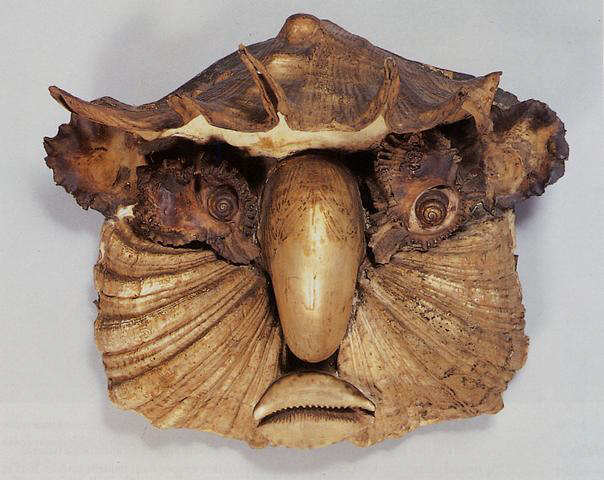
    Pascal Maissoneuve

    I have recently been conducting some further research into the way we display and interpret exhibitions of Outsider Art or work by Marginalised Artists. This research has raised a few questions for me that I thought might be interesting to include in the blog.

    I have been reading Lyle Rexer’s ‘How to Look at Outsider Art’, in which the author himself questions what really counts as Outsider Art. The term itself is so broad and covers so many different bases that more often than not we struggle to aptly define it at all. Rexer provides numerous definitions throughout the introduction and first chapter of the book; a chapter entitled ‘Art without Artists’. He quite correctly claims that Outsider Art “unlike the isms… does not refer to the art but to the status of the people who make it.”[1] He adds that the term has “become a catchall phrase for everything that is ostensibly raw, untutored and irrational in art.”[2]

    The traditional ‘movement’ of Outsider Art (if we can even call it a movement at all; apparently lacking precursors and emerging mainly as a ‘hindsight’ movement) includes artists from a whole host of different backgrounds. We have the ‘legendary’ Outsiders who include Henry Darger, Richard Dadd and Adolf Wolfli, alongside less well known artists who have been labelled within this category. But, Rexer argues – as I do to some extent – what really defines all of these artists? What is it about them or their work that enables us to group them all within this category of Outsider Art?

    Certainly, within the traditional art historical canon, movements such as Impressionism, Expressionism, and Surrealism to name a few, are defined by the work not the artist. They are defined by a distinct style, a certain brushstroke, or bold colours. Outsider Art is much more difficult to define in this way. It is based on the artist – their psychological state, their political standing or their social exclusion. As Rexer notes: “in art galleries and in most exhibitions of self-taught and outsider art, one is likely to see everything from early America advertising signs and Native American artifacts to Haitian Voudou flags, religious art from the South, and works by people in severe mental distress.”[3]

    Is it right, then, to group artists such as the academically trained Dadd together with the very private Darger? Darger, as one example, certainly did not actively want anyone to see his work, or even discuss it. Is Dadd only grouped within this category of Outsider Art because of his battle with Schizophrenia which resulted in him murdering his own father? After all, before the onset of his Schizophrenia, he was a professionally trained artist, who travelled the world to advance his skills. We could argue that artists such as Paul Cezanne, Gustave Courbet and Eduard Manet were Outsider Artists of their time. They did not fit into any previously existing art historical movement, and their work challenged pre-existing ideas of colour, subject matter and style. Rexer explains that the group of artists who exhibited at the Salon des Refuses of 1863 after announcing a break with tradition could be described as Outsiders – they were consciously working outside of the art historical norm.

    Giuseppe Archimboldo’s work of still lifes using fruit and vegetables are world-renowned, but similar work by Pascal Maisonneuve using shells to create faces is labelled as Outsider Art. How do we explain this divide, this difference? It has crossed my mind that perhaps the work of celebrated Outsider Artists such as Darger and Wolfli might come to be accepted into an art historical movement within time. Perhaps Maisonneuve’s work might sit alongside Archimboldo’s in an exhibition celebrating still lifes – just as the work of the Impressionists now sits in the timeline of the progression of nineteenth century French painting, following the work of David and Ingres. Outsider Art seems to me to be a label that encompasses the work of artists whom we do not know how – or where – to put. It is a ‘movement’ (in the loosest sense of the term) that covers a huge expanse of time and a huge range of styles, subject matter and indeed history. To finish, I would like to use a thought-provoking quote by Rexer which highlights the complicated nature of using such a broad term: “many of these objects do share some common ground, but putting them into a very large suitcase called ‘self-taught’ or ‘outsider’ certainly makes them harder to appreciate.”[4]

    References:

    [1] Rexer, Lyle. How to Look at Outsider Art  (Harry N. Abrams Inc, 2005), p 12

    [2] Ibid, p 6

    [3] Ibid, p 10

    [4] Ibid, p 10

  • What’s On in the Outsider Art World – May 2012

    What’s On in the Outsider Art World – May 2012


    Image

    Galerie Gugging, Austria

    Until 28th Oct 2012
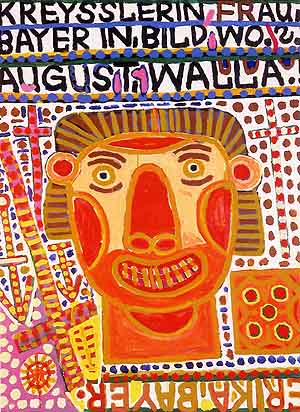
    ‘August Walla Retrospective’

    Until 7th Oct 2012
    ‘Sexi-Blatt’
    An exhibition based on the theme of sexuality

    Mad Musee, Belgium

    Until 6th May 2012
    ‘Rumours’
    An exhibition that includes the work of Morton Bartlett, Lee Godie, Loulou and Miroslav Tichy

    The Arts Festival of North Norway, Norway

    24th June 2012
    ‘The World of Outsider Art’ at the Trondenes Historic Centre, Harstad Norway

    The Aprad Szenes-Vieira da Silva, Lisbon Portugal

    Until 23rd Sep 2012
    ‘Arte Bruta – Terra Incognita’
    Outsider Art from the collections of Richard Troger and Antonio Saint-Silvestre

    Portugese Association of Outsider Art, Lisbon Portugal

    Until 31st May 2012
    ‘Xico Nico, Sculptor’

    Intuit: The Center for Intuitive and  Outsider Art, Chicago

    Until 30th June 2012
    ‘Heaven and Hell’

    Bethlem Heritage, London

    13th June 2012 – 13th July 2012
    ‘Hollow Space and Outgrowth’
    “Artists from Bethlem Gallery respond to the historical and art collection in the Archives and Museum”

    Art et Marges Musee, Belgium

    10th Feb – 20th May 2012
    ‘La Fabuloserie: le fabuleux destin des Bourbonnais’

    Frist Center for Visual Arts, Tennessee

    24th Feb – 29th May 2012
    ‘Fairy Tales, Monsters and the Genetic Imagination’

  • Design and Display: The Halle Saint Pierre, Paris

    Design and Display: The Halle Saint Pierre, Paris

    Completely conversely to the bright walls of the typical contemporary art gallery exhibition, the temporary exhibition at the Halle Saint Pierre in Paris was shrouded in darkness. This exhibition is called ‘Banditi dell’arte’ (which Google Translate tells me means ‘Bandits of the Art’) and is the first exhibition in France of Italian Outsider Art.

    At the bottom of the hill that leads up to the Sacre Coeur and Montmartre; one of my favourite Parisian places, sits the Halle Saint Pierre, an institution which celebrates the work of Outsider Artists. One of my interests regarding Outsider Art is how, often, the work of marginalised artists is displayed so differently to the work of ‘non-marginalised’ contemporary artists. This is what I was thinking about during my visit to Banditi dell’arte, and therefore, what this blog post will be focusing on.

    On entering, the exhibition space was very, very dark. Black walls. Spot lit works. It was incredibly different to what you might expect when visiting a ‘white cube’ contemporary exhibition. Many of the works, I found, were by ‘anonymous’ artists – and many of the works in fact were also nameless – something, perhaps, one would not come across in the commercial, contemporary art world. The works were grouped by artist, with a brief biography (only in French) and each artist almost had their own ‘mini-exhibition’; four or five works on display and their own corner or section of the room.

    There seemed to me to be no chronological order or narrative to the overall exhibition – perhaps just the fact that they were Italian Outsider Artists. There was also no set format for the display of the works, it was almost as if someone different had curated each artist’s ‘mini-exhibition’. Also, I found there were a considerable amount of photographs representing installations (rather than actually having the installations on display within the exhibition).

    Upstairs, in their more permanent exhibition room, I found the obligatory white walls. Similarly to the temporary exhibition space, this area also designated a space to each artist; they had their own sections again displaying about four or five works each.

    In terms of the technology used within the exhibition, any notebooks or doodle-books that had once belonged to the artists were displayed on screens that provided a slideshow of the pages. I found this quite a nice touch, as the actual book was under a glass case, but you were still able to explore the work inside of it.

    Something I noticed, in both exhibition spaces in fact, was that because of the partitions and dividers that separated each artist’s ‘mini-exhibition’, you were never just looking at one piece in isolation. Whilst looking at one artist’s work, you could be peering through the gaps at another’s at the same time.

    I would like to do some more research into the differences that are perhaps apparent between the exhibiting of marginalised artists work and that of ‘non-marginalised’ contemporary works. For now, I hope you enjoy this post. Sorry it is quite brief, I just wanted to get down everything I had written on a scrap of paper during my visit before I lost it!

    Image

    Banditi dell’arte: 23rd March 2012 – 6th January 2013, Halle Saint Pierre, Paris

    Don’t forget to follow me on Twitter: @kd_outsiderart

  • *GUEST POST* The Berlin Wall East Side Gallery by Lizzie Davey

    *GUEST POST* The Berlin Wall East Side Gallery by Lizzie Davey

    Many thanks to Lizzie Davey for this post on the Berlin Wall East Side Gallery. Read Lizzie’s blog for more posts about travel and culture: Wanderful World.

    Image

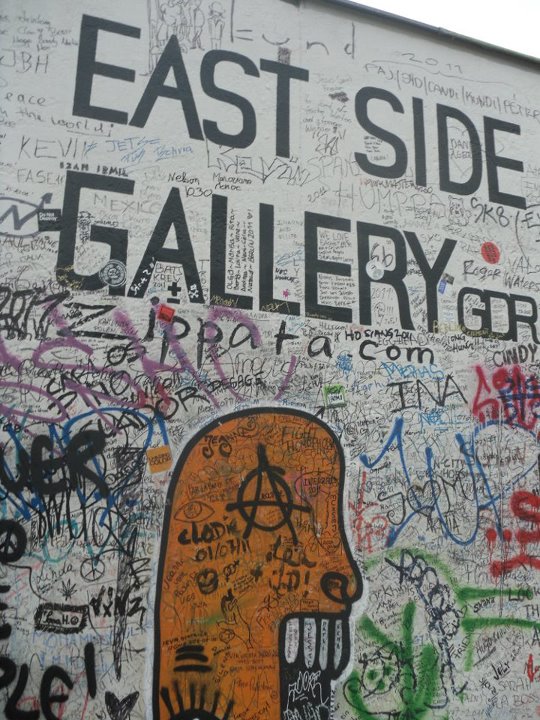
    At 1.3 kilometres long and featuring 106 paintings by international artists, the East Side Gallery is the largest open air gallery in the world. It stands as a memorial for freedom at a time when the future of Germany was unstable. The use of art here has become an expression of the turbulent times a separated and then unified Germany faced; the old and the new Berlin. In 1989, when the wall came down, hundreds of international artists collected at the east side which was once untouchable, and turned it into a colourful, exquisite memorial, providing a new future and place for the wall in Berlin. The paintings exhibited here express a new beginning and put forward new, euphoric hopes for the city; hopes that were formed when the wall came down.

    When visiting the East Side Gallery last year, I was amazed by the diversity of imagery on display. However, all seemed to convey a similar theme; freedom. The array of colour displayed in such a large format can be overwhelming, but once I reached the end I wanted more. Remembering that the gallery is actually exhibited on the wall, the wall that was once a huge part of German history is amazing and will enforce the struggle Germany faced during this time for years to come.

    Some critics state that the wall is in such bad condition now that the original artworks are almost undecipherable. I, however, think that it has evolved with the times, creating a portal where citizens of Berlin can express their feelings via an artistic platform. In some ways, the graffiti overlaying the original paintings only enhances the wall, showing how the visions and outlooks of the people have changed over time. Each piece was unique and brilliant in its own way, including the newly added graffiti that has accumulated. The memorial was created to express freedom, and surely this is evident in the way the wall appears today as an almost interactive gallery.    

    Again, thanks to Lizzie for this post. Don’t forget to check out her blog: Wanderful World.

  • What’s On in the Outsider Art World.. March/April 2012

    What’s On in the Outsider Art World.. March/April 2012

    Image(Image: Robin Ironside at Pallant House, Chichester)

    Bethlem Heritage, South London UK (www.bethlemheritage.org.uk)

    8th – 30th March 2012
    ‘There is Good in Us’

    An exhibition of Geroge Harding’s work – “The work encourages people to look at ‘us’ in a way that is celebratory, unconventional and can teach us something about different ways of being.”

    Pallant House, Chichester UK (www.pallant.org.uk)

    28th Feb – 22nd April 2012
    ‘Robin Ironside: Neo-Romantic Visionary’

    Galerie Gugging, Austria (www.gugging.org)

    Until 22nd April 2012
    ‘Inschriftierungen’

    Galerie Miyawaki, Kyoto Japan (www.galerie-miyawaki.com)

    March 2012
    Exhibition on the work of Outsider Artist Hans Krusi

    Art et Marges Musee, Belgium (www.artetmarges.be)

    10th Feb – 20th May 2012
    ‘La Fabuloserie: le fabuleux destin des Bourbonnais’

    Museum Im Lagerhaus, Switzerland (www.museumimlagerhaus.ch)

    Until 11th March 2012
    ‘Hidden Treasures from Swiss Psychiatry II: Encounters’

    Frist Center for Visual Arts, Tennessee (www.fristcenter.org)

    24th Feb – 29th May 2012
    ‘Fairy Tales, Monsters and the Genetic Imagination’

  • Pre-World War I: Primitivism, Nostalgia and the Rise of German Expressionism

    German Expressionism was born out of the influence of a variety of earlier movements, styles and subject matter, and of course, through the discontent of many avant-garde artists with recent modernisation and the alienation of urban living. Paul Gauguin (1848 – 1903), a French Post-Impressionist, proved significantly influential on the works of German Expressionists. Gauguin developed the visual language of ‘syntheticism.’ German Expressionism also undoubtedly takes some inspiration from Gauguin’s use of primitive artefacts and colour symbolism, as well as his use of nature without “(falling into) the abominable error of naturalism.” Vincent van Gogh (1853 – 90), was an incredibly important figure in the development of Expressionism, with the vibrant energy and colours found in his work. German Expressionists such as Ernst Ludwig Kirchner (1880 – 1938), Emil Nolde (1857 – 1956) and Ludwig Meidner (1884 – 1966) greatly identified with van Gogh’s alienation and isolation from the world, and his reliance on the ‘inner world’ to create, rather than external stimulation.

    The Brucke group, named after a quote by Friedrich Nietzsche, in which he states that “what is great in man is that he is a bridge and not a goal,” was founded in 1905, after the meeting of Fritz Bleyl (1880 – 1966), Kirchner, Karl Schmidt-Rottluff (1884 – 1976) and Erich Heckel (1883 – 1970) at the Dresden Technical College during their time there as architecture students. However, Bleyl left the group in 1907 to pursue a career in architecture, so the core group always remembered is made up of Kirchner, Heckel, Schmidt-Rottluff and Max Pechstein (1881 – 1955). These Expressionist artists were not content with the technical innovations and modern advancements that the early twentieth-century carried with it. The idea of the primitive was very much a basis for a large amount of the Brücke artists’ work. German Expressionists used the notion of timeless primitivism, and the borrowing from other traditions and cultures as a way to ignore what was actually occurring in Germany at the time, as well as to show their adversity to the modern world.

    The idea of the artist’s rejection of society and the urban city crop up throughout the history of art in Germany, for example, prior to Die Brücke, was Wilhelm Riehl’s Land und Leute (1857 – 63), which advocated traditional countryside living as the ultimate symbol of German tradition, as well as Carl Vinnen’s Worpswede Stimmungsladschaften (mood landscapes) and Arnold Bocklin’s mythological landscapes, which showed a romantic and untainted vision of countryside living. The notion of returning to nature is also highlighted in Adolf von Menzel’s a Journey Through Beautiful Nature, of 1892, which depicts figures in elegant clothing aboard a crowded train, desperately yearning to catch a glimpse of the countryside through the windows, yet irreparably isolated from it. Kirchner’s own figures in the countryside represent the unity of the human race with the natural environment, for example, Four Bathers of 1910, which was created during one of the Brucke artists’ summer trips to the Moritzburg lakes. His urban figures, however, show the alienation felt by people during the years of modernisation, like his piece entitled Five Women on the Street of 1913, part of his Street Scene series, which has defining primitive aspects and characteristics which Kirchner has used in attempt to highlight the contradictions of modernity.

    Emil Nolde, one of the most well-known German Expressionists, who was also a member of Die Brücke between 1906 and 1907, often showed his disdain for technological advancement and modern society within his work. He seldom depicted huge technological developments, such as that of the automobile or the aeroplane, and the hustle and bustle of city life goes undetected in his work. Nolde successfully avoided any representation of the modern world, even during his journey to New Guinea in 1913, where he chose to depict Russian peasants, and ignore the train and tracks his wife and he were travelling across. Despite spending every winter in the city of Berlin, the only signs of city life within Nolde’s work were the interiors of cafes and cabarets.

    Cesare Lombroso, an Italian psychiatrist, understood ‘madness’ to be a descent back into a primitive, or child-like stage of growth, and similar to this descent, was the use of primitivism by German Expressionists to represent their nostalgia for an earlier time; a time before modernisation. Similarly, Adolf Wolfli (1864 – 1930), a Swiss Outsider Artist, created art after his psychotic collapse as a way to emerge from chaos into stability. In a similar way, the German Expressionists escaped from the isolation and alienation of modern urban living through nostalgic primitive painting. Pascal Maisonneuve (1863 – 1934), a French Outsider Artist, portrayed his defiance and discontent with society and politics through his ‘shell faces,’ which he created by collecting strange objects and shells and arranging them into faces. These ‘shell faces’ defied conventional representation and ridiculed political figures, much in the same way as Expressionism was used as a new form of representation that was ideal for portraying discontent and frustration.

    A “direct and unadulterated” creative urge was crucial to the Brucke programme. Nolde would often concentrate exclusively on a specific subject matter in intense bursts of activity and in his autobiography, the artist conjures up images of himself as being “preoccupied only with his art.” Similarly, Kirchner would work obsessively, without taking notice of the time, and would often emphasise his mental distress as a key driving force behind his work; just as Outsider Artist, Wolfli, never planned in advance. In fact, one of the defining characteristics of Outsider Art is the appearance of compulsion; the need to fill in the gaps and continually create. Of course, the term Expressionism itself insinuates the “urge to express oneself,” and this urge is what enabled the German Expressionists to work without inhibitions, painting directly from the nude in the studio for bursts of approximately fifteen minutes, putting their own subjective stamp on the subject matter.

    The years directly prior to the break out of the First World War saw an escalation and intensification within Kirchner’s work, which eventually led to his prominent Street Scenes; of which there are eleven works, all executed between the years of 1913 and 1915.  The members of Die Brücke had moved to Berlin in 1911, following Max Pechstein who had relocated in 1908, where they had worked together as a group for another couple of years before dividing and going their separate ways. The last recorded work by the Brücke artists jointly was the poster for the exhibition entitled ‘Neuer Kunstsalon’ dated the 27th May 1913. In the pre-war climate of Berlin, the artists became withdrawn. Kirchner began his Street Scenes, which included his Berlin Street Scene of 1913.

    Kirchner reportedly took to stimulants such as alcohol, sex and morphine during his time in Berlin, and right up until his suicide in 1938 he was continually fighting a battle with loneliness and alienation, and his frustration and discontent with modern city life. Kirchner was keen to emphasise the dangers of modernisation within society, which he managed not only in his Street Scenes, but also in his colour lithograph of The Railway Accident of 1914. Here, a freight train is shown colliding with a horse drawn carriage, with Kirchner illustrating the destruction that can be associated with modernisation. The imminent outbreak of the First World War saw a huge shake up in the way people saw modern life, the city and their country. Inevitably, the War had a huge impact on everything from culture to the economy and as a result of this; the Weimar era would see a whole new side of German Expressionism.