Tag: outsider art under analysis

  • Outsider Art under Analysis: Part Two (Answers)

    Outsider Art under Analysis: Part Two (Answers)

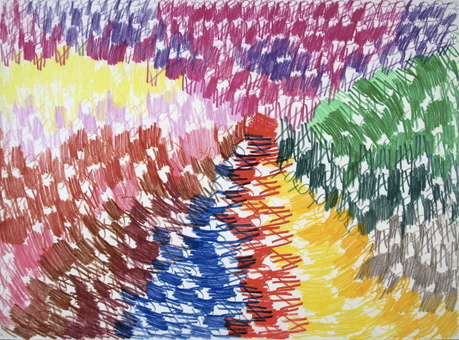
    Above image: Marcel Storr

    In Outsider Art under Analysis: Part One (Speakers), I wrote about the talk I attended at the Wellcome Collection on 15 June 2013. In this post, I will answer some of the questions raised during the discussion (no research, just my own thoughts). It would be great to hear everyone else’s answers too, so feel free to add a comment below the post.


    1) Can ‘outsider artists’ talk about their work meaningfully and coherently? 

    This is a difficult one, as I know a lot of people like accompanying interpretative material to aid them when they view an artwork. However, I think that art is really another form of communication, and so the idea that some artists – for example those without speech or writing – can’t actually talk about their work seems quite unimportant. This is more of a question that encompasses the whole of art history and not just ‘outsider art’; do we need accompanying material, or is the work alone enough? I think a lot of artists who are aligned with/align themselves with the notion of ‘outsider art’ (and actually, artists more generally) do use creativity as a way of communicating their ideas, so for this reason, does it matter that some may not be able to ‘talk’ about their work?

    2) Why do we feel we have to label people? Why can’t outsider artists just be called artists?

    This is obviously an on-going debate with regards to the label ‘outsider art,’ which I have spoken about in a previous blog post. I, for one, would love for all art to be considered as just ‘art’ and all artists to be considered as just ‘artists.’ But I think it’s a bit more complicated than that. In the present day, I actually think that the term ‘outsider art’ is verging on redundant. In ten, maybe twenty years’ time, I don’t think we will use it. But, if having had a label at some point has helped raised awareness and can actually bring this art into the mainstream, then it can only be a good thing.

    Karl Schmidt, Rottluff, 'The Factory,' 1909, Brucke Museum, Berlin
    Karl Schmidt, Rottluff, ‘The Factory,’ 1909, Brucke Museum, Berlin

    3) Did ‘outsider art’ exist before the 1930s?

    The golden age of Outsider art was between 1880 and 1930 – so in short, yes! It emerged at this time because of the development and progression of European psychiatry. Patients were encouraged to draw, paint, and take part in alternative activities to aid their recovery. This was also the period when modern artists started to take notice of what was becoming quite a powerful and popular type of art.  There was a lot of discontent due to accelerated mechanisation and urbanisation in Europe at this time, and of course, it encompassed two world wars and a period of huge unrest in between. Many artists working during this period were looking for new direction – they wanted a way to illustrate their discontent, a new way to depict the devastated world around them. The idea that ‘outsider artists’ were self-taught, yet representing the world as they saw it, and their inner worlds, regardless of whether this fitted with the accepted ‘canon’ of the time was something that really resonated– most notably with the German Expressionists such as Karl Schmidt-Rottluff and Max Beckmann, and, of course, the Surrealists.

    The term ‘outsider art’ itself was coined by Roger Cardinal in 1972, following on from Jean Dubuffet’s ‘Art Brut’ or ‘Raw Art’, which emerged in the 1940s.

    4) What is ‘outsider art’? In simple terms – has it become outdated?

    In simple terms, it is very outdated and almost redundant. The meaning of it has changed so much over the decades that actually describing it proves very difficult! It originated as a term to describe work created by those incarcerated within mental institutions, but has evolved to become more of an umbrella term for a whole host of different stylistic approaches – naïve art, folk art, self-taught art, to name but a few. Again, it is useful for the time being in that this art can be ‘called’ something, and is not just floating in the ethers, on the margins of the art world. In fact, particularly this year with the huge exhibitions taking place that are showcasing the talents of artists under this term, it seems almost ridiculous to describe this work as being ‘outside’ of the mainstream. The hope is that one day it won’t need a specific term and work created under this umbrella will simply be known as ‘art.’

    5) Not everyone is an artist, and not everything is art. People have to go to art school and study what has come before to become an artist.

    I really wasn’t sure about this statement. I know a lot of people work very hard to become artists in the dog-eat-dog art world; the go to art school, they learn about art and artists that have gone before, and they build on this in their own practice, BUT I do think that everyone has an inner artist, if this is too far, perhaps, then at least everyone has an immense amount of potential for creativity inside of them. I just don’t know who’s to say what is and isn’t art, and why people who aren’t formally trained cannot be considered as artists. I think this is one of the major reasons that the term itself needs to be forgotten; it gives the illusion of a distinction between who is ‘inside’ and who is ‘outside’ and therefore who can be called an ‘artist.’

    Jean Dubuffet, 'Spinning Round', 1961, Tate.
    Jean Dubuffet, ‘Spinning Round’, 1961, Tate.

    6) Why is ‘outsider art’ not taught as part of the art historical canon? 

    This is something that I really hope will change soon. As part of my undergraduate degree, I was very lucky as I was actually taught about the emergence of outsider art, and about artists such as Louis Wain and Richard Dadd. I think people find it difficult to include in the canon because it is not a ‘movement’, and it did not take place over one definite period of time – it has been happening throughout this period – running parallel, if you will, alongside the history of modern art.

    I also think that historians might find it difficult to talk about – there’s no definitive style etc. And, as Roger Cardinal said at the talk – it is a movement of individuals. I think the way forward is to include ‘outsider artists’ alongside teachings in the development of modern art. After all, they were immensely influential to hugely prolific modern artists, particularly those within the Surrealist movement, and this influence should not be forgotten.
  • Outsider Art under Analysis: Part One (Speakers)

    Outsider Art under Analysis: Part One (Speakers)

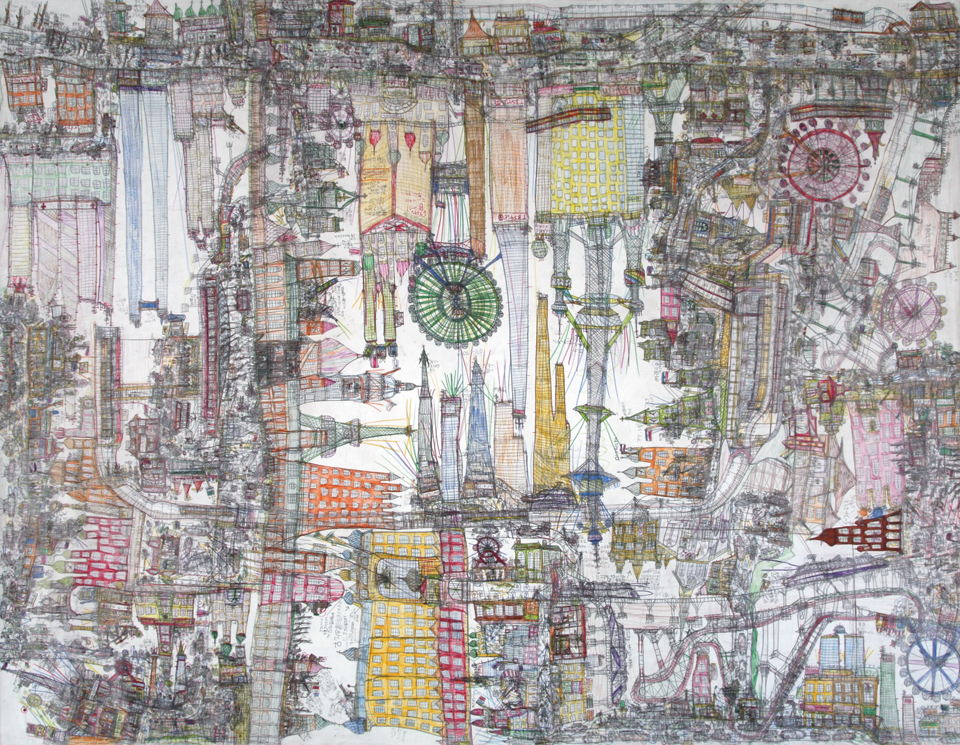
    Above Image:  ‘The Economically Booming City of Tianjin, China’ by Norimitsu Kokubo


    On Saturday 15 June, I visited the Wellcome Collection for a talk on the history and development of ‘outsider art’; an event accompanying the current ‘Souzou: Outsider Art from Japan’ exhibition. Here, I have outlined the main points covered by each of the speakers, and highlighted a few of the questions raised during the discussion. I am hoping to come back to these questions in ‘Part Two’, and answer them for myself. 


    The panel consisted of Roger Cardinal; art historian and ‘coiner’ of the term ‘outsider art’, John Maizels; editor of Raw Vision Magazine, David O’Flynn; consultant psychiatrist at the Lambeth and Maudsley Hospitals, and Shamita Sharmacharja; curator of the current Wellcome Collection exhibition.

    John Maizels chaired the event which aimed to explore the history of ‘outsider art’, right from its early days as a diagnostic tool for psychiatrists to the growing popularity of visionary artists in the present day. Each speaker gave a presentation on their specialist area, followed by a chance for questions and a discussion with the audience.

    Roger Cardinal spoke first, defining work aligned with the term as anything ‘outside the spheres of normal art making,’ before going into detail about the three highly influential characters who really shaped the beginning of what we now know as ‘outsider art’: Jean Dubuffet, Hans Prinzhorn, and Andre Breton. Roger discussed how early on in its development, ‘outsider art’ was merely a diagnostic tool within the asylums of 19th- and early 20th- century Europe. It was Prinzhorn’s interested in the work that really encouraged a much more creative and aesthetic stance, rather than a continuing pathological one.

    The point I found most interesting during Roger’s talk was his stating that ‘outsider art’ is categorically not a movement – it is not a school, a style, or a political movement – instead, it is a ‘movement of one’ in the sense that each artist should be looked at separately. It is a ‘movement of individuals.’ This was great to hear, as it is something I have been trying (and seemingly failing!) to put into words… until now!

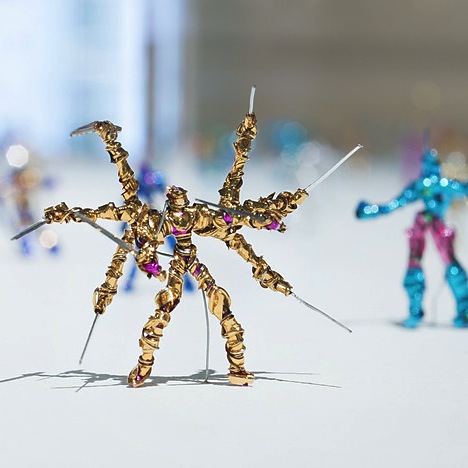
    'Untitled', by Shota Katsube
    ‘Untitled’, by Shota Katsube (source: careersuicideblog.wordpress.com)

    Next to speak was David O’Flynn. Having a psychiatrist on the panel was something I found really interesting, and I really wasn’t sure what to expect. I continuously advocate that work aligned with ‘outsider art’, or (for want of not using the term) work created by those on the margins of society, should not in any way be associated with the backgrounds or biographies of the artists, so to have a psychiatrist on the panel was something I questioned – would it take away from the focus on the aesthetic? Would it again pathologise the work?

    David, however, is not only a psychiatrist, but also manages the Adamson Collection – a collection of art founded by Edward Adamson, the ‘father’ of art therapy (I am definitely not an endorser of art therapy – and was pleased to hear David say that he was also extremely ‘anti-interpretation’). He spoke about the change in European mental health care in the mid 20th-century, and how this had a huge impact on the emergence of ‘outsider art’. There was a move from psychiatrists ‘discovering’ or ‘finding’ work created by patients to them actively setting up creative spaces where patients were encouraged to create.

    David also raised a few interesting points with regards to the Adamson collection – and to psychiatric collections more generally. Who has ownership of the work? They were created in a hospital environment during the process of healing; are they art objects or tools for healing? Should the creators be named? What are the copyright issues? David argued that the artists’ names should be shown, afterall, they were denied an identity in the asylums; they shouldn’t be excluded a second time around.

    Although I’m not sure how I feel about psychiatrists talking about ‘outsider art’ (or, actually, just art in general), I do think it was important for David to be there as the emergence of ‘outsider art’ relied quite heavily on the influence and encouragement of certain psychiatrists.

    'Mother', by Toshiko Yamanishi
    ‘Mother’, by Toshiko Yamanishi

    The final speaker was Shamita Sharmacharja, who focused on her curating of the ‘Souzou’ exhibition. Shamita said she had chosen to go for an ‘object-led’ approach rather than a heavily biographical or health focused interpretation – something which I think is very important when displaying ‘outsider art’. It means that the artists’ talents are not simply pushed to one side in favour of their medical history. Shamita quite rightly stated that the artists’ works were  art – she would not focus on the biography of other artists she was displaying, so why would she for this exhibition?

    After the introductory speeches, it was time for audience questions. The questions were wildly diverse, and came from people who worked with artists outside of the ‘mainstream’ art world, and from those who knew fairly little about the subject.


    The Questions

    1) Can ‘outsider artists’ talk about their work meaningfully and coherently? 

    2) Why do we feel we have to label people? Why can’t outsider artists just be called artists?

    3) Why is there so much interest in Japanese ‘outsider art’ at the moment?

    4) Did ‘outsider art’ exist before the 1930s?

    5) What is ‘outsider art’? In simple terms – has it become outdated?

    6) Not everyone is an artist, and not everything is art. People have to go to art school and study what has come before to become an artist.

    7) Why is ‘outsider art’ not taught as part of the art historical canon? 

    In Outsider Art under Analysis: Part Two, I will return to these questions and answer them for myself. I would be really interested to hear other people’s responses to the questions as well.