Blog

  • Outsider Art: An Ethical Minefield? What About Voyeurism…

    Outsider Art: An Ethical Minefield? What About Voyeurism…

    Above Image: Jean Dubuffet, ‘Les Vicissitudes’, 1977 (Source: http://www.tate.org.uk/art/work/T03679)

    I handed in my MA dissertation just over two months ago – and only now do I finally feel ready to return to it to blog about some of the queries it raised with regards to ‘outsider’ art (including but not limited to ethical issues, problems facing curators and, of course, the infinitely ambiguous definition of the term). One of the main questions I found myself focusing on when I began writing, was the issue of voyeurism; who gains what from viewing the work of ‘outsider’ artists. This ‘issue’ as such became a question to which I changed my mind about somewhere around 100 times during the writing process.


    “Though Outsiders expect nothing from us, not even our attention, we steal upon them like eavesdroppers.”[1]


    During the nineteenth-century, the time when the idea of art and ‘madness’ was first being explored by the Romantics, the relationship between the two was curiously idealistic. This unquestionably romantic view of madness was rarely based upon any real experience of insanity, but was rather a fantasy of madness; an idea of a wild, untameable, unbridled creativity. From this early on, we can see the beginnings of a voyeuristic interest in the work of those who were perhaps marginalised from society. Even Hans Prinzhorn’s Artistry of the Mentally Ill, published in 1922, focused more on the art of psychiatric patients as a pathological endeavour as opposed to an aesthetic one. There is, afterall, no stylistic guidelines with regards to the definition of the term ‘outsider’ art itself, meaning there is often more interest in the artist than in the work as a reason for ‘classification’ as an ‘outsider.’

    Despite my initial thoughts focusing more on the possibility of potential voyeurism, I soon decisively changed my mind – I have even written a blog post on how continually worrying about the presence of voyeurism can perhaps affect the accessibility of ‘outsider’ art exhibitions for those with little to no prior knowledge of the subject.


    “Why look at outsider and self-taught art, if not out of romantic nostalgia for some image of unfettered individuality and expressive freedom? Or is our fascination with this art just one more form of voyeurism?” [2]


    Just yesterday, conincidentally enough, I came across this article, in which Ian Patel asks who exactly benefits from ‘outsider’ art. The article, similarly to my initial thoughts about ‘outsider’ art exibitions being steeped in potential voyeurism, suggests that there are “many ethical questions surrounding the public display of art produced by what might be termed ‘vulnerable adult’ constituencies.” Patel continues, saying that “such exhibitions tend to go unquestioned as a positive force for both participating artists and the viewing public,” and that “participating artists are assumed to benefit from artistic recognition.”

    The article goes on to suggest that there are perhaps deeper ethical questions to consider with regards to the “public consumption” of marginal art. Patel considers The Koestler Trust – whose work he claims at first glance could appear as a “voyeuristic thirst for productions rooted in human degradation, infamy and shame.”

    Although the article does move on to talk more about how marginal art exhibitions can act as a “powerful advocacy tool,” I was interested in how voyeurism is often a recurring theme with regards to the subject of ‘outsider art.’

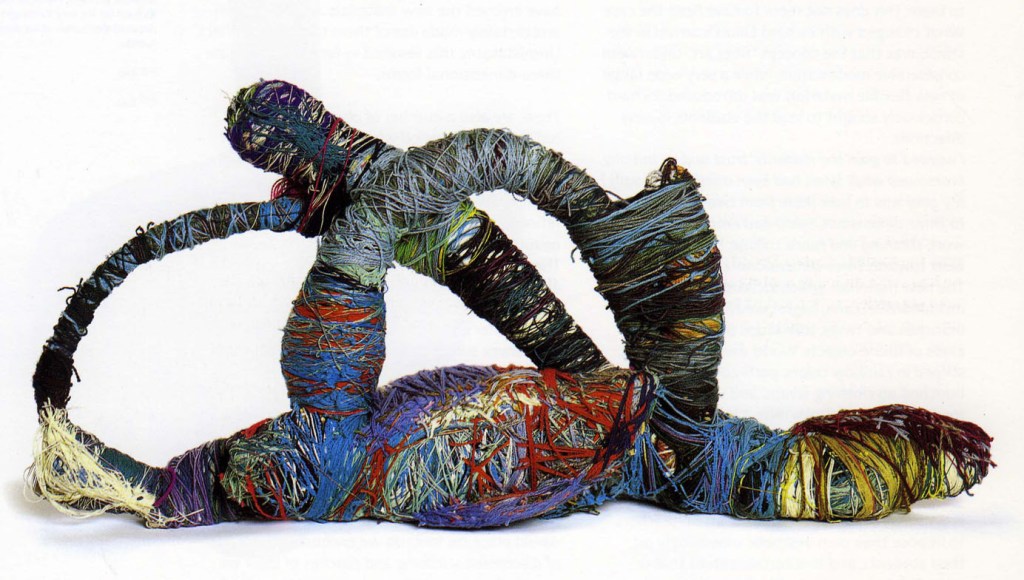
    Judith Scott, Source: http://www.nytimes.com

    Voyeurism, in my opinion, is a very dangerous word when considering what people get out of ‘outsider’ art. I can’t speak for everyone – but I can tell you what I get out of it. I studied History of Art at undergraduate level and two months ago, I completed an MA in Art History and Museum Curating. I think somewhere along the way, I got dissillusioned with the ‘mainstream’ art world (contemporary in particular). I have always believed that creativity is not something you can learn – going to art school isn’t going to teach you how to be creative, or imaginative. I also think it is not something that should work like a production mill for monetary gain. I think it is something innate, something that makes us human. I do, however, believe that everyone has the capacity for creativity. Art should be for everyone, not just those with an Art History degree, or a Fine Art degree for that matter, and ‘outsider’ art helps me to appreciate this. For me, there’s nothing like being blown away by a work of art created by someone with no formal training – someone who has produced a piece based on a feeling or raw creative intuition; something that can’t be put into words. Something that is a reflection of humanity and a portrayal of these feelings which make us human, rather than a creation made for commercial interest or capital.

    For me (and Patel also notes this too), public exhibitions are often not the “end-goal” of community art programmes. It is the therapeutic effect of creating and producing that should be celebrated – the final exhibition is just a space to share this. Increasing inclusivity within the art world is a whole huge leap towards a more generally inclusive society, and shunting this merging of the ‘inside’ and ‘outside’ (whoever gets to decide these terms) by using the term ‘voyeurism’ will only delay the process.


    References

    [1] V. Willing, ‘Out of Order’, in In Another World: Outsider Art from Europe and America Exhibition Catalogue, 1987.

    [2] Lyle Rexer, How to Look at Outsider Art, 2005.

    Response to article ‘Outside Looking In’ by Ian Patel, published at www.artsprofessional.co.uk

  • Sean Burn

    Sean Burn

    I am always keen to hear from artists who would be interested in a blog post focusing on their work. Usually, I ask for an artist’s statement and a few images which they would like to showcase, but these guidelines are very flexible and I am open to suggestions. If you would like a post on your work, please do contact: kdoutsiderart@yahoo.com.

    This post will focus on the work of Sean Burn.


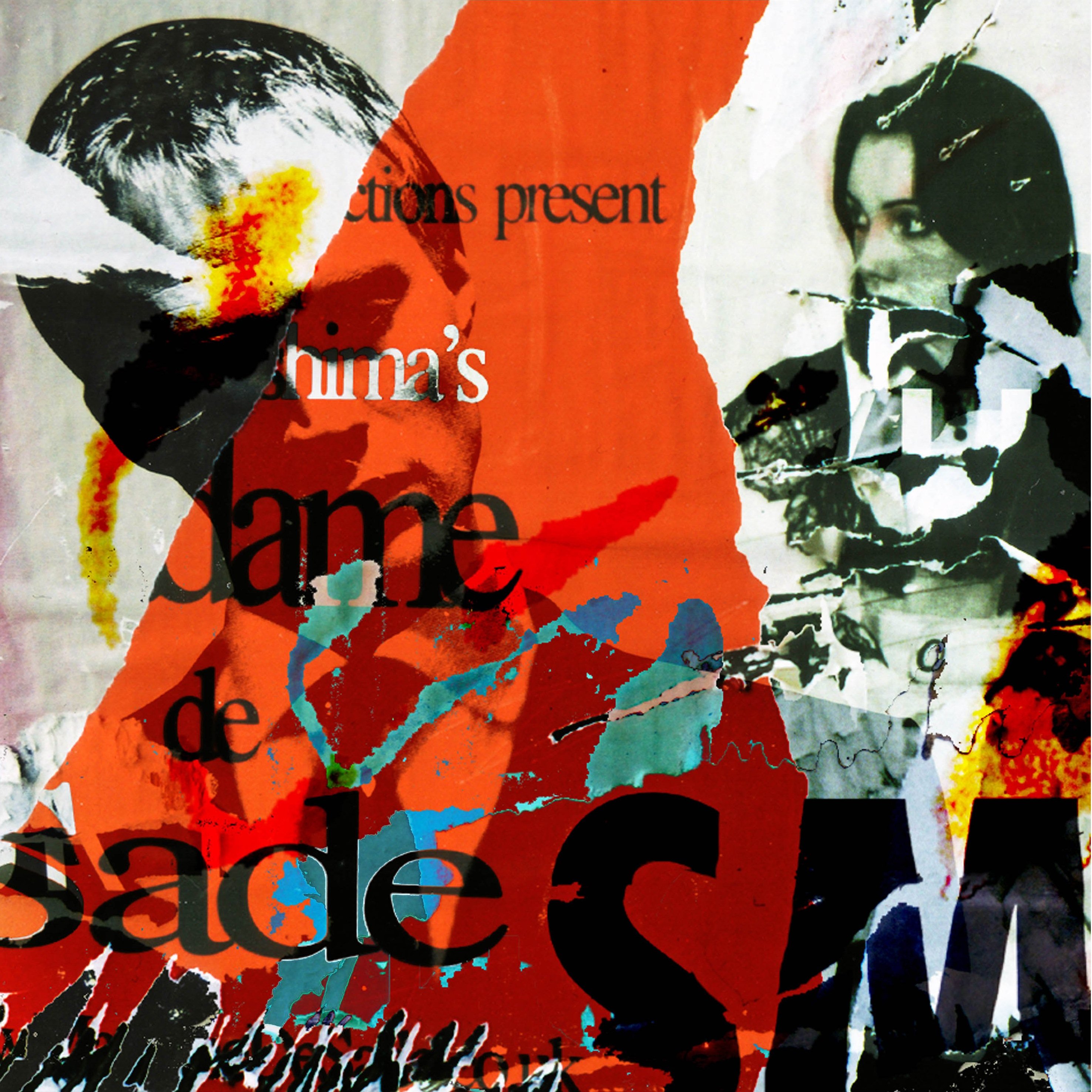
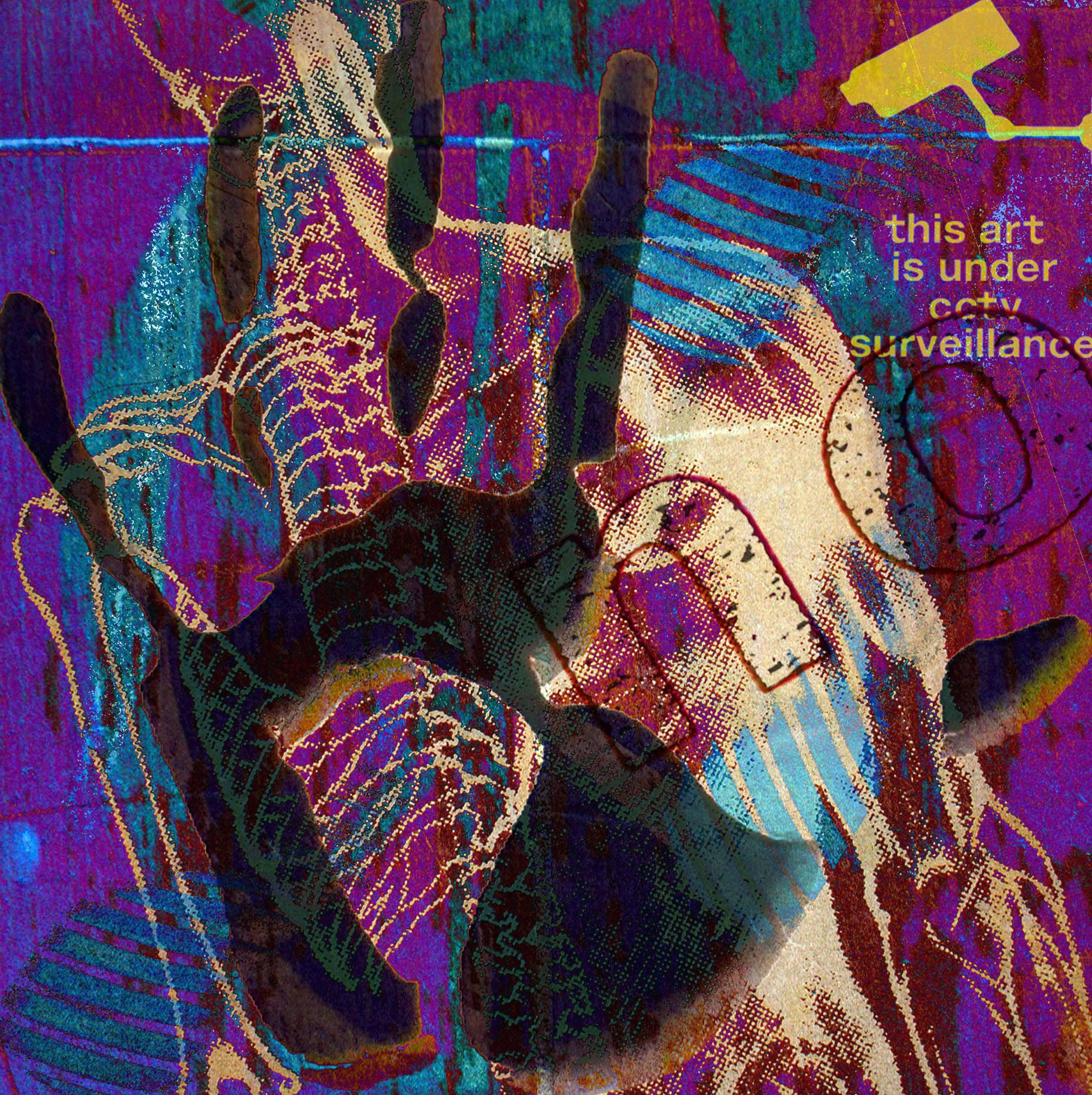
    “Sean Burn – outsider artist / performer / writer – works across performance / film / installation / soundmapping / visual poetry and spoken word to challenge ownership of narratives. He’s now established a considerable and international track-record with this creative questioning as key. Surrounded, often defined by languages (visual / sonic / textual / performative), we use them to free ourselves. Languages should be owned by all with bandwidth not hierarchy as a better contemporary model. he regularly challenges psychiatry, seeing it as a privileged storytelling rather than a science; this is based on his own long history as (enforced) service-user. He is an advocate of breaking down the stigmas surrounding mental ill health in his work and challenging society’s mis-perceptions. Such creative work saw him short-listed for a dadafest 2009 disability arts award.”


    Sean Burn – ‘Dame de Sade’
    Sean Burn – ‘In These Arms Riots Love’
    Sean Burn – ‘Son R Yo Here R Yu’
    Sean Burn – ‘No’
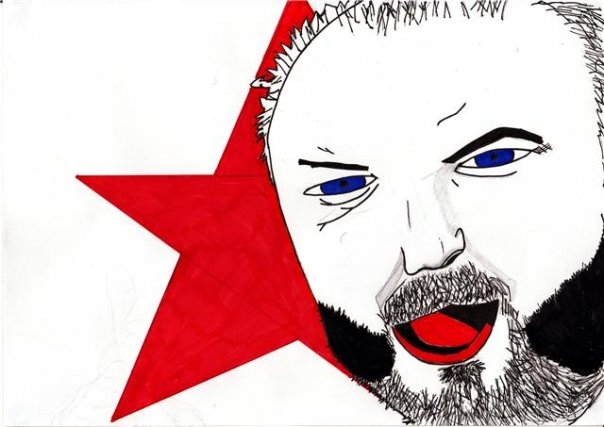
    Sean Burn – ‘Power to the Republika People ov the Fallen’
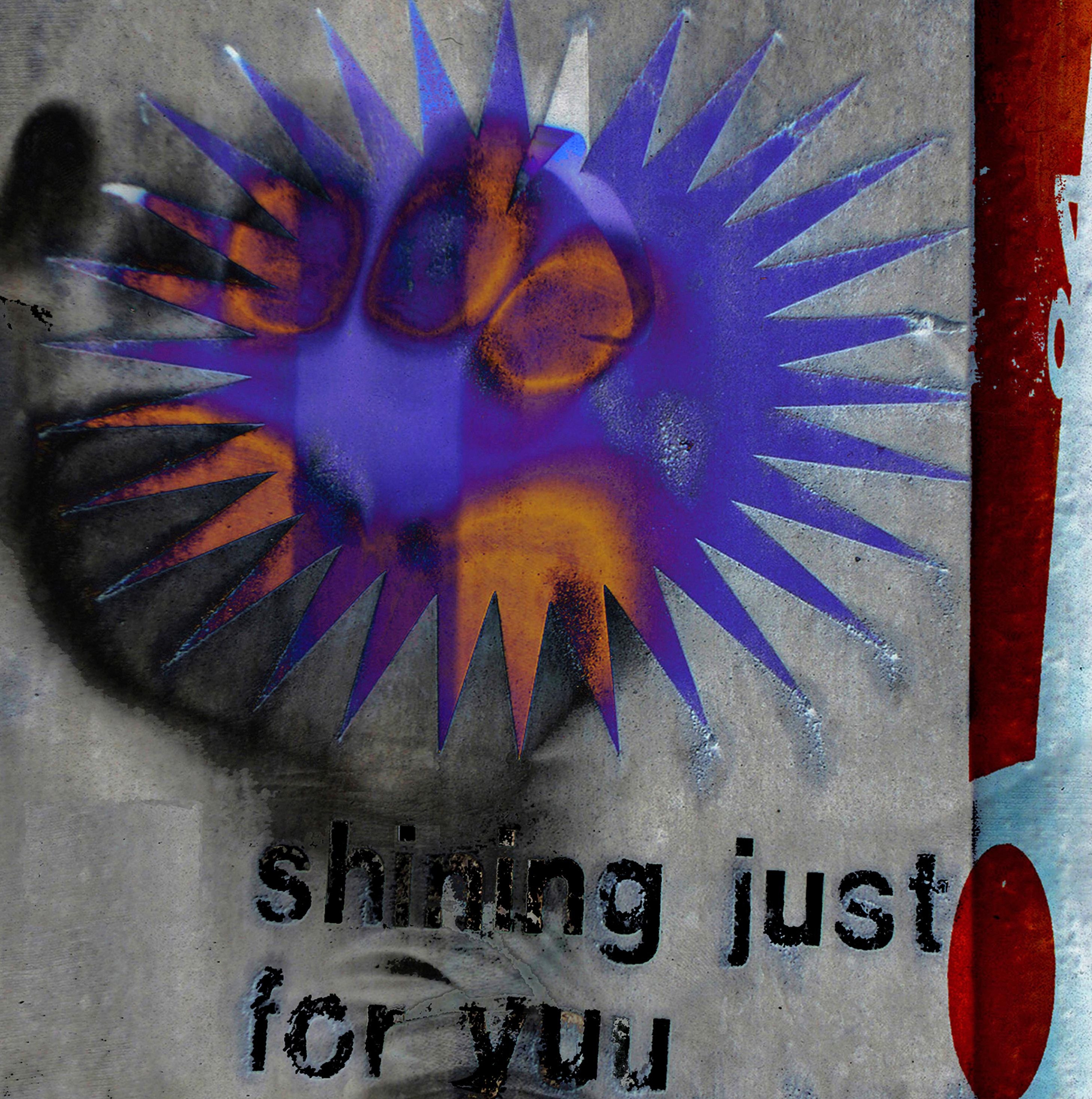
    Sean Burn – ‘Shining Just for Yuu’


    See more of Sean’s work:

    www.outsidein.org.uk/sean-burn

    www.flickr.com/photos/burnsean


  • Kye Wilson

    Kye Wilson

    I am always keen to hear from artists who would be interested in a blog post focusing on their work. Usually, I ask for an artist’s statement and a few images which they would like to showcase, but these guidelines are very flexible and I am open to suggestions. If you would like a post on your work, please do contact: kdoutsiderart@yahoo.com.

    This post will focus on the work of Kye Wilson.

    Above image: Kye Wilson, ‘Self-[Other]’ (video still)


    Kye Wilson is a visual artist and filmmaker who uses moving image to create short films and video installations that explore the notions of space, self and other. A signature characteristic of his work is the embodiment of (him)self through the medium of video, usually in the form of a female protagonist, character or performer. Wilson has exhibited in cinematic, art gallery, non-gallery/heritage and site-specific environments, nationally and internationally. His work has been selected for broadcast worldwide and has acquired numerous awards and commissions from Festival of Video Art Kinolevchyk; Madrid Festival of Contemporary Audio-Visual Arts (MADATAC) and Hayward Gallery.


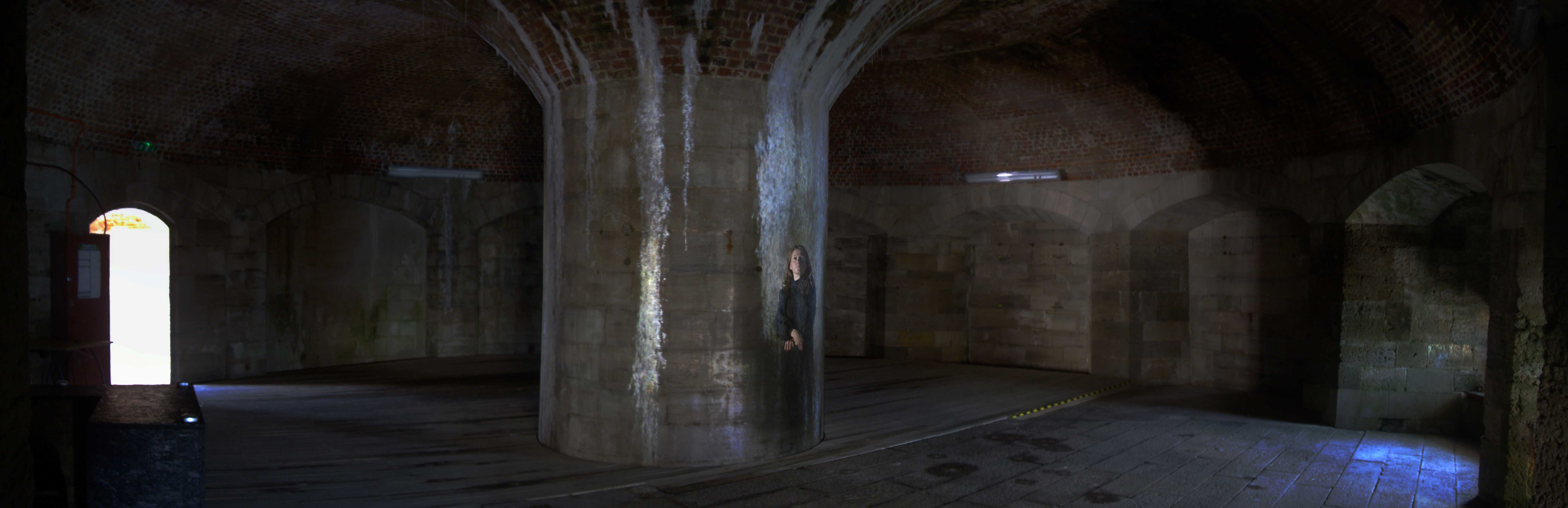
    Kye Wilson, ‘Entrapment of the o/Other’ (installation view, The Round Tower, Portsmouth, 2011)
    Kye Wilson, ‘Entrapment of the o/Other’ (video still)
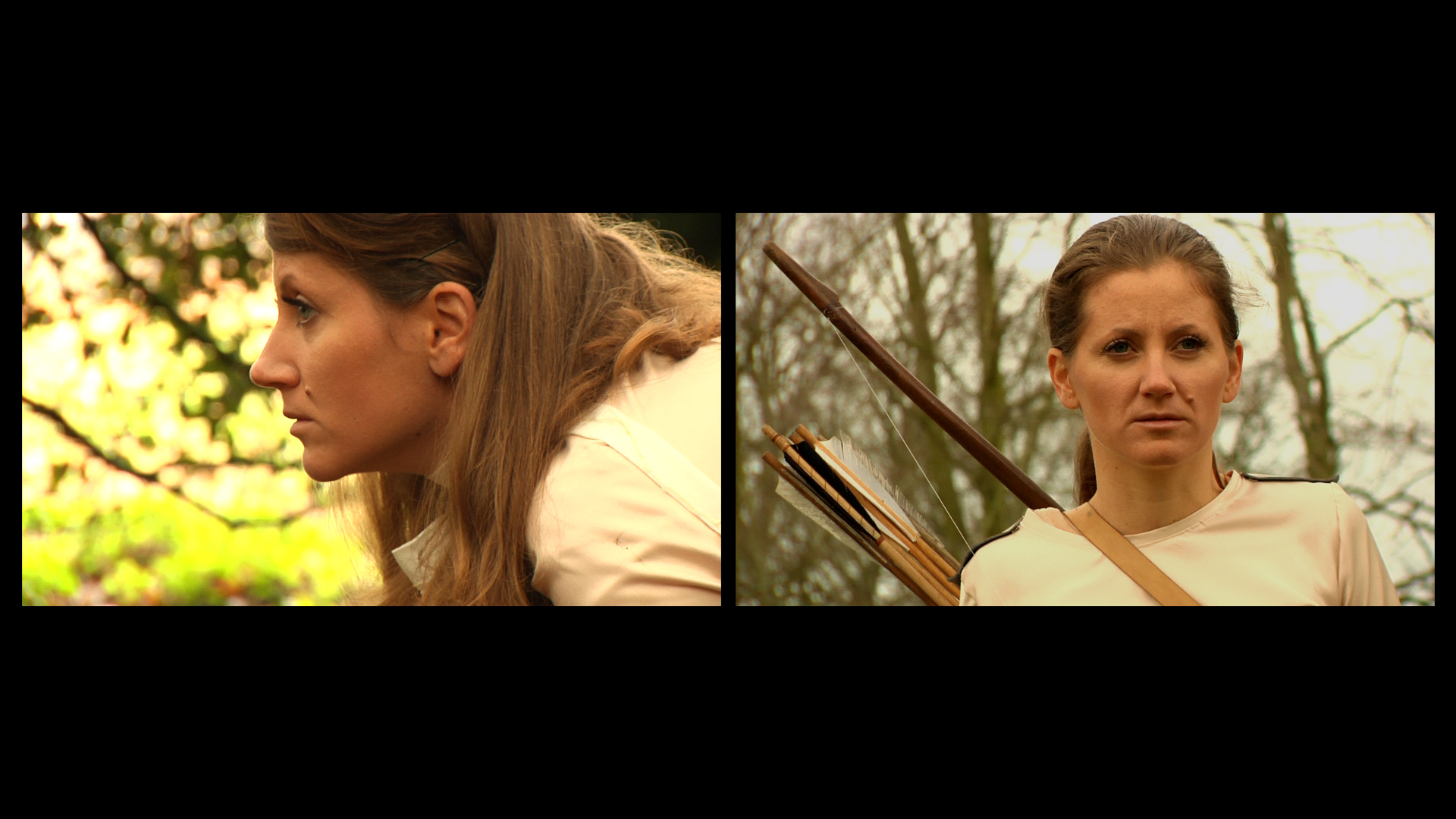
    Kye Wilson, ‘Hunter/Hunted’ (installation view, Mottisfont, Near Romsey, 2012)
    Kye Wilson, ‘Hunter/Hunted’ (video still)
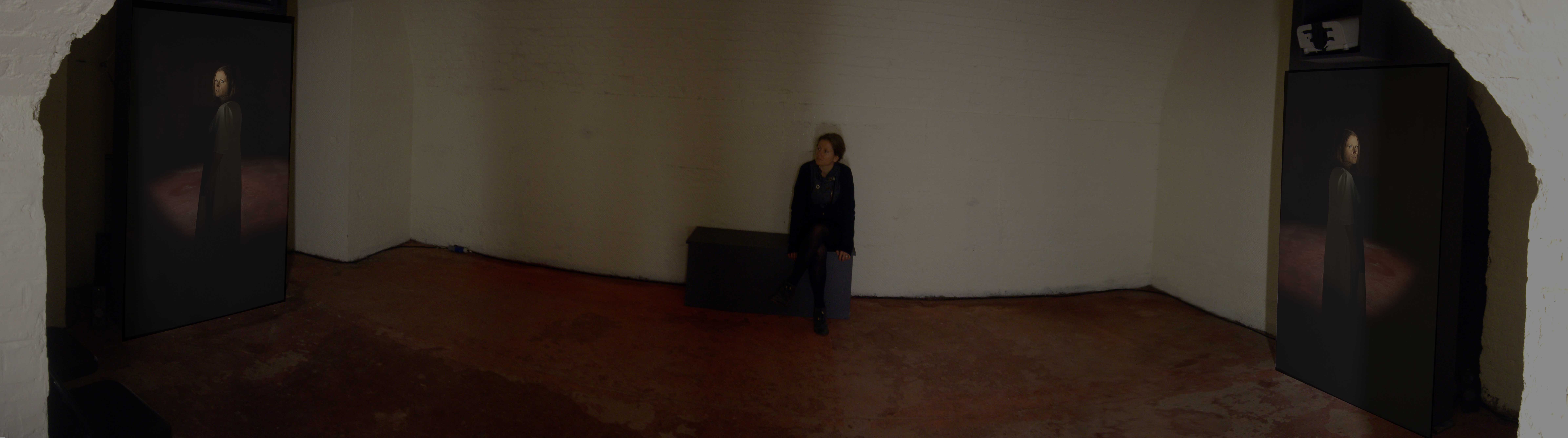
    Kye Wilson, ‘Self-[Other]’ (installation view, The Point Barracks, Old Portsmouth, 2011)

     Visit Kye’s website:

    www.kyewilson.co.uk

  • Liam O’Carroll

    Liam O’Carroll

    I am always keen to hear from artists (and in this instance, writers) who would be interested in a blog post focusing on their work. Usually, I ask for an artist’s statement and a few images which they would like to showcase, but these guidelines are very flexible and I am open to suggestions. If you would like a post on your work, please do contact: kdoutsiderart@yahoo.com.

    This post will focus on the written work of Liam O’Carroll.


    I am a writer and an actor.  These two strands usually stay separate but i am at my happiest when occasionally they unite and I get to perform material of my own.  However, as my acting would not be appropriate for this showcase, the creative strand I wish to share here is my writing.  The results of blindness provide such a resource of ideas but rather soberingly, were I to somehow regain significant sight, much of what I hope to write would be lost.  Therefore it is also important to explore work outside of disability.  To that end I have submitted a piece unrelated to visual impairment, though the reader is of course at liberty to make their own interpretations.” – Liam O’Carroll


    Value for Money

    By Liam O’Carroll

    Olly knocked on the open door of the office.

    ‘Ah, Hobson!’ exclaimed Professor Deeping glancing up from his computer.  ‘Come in.’

    Hobson? thought Olly as he stepped into the room, not used to being called by his surname.  Surely that was a bit offhand, like being in the Army or something.

    ‘Now, Hobson, your essay.  You’ll find it on the futon.’

    Olly stared down in dismay at the sheaf of papers.  It was the worst grade he’d ever received.  For anything, a devastating D.  If the mark was humiliating, it was nothing to the ensuing tutorial.  What made it so belittling was that his mentor conducted the verbal evaluation apparently from memory.  Throughout the interview the Professor barely took his eyes from the computer screen and yet his appraisal of the piece was as full, detailed and accurate as if he was the one holding the A4 sheets.

    ‘Forgive me if I continue my revisions as we go.  My latest article.  Highly lucrative.’

    Olly didn’t feel inclined to object, just stood aghast as his tutor explained the reason for so poor a mark, his words accompanied by the sound of feverish typing.

    ‘Your essay is deeply flawed.  No, let us be honest.  Your essay is shit, or as they seem to say up north, shite.  You repeatedly deviate from the question.  Some of your points are relevant, but so they should be.  Of these points, four were interesting, the rest ranged from the obvious to the … well, they were what my schoolteachers used to describe as waffle.’

    Olly blanched at this.  He hadn’t thought it that bad.

    ‘This was clearly left to the last minute.  I will say nothing of the spelling and punctuation mistakes or tangled syntax.  These are beneath me and, indeed, you.

    Now I expect you were probably hoping I’d just give you a vaguely average mark and leave it at that, but that wouldn’t be giving you your money’s worth.  Very important, value for money.  Top-up fees and all that.  I dare not fob you off with empty blather worthy of your own assignment.’

    Professor Deeping punctuated this latest comment by stabbing the enter key with particular venom.

    ‘You feel despondent? that is a good sign.  The answer is to, how should I say; withdraw your finger from its customary domicile, yes?’

    Olly grunted and nodded his head, now feeling utterly ashamed.

    ‘Take on board these comments, my boy, and act on them, your writing will prosper.  For a start, don’t leave it so late.  You had six weeks to write 1500 words.  Make a start when the pressure is off.  Allow the knowledge of the ample time ahead to lift your confidence.  But then use that confidence.  Apply it to the assignment; don’t let it lead you into five weeks of leisure and levity.  They will be five weeks of folly followed by one of panic ending in a summary humiliation at the hands of your tutor – assuming that he or she has any integrity.

    Next thing, focus completely on the question, plan the structure, write clearly, don’t make it up as you go along.  It should be like a stick of rock with a consistent thread throughout.  Nothing superfluous should be permitted.  Where it differs from the stick of rock is that it must develop its message: think of it as a chain, each link pertaining to the last but adding something new until the journey of your argument reaches its conclusion.  Have it proof-read before the final draught, allow time for last minute revisions, and ensure time to print out in a stress-free situation.  If you do this, your mark will rise as does the manhood of Dr Sutton on the appearance of his female students.  Your appalling mark is not due to a want of intellect.  If it were, I would be busily patronising you by now.  I have noted your contributions in seminars: you do have a brain, you’ve just been too lazy and foolish to use it.’

    Professor Deeping paused to lean back in his chair.  When he had finished yawning and stretching, he continued:

    ‘The clarity and honesty with which I address you here is precisely akin to the way you should engage your studies.  Don’t force the square peg of a bad point through the round hole of the evidence.  Be honest.  Be clear.  Focus on what it is your essay addresses and do not deviate.  Make your points, back them up and draw your conclusions.  For instance, I made a point recently to one of my female students that her body language betrayed an active libido.  I cited the following evidence: her pupils were dilated, she seemed breathless, she was wearing abundant perfume and her blouse was undone showing more naked breast than usual.  I drew the conclusion that she was about to meet her lover, that the first flush of romance was still present, her thoughts were dominated by the memory of what they had shared on their last meeting.’  The Professor paused momentarily.  ‘Perhaps not the best example, for, as it proved, I was wrong.  The girl told me that in fact I was the one for whom the fragrance had been applied and the buttons left undone.  She desired me.  This was somewhat embarrassing for I was unable to requite her lust.  I don’t normally like women, though as a gay man I gather I am supposed to.  But I recognise a good brain when I see it and I don’t like it going to waste.  I suppose I was flattered that she coveted me, but I was bound by professional duty, to say nothing of my sexual orientation.  Now, Hobson, had you come in here all aromatic and scantily-clad instead of unshaven and smelling like a docker’s armpit, we might have stumbled on a way to guarantee that you never received such an abysmal grade again.  Now, if you’ll excuse me, I am a very important academic.’

    And after a wary glance towards the futon, Olly hurriedly withdrew.


    Many thanks to Liam for sending this piece of written work and his artist’s statement.

  • What’s On: Talks this Coming Season

    What’s On: Talks this Coming Season

    Here is a run down of some interesting talks happening in the ‘Outsider Art’ world over the next couple of months. Let me know if you hear of anything else that we could add to the list by emailing: kdoutsiderart@yahoo.com

    (Featured Image: Ben Wilson, source: http://www.ibtimes.co.uk)


    Wednesday 7th November, 6.30pm

    Inside the Outside
    Where: Institute of Contemporary Art, London

    Looking to re-evaluate the notion of the ‘other’ in art, Inside the Outside takes a closer look at the tendency in 20th and 21st Century art to exoticise non-traditional, non-western or non-academic creative practices. Speakers include Dr. Leslie Topp – Senior Lecturer in History of Architecture at Birkbeck, University of London, and James Brett – founder and director of the Museum of Everything, and artist and writer Neal Brown.

    Price: £12 (£10 concessions)


    Thursday 15th November, 6.00pm

    Ben Wilson: From Wood Sculptor to Chewing Gum Artist
    Where: Pallant House Gallery, Chichester

    Ben Wilson is best-known for creating tiny pieces of art on chewing gum stuck to the street, but he also paints and sculpts and has exhibited internationally. This talk will comprise of him speaking about his life and his creative processes.

    Price: Free (booking essential)

    Ben Wilson. Source: http://www.telegraph.co.uk/news/picturegalleries/howaboutthat/3703065/Chewing-gum-art-on-the-streets-of-Muswell-Hill-by-Ben-Wilson.html

    Thursday 29th November, 6pm

    Roger Cardinal: The Marginal Arts
    Where: Pallant House Gallery, Chichester

    In 1972 Roger Cardinal first coined the term ‘Outsider Art’ as an English equivalent of Art Brut. In this talk he discusses the unlikely skills, powerful emotional resonances and seductive beauty of the ‘marginal arts’ including rural Folk Art, Child Art, Graffiti and Outsider Art.

    Price: Talk & wine £12
    Talk only £8.50 (students £7.50)


    Saturday 1st December, 2pm

    Museum Talk: Kaleidoscope Cats
    Where: Bethlem Museum, Beckenham

    Consultant psychiatrist Dr David O’Flynn will talk about the myths surrounding Louis Wain’s ‘Kaleidoscope Cats’ series from a clinical perspective.

    Louis Wain’s Cat paintings from the Guttman-MacClay Collection, Institute of Psychiatry London. Source: http://manualoracle.org/index.php?/visual/louis-wain-cats/

    Saturday 1st December, 2pm

    Lecture: The Weather in Darger
    Where: Intuit: The Center for Intuitive and Outsider Art, USA

    Henry Darger’s fascination with the weather is one of the best known facts about him. From his weather diaries to the extreme weather events — tornadoes, floods, wildfires — that fill his writings and paintings, evocations of the weather and its effects pervade his work. This has attracted lots of attention but relatively little analysis. In this lecture, Michael Moon will present some of the connections one can make between Darger’s intense concern with extreme weather and what we can know of his religious beliefs, his creative practices, and his general way of living.

    Price: Free with admission

    Henry Darger’s Book of Weather Reports. Source: http://www.art.org/2012/10/lecture-the-weather-in-darger/

    Thursday 6th December, 6pm

    Laurent Danchin on Dubuffet
    Where: Pallant House Gallery, Chichester

    Jean Dubuffet is best known as the father of Art brut, coining the concept in 1945 and creating a celebrated Art Brut collection. Laurent Danchin, Editor of Raw Vision France, explores the complex, intricate and controversial universe of the renowned French artist.

    Price: Talk & wine £12
    Talk only £8.50 (students £7.50)

    Jean Dubuffet, ‘Epoux en visite’. Source: http://www.applicat-prazan.com/en/en-artistes/2011/en-jean-dubuffet/attachment/en-dubuffet-2/

    Friday 7th December – Saturday 8th December

    Pain and its Meanings
    Where: The Wellcome Collection, London

    Is pain really so difficult to articulate? Or can it actually generate creative expression? If so, what do these narratives tell us about the meaning of pain? Some believe it has the power to purge sin; others interpret it as an unjust punishment. Pain can even be regarded as intrinsic to achievement – ‘no pain, no gain’.

    This unique two-day symposium will bring together some of the liveliest and most widely respected creative and scholarly minds to prod, probe and discuss profound questions about the relationship between body, mind and culture. How and why do we give meaning to bodily pain?

    Price: £30 (£25 concessions)


    Saturday 8th December, 2pm

    Museum Talk: Cats at Christmas
    Where: Bethlem Museum, Beckenham

    Join the Archivist for a free talk about Wain’s later life and his Christmas cats. There will also be an opportunity to pick up last minute gifts at the Bethlem Gallery’s Art Fair. 


    Don’t forget to follow us on Twitter for up-to-date news on what’s going on: @kd_outsiderart

  • Can we Place ‘Outsider Art’ within an Historical Context?

    Can we Place ‘Outsider Art’ within an Historical Context?

    Whenever someone asks me about Outsider Art, I always find it really difficult deciding where to begin. I know I have already written a ‘brief history’ of Outsider Art on my ‘About’ page, but that is more of an overview in comparison to this post. I thought it would be interesting to share some of the research I did whilst writing my dissertation with regards to the emergence and history of Outsider Art; a ‘movement’ that appears to be floating on the outskirts of traditional art history. This post will locate where I think Outsider Art really came from, and the key exhibitions and events that saw its apparent emergence during the ‘golden years’ of 1880 and 1930.


    Can we Place ‘Outsider Art’ within an Historical Context?

    A history of ‘Outsider Art’ is somewhat intangibly difficult to offer. Unlike other art movements, it did not specifically emerge from a precursory movement; it is in essence ‘an art bereft of historical and cultural context.’[1] However, if we begin somewhere, it is undoubtedly with the change in treatment towards psychiatric patients at the turn of the twentieth century. A more humane philosophy within the psychiatric institutions of Europe meant that psychiatrists were becoming more interested in the day to day lives of their incarcerated patients. In terms of psychiatry and the treatment of the mentally ill, the nineteenth century became the ‘century of the asylum.’[2] Before this period, patients had been incarcerated in overcrowded, abusive ‘madhouses’, alongside criminals and the terminally sick.

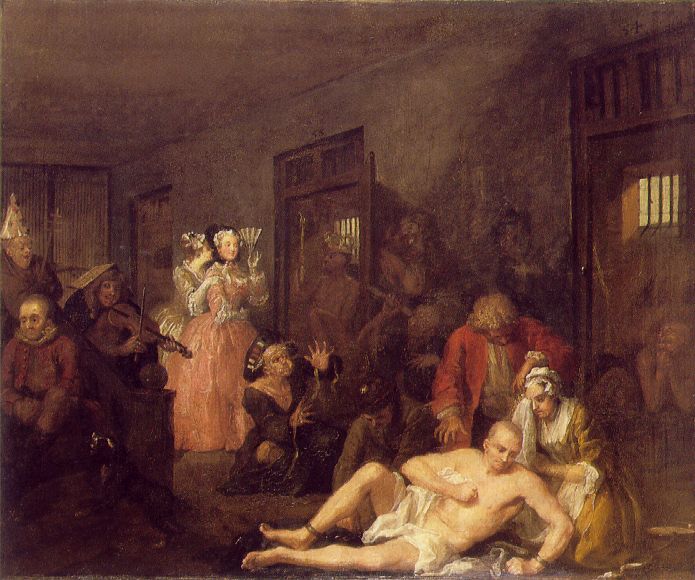
    Hans Prinzhorn, a pioneering collector of art created by those in psychiatric incarceration, was appointed in February 1919 to oversee the collection of art created by patients at the Heidelberg Psychiatric Clinic. It was Prinzhorn’s Artistry of the Mentally Ill (1922) which really drew peoples’ attention to ‘Outsider Art’ as an aesthetic and artistic endeavour as opposed to a pathological one. Prior to the publication of Prinzhorn’s book, landmark exhibitions of ‘Psychotic Art’ were held in both 1900 and 1913 at Bethlem Royal Hospital, which has a gallery and archives dedicated to the work of its past and present patients. This was seen as quite a progression, considering it was at Bethlem that just a century earlier the mentally ill were humiliatingly exhibited as objects for the entertainment of wealthier classes (see image below).

    William Hogarth, ‘The Rake’s Progress: The Rake in Bedlam’, 1735
    This piece shows two wealthy women who have paid to view the ‘madness’ of Bedlam.

    Similar exhibitions to the first two held at Bethlem were subsequently held in Berlin and Moscow, and the first ‘mad museum’ was opened in France in 1905.[3] Outsiders: An Art Without Precedent or Tradition, held at The London Hayward Gallery in 1979 was the first major survey exhibition of Outsider Art; since then, exhibitions have appeared all over the world in institutions such as the Tate and Whitechapel Gallery as well as in large European and American museums including the Los Angeles County Museum of Art. The ‘discovery’ of ‘Outsider Art’, Rhodes claims, ‘was part of an extensive search by modernist painters… for new forms of art that offered an alternative to what they perceived as the dried-up academicism of the western tradition.’[4]

    Jean Dubuffet, pioneer of Art Brut penned a manifesto entitled Art Brut in Preference to the Cultural Arts inn1949, in which he intended to ‘valorise the idiosyncratic creative works of individuals which he considered to be outside “the system”,’ but also to ‘directly challenge and undermine the authority of “high culture” and conventional definitions of art.’[5] This manifesto, and this period just after the end of the Second World War, saw a rise in interest in the works of Brut artists, yet Dubuffet was keen to keep these works infinitely separate from works within the ‘cultural mainstream.’ In 1972, Roger Cardinal coined the British term ‘Outsider Art’ as an alternative to the French term penned by Dubuffet.

    In the present day, we can still see some links to what I will call ‘traditional Outsider Art’; the art described and championed by Dubuffet and the works that Prinzhorn identified in his 1922 publication with regards to what we may include today as ‘Outsider Art’. However, the turn of the twenty-first century has seen the art world become more accepting of ‘Outsider Art’; over a century after its initial emergence. Many of the artists grouped under the term have gone on to find artistic fame within their lifetime; something unheard of during the early years.

    The term has definitely expanded, and during its expansion, it has become ever more difficult to place it within an art historical context. Since its very first emergence during those ‘golden years’, it has extended over a period of over a century; something which cannot be said for other, more ‘mainstream’ art movements (the isms for example: Impressionism, Fauvism, Cubism etc.). Perhaps it defies an art historical context. This is actually something that I quite like the idea of. Whilst ‘professional’ artists continue to create in a linear manner, with much regard and consideration for what has gone before, ‘Outsider Artists’ make art that is raw and, although not isolated from contemporary culture (this is a whole other debate – Dubuffet’s claim that the work of traditional Brut artists was always, without question, untouched by culture is something I wholeheartedly disagree with in every respect), it is not dependent on what has happened historically. It is art of the people, rather than the art of an era.

    References:

    [1]A. Fitzpatrick ‘Research Assistant Report’ in Framing Marginalised Art, 2010, p30

    [2] J Harsin, ‘Gender, Class and Madness in Nineteenth-Century France’ in French Historical Studies, 1991, p1050

    [3] C. Rhodes, Outsider Art: Spontaneous Alternatives, 2000, p53

    [4] Rhodes, Spontaneous Alternatives, p8

    [5] Fitzpatrick, ‘Research Assistant Report’, p 11

    (Image Credit: Judith Scott, image from: http://www.judithscottdocumentary.org/press-photos.htm)

    © Copyright, Kate Davey, 2012

  • Joe Cook

    Joe Cook

    (Featured Image: Joe Cook, UV)

    I am always keen to hear from artists who would be interested in a blog post focusing on their work. Usually, I ask for an artist’s statement and a few images which they would like to showcase, but these guidelines are very flexible and I am open to suggestions. If you would like a post on your work, please do contact: kdoutsiderart@yahoo.com.

    This post will focus on the work of Joe Cook, who you can follow on Twitter: @joecooknow


    “My name is Joe Cook, I am 6 foot 2 inches and self-taught.  I make many mistakes and incorporate my natural naivety into my art projects. I am fascinated in particular by portraits and murals.”


    Joe Cook, Curtains


    Joe Cook, Yellow Ashleigh


    Joe Cook, Diane Abbott on depressing her mentions tab in her twitter account


    Joe Cook, Gorgeous George


    Joe Cook, Lady on Laptop

     Thanks to Joe Cook for supplying the images and his artist’s statement.

    Follow Joe on Twitter: @joecooknow


    ** A new post from September 2014 highlights some more recent work of Joe’s. Click here to see it.


  • Outside In: National, Pallant House Gallery

    Outside In: National, Pallant House Gallery

    (Featured Image: Carlo Keshishian, Over-Load)

    It is an exciting month ahead at Pallant House Gallery in Chichester this October as we see the opening of three exhibitions focusing on the work of outsider artists, or those who face barriers to the mainstream art world. The triennial competition, Outside In: National, will showcase works by selected finalists who submitted their work the competition earlier this year. Accompanying this ground-breaking exhibition will be a chance to see the fascinatingly diverse work of Pat Douthwaite and (for the first time in the UK in almost 50 years!) a major review of the work of Jean Dubuffet: father of Art Brut.


    Outside In: National
    27th October 2012 – 3rd February 2013

    ‘A Ground-breaking open-entry exhibition for artists producing work from the edges of society. The exhibition will showcase 80 works by over 60 artists selected from pieces submitted to the Outside In: National competition over the past year. From substance misusers to self-taught visionaries, the exhibition will provide a unique insight into the extraordinary breadth and vitality of work produced by individuals from outside the mainstream art world.’

    www.outsidein.org.uk

    Pat Douthwaite: An Uncompromising Vision
    23rd October 2012 – 3rd February 2013

    Despite an introduction to painting by J. D. Fergusson, whose wife Douthwaite had studied mime and modern dance with, Douthwaite was for the most part a self-taught artist. Because of this, she is often associated with Outsider Art in spite of her regular exhibition schedule. She was controversially not interested in establishing a place within the cultural mainstream and was always comfortable being linked to the term Outsider Art; her early work was even influenced by pioneer of Art Brut, Jean Dubuffet. Douthwaite lived a predominantly disorderly lifestyle; a lifestyle that involved a lot of travel and a lack of a permanent base or studio from which to work. Douthwaite worked in a variety of media including collage and assemblage, making her work as colourful as her semi-nomadic life.

    Learn more about Douthwaite’s life and work in the Pat Douthwaite ‘Step Up’ pack. Step Up is an innovative project that offers training for marginalised and outsider artists, enabling them to feel more confident delivering workshops and conducting in-depth research: www.pallant.org.uk/docs/stepupdouthwaitelowres_0.pdf


    Pat Douthwaite, Simon With a Gun, 1967


    Jean Dubuffet: Transitions
    20th October 2012 – 3rd February 2013

    Transitions will be the first major review of Dubuffet’s work for almost 50 years in a UK institution. Organised with the assistance of the Fondation Dubuffet in Paris, the exhibition will feature key paintings, drawings and sculpture from collections across France and the UK.

    Born in Le Havre in 1901, Dubuffet ran his father’s wine business for 17 years before returning to painting in his distinctively simple, primitive style. Dubuffet himself was fascinated by the work of children and the insane, eventually leading him to coin the term Art Brut in 1945, which translates as ‘Raw Art’. In 1949, Dubuffet produced a manifesto entitled Art Brut in Preference to the Cultural Arts, in which he intended to ‘valorise the idiosyncratic creative works of individuals which he considered to be outside “the system”,’ but to also ‘directly challenge and undermine the authority of “high culture” and conventional definitions of art.’ [Karen Jones et al., Framing Marginalised Art, 2010, p 11].

    By emulating the ‘crude, violent’ energy of the work of children and the ‘clinically insane’, Dubuffet soon had the term he coined applied to his own work, ‘rather than to their stylistic source as he had intended.’ [http://www.dubuffet.com/bio.htm]


    Jean Dubuffet, Le bariole Mariole, 1964


    www.pallant.org.uk

    www.outsidein.org.uk


  • Shadows of a Dream

    Shadows of a Dream


    Shadows of a Dream, a collaborative exhibition between Creative Future and Outside In, opened last Sunday (16th September) at Outside In: Gallery located in Wellington House Day Centre, Brighton. The exhibition showcases works by Maria Kuipers, Mercedes Gil Simon, Michelle Roberts, Jessica Levine and Neal Pearce.

    Jessica Levine’s work stems from sources including ‘personal travels, Kentish landscape, current affairs, childhood memories and textile designs.’ Jessica often explores ‘ideas using collage as… this is a useful process in realising finished pieces of work or in translating ideas using paint.’


    Jessica Levine, ‘Mexico’


    Maria Kuipers’ work focuses on ‘self’, and is underpinned by her interest in the human condition and passion for meaningful art. She often uses mixed media and aims for ‘material presence as well as mysterious imagery.’ Maria is an artist led by materials, and by taking an intuitive approach, she reaches into her inner self and works from the unconscious. She hopes that by trusting the creative process, she can make an art that is ‘beyond what is seen into the unseen.’


    Maria Kuipers, ‘Into the Dark (Breaching Boundaries Series)’


    Mercedes Gil Simon’s Black Paintings have evolved from photographs that she took as source material. They focus on night scenes of Brighton, or other cities which Mercedes has a connection to. The photographs are taken in the early hours of the morning to capture the unnerving calm of a city still sleeping. The works explore themes of Film Noir, and ‘convey an emotional and mysterious quality, creating highly evocative, atmospheric and subdued vistas.’


    Mercedes Gil Simon, ‘Black Paintings’


    Michelle Roberts has drawn and painted throughout her life; as a young girl, she accompanied her grandfather, a watercolour painter who often worked outdoors. She spends much of her free time drawing and painting, with the evolution of her works often taking weeks. Michelle creates ‘colourful and complex worlds, each with a distant logic and meaning that connect to her own life.’ Michelle is supported by Project Art Works, based in Hastings, who ‘produce pioneering visual arts projects for individuals with profound intellectual disability and multiple impairments.’


    Michelle Roberts, ‘A Mouse For Your House’


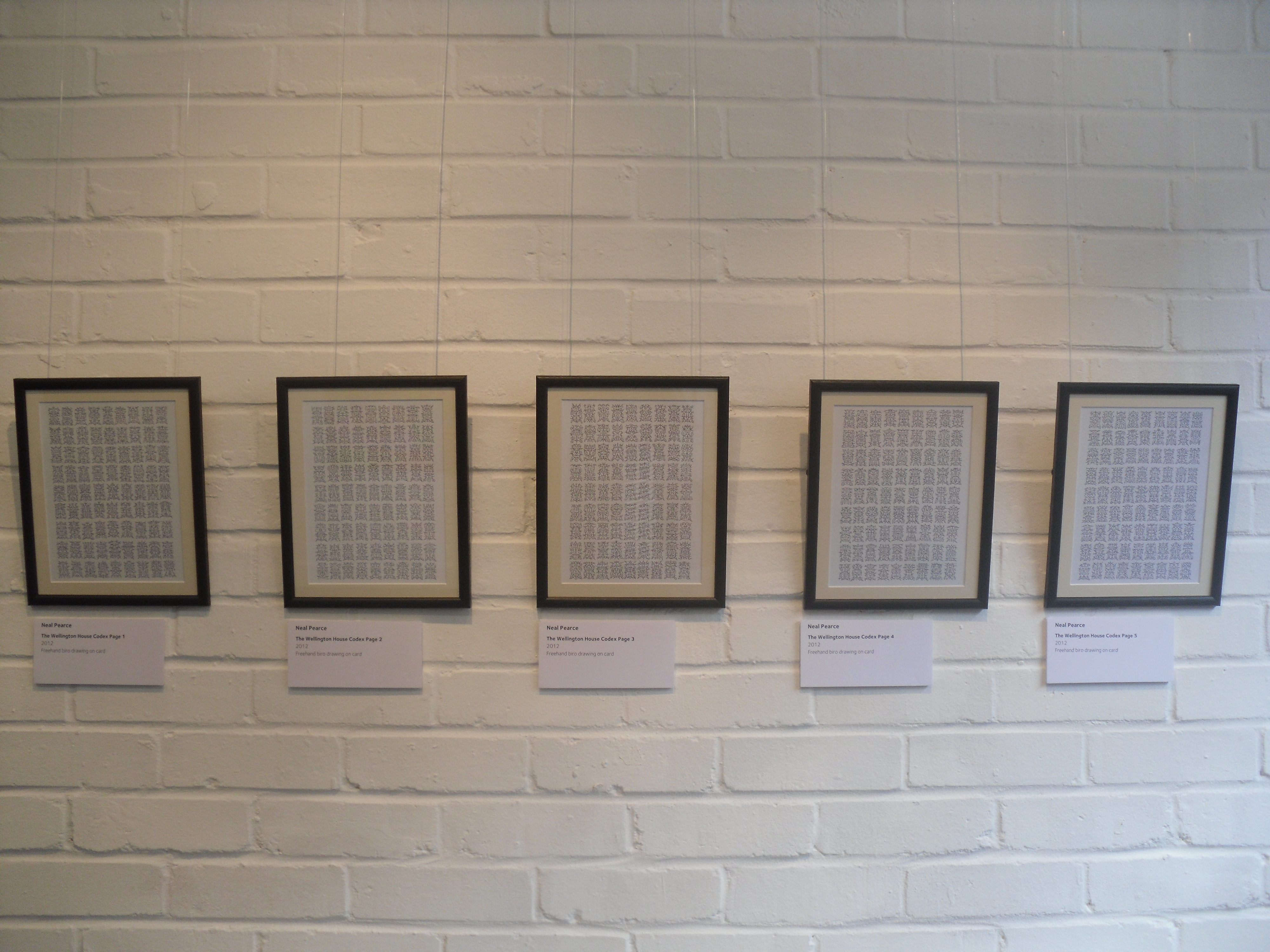
    Neal Pearce’s ‘The Infinite Codex’ was born in 1992, marking his departure from artistic and intellectual over-striving. Inspired by Douglas Adams’ Hitchhikers trilogy, Neal was intrigued by the depiction of Earth as the ultimate super-computer. ‘Could it be that each of us is encoded with invaluable data just waiting to be tapped – information far beyond the reaches of our worldly, tutored minds?’


    Neal Pearce, ‘Wellington House Codex’


    Shadows of a Dream is running until 21st Janurary 2013

    Outside In: Gallery
    Wellington House Day Options
    Wellington Street
    Brighton
    BN2 3AX

    Gallery opening times:

    Tuesday and Friday 1.30pm – 3.30pm
    Weekdays 9.30 – 3.30 (by appointment only)

    For more information visit:

    www.creativefuture.org.uk

    or

    www.outsidein.org.uk

  • Does Intention Have an Impact on what we Consider to be ‘Art’?

    Does Intention Have an Impact on what we Consider to be ‘Art’?

    I thought it was about time to produce another post on where I’m currently standing with regards to the never-ceasing debate on the definition of the term ‘Outsider Art’. This post is partially influenced by an article I came across this week, written by Jillian Steinhauer for Hyperallergic entitled ‘What Does “Outsider Artist” Even Mean’(see the end of this post for a link to the article). This post will focus on the idea of ‘intent’ – whether the intention behind creating a piece makes it ‘Art’ (with a capital A) – and what this means for ‘Outsider Art’.

    Steinhauer’s article was in essence influenced by a previous post from another Hyperallergic editor, Kyle Chayka, which discussed Wendy Vainity’s 3D web animations. Chayka claims of Vainity’s work – “Are the videos outsider art, or the work of a knowing artist making amazingly weird work on purpose?” Here, Chayka seems to be making no discernible difference between ‘strange artists’ and ‘Outsider Artists’. Is art about intentions, Steinhauer asks; and, “how much does – and should – the artist’s intentions affect how we receive his or her work?” Steinhauer draws on a 2007 blog post written by dealer Edward Winkleman who claimed that he couldn’t get himself “unstuck from an assumption about the importance of intent in art.” Winkleman continues, saying that “this assumption has led me to conclude that the work of Henry Darger, for example, is not ‘Art’ because (or so it’s been reported) he had no intention of ever showing it to anyone.”

    So, does intention define a work as ‘Art’? Perhaps it does – for example, many things in day to day life could conceivably be referred to as art, if they are placed into a gallery setting or bought by a known ‘Art’ dealer – but what stops them being referred to as such? Intent, I guess. This was the case with ‘ready-mades’, such as Duchamp’s Urinal  – taking something ‘every day’ and making it into art because of the intention behind it. Surely then, most ‘traditional’ ‘Outsider Art’ should not be classified as ‘Art’ (with a capital A). I, however, disagree with this. I’m still not sure how I really define ‘Art’ as such – can there ever really be a definition? And, likewise, I’m still not sure what defines ‘Outsider Art’. I am sure, however, that just because ‘Outsider Artists’ often never intended for their work to be seen in public doesn’t mean we can’t see it as ‘Art’ (with a capital A).

    Steinhauer’s article: ‘What Does “Outsider Artist” Even Mean?’