Blog

  • Alan Doyle

    Alan Doyle

    Alan Doyle on Tumblr


  • Kate Bradbury: Squalls and Murmurations

    Kate Bradbury: Squalls and Murmurations

    Open until 1 December 2013 at Pallant House Gallery, Chichester, Kate Bradbury: Squalls and Murmurations is the second exhibition in a series celebrating the Six Award Winners of Outside In: National 2012, a triennial competition for artists from the margins.

    Art Historian Roger Cardinal, performance artist Bobby Baker and ex-Director of Pallant House Gallery, Stefan van Raay, chose Kate Bradbury as one of six Outside In Award Winners as part of the 2012 National exhibition, for which one of the prizes was a solo exhibition in the Studio. Cardinal said of the competition and the subsequent winners: “It is about showing the public that ordinary people without training can produce great work. Art can happen anywhere in all sorts of places.”

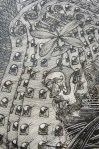
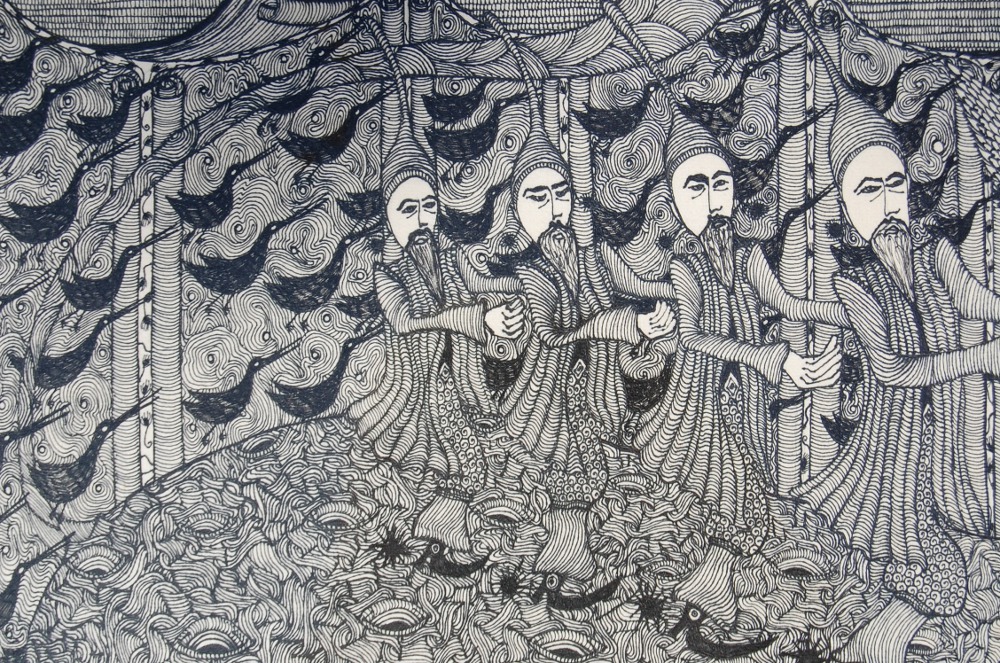
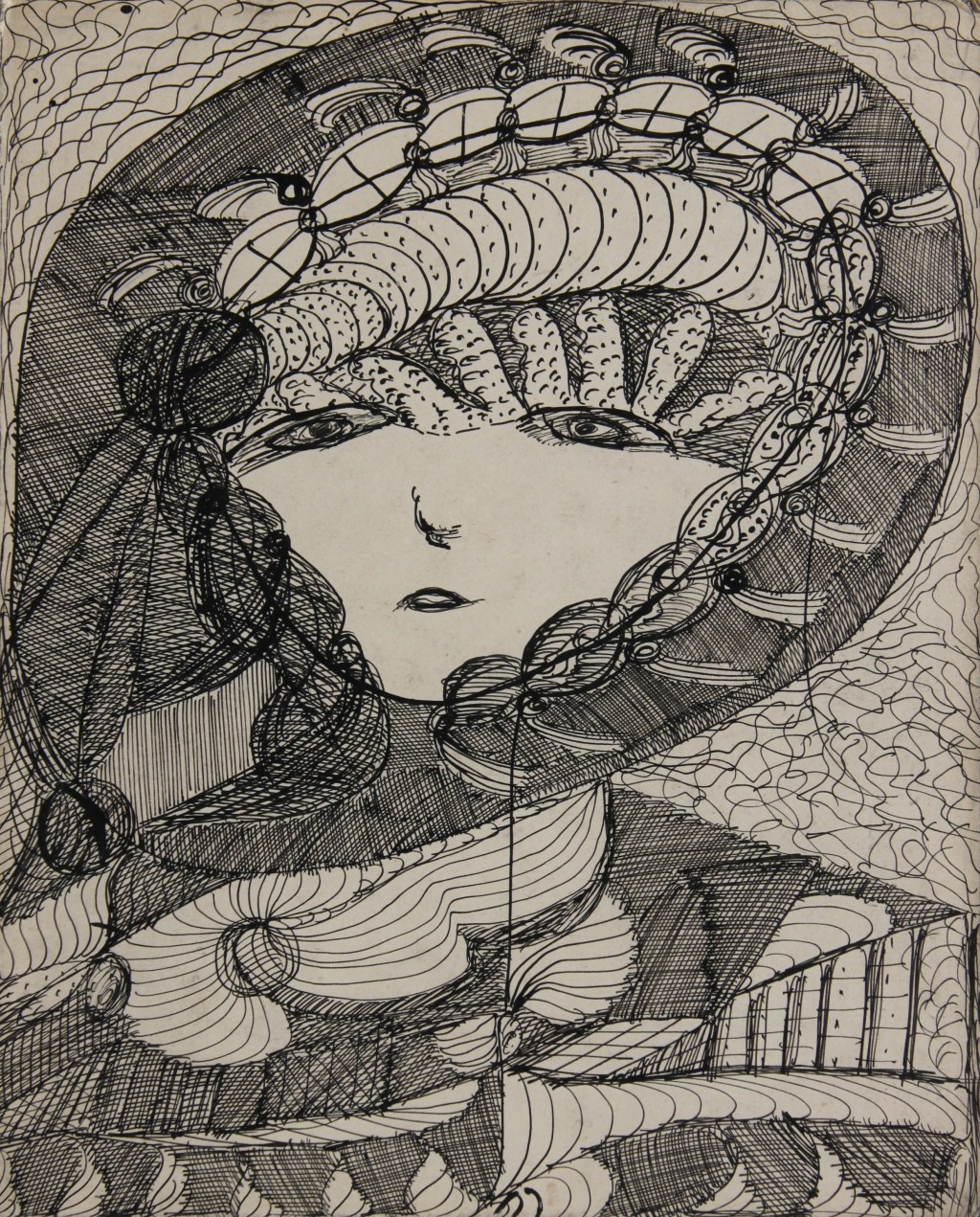
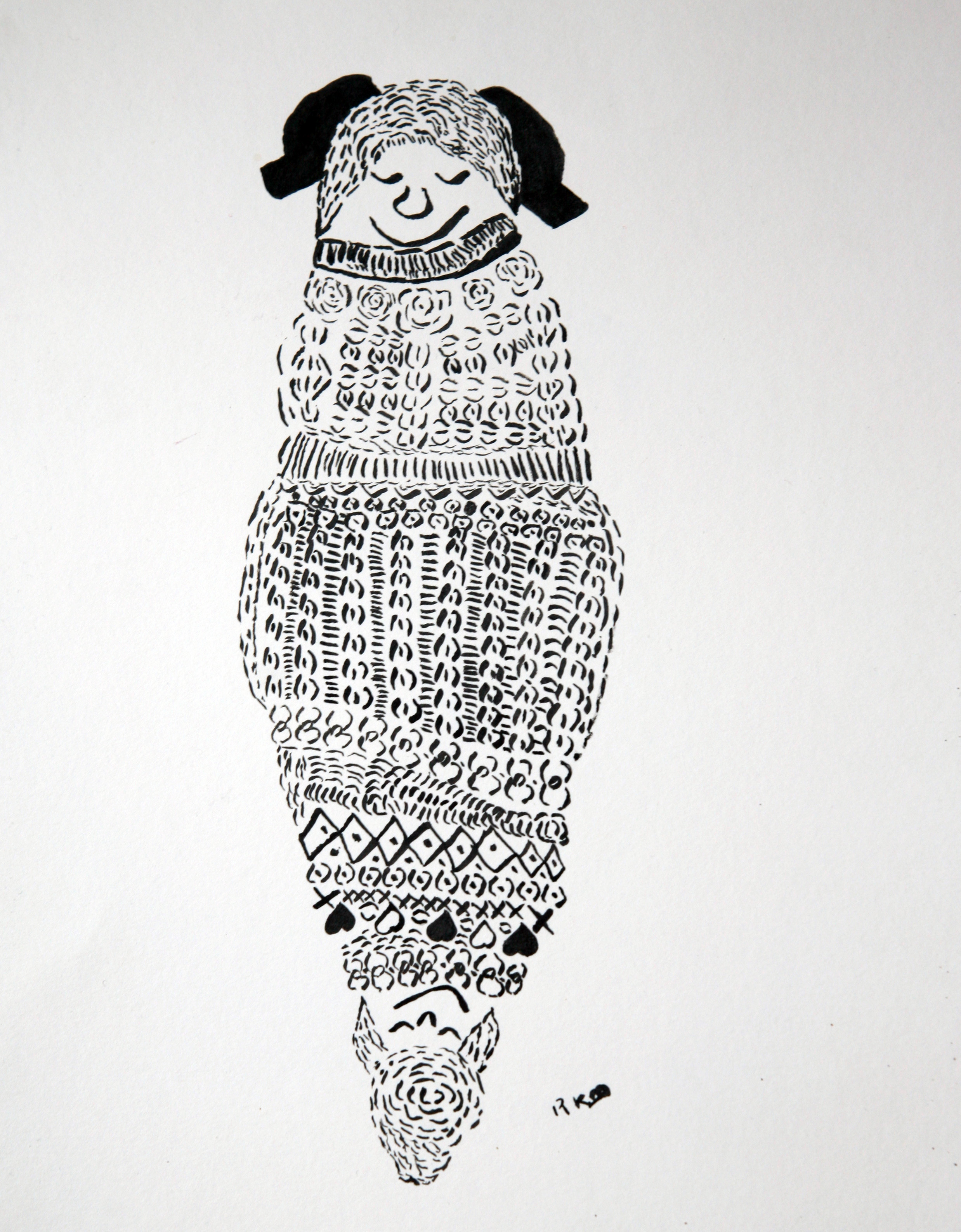
    Bradbury’s art career began some years ago in a run-down house in North London, where she started to intuitively make pictures and sculptures from abandoned belongings. Unearthing a role of thin Chinese paper and a well of black ink, an unforeseen tide of repetitive image and pattern-making promptly began. Bradbury also created sculptures from salvaged litter found in the tall, crumbling house.

    This obsession with found objects can perhaps be traced back to Bradbury’s childhood, where some family friends who were archaeologists would take her off into caves where she witnessed cave paintings with crude handprints and began finding and collecting things. Now, Bradbury collects material on her way to work, or on her way home from work – whatever she can find and wherever she can find it.

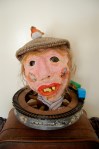
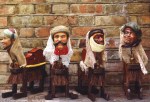
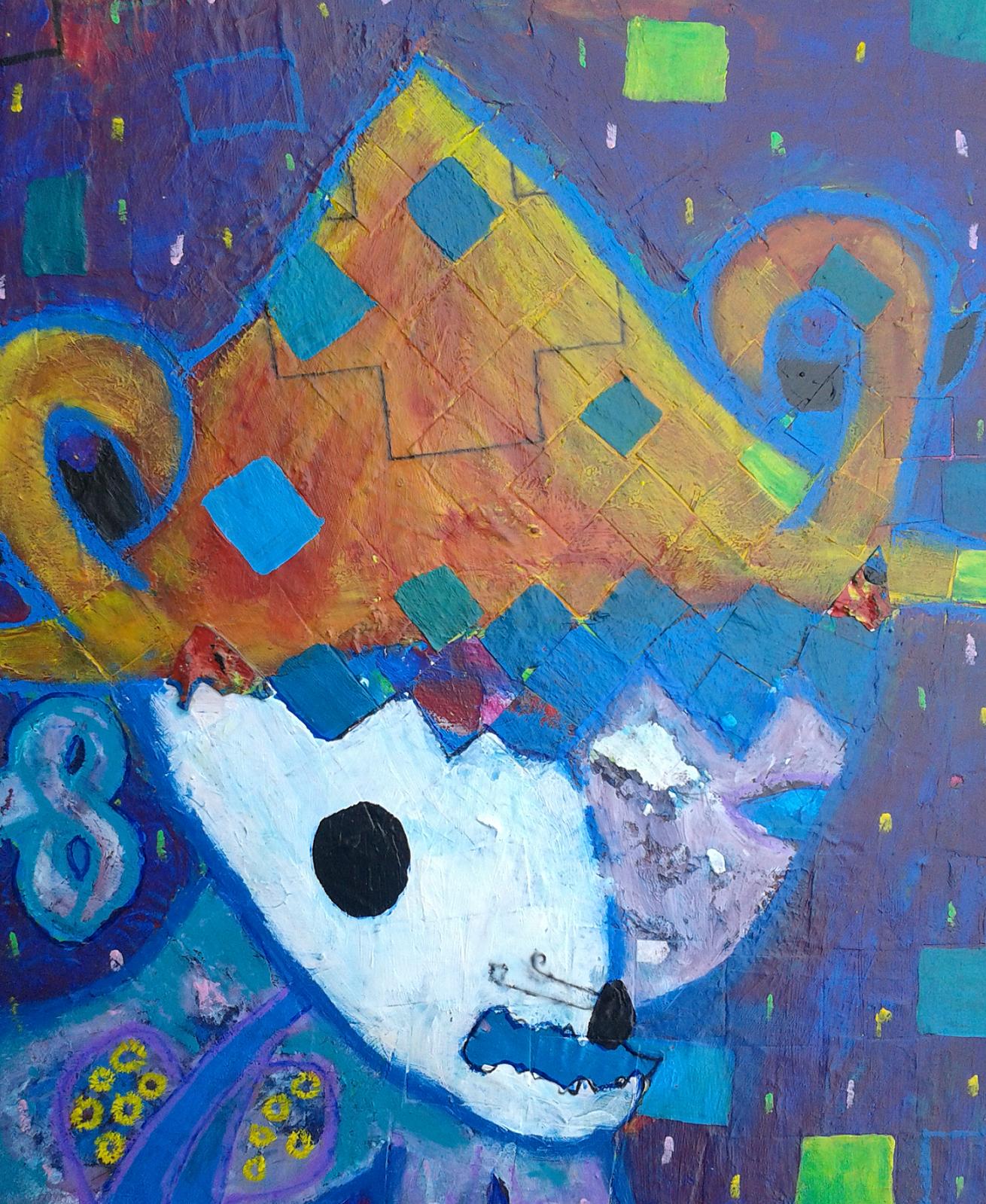
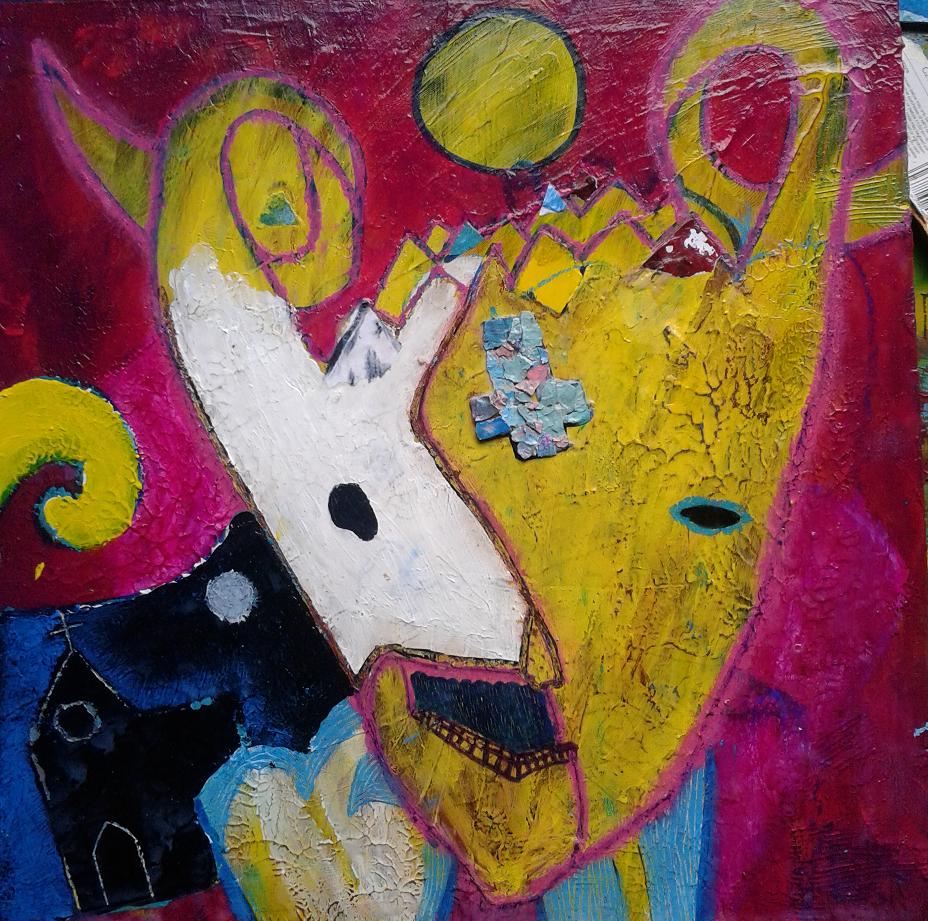
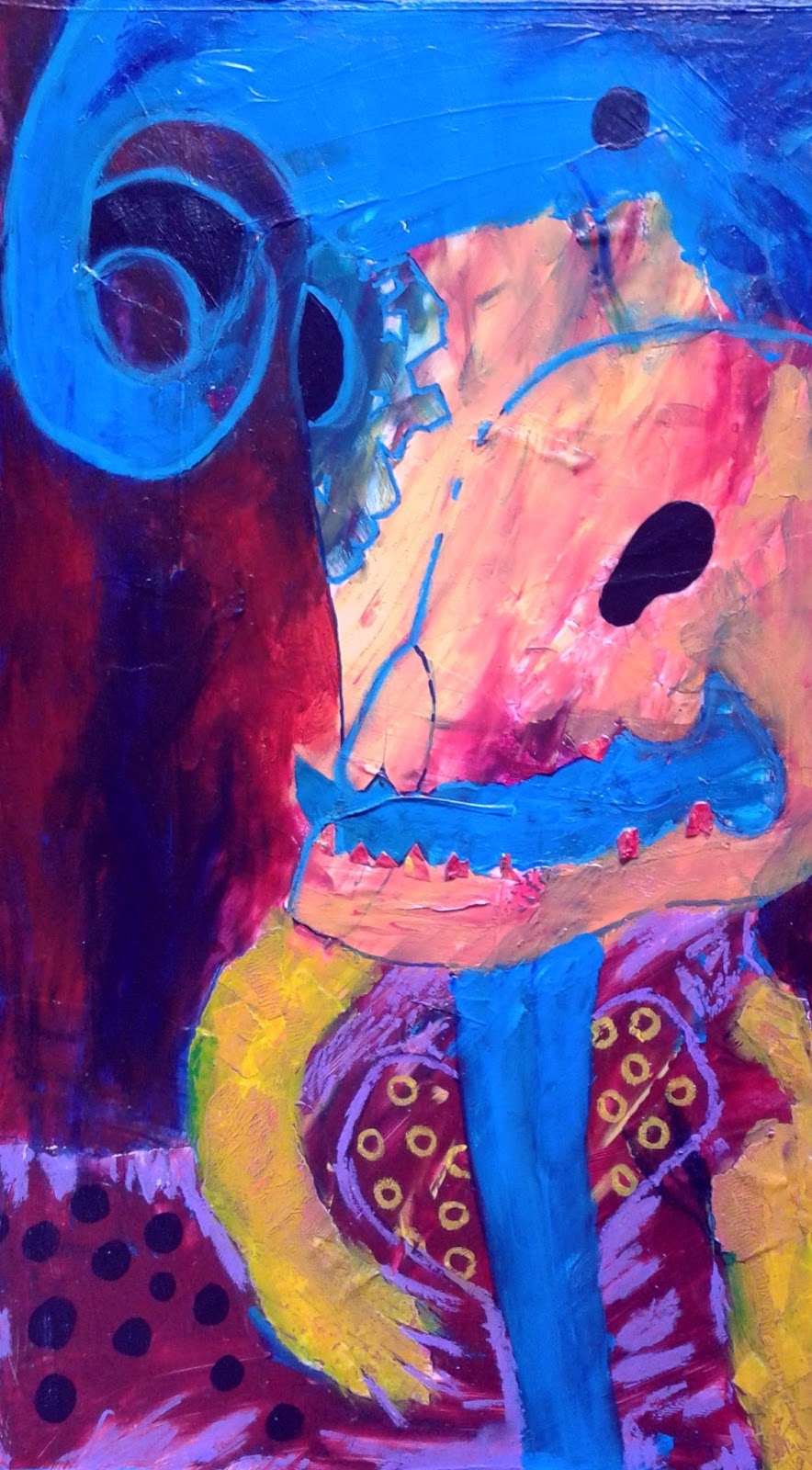
    Her suitcase people – the doctor, the artist, and Railroad Jim – all have their own personalities, each with a story inside their box-bodies. New additions to Bradbury’s family of sculptures are her ‘goat’ creatures. Constructed from the bristle-end of brushes, severed musical instruments and human faces, they came to life after Bradbury happened upon the ‘disembodied goat heads’ at her local car boot sale. Not wanting to separate a few goats from the herd, Bradbury took the lot before restoring them: “I have gifted them legs and bodies and I hope that one day soon I will have identified and practised the Holler that will alert a distant herdsman to their whereabouts, so that they may return to their native hills.”

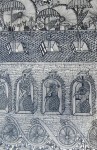
    To complement her trademark sculptures, the exhibition also includes some of Bradbury’s trademark ink drawings. It was one of these fantastical black and white worlds; The ones that I’ve been saving to make a feather bed, for which Bradbury was granted Outside In: Award Winner status. Bradbury says of her contrasting practices (sculpture and ink): “Both of these have become passions that fill both my waking and sleeping hours with ink-stains and splinters.”

    It is this diverse creativity that gives the exhibition its name. Bradbury explains: “A squall is a storm and that suited the swirly patterns in my drawings. The monoprints often have a stormy sky and a lot of the sculptures are crude and brutal in texture. Murmuration is playing on the word murmur, a much quieter space like the fine lines and delicate paper that I draw with. So it’s loud and quiet and reflects both sides of my work.”

    With no formal art education, Bradbury is inspired by known – Klee, Miro, Franz Kline – and unknown artists, stage sets, archaeology, visions, inventions, and by music and song. She thinks about ideas for her work whilst at her day job – in a sandwich shop – where she has the space to go to a different place in her head. She doesn’t make work to please an audience; she makes it because it needs to be made. She explains: “I get a picture of something in my head and then need to make it, to offload it and then I can think about something else. I get obsessed with an idea and try to see it through. I’d love to get a studio and be able to make some bigger or noisier work and I like the idea of making a stage set, working with animation and just to keep finding inspiration.”


    Outside In was set up by Pallant House Gallery in 2006 to provide opportunities for artists with a desire to create who see themselves as facing a barrier to the art world. The project’s main vehicle is a triennial open art exhibition which was first held in 2007 and featured 100 artists from across Sussex. By 2012, the project had gone national, engaging more than 1,500 artists and 13,000 audience members.


    Kate Bradbury: Squalls and Murmurations will be on in the Studio at Pallant House Gallery until 1 December 2013. Entry is free. Click here for more information.
    Outside In website
  • Art by Offenders: Strength, Vulnerability, and Forgiveness

    Art by Offenders: Strength, Vulnerability, and Forgiveness

    Above image: Lost Fruit | Thornford Park Hospital, The Tolkien Trust Silver Award for Drawing


    The Koestler Trust’s sixth annual UK showcase this year takes the form of ‘The Strength and Vulnerability Bunker’, curated by Mercury prize-winning rapper, Speech Debelle. The national exhibition, which is moulded yearly by a different group or individual, displays work by prisoners, offenders on community sentences, secure mental health patients and immigration detainees. 

    This year’s theme – the relationship between strength and vulnerability – was chosen as it threads together the work on display with Debelle’s music. Debelle’s political interventions (which include three albums pinpointing areas of social justice and injustice), make her the perfect candidate to provide a voice for those whose lives are being transformed by the power of art.


    “The Koestler Awards represent an injection of creativity, humanity and empowerment into the closed world of prisons” – Stephen Shaw, Prisons and Probation Ombudsman.

    This year’s exhibition has some strong, undeniably prison-centric, work. ‘Untitled’ by Patrick from HMP Leeds starkly shows the divide between the inside and outside. In it, a figure looks solemnly (although this is only an assumption, as all we can see is the back of his head) through the bars of what we can ascertain to be his cell. On the ‘outside’, skyscrapers loom above luscious green trees and two magpies – which symbolise joy in the well-known rhyme – perch on the prison boundary. There are, however, signs of life and hope within the confines of this prisoner’s cell. A butterfly rests on an arm, and two ladybirds and a spider scale the inside of the bars.

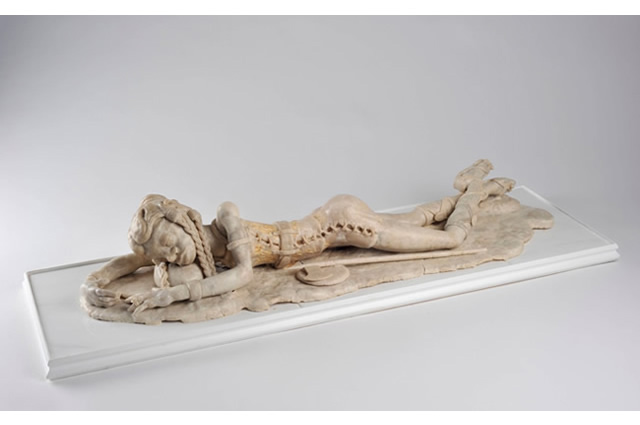
    Sleeping Brunnhilde | Derbyshire Probation Service, The Anne Peaker Platinum Award for Sculpture
    Sleeping Brunnhilde | Derbyshire Probation Service, The Anne Peaker Platinum Award for Sculpture

    ‘Not of the World’, by an inmate at HM Prison Cookham Wood, reflects “how far away the earth is when you’re locked up. Also, how far anything and anyone are from your reach in jail.” These are the artist’s own words. In the piece, a figure, plagued by darkness, looks longingly (again, maybe my assumption) towards the whole of the earth which sits uncomfortably out of reach on the horizon line.

    These two pieces quite obviously describe feelings of isolation, incarceration, and the loss of freedom. But there are more subtle pieces. ‘First Hour’, by an artist from Prison Littlehey and made entirely from chicken bones and glue, represents the feelings of a prisoner during the first hour of being ‘inside.’ Crouched over, the perfectly executed figure is both strong and incredibly vulnerable at the same time. Single chicken bones are extremely robust, but put them together as has been done with this sculpture, and they are fragile; the piece could topple or crack at any moment.

    The Dancers | HMP Brixton, The Patrick Holmes Platinum Award for Oil or Acrylic
    The Dancers | HMP Brixton, The Patrick Holmes Platinum Award for Oil or Acrylic

    Similarly to ‘First Hour’, other works on display are made out of any material that the artists could get their hands on. ‘Escape with a Book’, by an artist at HM Prison and Young Offender Institution Exeter is made entirely from soap, with the hands stained using tea bags. It was probably carved, as suggested by the exhibition host (an ex-offender employed to enhance the audience’s experience whilst gaining CV building skills), using a smuggled razor blade – something which makes it all the more intriguing. The artist was prepared to create this piece regardless of the rules.  ‘Sleeping Brunnhilde’,  by an artist from the Derbyshire Probation Service, was created using bread and PVA glue; such simple materials.

    The works on display were chosen from more than 7000 pieces of art created by prisoners, secure patients and immigration detainees, and each and everyone follows a personal journey reflecting on the meaning of both strength and vulnerability. The arts have been proven, more so in recent years, to be an incredibly effective way of engaging with offenders who are feeling isolated or alienated from mainstream education and employment.

    Creativity flourishes in prisons, more so than in any other institution; perhaps as a result of the physical incarceration.  This exhibition provides an opportunity for the artists to have their talents showcased, and is an example of how prisoners work through their feelings – in this instance strength, vulnerability and forgiveness – as part of their rehabilitation. Creativity and self-expression can often be the key to increasing self-esteem and self-efficacy; all proven factors in reducing rates of re-offending. Not to mention, the works in this exhibition are absolutely fantastic to look at – these artists are incredibly talented. Maybe once they have served their sentences, they can shake off that label of ‘prisoner’ ‘convict’ or even ‘ex-criminal’ and ‘ex-offender’ and instead be known more positively as ‘artists.’

    Garden of Eden, HM Prison Styal, Dalrymple Bronze Award for Sculpture
    Garden of Eden, HM Prison Styal, Dalrymple Bronze Award for Sculpture

    The exhibition is running until 1 December at the Southbank Centre, London. Click here for opening times and other information. 


    Exhibited artists on what the words ‘strength’ and ‘vulnerability’ mean to them

    “Without strength, you can’t go on. Without vulnerability, you can’t grow as a person. “

    “Being able to take a ‘warts and all’ look at myself through art does leave me feeling vulnerable to emotions I’ve closed off for years. However, I feel I’m in a safe environment with supportive peers and tutors. That is the strength of art.”

    “Strength means to me, someone who keeps going and keeps trying, no matter what obstacles they may face. Vulnerability means to me, someone who is human. Everyone is vulnerable and we all deal with it every day.”


    More information


  • Epiphanies! Secrets of Outsider Art

    Epiphanies! Secrets of Outsider Art

    Above Image: Kate Bradbury (courtesy of julianhartnoll.com)


    “Outsider Art is a movement of untrained artists with a burning desire and passion for expression that features art of an obsessive nature. Often this involves collecting debris shaped to express the inner thoughts and feelings of the creator. Some artists may suffer from mental health issues, others simply have no interest in conventional art practice.”

    Sue Kreitzman, a self-proclaimed ‘Outsider Curator’, and an Outsider Artist in her own right, is the co-creator of a very refreshing new Outsider Art exhibition; ‘Epiphanies! Secrets of Outsider Art’ opening at The Conference Centre at St Pancras Hospital on 25 September. Sue calls herself a ‘Typhoid Mary’: “People meet me and they catch the art virus. If they are established artists, they meet me and their work gets stranger.” She wants people to be inspired by her exhibitions, and for them to see what art can be – or what it really is.

    The exhibition aims to be an educational tool. For those who have not experienced Outsider Art, Sue wants to illustrate the scope of this genre. The show will include works covering a considerable range of content, media and style by almost 25 artists, all of whom Sue has personally befriended. “I love the art and I love the artists,” she says. There will be 3D pieces, drawings, paintings, and installations; a cornucopia of passionate works. The exhibition’s theme, as Sue puts it, is “art, the exhibition is about art.” It is possibly the first exhibition of Sue’s that has had such an open criteria – WOW was for ‘Wild Old Women’, and ‘Flashier and Trashier’ expanded on this to include ‘Wild Old Men’. However, all of the artists involved in ‘Epiphanies!’ have not had a formal art training.

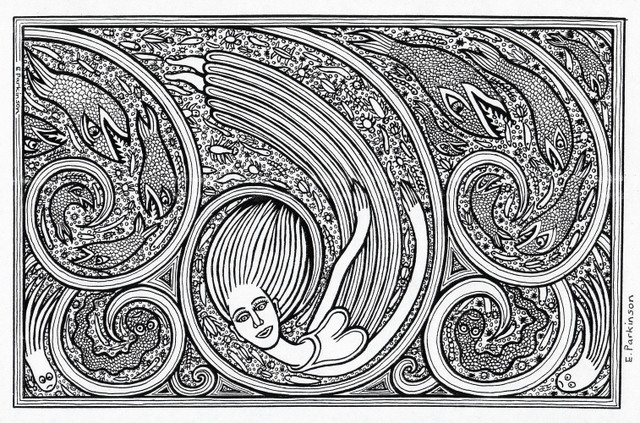
    One of the artists taking part is Valerie Potter. Valerie’s work is, Sue says, “like that of an angst ridden teenage boy, but then she comes in with the Jane Austen cross stitching. It’s very emotional to look at.” Liz Parkinson’s works are obsessive, repetitive, symmetrical depictions of faces with snakes and reptiles. “She sits at my kitchen table and she draws and draws.” Art critics have previously disregarded Liz’s snakes as ‘Freudian’ – in fact, Liz has suffered with eczema for many years, creating an emotional attachment to the image of a snake shedding its skin. Other artists involved in the show include Claudia Benassai, Kate Bradbury, Manuel Bonifacio, and Judith McNicol – plus many more.

    Liz Parkinson, Tsunami (courtesy of uncookedculture.ning.com)
    Liz Parkinson, Tsunami (courtesy of uncookedculture.ning.com)

    Talking about the – very topical – debate surrounding Outsider Art, Sue says that the subject is simultaneously complicated and uncomplicated. Originally, it best described work that was completely outside of the mainstream; it described artists with mental ill health, those who were isolated or not aware of the bigger, wider art world. Although there are hints of this today, it is not nearly as extreme. “When you discover an Outsider Artist,” Sue says, “suddenly they’re not outside anymore – they are not as naïve as they used to be.”

    Sue is keen on anything that gives a voice to Outsider Art – the recent spate of mainstream Outsider Art exhibitions, for example; Souzou at the Wellcome Collection and the Alternative Guide to the Universe. However, she warns us of the involvement of academics or curators, people who are likely to make rules: “I don’t like people saying ‘this is what it is’. It becomes meaningless when there are rules.”

    The mainstream art world, to Sue, is – and should remain – completely disparate to the world of Outsider Art. The conventional art world revolves around money, around prestige, and around the commercial, or commodity. Outsider Artists are driven to create – not for money, but for sanity; it comes “from their gut.” They create as a way of expressing their angst. “Creating art for Outsider Artists is self-medication,” says Sue, “just in the same way that alcoholics and drug addicts self-medicate.”

    Claudia Benassai, 'Peeping Tom'
    Claudia Benassai, ‘Peeping Tom’

    “If you hang out with us, you may experience epiphanies, revelations and visions. Visit us and you might burst into art, aflame with colour, exaltation and obsessive creativity. We are Outsider Artists, working far beyond the margins of the conventional art world. Untutored, obsessive, producing art for our own pleasure and therapy, inventing techniques, scavenging for unexpected materials, we are united in our need to express beliefs, angst, political and spiritual views, through art.”

    Sue’s ultimate concern is that Outsider Art, the only ‘real’ art, will be engulfed by the ‘rule-setting’ conventional art world. “I want to stay outside. I want to find people who are obsessive, who have to do it. I will remain outside.”

    ‘Epiphanies! Secrets of Outsider Art’ is on from 26 September – 28 November 2013 at The Conference Centre, St Pancras Hospital, London. Click here for more information

    Read my review for Raw Vision Magazine here.
  • Madge Gill: Medium and Visionary

    Madge Gill: Medium and Visionary

    5 October 2013 – 26 January 2014
    Orleans House Gallery, Twickenham


    A new exhibition opening on 5 October at Orleans House Gallery, Twickenham, will bring together little-seen works and archival material by prolific (and perhaps the best known) British ‘outsider artist’ Madge Gill.

    With no training and no aspirations to fame, Madge Gill produced thousands of ink drawings during her lifetime. Her work remains an enigma: is it true she was inspired by an ethereal spirit guide? Was she genuinely in touch with ‘the beyond’, or was art-making a form of self therapy?

    Orleans House Gallery invites you to delve into the world of Madge Gill (1882 – 1961) in this major retrospective exhibition supported by the Wellcome Trust. Featuring over 100 original artworks, and contextual photographs and documents, this exhibition is the first of its kind. Madge Gill was championed and collected by Jean Dubuffet, who coined the term ‘art brut’ (raw art), the precursor to the term ‘Outsider Art’. Gill is considered the most important, influential and recognised British ‘outsider artist.’ This project explores Gill’s work, history and psychic / mediumistic context in-depth, in order to question the use of such terms, whilst celebrating the benefits of creativity for wellbeing.

    Working mainly on paper, card and textiles, Gill used pen to create maze-like surfaces with a glittering, almost hallucinatory quality that often reveal a female face. Ranging from postcard size to over 10 metres long, her work immerses the eye in a dark world of mystery, beauty and obsession. Her work has been included in previous Orleans House Gallery Outsider and Visionary art exhibitions, the Tate Gallery, and more recently at the Whitechapel Art Gallery , Museum of Everything and Nunnery Gallery.

    The focal point of the exhibition will be The Crucifixion of the Soul, which has not been on display in the UK since 1979, and is Gill’s most important work. Over ten metres long, this immense calico is inscribed with Gill’s finely wrought doodle-like drawings and is testament to Gill’s commitment to creativity.

    The project has been generously funded by a People Award from the Wellcome Trust. Curators have worked with psychologists, medical historians, biographers, art historians and art psychotherapists to bring different approaches to Gill together within the exhibition and accompanying catalogue. Present day artists from the Art & Soul group, who celebrate mental and emotional wellbeing through the arts, are also represented in the project.

    Bringing together little-seen loans from the Newham Archive; the College of Psychic Studies in South Kensington; the Henry Boxer Gallery and other archival material and artworks from private collections, this exhibition is a must-see for all those interested in art, psychology, spiritualism, social history or all of the above.


    For more information on what promises to be an unmissable exhibition, please visit http://www.richmond.gov.uk/arts
    The exhibition will be open to the public Tuesday – Saturday 1pm – 4.30pm and Sundays 2pm – 4.30pm.
  • Steve Murison

    Steve Murison

    Above Image: Steve Murison, ‘Your Cat Was Sick at the Disco’


    ‘Upon a time I was really ill, and now I paint at my little desk, steaming mug of coffee at hand in the shadow of my pepper plant. As I step outside into the good of life I drag with me tales of horror, hope, witches and pills.’
    – Steve Murison
    stevemurison.blogspot.co.uk

    Steve Murison, 'Your Patchwork Witch has an Eternal Cat'
    Steve Murison, ‘Your Patchwork Witch has an Eternal Cat’
    Steve Murison, 'Let Summer Howl Through the Guts of a Dog'
    Steve Murison, ‘Let Summer Howl Through the Guts of a Dog’
    Steve Murison, 'Zombified Eternally'
    Steve Murison, ‘Zombified Eternally’
    Steve Murison, 'Take Another Trip with Your Black Tongued Pig'
    Steve Murison, ‘Take Another Trip with Your Black Tongued Pig’

    I asked Steve about the excellent titles he gives his pieces, his response was:

    “Each painting is a little story. As they take shape I try to encapsulate the tale, and the title has became an integral part of the process. Once it has a name it becomes tangible and present and I can start bringing it all together. Sometimes I have the title before I begin, but mostly it emerges as the lines become clear.”


    To see more of Steve’s work, click here.


  • Outsider Art Round-Up August 2013

    Outsider Art Round-Up August 2013

    (Image Credit: Claudia Benassai, ‘Peeping Tom’)


    I was recently having a think of ways to revamp the blog, especially after my currently-very-spaced-out posts (due to house move, no internet, etc.). I decided to start a ’round-up’ series that would include a mixture of Outsider Art news, recent articles on the subject (from newspapers, magazines, online, blogs), and relevant current or upcoming exhibitions. As this is the first installment of this new idea, please let me know what you think and what could be improved.

    If you have any news, articles, exhibitions, or opportunities for artists that you would like to be considered for the round-up, please email them to kdoutsiderart@yahoo.com


    News


    Impact Art Fair at Block 336, Brixton

    The Impact Art Fair – the UK’s first to display on works by those experiencing mental ill health, disability, or other socially exclusive circumstances – took place in the spacious (but sweaty) basement of Block 336 last weekend. The Fair itself was a tremendous success, with artists from all over the country represented on various stalls. The artwork was so diverse, ranging from intricate ink drawings, such as those by Colin Hambrook, to wildly bright ‘astral goats’ and ‘witches’ by the very talented Steve Murison.

    Various organisations also held stalls displaying work by multiple artists. These included Bethlem Gallery, Outside In, and Action Space to name a few.

    After assisting with the final stages of setting up on Thursday 25 July (as a member of staff at Creative Future – the organising organisation!), I stuck around for the private view, which was a resounding success. Artists, buyers, journalists, organisation staff, and the general public all came together to celebrate this fantastic display of truly tremendous and inspirational talent.

    Steve Murison, 'Your Witch has Erupted'
    Steve Murison, ‘Your Witch has Erupted’

    Click here to see the Fair in the Brixton Blog


    Raw Vision at the Halle Saint Pierre, Paris

    Between 18 September 2013 and 22 August 2014, the Halle Saint Pierre will be hosting a celebration of 25 years of Raw Vision Magazine. The exhibition will feature classical works of Art Brut, new discoveries, photos of extraordinary visionary environments and will include over 60 artists. Click here for more information on the upcoming anniversary exhibition.

    This exhibition will coincide with the Outsider Art Fair in Paris for one weekend in October. The Outsider Art Fair will be taking place from 24 – 27 October 2013 at Hotel Le A, a 26-room boutique hotel 1 kilometer away from the Grand Palais, which will be concurrently hosting FIAC, France’s premier contemporary art fair.


    Articles


    Jillian Steinhauer – ‘Do We Still Need to Defend Outsider Art?

    This article is Steinhauer’s response to Christian Viveros-Faune’s scathing attack on Outsider Art (read full attack here). In her article for Hyperallergic, Steinhauer picks apart Viveros-Faune’s arguments against the growth in popularity of Outsider Art and therefore it’s value as part of the art market.

    Click here to read Steinhauer’s full article on Hyperalleric

    Ralph Fasanella, 'American Tragedy', Courtesy of hyperallergic.com
    Ralph Fasanella, ‘American Tragedy’, Courtesy of hyperallergic.com

    A Perspective on the Heidelberg Conference on Outsider Art

    In this blog post, a delegate from the Heidelberg Conference talks about their experience of the event, in particular the conversation around ethical issues. The conference took place in May 2013 at the University of Heidelberg, where the Prinzhorn Collection is housed. The article proves very interesting if you were unable to attend the conference. It also raises awareness of the ethical issues that do surround Outsider Art.

    Click here to read the blog post


    Exhibitions


    ‘Art in the Asylum’ at the Djanogly Art Gallery, University Park Nottingham
    7 September – 3 November 2013

    This exhibition will present the first look at the evolution of artistic activity in British asylums from the early 1800s to the 1970s. Over nearly two centuries, the visual arts have played a significant part in the development of Psychiatric treatment methods; a period coinciding with a time of great chance in our understanding and treatment of mental disorder.

    With over 150 selected works from National and International collections, this exhibition will trace the historical shift from invasive treatments which included psychosurgery, insulin coma therapy and restraint to a more humane regime in which creativity played a key part.

    Click here to find out more.


    I usually post regular relevant news, exhibitions, and articles over on Twitter: @kd_outsiderart

  • ARTHOUSE Meath

    ARTHOUSE Meath

    Above Image: Peter Andrews, ‘Meds”


    When I came across ARTHOUSE Meath a couple of months ago, I thought that it was an incredible idea, and so when the opportunity arose to do a post on them, I jumped at the chance. ARTHOUSE Meath is an innovative social enterprise creating artworks and products for sale at exhibition, trade and retail. The works produced and sold are created by people over 19 living with severe epilepsy and learning difficulties.

    The ARTHOUSE’s main aim is to show what can be achieved – they have been the trade stationary supplier for Mary Portas concessions stores in House of Fraser – and 100% of sales revenue goes into the project for ongoing development, with any profit going to the Meath Epilepsy Charity.


    Below are two short case studies on two of the artists working at ARTHOUSE Meath; Marjorie Doherty and Peter Andrews.


    Marjorie Doherty

    Marjorie first came to the Meath Epilepsy Trust in October 2005 when ARTHOUSE Meath had just been set up. Although Marjorie had never done much art before, she seemed to really relish the fact that she was doing something with purpose. An incredibly hard worker, Marjorie visits the ARTHOUSE for two full days a week, where she creates stunning pieces of work proving that she has great artistic skills and is extremely dexterous.

    “Art is my favourite thing to do. I do birds, drawing birds and painting things.” – Marjorie Doherty

    Marjorie Doherty, 'Best Dad'
    Marjorie Doherty, ‘Best Dad’
    Marjorie Doherty, 'Spirit of Summer'
    Marjorie Doherty, ‘Spirit of Summer’

    Peter Andrews

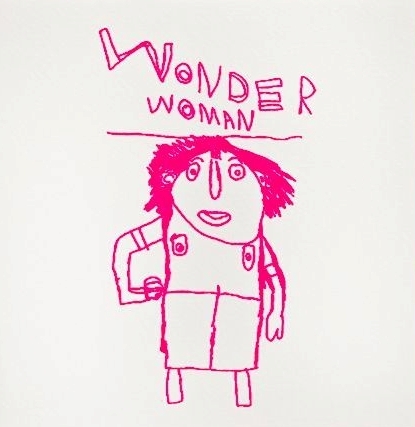
    Peter visits the ARTHOUSE Meath studio nearly everyday, meaning he has become one of the organisation’s most prolific artists. He also works front of house, greeting customers in the shop and selling products. Recently, Peter sold his own work to a customer in the shop; an interaction that embodies everything that ARTHOUSE Meath strives to achieve.

    “I love painting because it calms me down. I love to paint ladies because of the feelings inside when I achieve nice paintings.” – Peter Andrews

    Peter Andrews, 'Wonder Woman'
    Peter Andrews, ‘Wonder Woman’
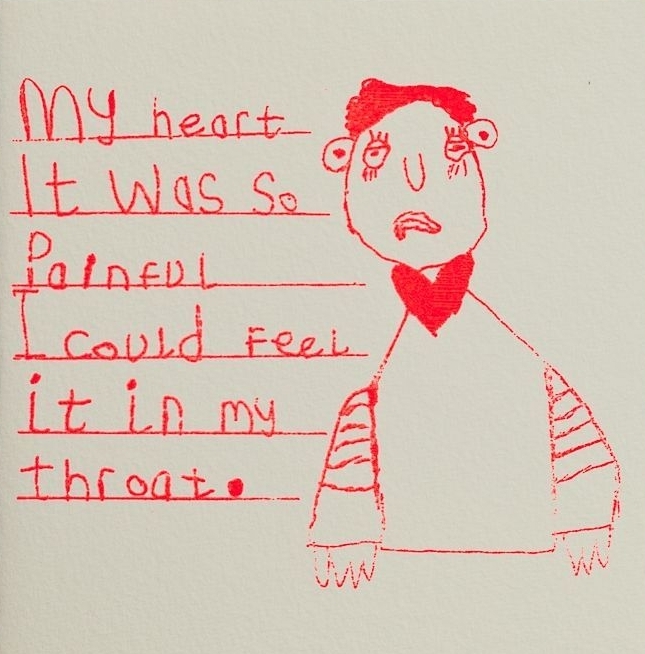
    Peter Andrews, 'Heart in Throat'
    Peter Andrews, ‘Heart in Throat’

    The piece below is a collaboration between 8+ ARTHOUSE Meath artists who, depending on levels of dexterity and ability, would have all worked on different aspects of it. Marjorie and Pete both worked on it.


    ARTHOUSE Meath, 'Jungle Fever'
    ARTHOUSE Meath, ‘Jungle Fever’

    For more information on ARTHOUSE Meath, please visit their website:

    www.arthousemeath.com

  • Bold Vision: Outsiders in Black and White

    Bold Vision: Outsiders in Black and White

    Above Image: Kate Bradbury, ‘Underground’


    From 7-14 July a collaborative exhibition between Julian Hartnoll Gallery and Outside In will showcase the work of 12 artists from the margins. From intuitive artists to self-taught visionaries, ‘Bold Vision’ provides a unique insight into the black and white world of these artists.

    Seven Outside In artists will have their work shown alongside five Outsider Artists’ works at Julian Hartnoll Gallery. Outside In works with artists who face barriers to the art world for reasons including health, disability and social circumstance.

    The artists in the exhibition create for numerous different reasons, one of the most common being as a release or a way of finding balance. Albert’s pen and pencil drawings of imagined buildings act as a form of meditation for the artist, a release from the boredom and tedium of hospital life, whilst Chris Neate’s automatic ink doodles help him maintain a calm stability. Albert says of his work: “I start with a vision in my mind and it blossoms from there … I imagine the building being constructed in brick and brought to life.”

    Similarly, Roy fights his low moments by drawing heads and faces, houses and fidgety lines in an effort to describe elements of his past, or his visions for the future.

    Roy, 'Shadow'
    Roy, ‘Shadow’
    Roy, 'Caveman'
    Roy, ‘Caveman’

    Intricately designed faces and the human figure make reoccurring appearances throughout the show. A fascination with the female form inspires Nigel Kingsbury to create drawings with a frequently mysterious and eerie quality, although his idolisation of the figure in such a rare and carefully observed manner is far removed from contemporary issues of gender stereotyping.

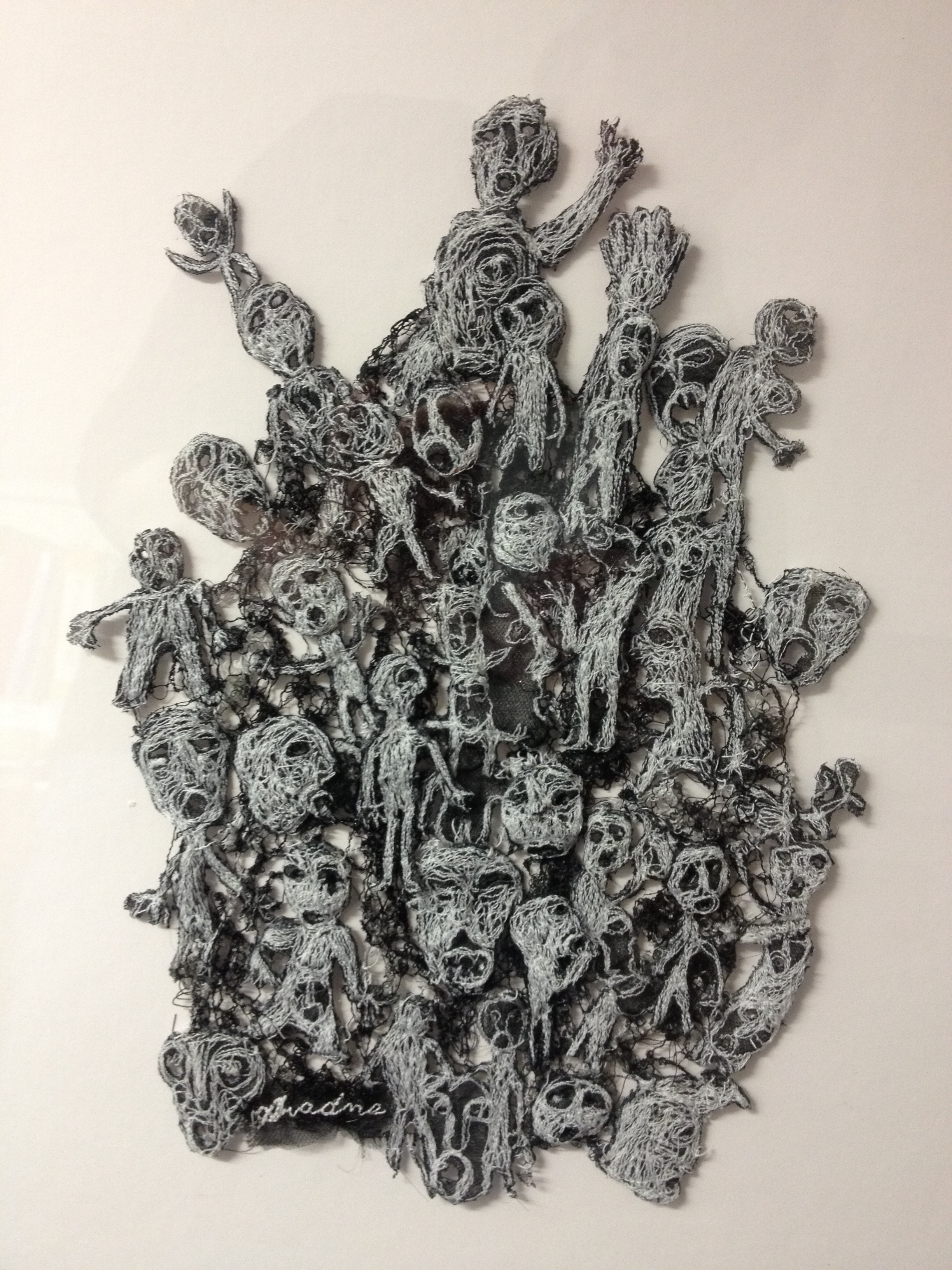
    Both Valerie Potter and Aradne use embroidery techniques to, in the case of Aradne, create figures, birds, insects, flowers and text, which all come together in her web-like structures, and in the case of Potter, keep herself sane.

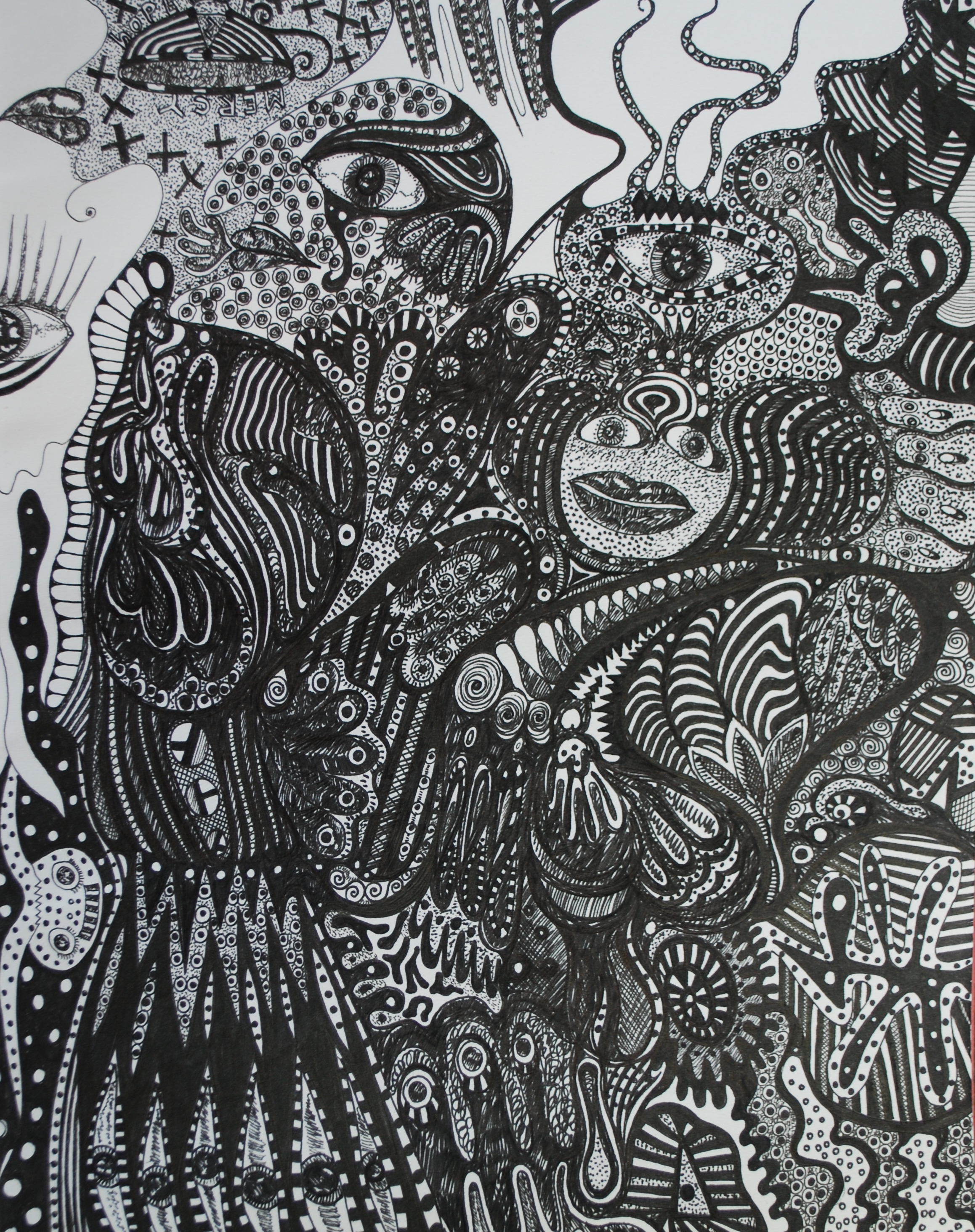
    Kate Bradbury’s intricate black and white creations began when the artist unearthed rolls of Chinese paper and a well of black ink during time spent in a run-down house in London. The discovery of this new medium followed on from her intuitive creation of pictures and assemblages from abandoned belongings, leading to a tidal rhythmic pattern and repetitive form of image making.

    This idea of repetition crops up regularly throughout the exhibition, alongside strong compulsion, a desirable lack of intention and incredible imagination. Ted Gordon, one of the five Outsider Artists, is a self-taught draughtsman whose spontaneous, unmonitored creation enables the mind to give free rein to the hand. He becomes, as described by his biographer, Roger Cardinal, absorbed by his image-making, a “perpetual motion machine, an instrument of what the Surrealists called ‘automatism’.”

    Similarly, British Outsider Artist Nick Blinko draws intensely dense and detailed compositions of faces, figures and obsessive patterns. His art conjures a nightmarish, anxiety-ridden world where inner demons might be exorcised through repetitive graphic marks. Reminiscent of the macabre images of Goya or James Ensor, Blinko creates a personal iconography that evokes the magic and menace of rich imagination.

    Aradne, 'Communion'
    Aradne, ‘Communion’

    The form and content of the work is greatly varied, from Kingsbury’s loosely drawn female figures and Aradne’s hand and machine embroidered web structures to ‘time traveller’ George Widener’s bold compositions of dates and imagery and Ben Wilson’s black and white prints.

    Both Widener and Wilson often use found objects as their source of inspiration; with Wilson’s distaste for industrial waste, cars and rubbish eventually turning into an art form. Widener, a calendar savant, or ‘lightning calendar calculator’, creates mixed-media works on found paper, or layers of tea-stained napkins, that give aesthetic, visual form to complex calculations based on dates and historical events.

    Chris Neate, 'Untitled'
    Chris Neate, ‘Untitled’

    The exhibition will run from 7 – 14 July at Julian Hartnoll Gallery, 37 Duke Street, St. James’, London, SW1Y 6DF. Call 07973 932271 for more information. Opening tims are 10am – 2.30pm Monday – Friday and 11am – 5pm on Saturday. Visits can be arranged by appointment outside of these times.
  • Outsider Art under Analysis: Part Two (Answers)

    Outsider Art under Analysis: Part Two (Answers)

    Above image: Marcel Storr

    In Outsider Art under Analysis: Part One (Speakers), I wrote about the talk I attended at the Wellcome Collection on 15 June 2013. In this post, I will answer some of the questions raised during the discussion (no research, just my own thoughts). It would be great to hear everyone else’s answers too, so feel free to add a comment below the post.


    1) Can ‘outsider artists’ talk about their work meaningfully and coherently? 

    This is a difficult one, as I know a lot of people like accompanying interpretative material to aid them when they view an artwork. However, I think that art is really another form of communication, and so the idea that some artists – for example those without speech or writing – can’t actually talk about their work seems quite unimportant. This is more of a question that encompasses the whole of art history and not just ‘outsider art’; do we need accompanying material, or is the work alone enough? I think a lot of artists who are aligned with/align themselves with the notion of ‘outsider art’ (and actually, artists more generally) do use creativity as a way of communicating their ideas, so for this reason, does it matter that some may not be able to ‘talk’ about their work?

    2) Why do we feel we have to label people? Why can’t outsider artists just be called artists?

    This is obviously an on-going debate with regards to the label ‘outsider art,’ which I have spoken about in a previous blog post. I, for one, would love for all art to be considered as just ‘art’ and all artists to be considered as just ‘artists.’ But I think it’s a bit more complicated than that. In the present day, I actually think that the term ‘outsider art’ is verging on redundant. In ten, maybe twenty years’ time, I don’t think we will use it. But, if having had a label at some point has helped raised awareness and can actually bring this art into the mainstream, then it can only be a good thing.

    Karl Schmidt, Rottluff, 'The Factory,' 1909, Brucke Museum, Berlin
    Karl Schmidt, Rottluff, ‘The Factory,’ 1909, Brucke Museum, Berlin

    3) Did ‘outsider art’ exist before the 1930s?

    The golden age of Outsider art was between 1880 and 1930 – so in short, yes! It emerged at this time because of the development and progression of European psychiatry. Patients were encouraged to draw, paint, and take part in alternative activities to aid their recovery. This was also the period when modern artists started to take notice of what was becoming quite a powerful and popular type of art.  There was a lot of discontent due to accelerated mechanisation and urbanisation in Europe at this time, and of course, it encompassed two world wars and a period of huge unrest in between. Many artists working during this period were looking for new direction – they wanted a way to illustrate their discontent, a new way to depict the devastated world around them. The idea that ‘outsider artists’ were self-taught, yet representing the world as they saw it, and their inner worlds, regardless of whether this fitted with the accepted ‘canon’ of the time was something that really resonated– most notably with the German Expressionists such as Karl Schmidt-Rottluff and Max Beckmann, and, of course, the Surrealists.

    The term ‘outsider art’ itself was coined by Roger Cardinal in 1972, following on from Jean Dubuffet’s ‘Art Brut’ or ‘Raw Art’, which emerged in the 1940s.

    4) What is ‘outsider art’? In simple terms – has it become outdated?

    In simple terms, it is very outdated and almost redundant. The meaning of it has changed so much over the decades that actually describing it proves very difficult! It originated as a term to describe work created by those incarcerated within mental institutions, but has evolved to become more of an umbrella term for a whole host of different stylistic approaches – naïve art, folk art, self-taught art, to name but a few. Again, it is useful for the time being in that this art can be ‘called’ something, and is not just floating in the ethers, on the margins of the art world. In fact, particularly this year with the huge exhibitions taking place that are showcasing the talents of artists under this term, it seems almost ridiculous to describe this work as being ‘outside’ of the mainstream. The hope is that one day it won’t need a specific term and work created under this umbrella will simply be known as ‘art.’

    5) Not everyone is an artist, and not everything is art. People have to go to art school and study what has come before to become an artist.

    I really wasn’t sure about this statement. I know a lot of people work very hard to become artists in the dog-eat-dog art world; the go to art school, they learn about art and artists that have gone before, and they build on this in their own practice, BUT I do think that everyone has an inner artist, if this is too far, perhaps, then at least everyone has an immense amount of potential for creativity inside of them. I just don’t know who’s to say what is and isn’t art, and why people who aren’t formally trained cannot be considered as artists. I think this is one of the major reasons that the term itself needs to be forgotten; it gives the illusion of a distinction between who is ‘inside’ and who is ‘outside’ and therefore who can be called an ‘artist.’

    Jean Dubuffet, 'Spinning Round', 1961, Tate.
    Jean Dubuffet, ‘Spinning Round’, 1961, Tate.
    6) Why is ‘outsider art’ not taught as part of the art historical canon? 

    This is something that I really hope will change soon. As part of my undergraduate degree, I was very lucky as I was actually taught about the emergence of outsider art, and about artists such as Louis Wain and Richard Dadd. I think people find it difficult to include in the canon because it is not a ‘movement’, and it did not take place over one definite period of time – it has been happening throughout this period – running parallel, if you will, alongside the history of modern art.

    I also think that historians might find it difficult to talk about – there’s no definitive style etc. And, as Roger Cardinal said at the talk – it is a movement of individuals. I think the way forward is to include ‘outsider artists’ alongside teachings in the development of modern art. After all, they were immensely influential to hugely prolific modern artists, particularly those within the Surrealist movement, and this influence should not be forgotten.