German Expressionism was born out of the influence of a variety of earlier movements, styles and subject matter, and of course, through the discontent of many avant-garde artists with recent modernisation and the alienation of urban living. Paul Gauguin (1848 – 1903), a French Post-Impressionist, proved significantly influential on the works of German Expressionists. Gauguin developed the visual language of ‘syntheticism.’ German Expressionism also undoubtedly takes some inspiration from Gauguin’s use of primitive artefacts and colour symbolism, as well as his use of nature without “(falling into) the abominable error of naturalism.” Vincent van Gogh (1853 – 90), was an incredibly important figure in the development of Expressionism, with the vibrant energy and colours found in his work. German Expressionists such as Ernst Ludwig Kirchner (1880 – 1938), Emil Nolde (1857 – 1956) and Ludwig Meidner (1884 – 1966) greatly identified with van Gogh’s alienation and isolation from the world, and his reliance on the ‘inner world’ to create, rather than external stimulation.
The Brucke group, named after a quote by Friedrich Nietzsche, in which he states that “what is great in man is that he is a bridge and not a goal,” was founded in 1905, after the meeting of Fritz Bleyl (1880 – 1966), Kirchner, Karl Schmidt-Rottluff (1884 – 1976) and Erich Heckel (1883 – 1970) at the Dresden Technical College during their time there as architecture students. However, Bleyl left the group in 1907 to pursue a career in architecture, so the core group always remembered is made up of Kirchner, Heckel, Schmidt-Rottluff and Max Pechstein (1881 – 1955). These Expressionist artists were not content with the technical innovations and modern advancements that the early twentieth-century carried with it. The idea of the primitive was very much a basis for a large amount of the Brücke artists’ work. German Expressionists used the notion of timeless primitivism, and the borrowing from other traditions and cultures as a way to ignore what was actually occurring in Germany at the time, as well as to show their adversity to the modern world.
The idea of the artist’s rejection of society and the urban city crop up throughout the history of art in Germany, for example, prior to Die Brücke, was Wilhelm Riehl’s Land und Leute (1857 – 63), which advocated traditional countryside living as the ultimate symbol of German tradition, as well as Carl Vinnen’s Worpswede Stimmungsladschaften (mood landscapes) and Arnold Bocklin’s mythological landscapes, which showed a romantic and untainted vision of countryside living. The notion of returning to nature is also highlighted in Adolf von Menzel’s a Journey Through Beautiful Nature, of 1892, which depicts figures in elegant clothing aboard a crowded train, desperately yearning to catch a glimpse of the countryside through the windows, yet irreparably isolated from it. Kirchner’s own figures in the countryside represent the unity of the human race with the natural environment, for example, Four Bathers of 1910, which was created during one of the Brucke artists’ summer trips to the Moritzburg lakes. His urban figures, however, show the alienation felt by people during the years of modernisation, like his piece entitled Five Women on the Street of 1913, part of his Street Scene series, which has defining primitive aspects and characteristics which Kirchner has used in attempt to highlight the contradictions of modernity.
Emil Nolde, one of the most well-known German Expressionists, who was also a member of Die Brücke between 1906 and 1907, often showed his disdain for technological advancement and modern society within his work. He seldom depicted huge technological developments, such as that of the automobile or the aeroplane, and the hustle and bustle of city life goes undetected in his work. Nolde successfully avoided any representation of the modern world, even during his journey to New Guinea in 1913, where he chose to depict Russian peasants, and ignore the train and tracks his wife and he were travelling across. Despite spending every winter in the city of Berlin, the only signs of city life within Nolde’s work were the interiors of cafes and cabarets.
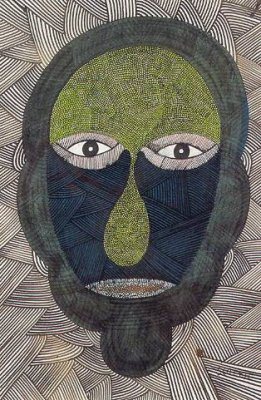
Cesare Lombroso, an Italian psychiatrist, understood ‘madness’ to be a descent back into a primitive, or child-like stage of growth, and similar to this descent, was the use of primitivism by German Expressionists to represent their nostalgia for an earlier time; a time before modernisation. Similarly, Adolf Wolfli (1864 – 1930), a Swiss Outsider Artist, created art after his psychotic collapse as a way to emerge from chaos into stability. In a similar way, the German Expressionists escaped from the isolation and alienation of modern urban living through nostalgic primitive painting. Pascal Maisonneuve (1863 – 1934), a French Outsider Artist, portrayed his defiance and discontent with society and politics through his ‘shell faces,’ which he created by collecting strange objects and shells and arranging them into faces. These ‘shell faces’ defied conventional representation and ridiculed political figures, much in the same way as Expressionism was used as a new form of representation that was ideal for portraying discontent and frustration.
A “direct and unadulterated” creative urge was crucial to the Brucke programme. Nolde would often concentrate exclusively on a specific subject matter in intense bursts of activity and in his autobiography, the artist conjures up images of himself as being “preoccupied only with his art.” Similarly, Kirchner would work obsessively, without taking notice of the time, and would often emphasise his mental distress as a key driving force behind his work; just as Outsider Artist, Wolfli, never planned in advance. In fact, one of the defining characteristics of Outsider Art is the appearance of compulsion; the need to fill in the gaps and continually create. Of course, the term Expressionism itself insinuates the “urge to express oneself,” and this urge is what enabled the German Expressionists to work without inhibitions, painting directly from the nude in the studio for bursts of approximately fifteen minutes, putting their own subjective stamp on the subject matter.
The years directly prior to the break out of the First World War saw an escalation and intensification within Kirchner’s work, which eventually led to his prominent Street Scenes; of which there are eleven works, all executed between the years of 1913 and 1915. The members of Die Brücke had moved to Berlin in 1911, following Max Pechstein who had relocated in 1908, where they had worked together as a group for another couple of years before dividing and going their separate ways. The last recorded work by the Brücke artists jointly was the poster for the exhibition entitled ‘Neuer Kunstsalon’ dated the 27th May 1913. In the pre-war climate of Berlin, the artists became withdrawn. Kirchner began his Street Scenes, which included his Berlin Street Scene of 1913.
Kirchner reportedly took to stimulants such as alcohol, sex and morphine during his time in Berlin, and right up until his suicide in 1938 he was continually fighting a battle with loneliness and alienation, and his frustration and discontent with modern city life. Kirchner was keen to emphasise the dangers of modernisation within society, which he managed not only in his Street Scenes, but also in his colour lithograph of The Railway Accident of 1914. Here, a freight train is shown colliding with a horse drawn carriage, with Kirchner illustrating the destruction that can be associated with modernisation. The imminent outbreak of the First World War saw a huge shake up in the way people saw modern life, the city and their country. Inevitably, the War had a huge impact on everything from culture to the economy and as a result of this; the Weimar era would see a whole new side of German Expressionism.

 KDOA
KDOA 