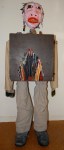
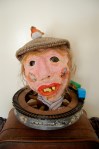
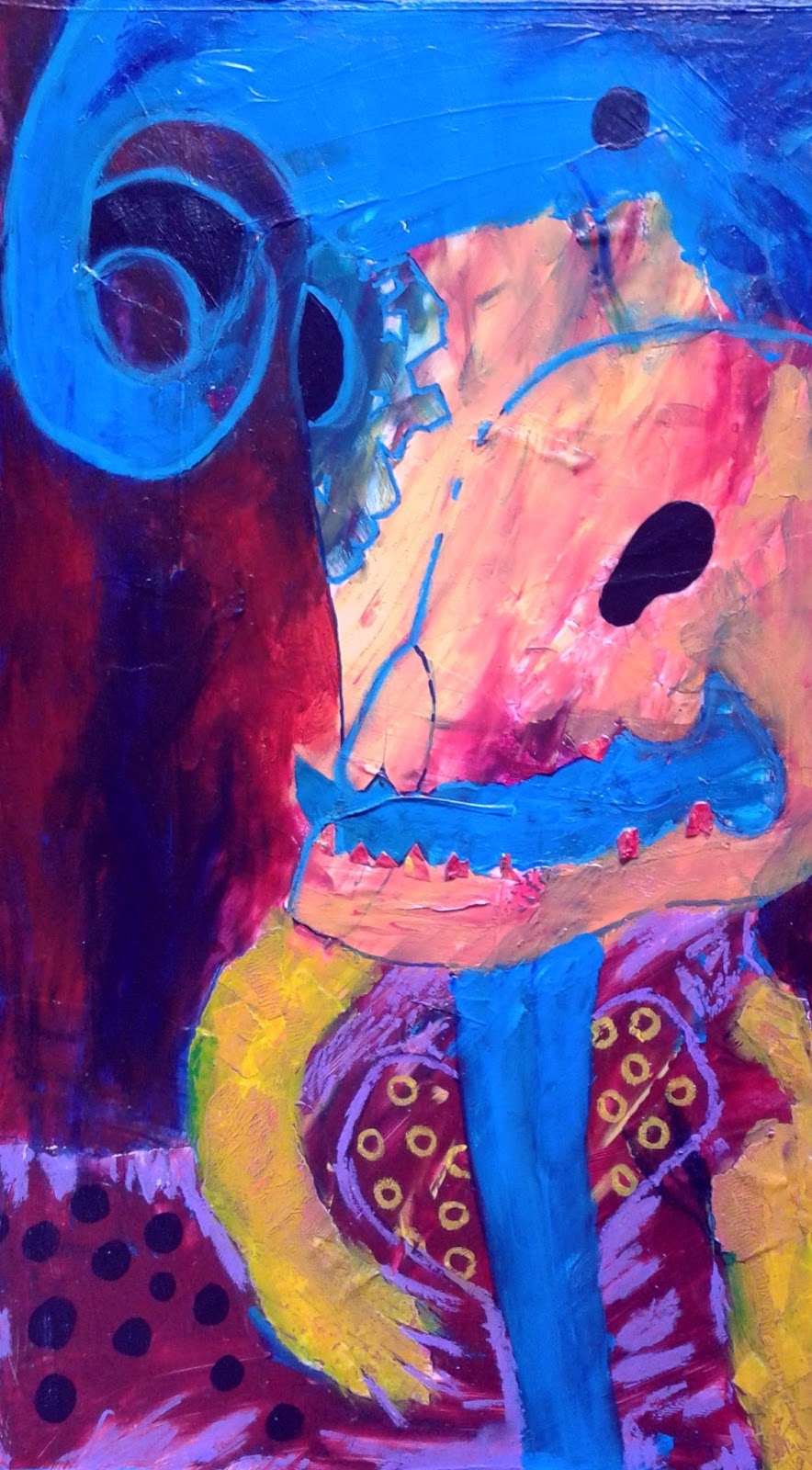
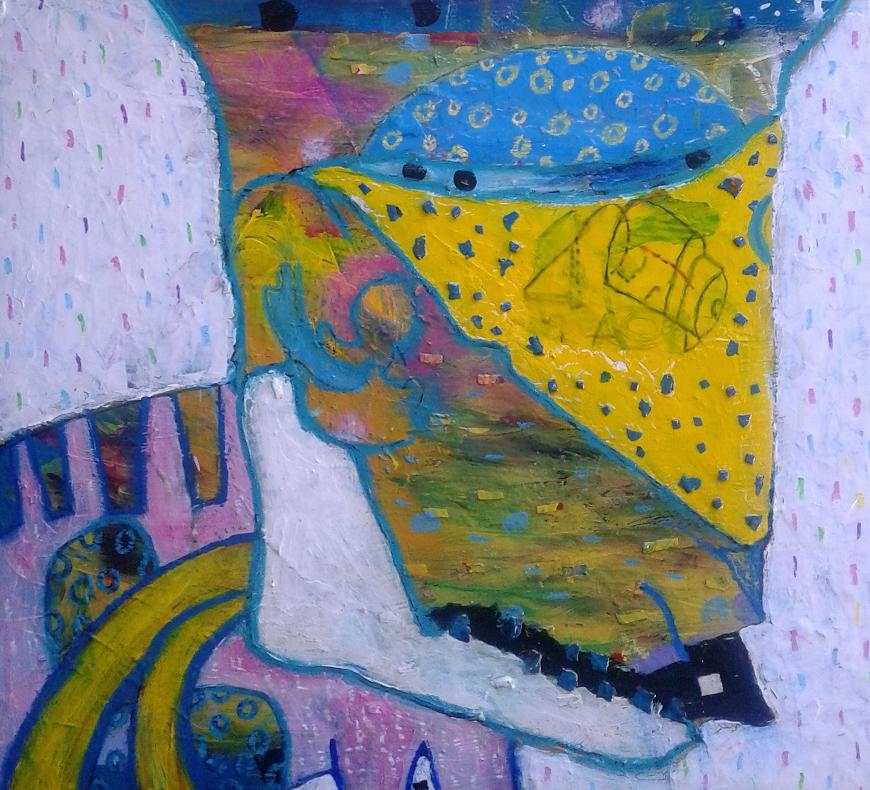
Hidekazu Sogabe was born in Osaka and has lived and worked in London since 1997. His early paint work puts together abstract, flattened figures, whilst his more recent sculptural work re-imagines his concerns for embodied experience.
You can see more of Hidekazu’s work by clicking here
Happy New Year everyone – I hope you are all enjoying what 2014 has had to offer so far. I thought I would do a bit of an off the cuff ‘rambling’ blog post talking about a couple of ideas I have recently had relating to the term ‘outsider art’. Hopefully you will share your ideas and opinions on these below.
The festive period brought a bit of a break from blogging and the art world in general, so, as I rekindled old and started new conversations about ‘outsider art’ in the new year, I had some fresh ideas that I wanted to share with you. The first came to me earlier in the week, when I was thinking about how I would now – two years on from starting the blog – describe the term ‘outsider art.’ This is an art that categorically comes from within, an art that (according to Dubuffet) isn’t influenced by art history or external factors. Despite my absolute disagreement with this idea of Dubuffet’s, I do believe that one of the reasons I am so drawn to ‘outsider art’ is because it epitomises raw communication from the heart and soul. Why then, do we call it ‘outsider art’ – shouldn’t it be ‘inside art’ or ‘art from within’? It seems absurd to me, as someone who enjoys using words, that the term itself should be so contradictory to the work caught beneath this umbrella.
Often, when I tell people that I write about ‘outsider art’, they’ll ask: “Is that open-air art?” Hmm, it would make sense, wouldn’t it? I think someone also shared this opinion on BBC Imagine’s recent programme dedicated to ‘outsider art’; ‘Turning the Art World Inside Out’ (I think you can still catch it here on Youtube). So why, I wonder, can’t we give it a more deserving, fitting, and altogether less controversial name? ‘Art from within’ or ‘Inside’ art might go some of the way to distilling visions of the ‘societal outsider’ and alleviate the current separation between ‘outsider art’ and the ‘mainstream’ art world. Or, to play devil’s advocate, do we even need a label at all? I’m not so sure any more… Let me know what you think.
Bill Traylor
The second thing I wanted to write about stems from a conversation I had on a recent visit to a prison. I was asked how artists who are also offenders or ex-offenders could ever shake the label of being an offender or an ex-offender if they are continuously associated with organisations who are known to work with these groups. This is something I have thought about previously, but to have someone who is potentially in that position to voice their concerns made me re-evaluate its importance. I know a lot of fantastic organisations working with ‘marginalised’ groups, but I wonder if perhaps there is something in this idea that people don’t want to be associated with their past or known by one label that doesn’t encompass everything they are or can be. For example, if art is marketed as ‘offender art’, does that mean the creator’s image is tainted; that they are not seen simply as an artist working within the art world?
I have always wanted ‘outsider art’ to be exhibited and publicised in a way that eliminates in-depth biographies, and instead just focusses on the art as a captivating piece of work created by a talented individual. There are plenty of organisations operating across the country that do a fantastic job in supporting artists who are perhaps facing barriers to the ‘mainstream’ art world for whatever reason, and I think that these charities and groups are undoubtedly needed; in particular to encourage and nurture an artist’s first steps into, or a return to, the art world. The conversation in the prison concluded with a suggested solution that these organisations are invaluable as a springboard towards a career as an artist. By becoming an artist unwanted labels can be lost; replaced, if necessary, with more favourable and accurate ones.
I would really value and appreciate your ideas on either of these thoughts, so please post any comments below. Happy New Year!
It’s certainly true; the past year has been an incredible one in terms of raising the profile of outsider art. It came from almost complete obscurity into the limelight with multiple London-based exhibitions and more national coverage at the Venice Biennale. Here’s a bit of a recap of what happened. Sorry for the UK-centric view here – it’s only because I’m based here! Let me know of any major outsider art events that took place in the last year where you are in the comments below.
In March, ‘Souzou: Outsider Art from Japan’ opened at the esteemed Wellcome Collection in London. This display showcased the creations of Japanese artists working at day centres in Japan and was extremely successful in its aim of highlighting the complex intersections between health and creativity, work and wellbeing and mainstream and marginality. It also gave us the word ‘Souzou’, which is perhaps a somewhat better reference for what we currently recognise as Outsider Art, although it has no direct translation in English. In Japanese, depending on how it is written, it can mean creation or imagination. The term itself, I think, goes part of the way in distilling any preconceptions about this type of art because it is a word that the Western world has (somewhat unknowingly) needed for so long.
The exhibition was a timely reminder of the importance of displaying works created by those who cannot so easily align themselves with the mainstream art world. It blew away the hierarchical idea of biographical context and focused on the achievements of these artists and their incredible creations.
Norimitsu Kokubo
Following on from this majorly important exhibition at the Wellcome Collection, the Hayward Gallery hosted ‘Alternative Guide to the Universe’; an exploration of the work of self-taught artists and architects, fringe physicists and visionary inventors. The Hayward Gallery is no stranger to outsider art, having hosted the UK’s first major exhibition of outsider art thirty four years ago, and it certainly did the subject justice once more.
The show was an incredible display of the power of imagination, most aptly illustrated, perhaps, by ‘gothic futurist’ and hip-hop pioneer Rammellzee’s ‘Letter Racers’, which depicts how the alphabet might look if the letters were to become mechanised and able to fly into battle. It was without a doubt an innovative combination of art and science and re-imagined worlds, of artists and inventors who want to better understand the universe.
Of course, probably the biggest event in the outsider art calendar this year was the Venice Biennale. The Biennale, which ran from 1 June – 24 November, was titled ‘The Encyclopedic Palace’ by curator Massimiliano Gioni after self-taught artist Marino Auriti’s Palazzo Enciclopedico design for an imaginary museum meant to house all worldly knowledge. The Palace showed works from the past century alongside several new commissions, showcasing one hundred and fifty artists from more than thirty-eight countries. Blurring the line between professional artists and amateurs, outsiders and insiders, the exhibition took an anthropological approach to the study of images, focussing in particular on the realms of the imaginary and the functions of the imagination.
From 26 September – 28 November, self-proclaimed ‘Outsider Curator’ Sue Kreitzman organised ‘Epiphanies! Secrets of Outsider Art’ at the St. Pancras Hospital Conference Centre in London. The show revealed works covering an impressive range of content, media and style by almost 25 artists, all of whom Kreitzman had personally befriended.
Orleans House Gallery in Twickenham hosted (and still are hosting!) a major retrospective of the work of Madge Gill, who without training or aspirations for fame produced thousands of ink drawings during her lifetime. The focal point of the exhibition was The Crucifixion of the Soul, which had not been on display in the UK since 1979. Over ten metres long, this immense calico is inscribed with Gill’s finely wrought doodle-like drawings and is testament to Gill’s commitment to creativity.
‘Face to Face with the Outsiders’ at the Julian Hartnoll Gallery in London beautifully brought together a vast and varied range of portraits created by those considered to be on the ‘margins’ of the art world, and ‘The Gravy Train and Roads to Recovery’ in the St. Pancras Hospital Conference Centre in London was an eclectic mix of work by Service Users at the Margarete Centre and Kate Bradbury’s dervishes. Organised by The Arts Project, the exhibition aimed to highlight the idea that whilst treatment for substance misuse historically focussed on harm reduction and substitute prescribing, other recovery methods emphasis equality, opportunity and equal access to society.
Kate Bradbury’s ‘Goats’
Throughout the year, Outside In ran a touring show as a follow on from their National exhibition in 2012. The show displayed work by twenty artists facing barriers to art world who were selected through the open national competition. Running parallel to this, the organisation also held regional exhibitions which allowed people all over Scotland and England to experience this incredible work.
So, this is just a brief round-up – and certainly doesn’t cover everything that happened! Here’s to an even better 2014 – we already have a lot to look forward to, including ‘Intuitive Folk’ at Pallant House Gallery and ‘British Folk Art’ at the Tate.
I would like to take this opportunity wish you all a very Happy New Year, and thank you for reading. I hope you’ve enjoyed all that has been on the Blog this year, and that you will join us again next year. If you have anything you would like to see on here, please do not hesitate to get in touch.
Open until 1 December 2013 at Pallant House Gallery, Chichester, Kate Bradbury: Squalls and Murmurations is the second exhibition in a series celebrating the Six Award Winners of Outside In: National 2012, a triennial competition for artists from the margins.
Art Historian Roger Cardinal, performance artist Bobby Baker and ex-Director of Pallant House Gallery, Stefan van Raay, chose Kate Bradbury as one of six Outside In Award Winners as part of the 2012 National exhibition, for which one of the prizes was a solo exhibition in the Studio. Cardinal said of the competition and the subsequent winners: “It is about showing the public that ordinary people without training can produce great work. Art can happen anywhere in all sorts of places.”
Bradbury’s art career began some years ago in a run-down house in North London, where she started to intuitively make pictures and sculptures from abandoned belongings. Unearthing a role of thin Chinese paper and a well of black ink, an unforeseen tide of repetitive image and pattern-making promptly began. Bradbury also created sculptures from salvaged litter found in the tall, crumbling house.
This obsession with found objects can perhaps be traced back to Bradbury’s childhood, where some family friends who were archaeologists would take her off into caves where she witnessed cave paintings with crude handprints and began finding and collecting things. Now, Bradbury collects material on her way to work, or on her way home from work – whatever she can find and wherever she can find it.
Her suitcase people – the doctor, the artist, and Railroad Jim – all have their own personalities, each with a story inside their box-bodies. New additions to Bradbury’s family of sculptures are her ‘goat’ creatures. Constructed from the bristle-end of brushes, severed musical instruments and human faces, they came to life after Bradbury happened upon the ‘disembodied goat heads’ at her local car boot sale. Not wanting to separate a few goats from the herd, Bradbury took the lot before restoring them: “I have gifted them legs and bodies and I hope that one day soon I will have identified and practised the Holler that will alert a distant herdsman to their whereabouts, so that they may return to their native hills.”
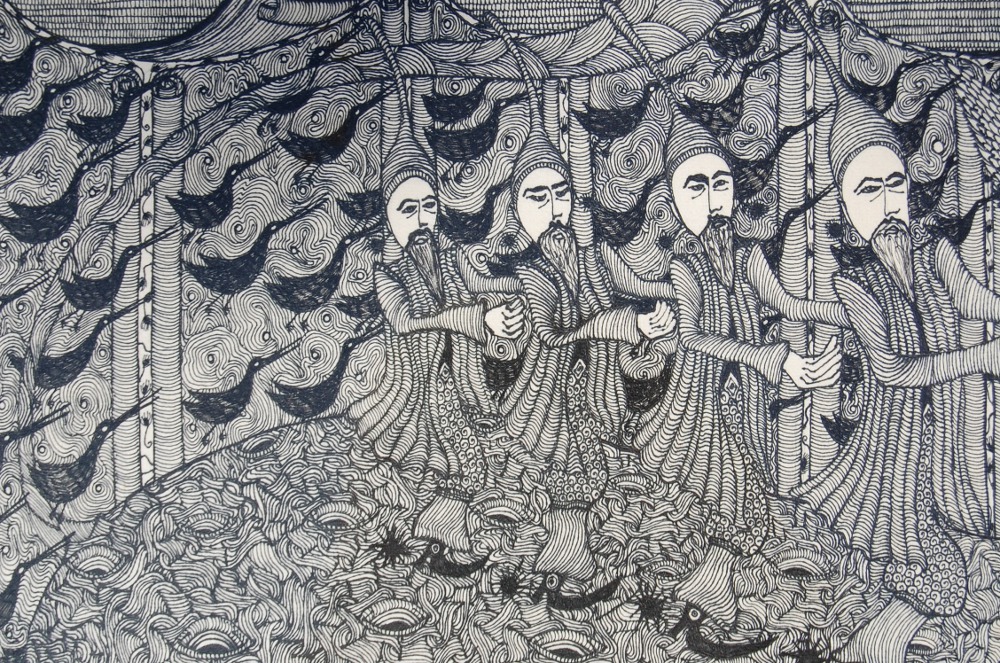
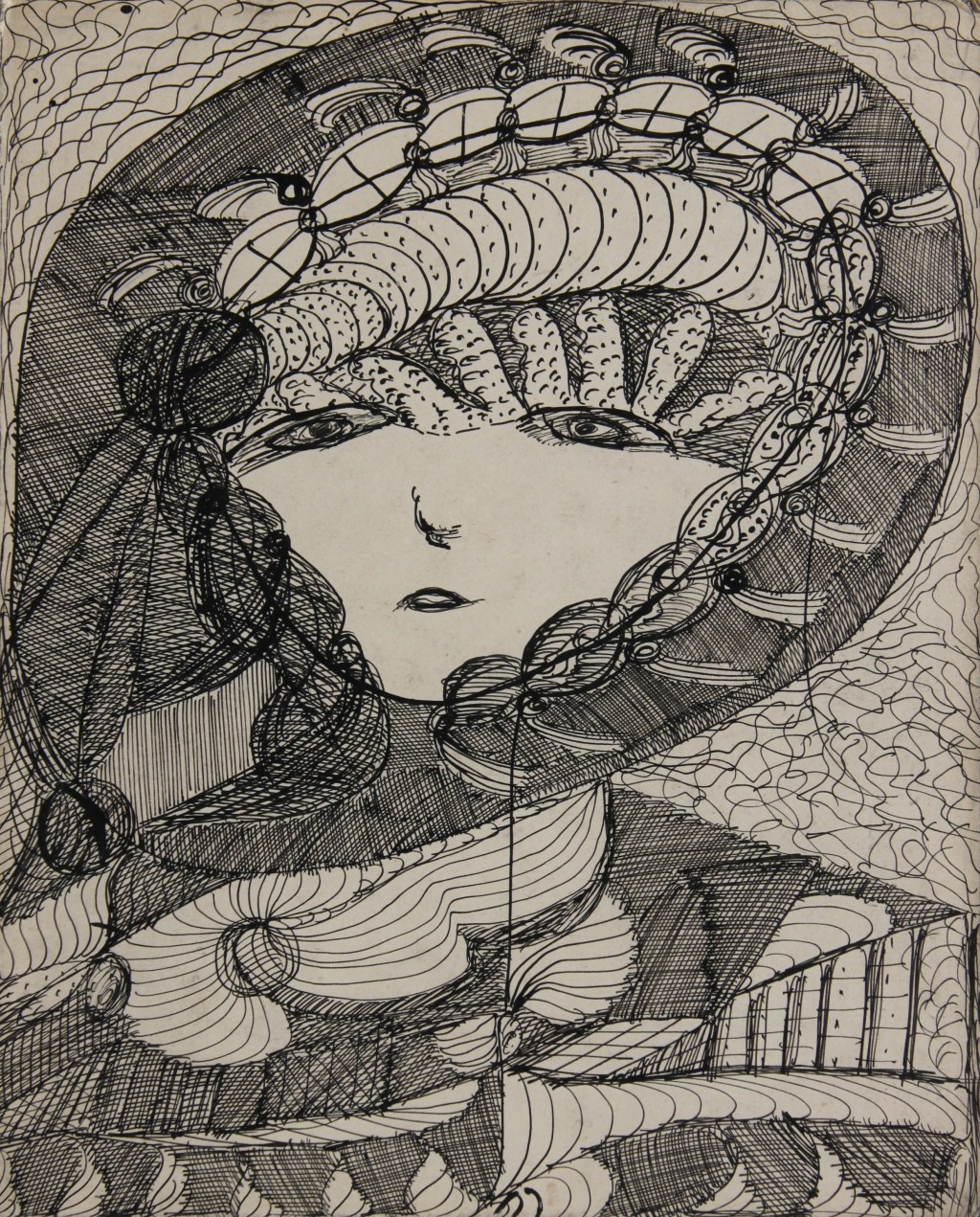
To complement her trademark sculptures, the exhibition also includes some of Bradbury’s trademark ink drawings. It was one of these fantastical black and white worlds; The ones that I’ve been saving to make a feather bed, for which Bradbury was granted Outside In: Award Winner status. Bradbury says of her contrasting practices (sculpture and ink): “Both of these have become passions that fill both my waking and sleeping hours with ink-stains and splinters.”
It is this diverse creativity that gives the exhibition its name. Bradbury explains: “A squall is a storm and that suited the swirly patterns in my drawings. The monoprints often have a stormy sky and a lot of the sculptures are crude and brutal in texture. Murmuration is playing on the word murmur, a much quieter space like the fine lines and delicate paper that I draw with. So it’s loud and quiet and reflects both sides of my work.”
With no formal art education, Bradbury is inspired by known – Klee, Miro, Franz Kline – and unknown artists, stage sets, archaeology, visions, inventions, and by music and song. She thinks about ideas for her work whilst at her day job – in a sandwich shop – where she has the space to go to a different place in her head. She doesn’t make work to please an audience; she makes it because it needs to be made. She explains: “I get a picture of something in my head and then need to make it, to offload it and then I can think about something else. I get obsessed with an idea and try to see it through. I’d love to get a studio and be able to make some bigger or noisier work and I like the idea of making a stage set, working with animation and just to keep finding inspiration.”
Kate Bradbury, The Artist
Kate Bradbury, Detail of the Dust Gatherer
Kate Bradbury, Detail of Railroad Jim
Kate Bradbury, Angel
Kate Bradbury, Detail of Where Have all the Birdsongs Gone
Outside In was set up by Pallant House Gallery in 2006 to provide opportunities for artists with a desire to create who see themselves as facing a barrier to the art world. The project’s main vehicle is a triennial open art exhibition which was first held in 2007 and featured 100 artists from across Sussex. By 2012, the project had gone national, engaging more than 1,500 artists and 13,000 audience members.
Kate Bradbury: Squalls and Murmurations will be on in the Studio at Pallant House Gallery until 1 December 2013. Entry is free. Click here for more information.
Above image: Lost Fruit | Thornford Park Hospital, The Tolkien Trust Silver Award for Drawing
The Koestler Trust’s sixth annual UK showcase this year takes the form of ‘The Strength and Vulnerability Bunker’, curated by Mercury prize-winning rapper, Speech Debelle. The national exhibition, which is moulded yearly by a different group or individual, displays work by prisoners, offenders on community sentences, secure mental health patients and immigration detainees.
This year’s theme – the relationship between strength and vulnerability – was chosen as it threads together the work on display with Debelle’s music. Debelle’s political interventions (which include three albums pinpointing areas of social justice and injustice), make her the perfect candidate to provide a voice for those whose lives are being transformed by the power of art.
“The Koestler Awards represent an injection of creativity, humanity and empowerment into the closed world of prisons” – Stephen Shaw, Prisons and Probation Ombudsman.
This year’s exhibition has some strong, undeniably prison-centric, work. ‘Untitled’ by Patrick from HMP Leeds starkly shows the divide between the inside and outside. In it, a figure looks solemnly (although this is only an assumption, as all we can see is the back of his head) through the bars of what we can ascertain to be his cell. On the ‘outside’, skyscrapers loom above luscious green trees and two magpies – which symbolise joy in the well-known rhyme – perch on the prison boundary. There are, however, signs of life and hope within the confines of this prisoner’s cell. A butterfly rests on an arm, and two ladybirds and a spider scale the inside of the bars.
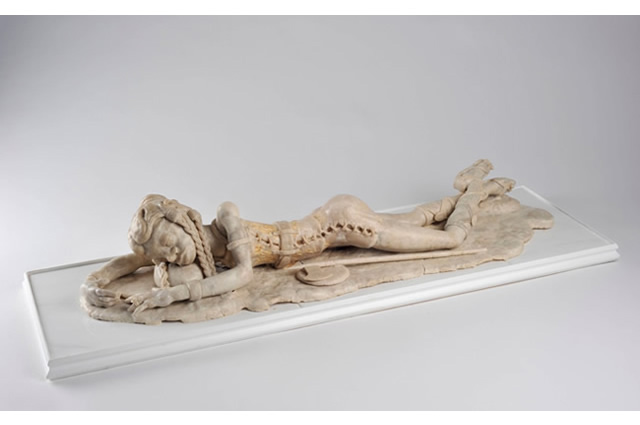
Sleeping Brunnhilde | Derbyshire Probation Service, The Anne Peaker Platinum Award for Sculpture
‘Not of the World’, by an inmate at HM Prison Cookham Wood, reflects “how far away the earth is when you’re locked up. Also, how far anything and anyone are from your reach in jail.” These are the artist’s own words. In the piece, a figure, plagued by darkness, looks longingly (again, maybe my assumption) towards the whole of the earth which sits uncomfortably out of reach on the horizon line.
These two pieces quite obviously describe feelings of isolation, incarceration, and the loss of freedom. But there are more subtle pieces. ‘First Hour’, by an artist from Prison Littlehey and made entirely from chicken bones and glue, represents the feelings of a prisoner during the first hour of being ‘inside.’ Crouched over, the perfectly executed figure is both strong and incredibly vulnerable at the same time. Single chicken bones are extremely robust, but put them together as has been done with this sculpture, and they are fragile; the piece could topple or crack at any moment.
The Dancers | HMP Brixton, The Patrick Holmes Platinum Award for Oil or Acrylic
Similarly to ‘First Hour’, other works on display are made out of any material that the artists could get their hands on. ‘Escape with a Book’, by an artist at HM Prison and Young Offender Institution Exeter is made entirely from soap, with the hands stained using tea bags. It was probably carved, as suggested by the exhibition host (an ex-offender employed to enhance the audience’s experience whilst gaining CV building skills), using a smuggled razor blade – something which makes it all the more intriguing. The artist was prepared to create this piece regardless of the rules. ‘Sleeping Brunnhilde’, by an artist from the Derbyshire Probation Service, was created using bread and PVA glue; such simple materials.
The works on display were chosen from more than 7000 pieces of art created by prisoners, secure patients and immigration detainees, and each and everyone follows a personal journey reflecting on the meaning of both strength and vulnerability. The arts have been proven, more so in recent years, to be an incredibly effective way of engaging with offenders who are feeling isolated or alienated from mainstream education and employment.
Creativity flourishes in prisons, more so than in any other institution; perhaps as a result of the physical incarceration. This exhibition provides an opportunity for the artists to have their talents showcased, and is an example of how prisoners work through their feelings – in this instance strength, vulnerability and forgiveness – as part of their rehabilitation. Creativity and self-expression can often be the key to increasing self-esteem and self-efficacy; all proven factors in reducing rates of re-offending. Not to mention, the works in this exhibition are absolutely fantastic to look at – these artists are incredibly talented. Maybe once they have served their sentences, they can shake off that label of ‘prisoner’ ‘convict’ or even ‘ex-criminal’ and ‘ex-offender’ and instead be known more positively as ‘artists.’
Garden of Eden, HM Prison Styal, Dalrymple Bronze Award for Sculpture
The exhibition is running until 1 December at the Southbank Centre, London. Click here for opening times and other information.
Exhibited artists on what the words ‘strength’ and ‘vulnerability’ mean to them
“Without strength, you can’t go on. Without vulnerability, you can’t grow as a person. “
“Being able to take a ‘warts and all’ look at myself through art does leave me feeling vulnerable to emotions I’ve closed off for years. However, I feel I’m in a safe environment with supportive peers and tutors. That is the strength of art.”
“Strength means to me, someone who keeps going and keeps trying, no matter what obstacles they may face. Vulnerability means to me, someone who is human. Everyone is vulnerable and we all deal with it every day.”
Above Image: Kate Bradbury (courtesy of julianhartnoll.com)
“Outsider Art is a movement of untrained artists with a burning desire and passion for expression that features art of an obsessive nature. Often this involves collecting debris shaped to express the inner thoughts and feelings of the creator. Some artists may suffer from mental health issues, others simply have no interest in conventional art practice.”
Sue Kreitzman, a self-proclaimed ‘Outsider Curator’, and an Outsider Artist in her own right, is the co-creator of a very refreshing new Outsider Art exhibition; ‘Epiphanies! Secrets of Outsider Art’ opening at The Conference Centre at St Pancras Hospital on 25 September. Sue calls herself a ‘Typhoid Mary’: “People meet me and they catch the art virus. If they are established artists, they meet me and their work gets stranger.” She wants people to be inspired by her exhibitions, and for them to see what art can be – or what it really is.
The exhibition aims to be an educational tool. For those who have not experienced Outsider Art, Sue wants to illustrate the scope of this genre. The show will include works covering a considerable range of content, media and style by almost 25 artists, all of whom Sue has personally befriended. “I love the art and I love the artists,” she says. There will be 3D pieces, drawings, paintings, and installations; a cornucopia of passionate works. The exhibition’s theme, as Sue puts it, is “art, the exhibition is about art.” It is possibly the first exhibition of Sue’s that has had such an open criteria – WOW was for ‘Wild Old Women’, and ‘Flashier and Trashier’ expanded on this to include ‘Wild Old Men’. However, all of the artists involved in ‘Epiphanies!’ have not had a formal art training.
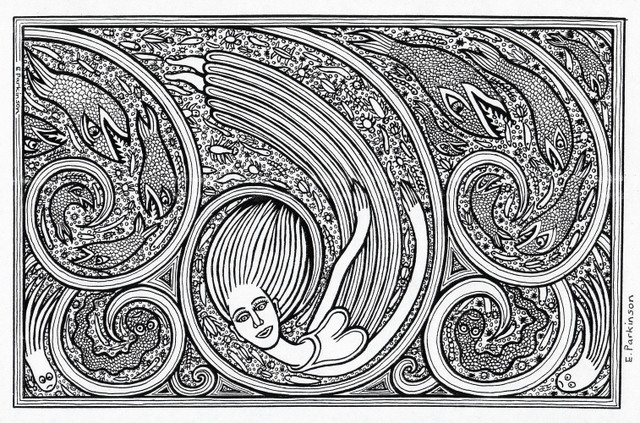
One of the artists taking part is Valerie Potter. Valerie’s work is, Sue says, “like that of an angst ridden teenage boy, but then she comes in with the Jane Austen cross stitching. It’s very emotional to look at.” Liz Parkinson’s works are obsessive, repetitive, symmetrical depictions of faces with snakes and reptiles. “She sits at my kitchen table and she draws and draws.” Art critics have previously disregarded Liz’s snakes as ‘Freudian’ – in fact, Liz has suffered with eczema for many years, creating an emotional attachment to the image of a snake shedding its skin. Other artists involved in the show include Claudia Benassai, Kate Bradbury, Manuel Bonifacio, and Judith McNicol – plus many more.
Liz Parkinson, Tsunami (courtesy of uncookedculture.ning.com)
Talking about the – very topical – debate surrounding Outsider Art, Sue says that the subject is simultaneously complicated and uncomplicated. Originally, it best described work that was completely outside of the mainstream; it described artists with mental ill health, those who were isolated or not aware of the bigger, wider art world. Although there are hints of this today, it is not nearly as extreme. “When you discover an Outsider Artist,” Sue says, “suddenly they’re not outside anymore – they are not as naïve as they used to be.”
Sue is keen on anything that gives a voice to Outsider Art – the recent spate of mainstream Outsider Art exhibitions, for example; Souzou at the Wellcome Collection and the Alternative Guide to the Universe. However, she warns us of the involvement of academics or curators, people who are likely to make rules: “I don’t like people saying ‘this is what it is’. It becomes meaningless when there are rules.”
The mainstream art world, to Sue, is – and should remain – completely disparate to the world of Outsider Art. The conventional art world revolves around money, around prestige, and around the commercial, or commodity. Outsider Artists are driven to create – not for money, but for sanity; it comes “from their gut.” They create as a way of expressing their angst. “Creating art for Outsider Artists is self-medication,” says Sue, “just in the same way that alcoholics and drug addicts self-medicate.”
Claudia Benassai, ‘Peeping Tom’
“If you hang out with us, you may experience epiphanies, revelations and visions. Visit us and you might burst into art, aflame with colour, exaltation and obsessive creativity. We are Outsider Artists, working far beyond the margins of the conventional art world. Untutored, obsessive, producing art for our own pleasure and therapy, inventing techniques, scavenging for unexpected materials, we are united in our need to express beliefs, angst, political and spiritual views, through art.”
Sue’s ultimate concern is that Outsider Art, the only ‘real’ art, will be engulfed by the ‘rule-setting’ conventional art world. “I want to stay outside. I want to find people who are obsessive, who have to do it. I will remain outside.”
‘Epiphanies! Secrets of Outsider Art’ is on from 26 September – 28 November 2013 at The Conference Centre, St Pancras Hospital, London. Click here for more information
5 October 2013 – 26 January 2014
Orleans House Gallery, Twickenham
A new exhibition opening on 5 October at Orleans House Gallery, Twickenham, will bring together little-seen works and archival material by prolific (and perhaps the best known) British ‘outsider artist’ Madge Gill.
With no training and no aspirations to fame, Madge Gill produced thousands of ink drawings during her lifetime. Her work remains an enigma: is it true she was inspired by an ethereal spirit guide? Was she genuinely in touch with ‘the beyond’, or was art-making a form of self therapy?
Orleans House Gallery invites you to delve into the world of Madge Gill (1882 – 1961) in this major retrospective exhibition supported by the Wellcome Trust. Featuring over 100 original artworks, and contextual photographs and documents, this exhibition is the first of its kind. Madge Gill was championed and collected by Jean Dubuffet, who coined the term ‘art brut’ (raw art), the precursor to the term ‘Outsider Art’. Gill is considered the most important, influential and recognised British ‘outsider artist.’ This project explores Gill’s work, history and psychic / mediumistic context in-depth, in order to question the use of such terms, whilst celebrating the benefits of creativity for wellbeing.
Working mainly on paper, card and textiles, Gill used pen to create maze-like surfaces with a glittering, almost hallucinatory quality that often reveal a female face. Ranging from postcard size to over 10 metres long, her work immerses the eye in a dark world of mystery, beauty and obsession. Her work has been included in previous Orleans House Gallery Outsider and Visionary art exhibitions, the Tate Gallery, and more recently at the Whitechapel Art Gallery , Museum of Everything and Nunnery Gallery.
The focal point of the exhibition will be The Crucifixion of the Soul, which has not been on display in the UK since 1979, and is Gill’s most important work. Over ten metres long, this immense calico is inscribed with Gill’s finely wrought doodle-like drawings and is testament to Gill’s commitment to creativity.
The project has been generously funded by a People Award from the Wellcome Trust. Curators have worked with psychologists, medical historians, biographers, art historians and art psychotherapists to bring different approaches to Gill together within the exhibition and accompanying catalogue. Present day artists from the Art & Soul group, who celebrate mental and emotional wellbeing through the arts, are also represented in the project.
Bringing together little-seen loans from the Newham Archive; the College of Psychic Studies in South Kensington; the Henry Boxer Gallery and other archival material and artworks from private collections, this exhibition is a must-see for all those interested in art, psychology, spiritualism, social history or all of the above.
Above Image: Steve Murison, ‘Your Cat Was Sick at the Disco’
‘Upon a time I was really ill, and now I paint at my little desk, steaming mug of coffee at hand in the shadow of my pepper plant. As I step outside into the good of life I drag with me tales of horror, hope, witches and pills.’
Steve Murison, ‘Your Patchwork Witch has an Eternal Cat’Steve Murison, ‘Let Summer Howl Through the Guts of a Dog’Steve Murison, ‘Zombified Eternally’Steve Murison, ‘Take Another Trip with Your Black Tongued Pig’
I asked Steve about the excellent titles he gives his pieces, his response was:
“Each painting is a little story. As they take shape I try to encapsulate the tale, and the title has became an integral part of the process. Once it has a name it becomes tangible and present and I can start bringing it all together. Sometimes I have the title before I begin, but mostly it emerges as the lines become clear.”
I was recently having a think of ways to revamp the blog, especially after my currently-very-spaced-out posts (due to house move, no internet, etc.). I decided to start a ’round-up’ series that would include a mixture of Outsider Art news, recent articles on the subject (from newspapers, magazines, online, blogs), and relevant current or upcoming exhibitions. As this is the first installment of this new idea, please let me know what you think and what could be improved.
If you have any news, articles, exhibitions, or opportunities for artists that you would like to be considered for the round-up, please email them to kdoutsiderart@yahoo.com
News
Impact Art Fair at Block 336, Brixton
The Impact Art Fair – the UK’s first to display on works by those experiencing mental ill health, disability, or other socially exclusive circumstances – took place in the spacious (but sweaty) basement of Block 336 last weekend. The Fair itself was a tremendous success, with artists from all over the country represented on various stalls. The artwork was so diverse, ranging from intricate ink drawings, such as those by Colin Hambrook, to wildly bright ‘astral goats’ and ‘witches’ by the very talented Steve Murison.
Various organisations also held stalls displaying work by multiple artists. These included Bethlem Gallery, Outside In, and Action Space to name a few.
After assisting with the final stages of setting up on Thursday 25 July (as a member of staff at Creative Future – the organising organisation!), I stuck around for the private view, which was a resounding success. Artists, buyers, journalists, organisation staff, and the general public all came together to celebrate this fantastic display of truly tremendous and inspirational talent.
Between 18 September 2013 and 22 August 2014, the Halle Saint Pierre will be hosting a celebration of 25 years of Raw Vision Magazine. The exhibition will feature classical works of Art Brut, new discoveries, photos of extraordinary visionary environments and will include over 60 artists. Click here for more information on the upcoming anniversary exhibition.
This exhibition will coincide with the Outsider Art Fair in Paris for one weekend in October. The Outsider Art Fair will be taking place from 24 – 27 October 2013 at Hotel Le A, a 26-room boutique hotel 1 kilometer away from the Grand Palais, which will be concurrently hosting FIAC, France’s premier contemporary art fair.
Articles
Jillian Steinhauer – ‘Do We Still Need to Defend Outsider Art?
This article is Steinhauer’s response to Christian Viveros-Faune’s scathing attack on Outsider Art (read full attack here). In her article for Hyperallergic, Steinhauer picks apart Viveros-Faune’s arguments against the growth in popularity of Outsider Art and therefore it’s value as part of the art market.
Click here to read Steinhauer’s full article on Hyperalleric
Ralph Fasanella, ‘American Tragedy’, Courtesy of hyperallergic.com
A Perspective on the Heidelberg Conference on Outsider Art
In this blog post, a delegate from the Heidelberg Conference talks about their experience of the event, in particular the conversation around ethical issues. The conference took place in May 2013 at the University of Heidelberg, where the Prinzhorn Collection is housed. The article proves very interesting if you were unable to attend the conference. It also raises awareness of the ethical issues that do surround Outsider Art.
‘Art in the Asylum’ at the Djanogly Art Gallery, University Park Nottingham 7 September – 3 November 2013
This exhibition will present the first look at the evolution of artistic activity in British asylums from the early 1800s to the 1970s. Over nearly two centuries, the visual arts have played a significant part in the development of Psychiatric treatment methods; a period coinciding with a time of great chance in our understanding and treatment of mental disorder.
With over 150 selected works from National and International collections, this exhibition will trace the historical shift from invasive treatments which included psychosurgery, insulin coma therapy and restraint to a more humane regime in which creativity played a key part.
















 KDOA
KDOA 