
Although it has not yet reached the highs achieved by auctions of ‘mainstream’ art, the monetary value of ‘outsider art’ is creeping up. This blog is written in light of the recent Christie’s auction of outsider art from the William Louis-Dreyfus Foundation which took place earlier this month.
(more…)Tag: mainstream art
-
The Conditions of Success?
Recently, whilst undertaking some research around the role of the critic and what makes artists ‘successful’ in the art world, I came across a transcription of a lecture given by Sir Alan Bowness, Art Historian and Director of Tate (1980-1988), at the University of London in 1989. The talk centred on the idea of artistic achievement, and was titled The Conditions of Success: How the Modern Artist Rises to Fame.

Bill Traylor, Man and Large Dog, Smithsonian Institute In the text, Bowness outlines his idea that there are four steps that lead to an artist achieving recognition and success in the art world. What I found most interesting about this quite rigid ‘how-to’ guide is how little room for success it leaves for those who are not able to complete one of the steps. This, of course, ties into my interests around what continues to separate so-called outsider art from the cultural mainstream.
Early on in the lecture, Bowness asserts that “there is a clear and regular progression towards artistic success. There are,” he says, “in my view, conditions of success, which can be exactly described. And success is conditioned, in an almost deterministic way. Artistic fame is predictable.” These ‘conditions of success’ revolve around the idea of recognition. Recognition from whom, and when this occurs during the artist’s career.
The first condition is peer recognition, and Bowness quite boldly claims that this initial type of recognition is “at first a matter of personality as much as it is of achievement.” He goes on to speak about his discovery of David Hockney during the 1960 annual exhibition of the London Group (Hockney at that time being a 22 year old first year student at the Royal College of Art): “it was quite obvious to… a thirty year old art historian/critic like myself that here was an exceptional talent.”

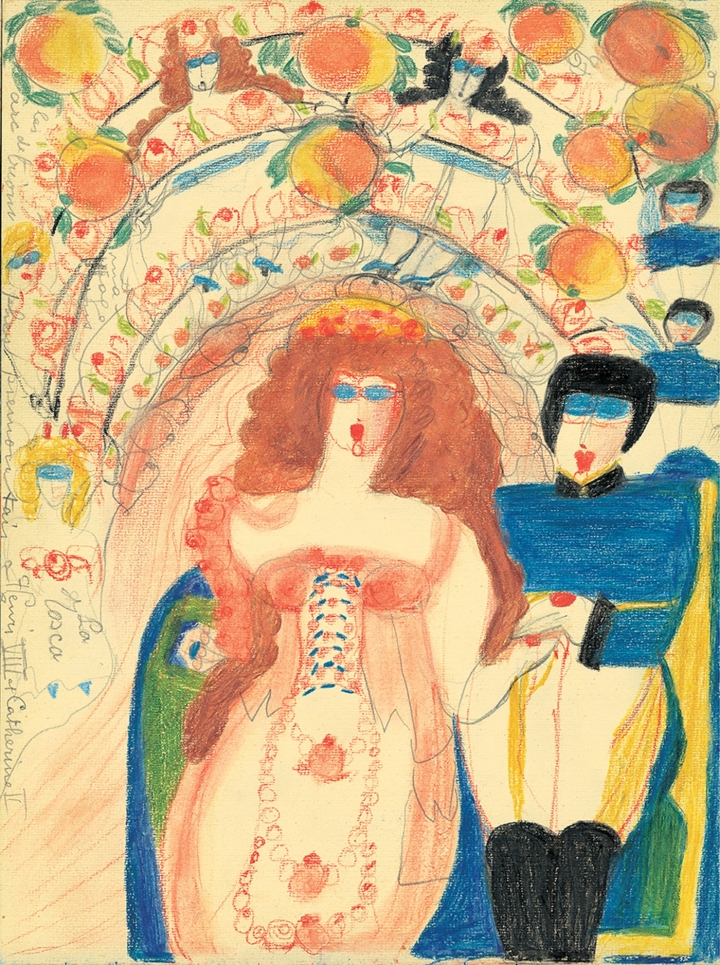
Aloise Corbaz My immediate issue with this condition is that it first requires the artist to already be rotating in artistic circles and communities. This is generally not the case for artists who are considered to be working outside of the mainstream. It is a condition that relies heavily on an artist having travelled the traditional route – art school, formal and informal networking, student exhibitions, etc. Some of the most well-known outsider artists (think Bill Traylor), did not start creating work until much later in life, and many lived or had lived lives on the outskirts of artistic communities and therefore outside of the possibility of any form of peer critique.
My second issue is that this also requires the artist to have a peer group that is already well established in the art world – or at least one that in some way already holds some kind of esteem. It relies on networks created at some of the most prestigious art schools in the world. Networks that include artists and creatives who already have some kind of influence or sway. This is something that not all aspiring artists are privy to. My final point on this condition is that not all of those we now see as ‘outsider artists’ (for want of a better phrase) originally saw themselves as artists or makers. How then, without even seeing themselves in this way, would they be able to integrate into these important artistic circles and achieve peer recognition?

Adolf Wolfli The second condition that Bowness claims illustrates that someone is on the right path to success is recognition from those who write and talk about art. He notes that “the writer has two important functions: the first is to help create the verbal language that allows us to talk about art… The second… his contribution to the critical debate.” This condition comes, of course, with issues relating to the role of the critic, which I have written about at some length in previous posts. Who are these critics, and what gives them the power to recognise some people as artists, but not others?
The third condition for success is the recognition of patrons and collectors. Now, this where these conditions begin to become a little inextricable. They become tied to one another, and it becomes increasingly more tiresome to differentiate between the influence-r and the influence-d. Those who write about art (the critics, the curators), undoubtedly influence what sort of art prestigious collectors and patrons will buy and sponsor, and likewise, collectors and patrons with power and authority in the art world will have a hefty load of influence over which artists are celebrated by critics and exhibited by curators.
The final stage – the pinnacle – that artists must reach and ‘complete’ is that of being recognised by the public. This, Bowness claims, is what shows that an artist really has become ‘famous.’ To me, this is an interesting idea. From my previous posts – (one example here, and another here) – it seems almost to go without saying that the previous conditions for success will have a huge impact on whether an artist reaches this stage. Without some kind of celebration or support from critics, curators, or collectors and patrons, an artist will struggle to have their work seen by the public. And if the public can’t see the work, how can they possibly judge whether it is a success or not? It is apparent that an artist cannot skip a step on Bowness’ staircase to public acclaim and fame.
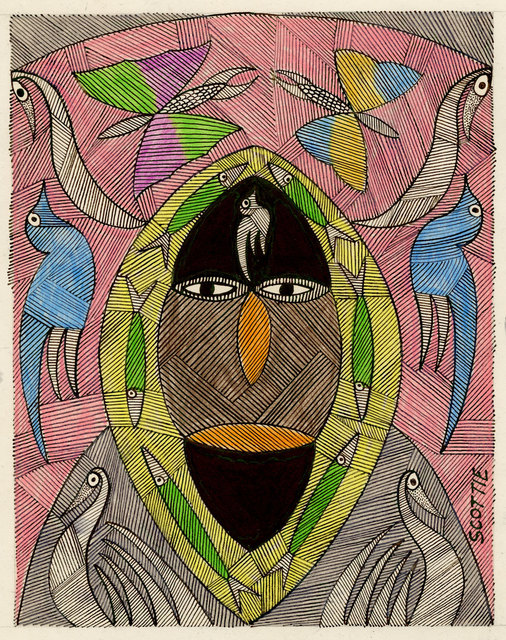
Scottie Wilson, Geometric Face 3 Bowness does talk about the psychological and socio-economic factors that can impede the artist’s journey to success. These factors, he ascertains, play a huge part in whether an artist really can make it to the top. For example, neither Van Gogh, whose mental health issues became a huge barrier, or Gauguin, who simply could not be in the right place at the right time, achieved acclaim or success in their lifetime. This says a lot about the journey for outsider artists – historical and contemporary – who in many different ways continue to come up against psychological or societal factors that will impede their success. What if they can’t afford – or simply aren’t able to – relocate to a big city where there is a vibrant artistic community? Does this mean that fame is just simply not within their reach?
Another of Bowness’ statements does not sit well in relation to the work of outsiders. He says that:
“The creative act is a unique and personal one, but it cannot exist in isolation. I do not believe that any great art has been produced in a non-competitive situation: on the contrary it is the fiercely competitive environment in which the young artist finds himself that drives him to excel.”
This, of course, raises many questions about the very nature of outsider art, much of which is created in isolation, and is not created as part of a competitive relationship with peers. I disagree wholeheartedly with this statement from Bowness. I think it relegates the act of making art – something so unique and innately human – to a formulaic, almost business-like endeavour.
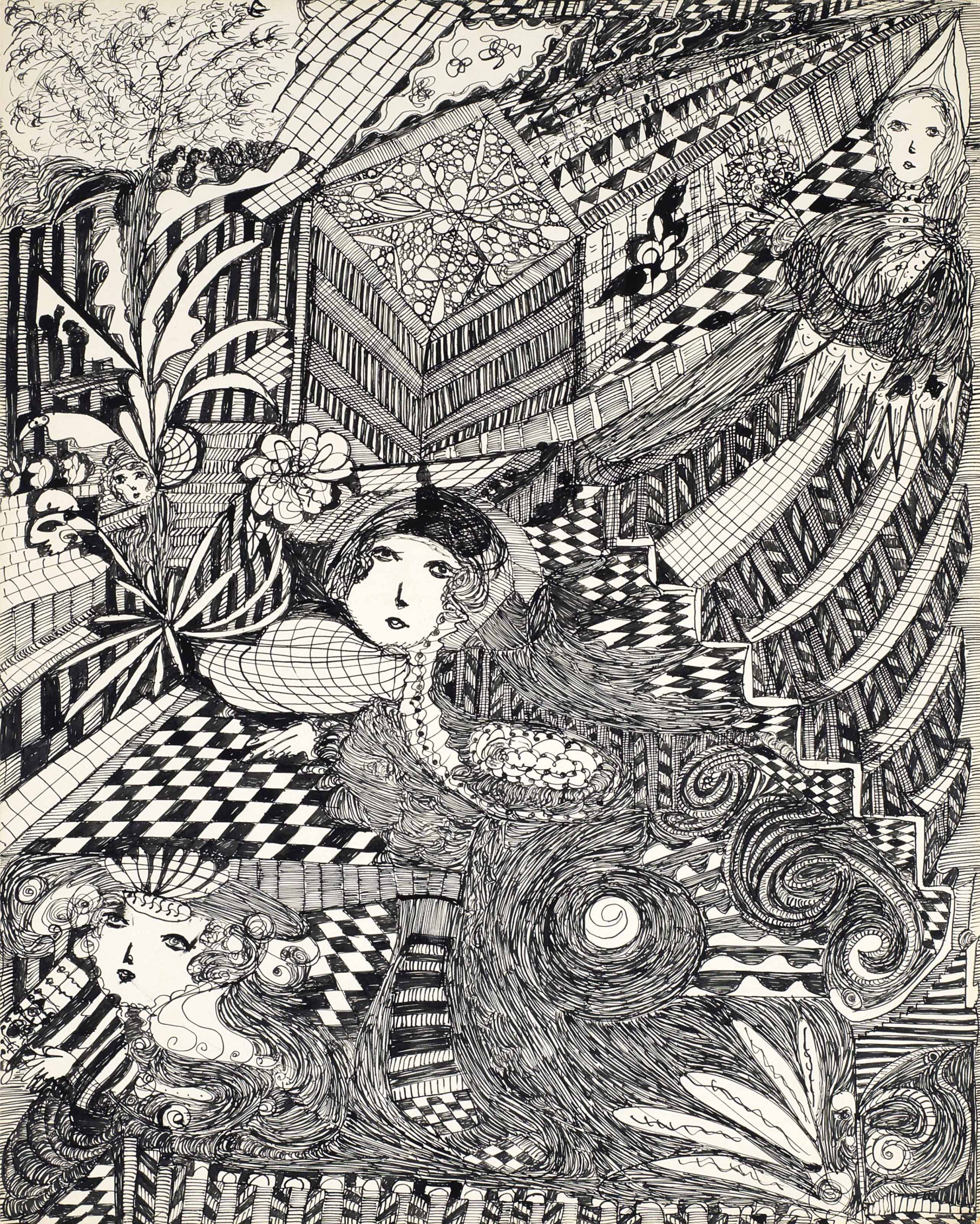
Madge Gill, Untitled But it is Bowness’ final statement in the text that I struggle with the most. He states that “to imagine that there are unrecognized geniuses working away in isolation somewhere, waiting to be discovered, is simply not credible. Great art doesn’t happen like that.”
From my experience, this is exactly how great art happens. Perhaps the artist is not hidden away, hiding in isolation, but they simply have not been discovered yet. Maybe there are not even trying to be discovered. I think it is naïve to think that we all already know the greatest artists and the greatest art that has ever existed. To think that the best art is already publicly available – we already know where it is, who’s made it, where it’s being made, why it’s being made. I think this simply cannot be true. Think how many people are out there now, all over the world, making art – not for any specific audience, not for any specific purpose, but making, nonetheless. And to think that we cannot consider that to be ‘good’ or ‘successful’ art because it has not already been recognized (by peers, by critics, by collectors, and by the public), just seems to me incredibly absurd.
Bowness’ conditions of success once again outline the rigid, self-feeding system that epitomises large parts of the mainstream art world. Each condition depends on the previous, and all are working in each other’s best interests. This is just one of many examples highlighting how exclusive the art world is as a system. It leaves little room for success for those who are not already on the inside.
-
Reputation and the Art World
The next post in my PhD series continues on the theme of the art world as a system, and, more specifically, Becker’s book Art Worlds. This post will focus on the notion of reputation in the art world – how it’s gained, what it means for artists who do gain a ‘reputation,’ and how the theory of reputation excludes art that could or would be considered ‘good’ or ‘great’ art under other circumstances.

Marcel Duchamp’s Foundation (courtesy of http://www.tate.org.uk) I’ll start by reiterating something that has always been a strong (but also evidenced) feeling of mine. That the history of art has only ever celebrated success that has slotted into the expected idea or ‘norm’ of what success looks like. Changes in what is celebrated, or what can be celebrated, do happen, but generally only through the existing channels and expectations of the art world. For example, change is generally catalysed by people who have had previous experience of or in the art world (Marcel Duchamp and his fountain). This means that to create real change in what is expected and what is accepted, ultimately, a systemic upheaval is needed.
The art world has and still does single out somewhat interchangeable artists. It waves a magic wand and calls them ‘special’. But, again, why? How? And who makes these decisions? The idea of the art world being built around individuals and their reputations is a rather Western theory. Many societies’ art systems’ do not work like this, which is why we often don’t hear about specific artists from other countries (non-Western, generally). This is the ‘individualistic’ theory of art. Sociologist Raymonde Moulin’s theory is that the contemporary art world (in western society) frequently celebrates the artist over the art work. This means that anything a certain artist makes will always be celebrated as ‘good art.’
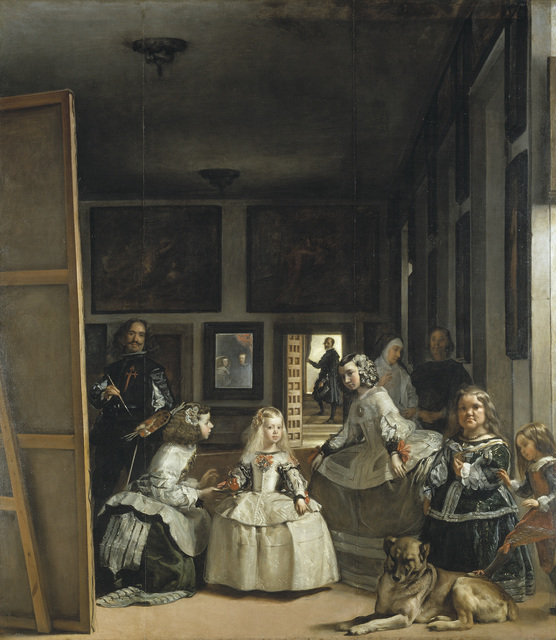
Diego Velazquez, Las Meninas, (courtesy of http://www.artsy.net) Artists (or artists with a reputation) are special because they make work that no one else can make, or that other people could only make ‘badly.’ The theory states that these artists have a special quality that separates them from others working in a similar field. Take for example, the novels of Charles Dickens. What makes these so special, and therefore so celebrated, compared to other literature from 19th century England? A good question. To answer it, we have to ask ourselves what this ‘something special’ is.
Becker notes that this special quality is seen in works that evoke profound human emotions in audiences, and works that talk to the current social or historical context. If we as the audience know that a work has been created by someone with this ‘superior ability,’ we take more notice of it. This is evidenced in new exhibitions of ‘blockbuster’ artists that pop up all over the world – they are attractive to audiences with experience of the art world at all points on the spectrum. We visit these exhibitions not because we know that every work in the show will be to our liking, but because we know that the work will be of a certain standard, aligned with the artist’s reputation. In essence, we know what to expect.
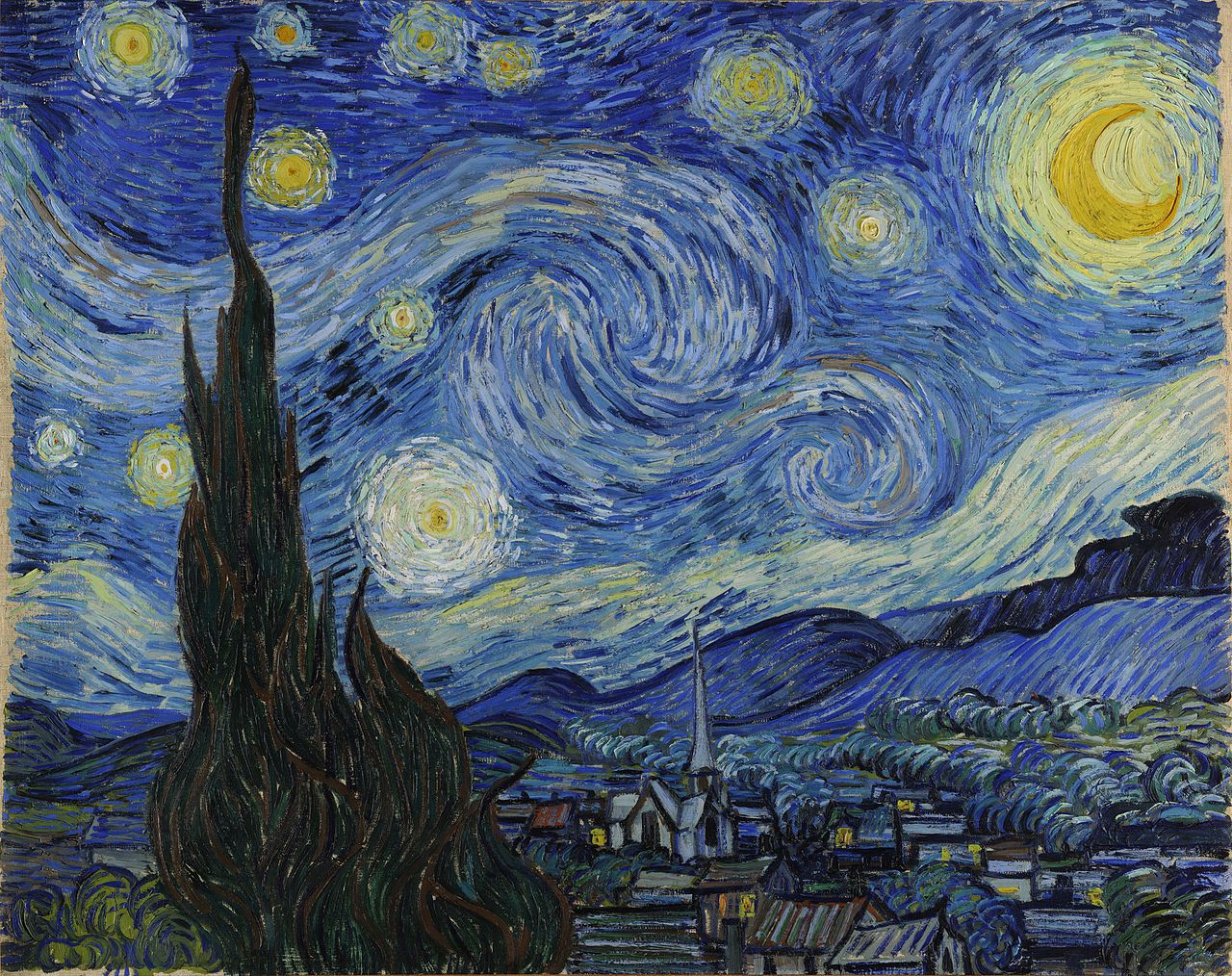
Vincent Van Gogh, Starry Night (courtesy of http://www.vangoghgallery.com) Because of this idea of reputation building and making, artists start to separate their ‘commercial’ and ‘personal’ work; they mark work as ‘unfinished’ if they are not happy with it, and sometimes, they destroy it or take out lawsuits that mean images of it cannot be published or reproduced. They do this to maintain their reputation. All work they make has to live up to the standard ascribed to them and their work. It is not just artists that gain reputations, though, art works can be described as ‘masterpieces’ and schools of art are judged on the work created by their members. Different mediums also have different reputational status. For example, works made in oil paint are generally considered to be of a higher calibre than glass blown works, or tapestries.
Such reputational ascription needs a certain person or peoples to imbue such status. This elevates academics, historians and critics to the position of reputation-maker. They must select the criteria by which we can determine whether a work, medium or artist is any good. Similarly, those involved in the chain of distribution set similar criteria, or boundaries. For example, a work must be unique, singular, irreplaceable, produced by just one person. A sculpture must not be too heavy to sit on a gallery floor, a piece of music not too long so an audience cannot sit through the full duration.

Charles Dickens book cover (courtesy of http://www.waterstones.com) The problem with this ascription of reputation by a small number of people is that there is so much work being created that an academic, historian, critic, couldn’t possibly know or recognise every piece from a certain genre, or made in a certain medium. This is more difficult, too, in the field of visual art, because visual language is universal. Literature is slightly different, in that not every text is available in every language.
The theory of ‘universals’ suggests that works with the highest reputation are those with lasting power. Some works have been celebrated for years, centuries, and even millennia. We must remember, however, that some works last not because they are incredibly special aesthetically, but because they are historically important. And this also does not answer the question of how contemporary artists still working today are ascribed such high status.
The problem with the individualistic theory and the theory of reputation is that it leaves a lot of people and work behind. It is in essence a selection process that is undertaken by a small few. Mavericks are often closely linked enough to the art world that certain works may get noticed some of the time, but this selection process almost always excludes work by folk and naïve artists (of the four categories Becker discusses in his book). This is not to say that folk or naïve artists to not have any special gifts, or cannot created aesthetically astounding works. A folk artist’s work, if we adhere to the theory of reputation, is too commonplace, and a naïve artist’s too private.
By Kate Davey
Referencing Howard S. Becker, Art Worlds, University of California Press, 1982
 KDOA
KDOA 