Category: Reviews

  • Shadows of a Dream

    Shadows of a Dream


    Shadows of a Dream, a collaborative exhibition between Creative Future and Outside In, opened last Sunday (16th September) at Outside In: Gallery located in Wellington House Day Centre, Brighton. The exhibition showcases works by Maria Kuipers, Mercedes Gil Simon, Michelle Roberts, Jessica Levine and Neal Pearce.

    Jessica Levine’s work stems from sources including ‘personal travels, Kentish landscape, current affairs, childhood memories and textile designs.’ Jessica often explores ‘ideas using collage as… this is a useful process in realising finished pieces of work or in translating ideas using paint.’


    Jessica Levine, ‘Mexico’


    Maria Kuipers’ work focuses on ‘self’, and is underpinned by her interest in the human condition and passion for meaningful art. She often uses mixed media and aims for ‘material presence as well as mysterious imagery.’ Maria is an artist led by materials, and by taking an intuitive approach, she reaches into her inner self and works from the unconscious. She hopes that by trusting the creative process, she can make an art that is ‘beyond what is seen into the unseen.’


    Maria Kuipers, ‘Into the Dark (Breaching Boundaries Series)’


    Mercedes Gil Simon’s Black Paintings have evolved from photographs that she took as source material. They focus on night scenes of Brighton, or other cities which Mercedes has a connection to. The photographs are taken in the early hours of the morning to capture the unnerving calm of a city still sleeping. The works explore themes of Film Noir, and ‘convey an emotional and mysterious quality, creating highly evocative, atmospheric and subdued vistas.’


    Mercedes Gil Simon, ‘Black Paintings’


    Michelle Roberts has drawn and painted throughout her life; as a young girl, she accompanied her grandfather, a watercolour painter who often worked outdoors. She spends much of her free time drawing and painting, with the evolution of her works often taking weeks. Michelle creates ‘colourful and complex worlds, each with a distant logic and meaning that connect to her own life.’ Michelle is supported by Project Art Works, based in Hastings, who ‘produce pioneering visual arts projects for individuals with profound intellectual disability and multiple impairments.’


    Michelle Roberts, ‘A Mouse For Your House’


    Neal Pearce’s ‘The Infinite Codex’ was born in 1992, marking his departure from artistic and intellectual over-striving. Inspired by Douglas Adams’ Hitchhikers trilogy, Neal was intrigued by the depiction of Earth as the ultimate super-computer. ‘Could it be that each of us is encoded with invaluable data just waiting to be tapped – information far beyond the reaches of our worldly, tutored minds?’
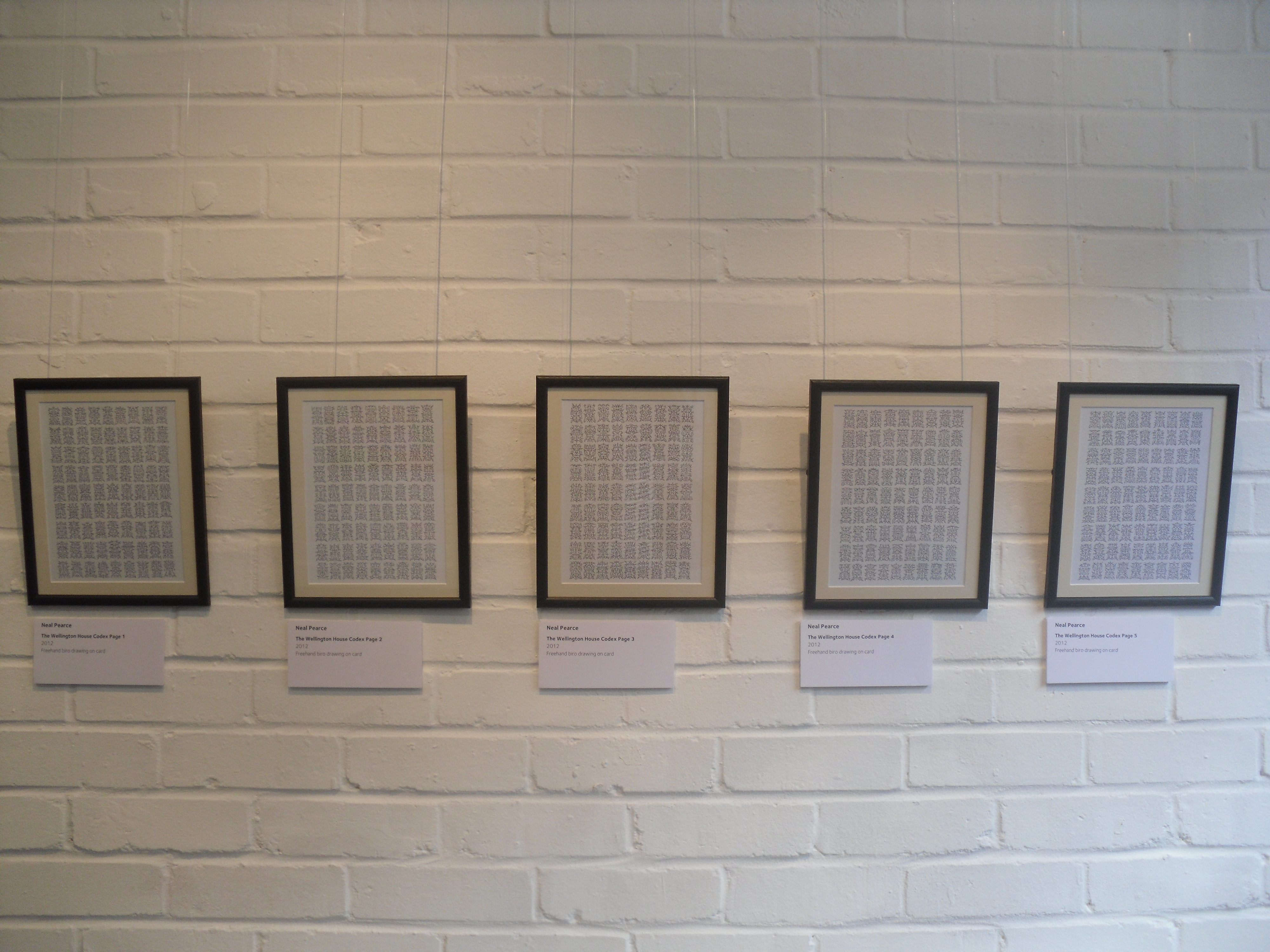
     

    Neal Pearce, ‘Wellington House Codex’


    Shadows of a Dream is running until 21st Janurary 2013

    Outside In: Gallery
    Wellington House Day Options
    Wellington Street
    Brighton
    BN2 3AX

    Gallery opening times:

    Tuesday and Friday 1.30pm – 3.30pm
    Weekdays 9.30 – 3.30 (by appointment only)

    For more information visit:

    www.creativefuture.org.uk

    or

    www.outsidein.org.uk

  • Review and Summary: A. L. Kennedy’s Art and Madness, BBC Radio 3

    On Sunday 22nd April, BBC Radio 3 aired a programme by writer A. L. Kennedy on the supposed links between art and madness. In this post, I want to briefly summarise Kennedy’s views within the programme and discuss some of the questions she raises.

    “Losing one’s mind is a negative, terrifying experience, freeing it can be nerve-wracking too, but also exhilarating, beautiful and eloquent – for everyone.”

    Kennedy begins by noting that we often link art and madness – we don’t link, for example, art and sport, or art and banking. As a female writer, she claims that ‘mad dead Sylvia Plath’ and ‘mad dead Virginia Woolf’ are her role models. As humans, we are ‘obsessed’ by ‘mad, dead’ icons – and, to some extent, this is a myth that can trivialise madness and marginalise art.

    But, what constitutes madness? Dorothy Rowe, Psychologist and writer, claims that even those with a ‘healthy mind’ cannot directly see reality. It is something which is impossible for us as human beings. We can only believe the ideas our brain gives us. Reality is in fact, she claims, a story we tell ourselves; how then, do we know what is, really is?

    Further into the programme, Kennedy takes us as the listener on a journey to a hotel. She is suffering from dizziness, nausea and anxiety – something, she claims, that might suggest to the hotel receptionist that she is ‘stoned’. She explains that that wants to tell the receptionist that she is a professional – a writer, but suddenly, she is embarrassed and ashamed of her profession. To claim she is a writer, in this country in particular, will only confirm beliefs of extremity, eccentricity and madness. She asks, rather pivotally, has a long term exposure to her art harmed her?

    Lisa Appignanesi, a British writer, states that there are many people self-diagnosed and professionally diagnosed with a mental illness who do not ‘create’ in some sense – therefore, there cannot be a direct link between art and ‘madness’. Why is it then, that we insist that all artists experience ‘bad times’?

    Shakespeare’s portrayals of madness are interesting to note. For example, Hamlet is the “sanest guy” acting out in an insane situation and Lady MacBeth is maddened by destruction not construction – or creation. Shakespeare, then, could be said to focus on the insanity of the world, rather than the insanity of the artist.

    The individual, it is claimed, is most defined as individual in extreme states. Madness, then, is an extreme expression of individuality.

    The modern era of art embraced madness; something which could be portrayed as somewhat insulting to those who wake up every morning with no choice. Involuntary mental distress means that our guesses are wrong; we become anxious as a result of this, and then fearful – “we feel ourselves falling apart.” Often, literature on the connection between art and madness beautifies the experience of mentall illness. Psychiatrist R. D Laing once said that Schizophrenia was a type of poetry.

    Kennedy looks at the work of William Kurelek. She asks if we choose to associated madness with artso that we don’t have to associate it with ourselves.

    The connection that is usually made is one which states that the ‘mad’ artist creates more, or perhaps only creates at times when they are experiencing mental distress. This however, is evidentally not the case. Van Gogh, for example, could not paint during times of deep distress and Virginia Woolf would often only experience breakdowns after she had written.

    Being an artist can often create another identity for someone who is suffering from a mental illness. They become an ‘artist’ as opposed to an ‘unwell person’. The creation of art can be therapeutic – not, as Kennedy claims, in the sense of Art Therapy, but in terms of the fact that producing art for many people makes them feel better. Does this not then undermine the myth if art is in fact a cure for madness?

    Being an artist in itself can create turmoil and breakdowns. Performance artist Bobby Baker has claimed that the struggle of working so many hours for an unstable income led to her breakdown. Artists are often idolised, but not paid well for this idolisation. Baker would paint watercolours of her standing on the edge of a cliff during her darkest moments. Her daughter later revealed that she found these images comforting; to her it meant her mother was using an outlet for her feelings that didn’t involve actually going and standing on the edge of a cliff. We all have ideas and thoughts that are unacceptable, and artists ‘speak’ these thoughts. Baker describes the ‘nutty’ artist, who represents what we are scared to see in ourselves.

    Being an artist is not just an occupation, often, it is what makes a person who they are. This can become all consuming. But we, as art viewers, can learn to live and understand ourselves through the work of artists. Art has the ability to help us deal with our lives; it goes on transforming, and it goes on being ‘new’. The ability to create, Kennedy claims, is not something restricted to the ‘mad’, it is in fact something for everyone. Through art we can change the story – we can see the light instead of the dark. It can help us be here, and be alive.

    The BBC programme can be found at: http://www.bbc.co.uk/programmes/b01ghb93

  • Design and Display: The Halle Saint Pierre, Paris

    Design and Display: The Halle Saint Pierre, Paris

    Completely conversely to the bright walls of the typical contemporary art gallery exhibition, the temporary exhibition at the Halle Saint Pierre in Paris was shrouded in darkness. This exhibition is called ‘Banditi dell’arte’ (which Google Translate tells me means ‘Bandits of the Art’) and is the first exhibition in France of Italian Outsider Art.

    At the bottom of the hill that leads up to the Sacre Coeur and Montmartre; one of my favourite Parisian places, sits the Halle Saint Pierre, an institution which celebrates the work of Outsider Artists. One of my interests regarding Outsider Art is how, often, the work of marginalised artists is displayed so differently to the work of ‘non-marginalised’ contemporary artists. This is what I was thinking about during my visit to Banditi dell’arte, and therefore, what this blog post will be focusing on.

    On entering, the exhibition space was very, very dark. Black walls. Spot lit works. It was incredibly different to what you might expect when visiting a ‘white cube’ contemporary exhibition. Many of the works, I found, were by ‘anonymous’ artists – and many of the works in fact were also nameless – something, perhaps, one would not come across in the commercial, contemporary art world. The works were grouped by artist, with a brief biography (only in French) and each artist almost had their own ‘mini-exhibition’; four or five works on display and their own corner or section of the room.

    There seemed to me to be no chronological order or narrative to the overall exhibition – perhaps just the fact that they were Italian Outsider Artists. There was also no set format for the display of the works, it was almost as if someone different had curated each artist’s ‘mini-exhibition’. Also, I found there were a considerable amount of photographs representing installations (rather than actually having the installations on display within the exhibition).

    Upstairs, in their more permanent exhibition room, I found the obligatory white walls. Similarly to the temporary exhibition space, this area also designated a space to each artist; they had their own sections again displaying about four or five works each.

    In terms of the technology used within the exhibition, any notebooks or doodle-books that had once belonged to the artists were displayed on screens that provided a slideshow of the pages. I found this quite a nice touch, as the actual book was under a glass case, but you were still able to explore the work inside of it.

    Something I noticed, in both exhibition spaces in fact, was that because of the partitions and dividers that separated each artist’s ‘mini-exhibition’, you were never just looking at one piece in isolation. Whilst looking at one artist’s work, you could be peering through the gaps at another’s at the same time.

    I would like to do some more research into the differences that are perhaps apparent between the exhibiting of marginalised artists work and that of ‘non-marginalised’ contemporary works. For now, I hope you enjoy this post. Sorry it is quite brief, I just wanted to get down everything I had written on a scrap of paper during my visit before I lost it!

    Image

    Banditi dell’arte: 23rd March 2012 – 6th January 2013, Halle Saint Pierre, Paris

    Don’t forget to follow me on Twitter: @kd_outsiderart

  • *GUEST POST* The Berlin Wall East Side Gallery by Lizzie Davey

    *GUEST POST* The Berlin Wall East Side Gallery by Lizzie Davey

    Many thanks to Lizzie Davey for this post on the Berlin Wall East Side Gallery. Read Lizzie’s blog for more posts about travel and culture: Wanderful World.

    Image

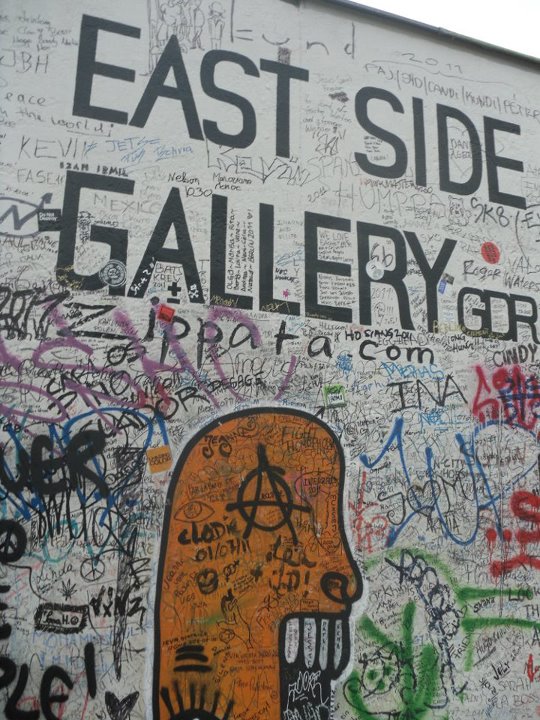
    At 1.3 kilometres long and featuring 106 paintings by international artists, the East Side Gallery is the largest open air gallery in the world. It stands as a memorial for freedom at a time when the future of Germany was unstable. The use of art here has become an expression of the turbulent times a separated and then unified Germany faced; the old and the new Berlin. In 1989, when the wall came down, hundreds of international artists collected at the east side which was once untouchable, and turned it into a colourful, exquisite memorial, providing a new future and place for the wall in Berlin. The paintings exhibited here express a new beginning and put forward new, euphoric hopes for the city; hopes that were formed when the wall came down.

    When visiting the East Side Gallery last year, I was amazed by the diversity of imagery on display. However, all seemed to convey a similar theme; freedom. The array of colour displayed in such a large format can be overwhelming, but once I reached the end I wanted more. Remembering that the gallery is actually exhibited on the wall, the wall that was once a huge part of German history is amazing and will enforce the struggle Germany faced during this time for years to come.

    Some critics state that the wall is in such bad condition now that the original artworks are almost undecipherable. I, however, think that it has evolved with the times, creating a portal where citizens of Berlin can express their feelings via an artistic platform. In some ways, the graffiti overlaying the original paintings only enhances the wall, showing how the visions and outlooks of the people have changed over time. Each piece was unique and brilliant in its own way, including the newly added graffiti that has accumulated. The memorial was created to express freedom, and surely this is evident in the way the wall appears today as an almost interactive gallery.    

    Again, thanks to Lizzie for this post. Don’t forget to check out her blog: Wanderful World.