Category: Exhibitions

  • What’s On – June 2012

    What’s On – June 2012

    Flash of Splendour Artists
    Image
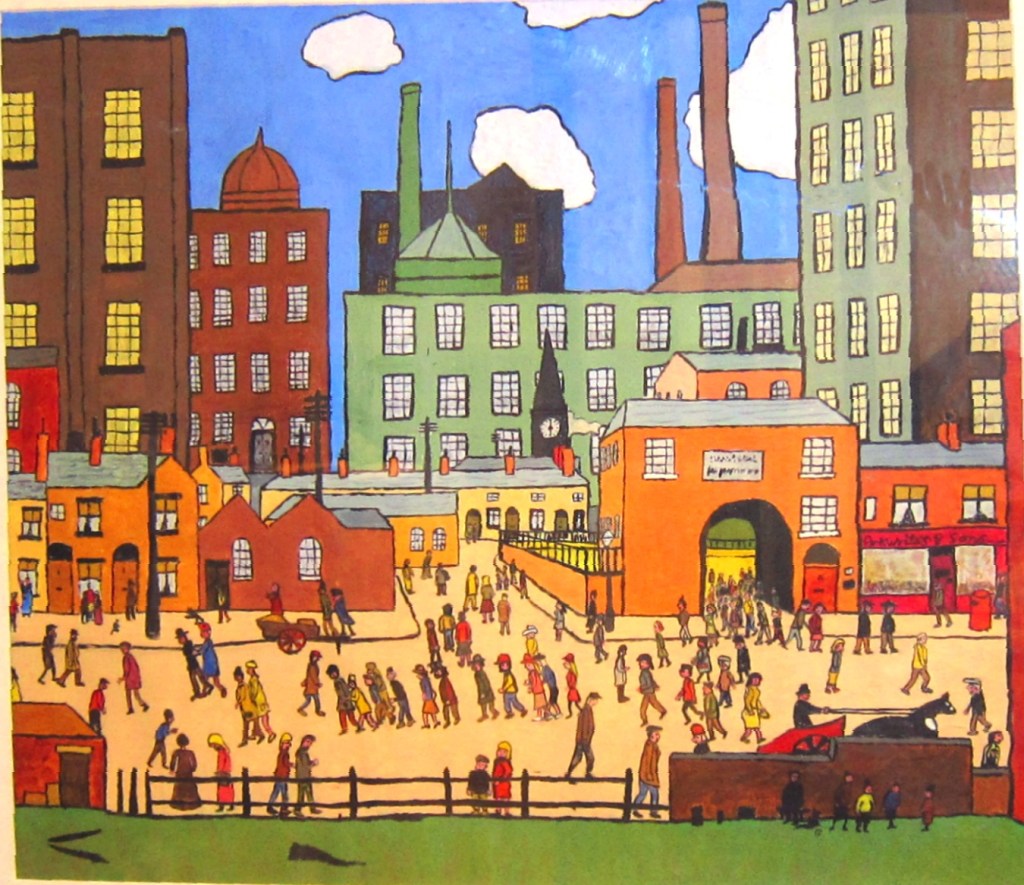
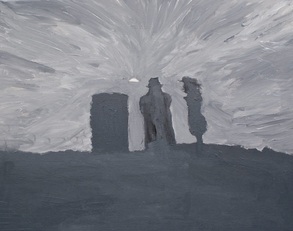
    Charlie Lagden, The London Job, 2009

    Flash of Splendour Artists @ Threadneedle Street, London

    Ongoing

    Flash of Splendour Artists is a “groundbreaking and highly acclaimed not-for-profit creative arts organisation working with music, poetry and the visual arts to effect societal change.”

    The exhibition itself will focus on the work of 5 young British artists who are mentored by Flash of Splendour Arts.

    The organisation itself specialises in “fostering creativity and self-determination in children and young adults, with a passionate interest in empowering those disempowered, for whatever reason, by their societal positioning.”

    For more information please visit: www.flashofsplendour.com

    Creative Future

    // Tight Modern Submissions \\

    50 works will be selected from submissions by marginalised or disabled artists to go on a touring exhibition across Sussex and London. The gallery is a minute replica of the Tate Modern, will dimensions of 8 ft x 5 ft with a 12 ft high chimney.

    Images that are submitted should be original, photographs, collages or computer generated, measuring 18 x 13 cm or 13 x 13 cm. Each artwork entered will cost £5.

    There are prizes of £250, £175 and £75.

    DEADLINE: 4TH JUNE 2012

    Once selections are made, the exhibition will take place at the following venues, on the following dates:

    London: 13th – 17th June @ Royal Brompton Hospital

    Brighton: 9th – 12th August @ East Street Bastion

    London: 10th October @ Gillet Square, Hackney

    Chichester: 9th – 11th November @ Pallant House Gallery

    For more information please visit: www.wix.com/tightmodern/gallery

    Studio Upstairs

    Image

    RIGHT HERE RIGHT NOW @ CRE8 Centre, Hackney Wick

    31st May – 7th June

    “A group show focusing on the lives of ten Studio Upstairs artists…. Where the viewer is invited into the secret world of each artist.”

    For more information please visit: www.studioupstairs.org.uk

    Outsider Folk Art Gallery
    Image

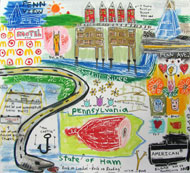
    Intertwined @ The Freedman Gallery at Albright College – Reading PA, USA

    20th May – 1st July 2012

    This exhibition “examines the artistic relationship of a mother and daughter, and a father and son, who have experienced extraordinary circumstances.”

    For more information please visit: www.outsiderfolkart.com

    The Graeter Art Gallery

    ImageTridacna @ The Graeter Art Gallery

    3rd May onwards

    The artworks on display in this exhibition mirror the struggle of the Tridacna; a creature which when put in peril will vanish, leaving behind just a skeleton.

    The exhibition includes pieces that represented “suspended dreams” and a “romantic merging of humanity, nature and animal.”

    For more information please visit: www.graeterartgallery.com

    Bethlem Heritage

    Hollow Space and Outgrowth @ Bethlem Gallery

    13th June – 13th July 2012

    “Artists from Bethlem Gallery respond to the historical and art  collection in the Archives and Museum.”

    For more information please visit: www.bethlemheritage.co.uk

  • Outside In: National 2012

    Outside In: National 2012

    Outside In‘s National Exhibition will take place between the 27th October 2012 and 3rd February 2013 at Pallant House Gallery in Chichester. Outside In work to provide a platform for artists who are marginalised from sociaty due to a number of reasons including mental health issues, social circumstances and disability. The deadline for applications for the exhibition is Friday 20th July 2012, and there is no submission fee for entering the competition. There will be six award winners who will receive a month long solo exhibition in the Studio at Pallant House.

    Accompanying the Outside In: National will be other exhibitions based around the idea of ‘outsider’ art. Pallant House will be exhibiting the work of Jean Dubuffet, who originally coined the term Art Brut. He was a painter and sculptor as well as a collector of ‘outsider’ art in the early 20th century. As an artist, Dubuffet disregarded traditional ideals of beauty and instead focused on what he believed to be a more authentic and ‘raw’ approach to creating art. The exhibition at Pallant House will focus on the L’Horloupe series within Dubuffet’s collection.

    Also accompanying Outside In: National will be an exhibition of Pat Douthwaite’s prints. Douthwaite is considered both a ‘self-taught’ and ‘outsider’ artist after starting her life as a dancer and aspiring actress. After giving up the stage to focus on her art, Douthwaite was encouraged not to attend art school by fellow Scottish artist J. D. Ferguson. Lacking a permanent base, Douthwaite worked from numerous cities and countries including England, Scotland, North Africa, India and South America, but eventually struggled with physical illness after an attack she suffered in Edinburgh. Douthwaite exhibited regularly within the art world, but her work and its unique style was not considered to fit into the artistic conventions of her day. She was uninterested in becoming caught up in the art world, instead being comfortable being linked to ‘outsider’ art.

    Douthwaite’s early work was heavily influenced by the work of Dubuffet – something which connects the two exhibitions at Pallant House which are accompanying Outside In: National this coming Autumn/Winter.

    This series of exhibitions is something not to be missed by those interested in the work of ‘outsider’ artists. For more information on the exhibitions, and to keep up to date when information is released about them, please visit Outside In‘s website.

  • Safety Net of Sky: 30th March – 27th May

    Safety Net of Sky: 30th March – 27th May


    The Koestler Trust is currently running an exhibition curated by young people from the Liverpool Youth Offending Service, with help from professional curators.

    The exhibition includes paintings, drawings and sculpture as well as creative writing which were selected from entried to the 2011 Koestler Awards.

    The exhibition is taking place at the World Museum on William Brown Street in Liverpool.

    For more information you can visit: The Koestler Trust or the World Museum

  • What’s On in the Outsider Art World – May 2012

    What’s On in the Outsider Art World – May 2012


    Image

    Galerie Gugging, Austria

    Until 28th Oct 2012
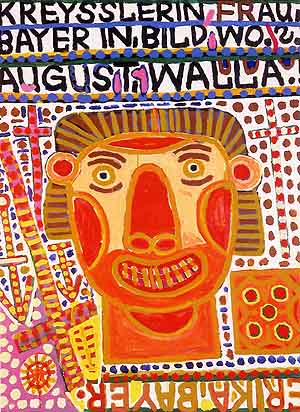
    ‘August Walla Retrospective’

    Until 7th Oct 2012
    ‘Sexi-Blatt’
    An exhibition based on the theme of sexuality

    Mad Musee, Belgium

    Until 6th May 2012
    ‘Rumours’
    An exhibition that includes the work of Morton Bartlett, Lee Godie, Loulou and Miroslav Tichy

    The Arts Festival of North Norway, Norway

    24th June 2012
    ‘The World of Outsider Art’ at the Trondenes Historic Centre, Harstad Norway

    The Aprad Szenes-Vieira da Silva, Lisbon Portugal

    Until 23rd Sep 2012
    ‘Arte Bruta – Terra Incognita’
    Outsider Art from the collections of Richard Troger and Antonio Saint-Silvestre

    Portugese Association of Outsider Art, Lisbon Portugal

    Until 31st May 2012
    ‘Xico Nico, Sculptor’

    Intuit: The Center for Intuitive and  Outsider Art, Chicago

    Until 30th June 2012
    ‘Heaven and Hell’

    Bethlem Heritage, London

    13th June 2012 – 13th July 2012
    ‘Hollow Space and Outgrowth’
    “Artists from Bethlem Gallery respond to the historical and art collection in the Archives and Museum”

    Art et Marges Musee, Belgium

    10th Feb – 20th May 2012
    ‘La Fabuloserie: le fabuleux destin des Bourbonnais’

    Frist Center for Visual Arts, Tennessee

    24th Feb – 29th May 2012
    ‘Fairy Tales, Monsters and the Genetic Imagination’

  • Edward Burra (1905 – 1976) – Modern Connections

    Edward Burra (1905 – 1976) – Modern Connections

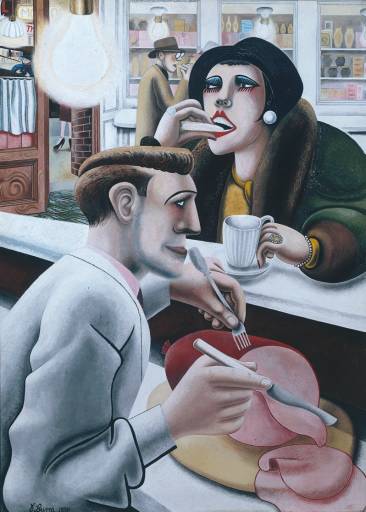
    Edward Burra, The Snack Bar (1930)

    Edward Burra, not exactly an ‘Outsider Artist’, never seemed to quite fit in to any particular art canon. After visiting the first solo exhibition of his work in 25 years at Pallant House Gallery in Chichester earlier this year, I could see connections with German Expressionism, Surrealism, and potentially Impressionism – connections which I will discuss in more detail later in this post. However, despite being named one of the most acclaimed modern British artists, his work is somewhat unknown to the majority.

    Working predominantly in watercolour, Burra’s work is unlike any other pieces found in this medium. He uses the paint to produce a bold, solid colour – a characteristic that made his work centre stage at Tate Britain’s recent ‘Watercolour’ exhibition. Burra’s work encompasses four main themes; the first being the almost voyeuristic depictions of prostitutes and drinkers, then there are his more macabre, surrealist works, then his landscapes and, finally, his theatre designs.

    His depictions of the Hollywood scene and life in Harlem – in which he represents drinkers, prostitutes and immigrants – are almost comparable to the work of early Impressionists working in Paris in the late nineteenth century. The voyeuristic, almost flaneur-like gaze of the artist represents the woes and tribulations of modern industrial life. Similarly to Eduard Manet and Pierre-Auguste Renoir, Burra plays the flaneur in these works, for example in his piece entitled The Snack Bar (1930), which depicts a prostitute in a café-bar. Comparable to Manet’s scenes of café-life, such as At a Corner Café-Concert (1878), Burra’s work unashamedly depicts working-class urban life. The idea of the flaneur, a theory highlighted in the work of Charles Baudelaire, is that the artist depicts fleeting moments in time; capturing everyday life on the canvas – or in Burra’s case, on paper.

    Burra’s work has already been compared by many to the work of the German Expressionists Otto Dix, George Grosz and Max Beckmann. The German Expressionists used their art to portray their discontent with the rapid modernisation and industrialisation that was taking place in Germany during the early twentieth-century. Similarly to Burra, they worked in bold, solid colour, with harsh lines and also depicted the turmoil and dissatisfaction that is often a companion to the loneliness of modern city life. Dix, Grosz and Beckmann, amongst other Expressionists, were not afraid to show the dark side of urban life; the back streets, the macabre and the poverty; subject matter that resulted in the their inclusion in the 1937 Degenerate Art exhibition in Munich.

    Despite the difficulty to place Burra within the traditional art historical canon, his work is definitely something to be celebrated. His use of watercolours can only be admired; from a distance, it is impossible to tell that his courageous use of colour is produced using this medium. His work shamelessly depicts the underworld of modern urban life; a theme that is iconic and almost representative of works produced during the early twentieth-century in Western cities.

    The Edward Burra Exhibition, which began at Pallant House Gallery, Chichester earlier this year is now touring. You can see this exhibition at the Djanogly Art Gallery until the 27th of May 2012.

  • Design and Display: The Halle Saint Pierre, Paris

    Design and Display: The Halle Saint Pierre, Paris

    Completely conversely to the bright walls of the typical contemporary art gallery exhibition, the temporary exhibition at the Halle Saint Pierre in Paris was shrouded in darkness. This exhibition is called ‘Banditi dell’arte’ (which Google Translate tells me means ‘Bandits of the Art’) and is the first exhibition in France of Italian Outsider Art.

    At the bottom of the hill that leads up to the Sacre Coeur and Montmartre; one of my favourite Parisian places, sits the Halle Saint Pierre, an institution which celebrates the work of Outsider Artists. One of my interests regarding Outsider Art is how, often, the work of marginalised artists is displayed so differently to the work of ‘non-marginalised’ contemporary artists. This is what I was thinking about during my visit to Banditi dell’arte, and therefore, what this blog post will be focusing on.

    On entering, the exhibition space was very, very dark. Black walls. Spot lit works. It was incredibly different to what you might expect when visiting a ‘white cube’ contemporary exhibition. Many of the works, I found, were by ‘anonymous’ artists – and many of the works in fact were also nameless – something, perhaps, one would not come across in the commercial, contemporary art world. The works were grouped by artist, with a brief biography (only in French) and each artist almost had their own ‘mini-exhibition’; four or five works on display and their own corner or section of the room.

    There seemed to me to be no chronological order or narrative to the overall exhibition – perhaps just the fact that they were Italian Outsider Artists. There was also no set format for the display of the works, it was almost as if someone different had curated each artist’s ‘mini-exhibition’. Also, I found there were a considerable amount of photographs representing installations (rather than actually having the installations on display within the exhibition).

    Upstairs, in their more permanent exhibition room, I found the obligatory white walls. Similarly to the temporary exhibition space, this area also designated a space to each artist; they had their own sections again displaying about four or five works each.

    In terms of the technology used within the exhibition, any notebooks or doodle-books that had once belonged to the artists were displayed on screens that provided a slideshow of the pages. I found this quite a nice touch, as the actual book was under a glass case, but you were still able to explore the work inside of it.

    Something I noticed, in both exhibition spaces in fact, was that because of the partitions and dividers that separated each artist’s ‘mini-exhibition’, you were never just looking at one piece in isolation. Whilst looking at one artist’s work, you could be peering through the gaps at another’s at the same time.

    I would like to do some more research into the differences that are perhaps apparent between the exhibiting of marginalised artists work and that of ‘non-marginalised’ contemporary works. For now, I hope you enjoy this post. Sorry it is quite brief, I just wanted to get down everything I had written on a scrap of paper during my visit before I lost it!

    Image

    Banditi dell’arte: 23rd March 2012 – 6th January 2013, Halle Saint Pierre, Paris

    Don’t forget to follow me on Twitter: @kd_outsiderart

  • *GUEST POST* The Berlin Wall East Side Gallery by Lizzie Davey

    *GUEST POST* The Berlin Wall East Side Gallery by Lizzie Davey

    Many thanks to Lizzie Davey for this post on the Berlin Wall East Side Gallery. Read Lizzie’s blog for more posts about travel and culture: Wanderful World.

    Image

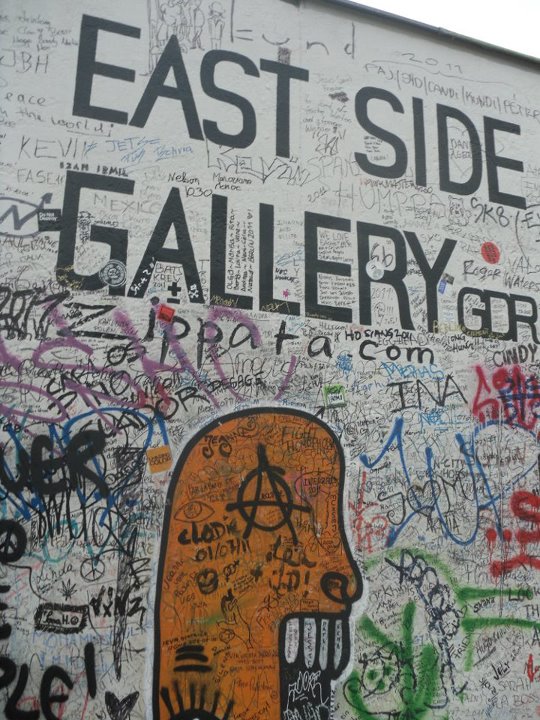
    At 1.3 kilometres long and featuring 106 paintings by international artists, the East Side Gallery is the largest open air gallery in the world. It stands as a memorial for freedom at a time when the future of Germany was unstable. The use of art here has become an expression of the turbulent times a separated and then unified Germany faced; the old and the new Berlin. In 1989, when the wall came down, hundreds of international artists collected at the east side which was once untouchable, and turned it into a colourful, exquisite memorial, providing a new future and place for the wall in Berlin. The paintings exhibited here express a new beginning and put forward new, euphoric hopes for the city; hopes that were formed when the wall came down.

    When visiting the East Side Gallery last year, I was amazed by the diversity of imagery on display. However, all seemed to convey a similar theme; freedom. The array of colour displayed in such a large format can be overwhelming, but once I reached the end I wanted more. Remembering that the gallery is actually exhibited on the wall, the wall that was once a huge part of German history is amazing and will enforce the struggle Germany faced during this time for years to come.

    Some critics state that the wall is in such bad condition now that the original artworks are almost undecipherable. I, however, think that it has evolved with the times, creating a portal where citizens of Berlin can express their feelings via an artistic platform. In some ways, the graffiti overlaying the original paintings only enhances the wall, showing how the visions and outlooks of the people have changed over time. Each piece was unique and brilliant in its own way, including the newly added graffiti that has accumulated. The memorial was created to express freedom, and surely this is evident in the way the wall appears today as an almost interactive gallery.    

    Again, thanks to Lizzie for this post. Don’t forget to check out her blog: Wanderful World.

  • What’s On in the Outsider Art World.. March/April 2012

    What’s On in the Outsider Art World.. March/April 2012

    Image(Image: Robin Ironside at Pallant House, Chichester)

    Bethlem Heritage, South London UK (www.bethlemheritage.org.uk)

    8th – 30th March 2012
    ‘There is Good in Us’

    An exhibition of Geroge Harding’s work – “The work encourages people to look at ‘us’ in a way that is celebratory, unconventional and can teach us something about different ways of being.”

    Pallant House, Chichester UK (www.pallant.org.uk)

    28th Feb – 22nd April 2012
    ‘Robin Ironside: Neo-Romantic Visionary’

    Galerie Gugging, Austria (www.gugging.org)

    Until 22nd April 2012
    ‘Inschriftierungen’

    Galerie Miyawaki, Kyoto Japan (www.galerie-miyawaki.com)

    March 2012
    Exhibition on the work of Outsider Artist Hans Krusi

    Art et Marges Musee, Belgium (www.artetmarges.be)

    10th Feb – 20th May 2012
    ‘La Fabuloserie: le fabuleux destin des Bourbonnais’

    Museum Im Lagerhaus, Switzerland (www.museumimlagerhaus.ch)

    Until 11th March 2012
    ‘Hidden Treasures from Swiss Psychiatry II: Encounters’

    Frist Center for Visual Arts, Tennessee (www.fristcenter.org)

    24th Feb – 29th May 2012
    ‘Fairy Tales, Monsters and the Genetic Imagination’

  • Art in the Woods

    Art in the Woods

    Today, I took an camera and a walk through some local woods. Here, I stumbled across a community garden project which combines horticulture, creativity and vegetable growing with other community projects, created wholly by volunteers and service users.

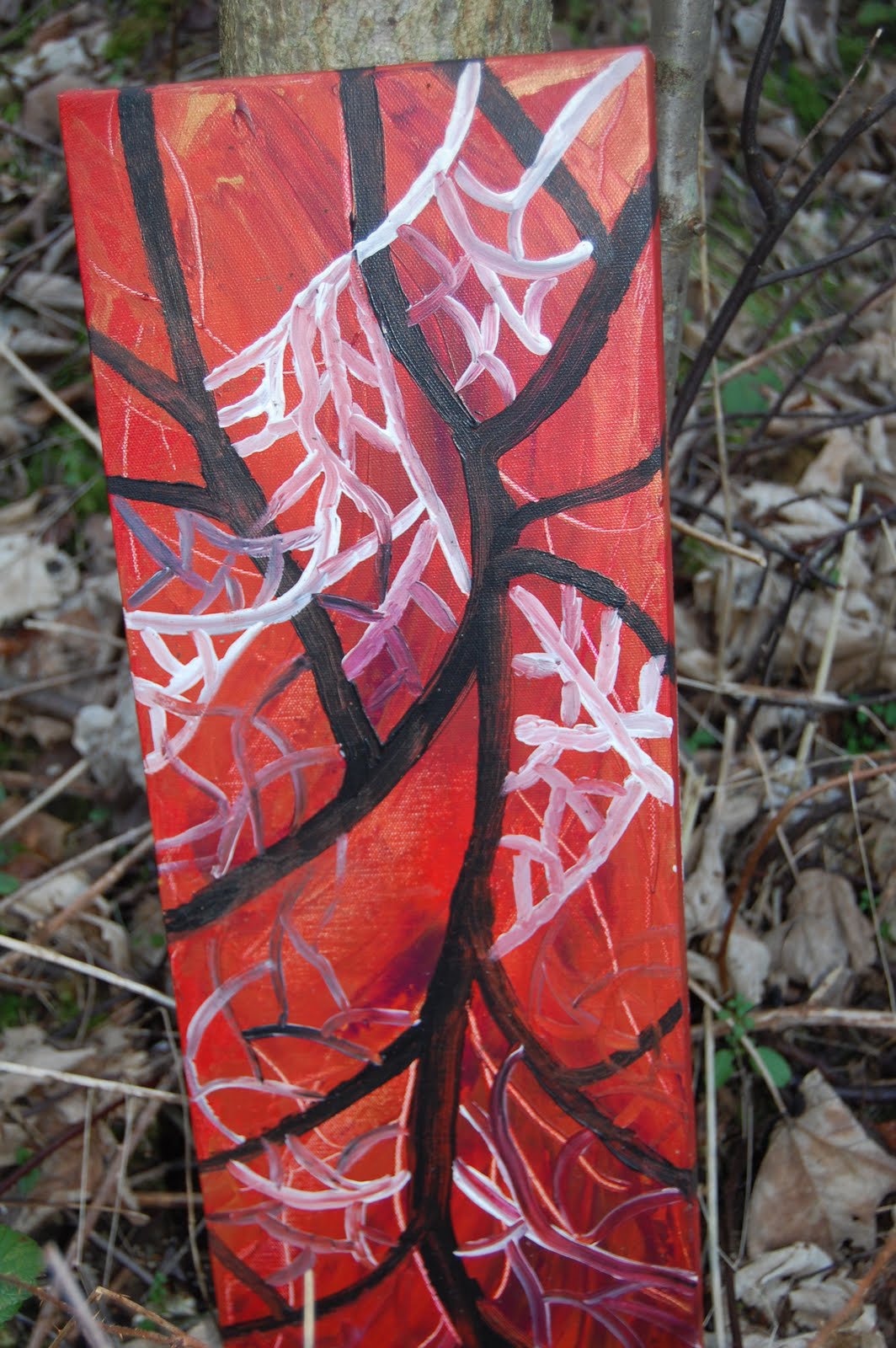
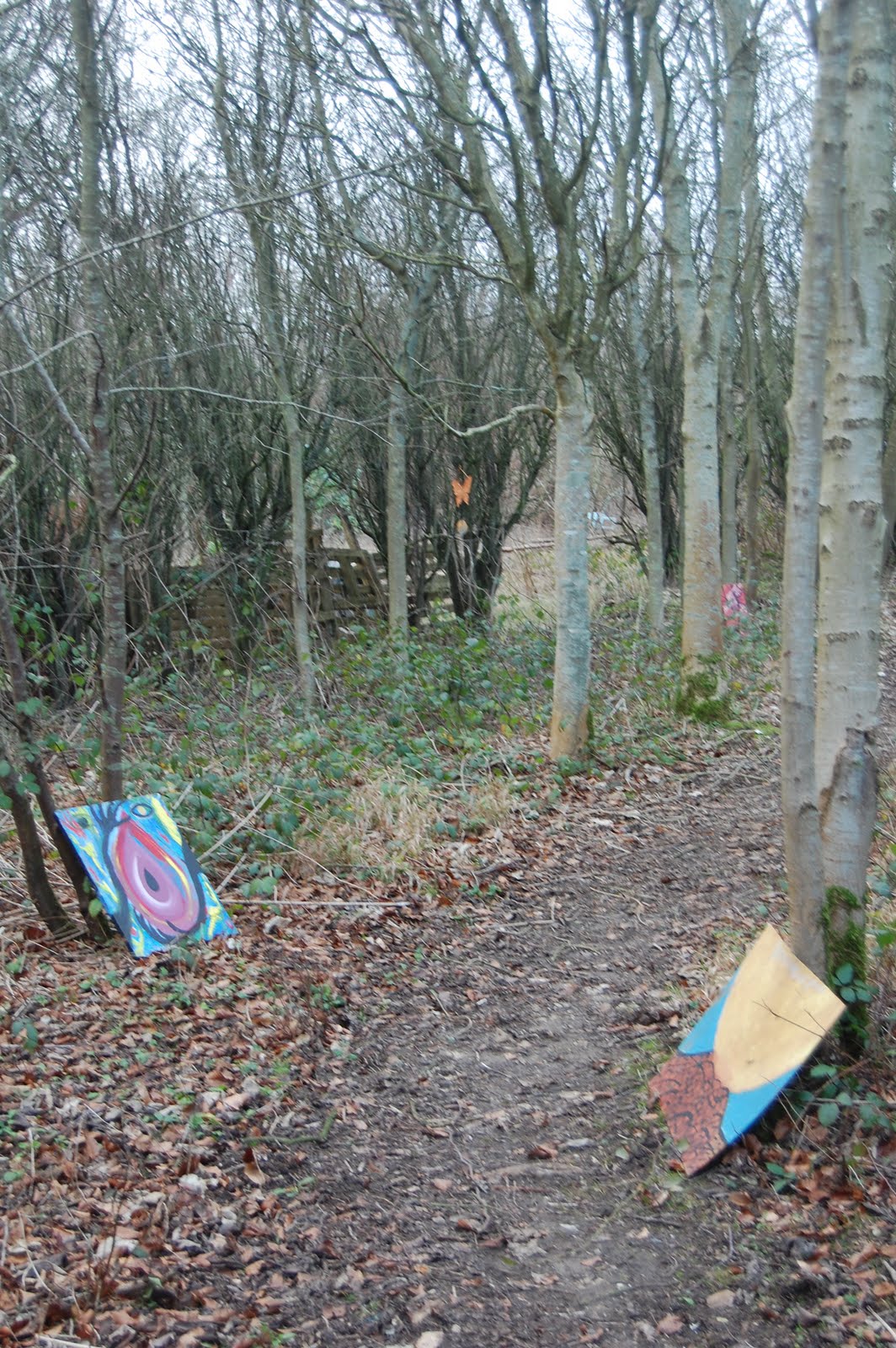
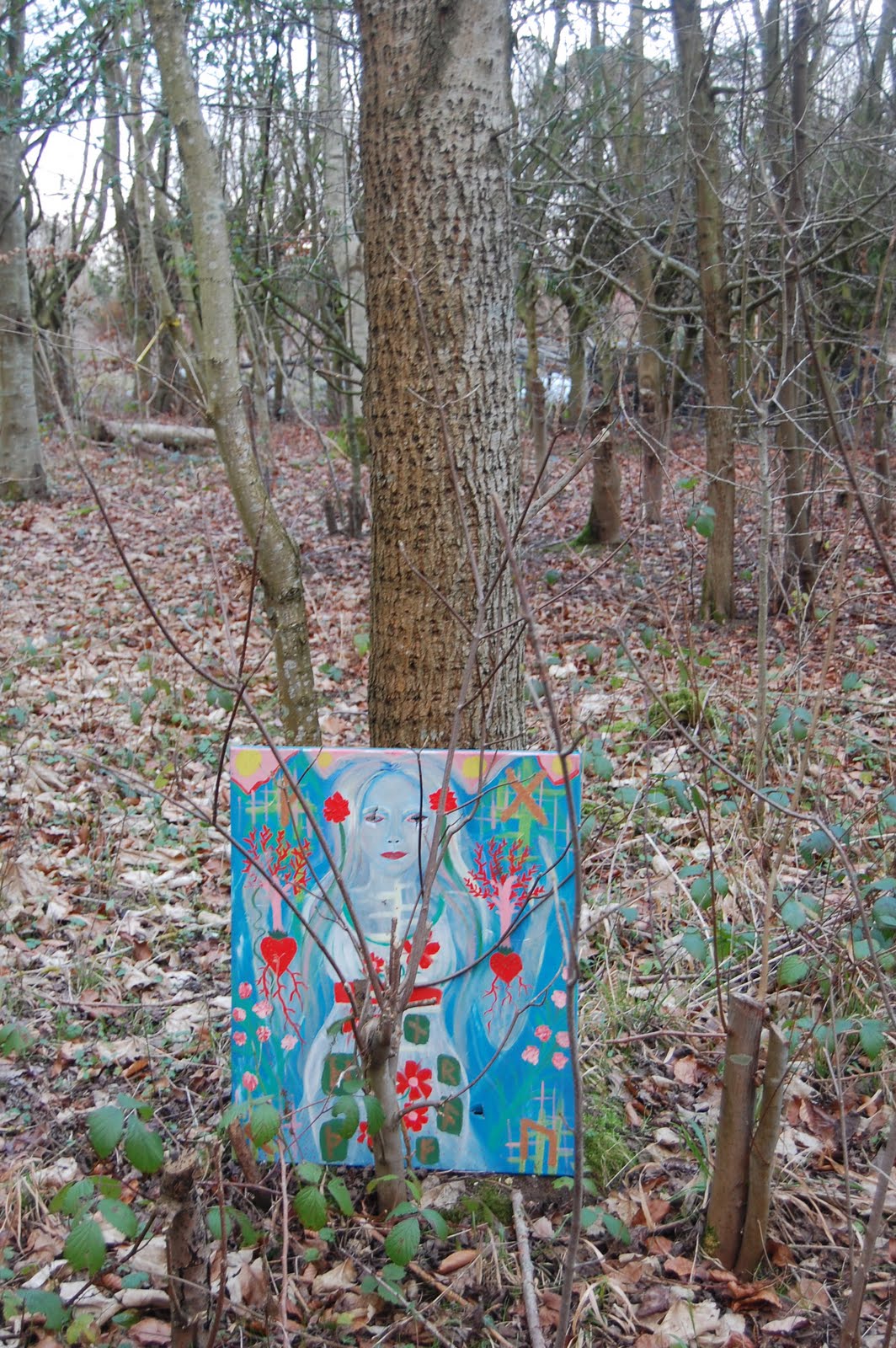
    Interspersed amongst the trees I noticed canvases painted with intricate patterns and bold colours. The walk through the pathway of paintings, hand made bird houses and wind chimes was peaceful, if somewhat eerie in the sense that this part of the wood had obviously seen activity, yet there was no one in sight. The area was a warren of pathways, connected gardens and vegetable patches.

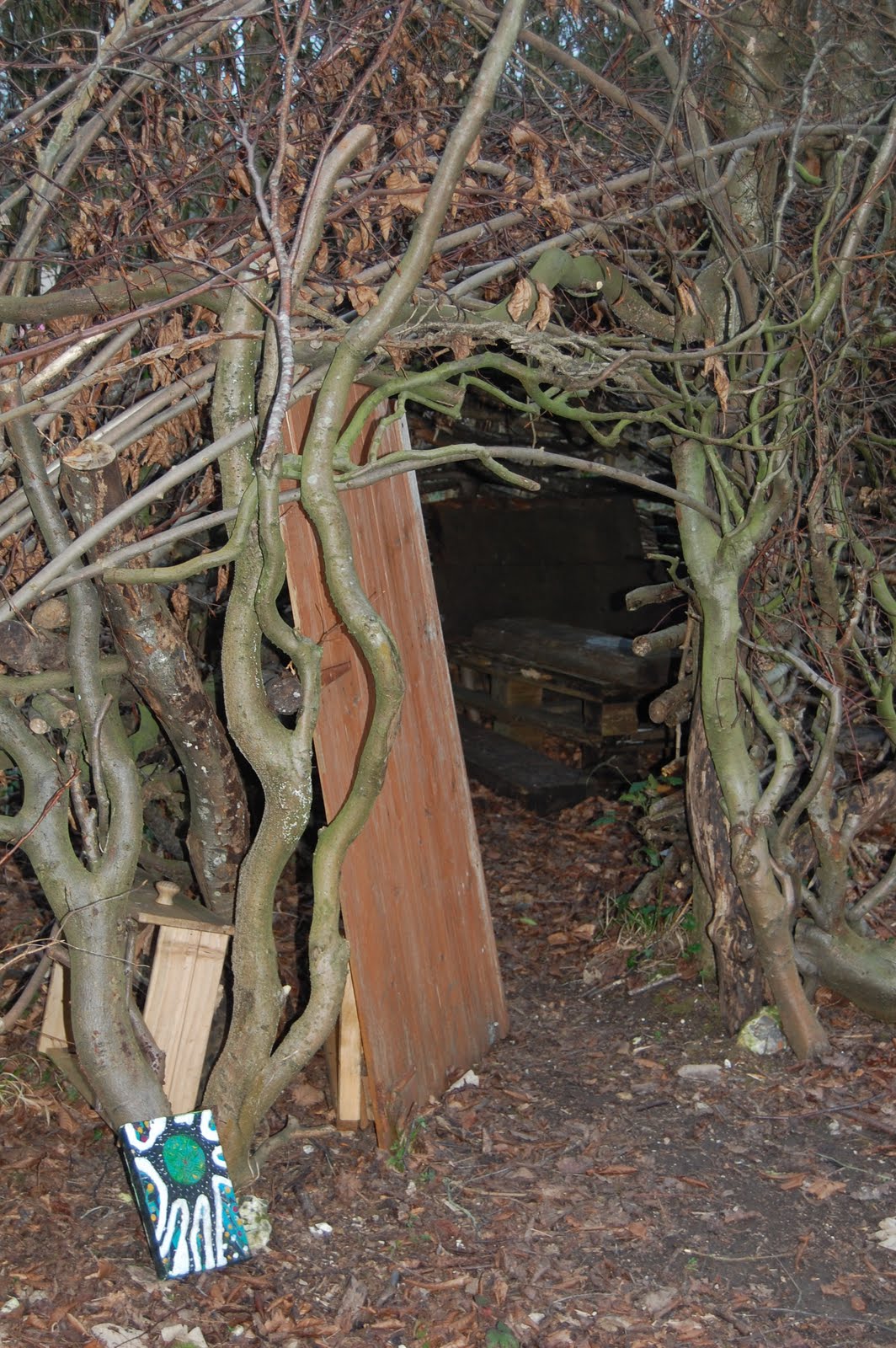
    After entering through numerous gates with hand painted signs which asked visitors not to pick the crops, I came across a house made of woven twigs, with a wooden armchair fashioned as the centrepiece within; a young child’s den paradise. At various points throughout the walk, there came resting points which consisted of large wooden seating areas, often surrounding the remains of once-burning camp fires. A barbecue area, labelled ‘Kitchen’, (complete with an old mouldy block of cheese!) sat in the centre of the vegetable garden. Painted panels told me which vegetables and fruits were gowing in each raised bed, fenced in with upturned glass bottles.

    After some research on my return home, the woodland project is called ‘Nourish’, and is run for communities that often face marginalisation or have difficulties living independently. The project provides volunteers with transferable skills and the opportunity to spend time with people who are possibly facing the same problems as they themselves are, whilst building what is potentially a self-sufficient garden – complete with beehives! What I found the area offered, was a place right in the heart of nature which showed a whole host of creative and practical creations that the volunteers had worked towards. For further information, you can check out the Nourish website at: http://www.nourishcic.co.uk :)

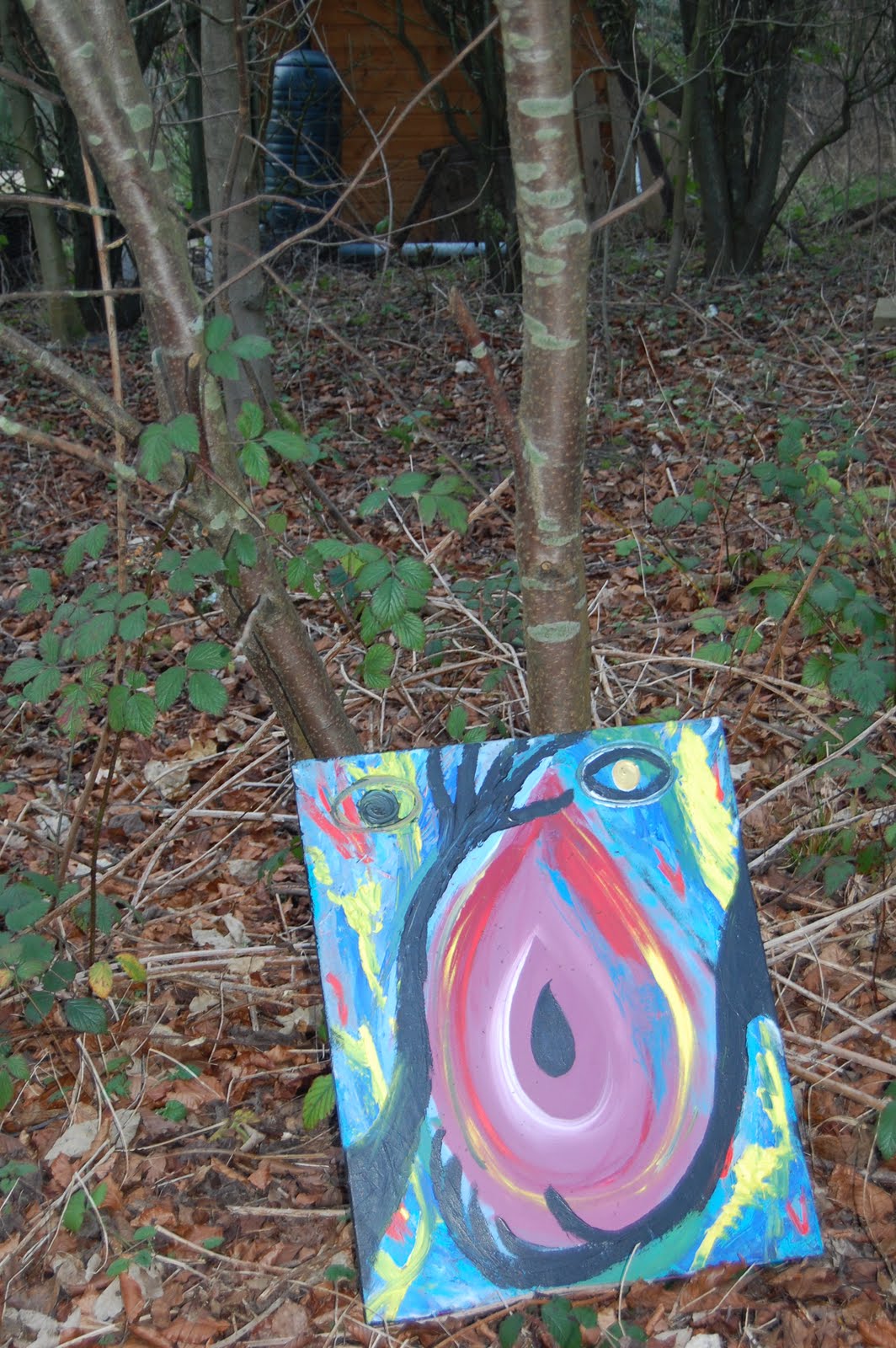
    Below you will find some of the photographs of the artworks I found here. The canvases were almost all found unattached, leaning against the bases of trees.

    This piece, with what seems like a large bulbous ‘nose’ seems almost Scottie Wilson-esque?

    The way the trees were almost ‘growing over’ the paintings really made it seem as if the works were meant to be there.


    In this photograph you can see the entrance to the woven ‘den’, complete with door! 

     Follow me on twitter: @kd_outsiderart