Category: Exhibitions

  • Circus Terminal Worldwide: Next Stop Suriname

    Circus Terminal Worldwide: Next Stop Suriname

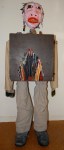
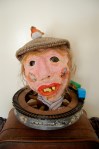
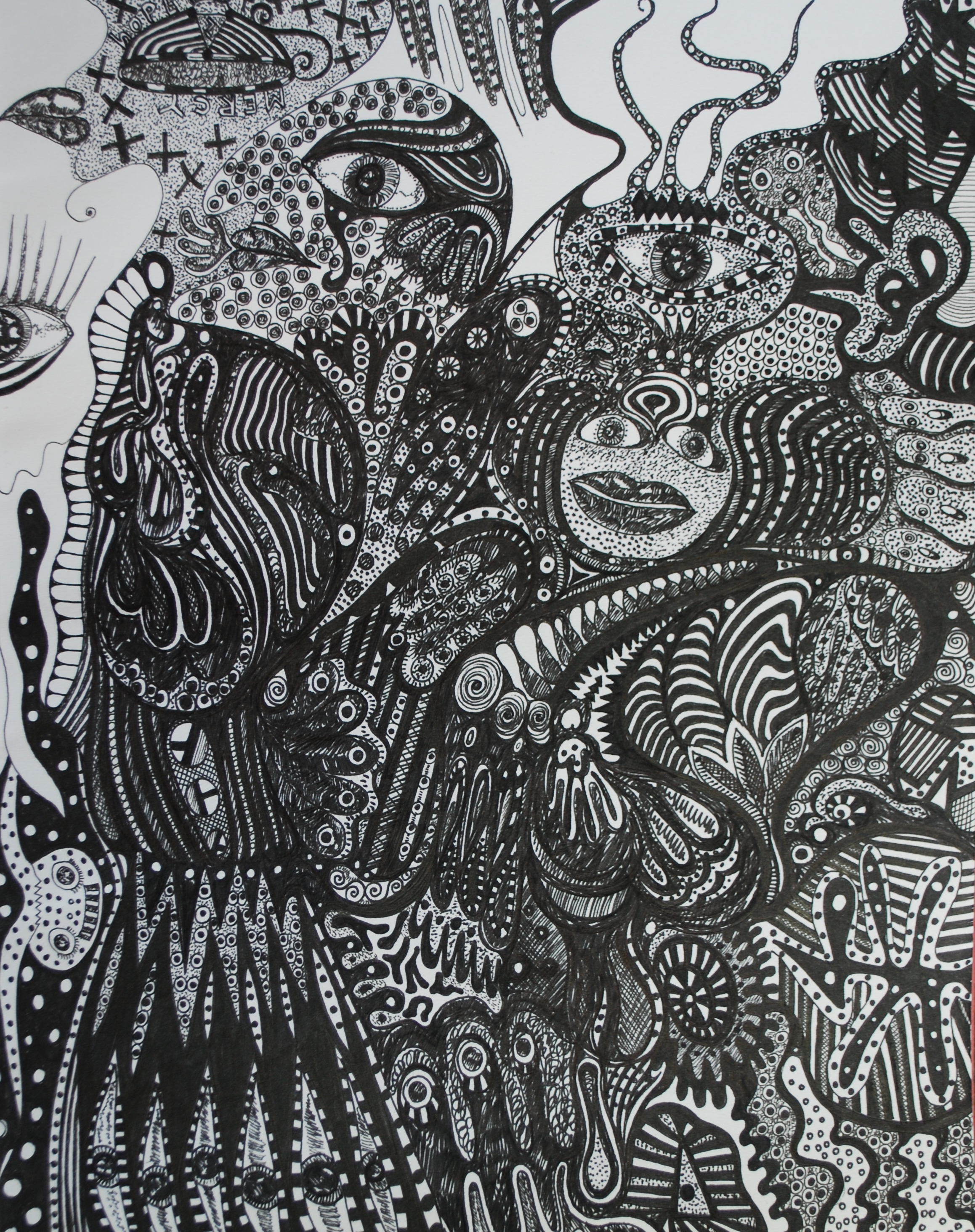
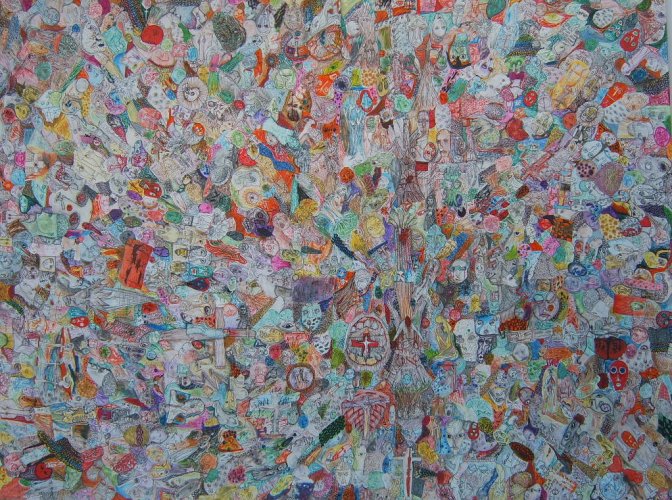
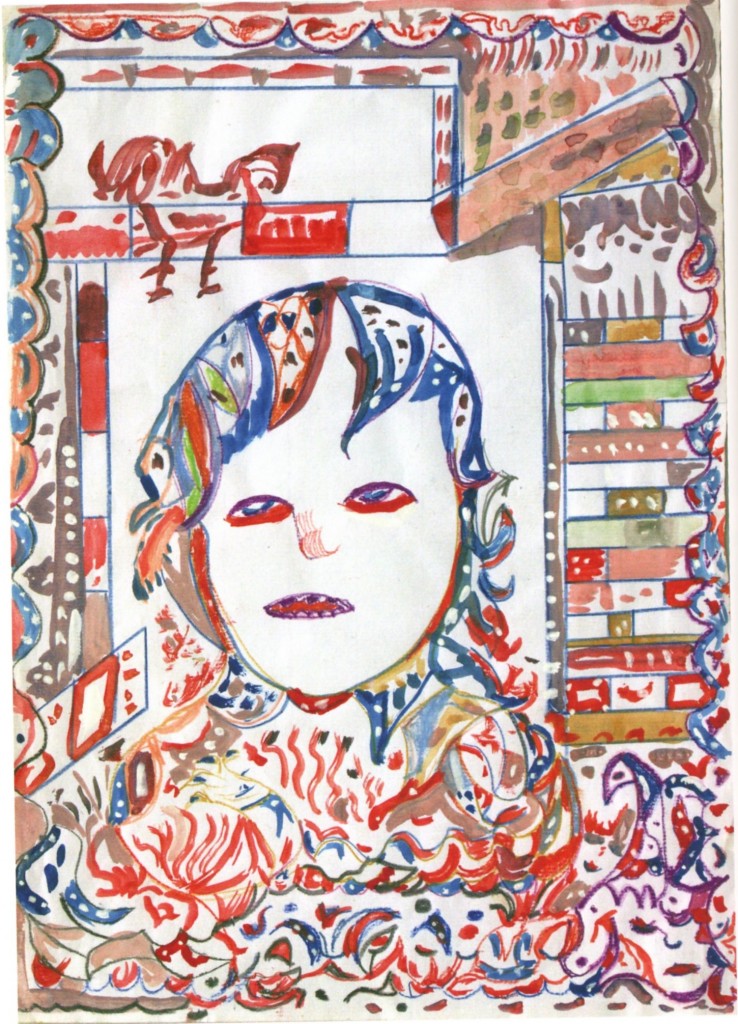
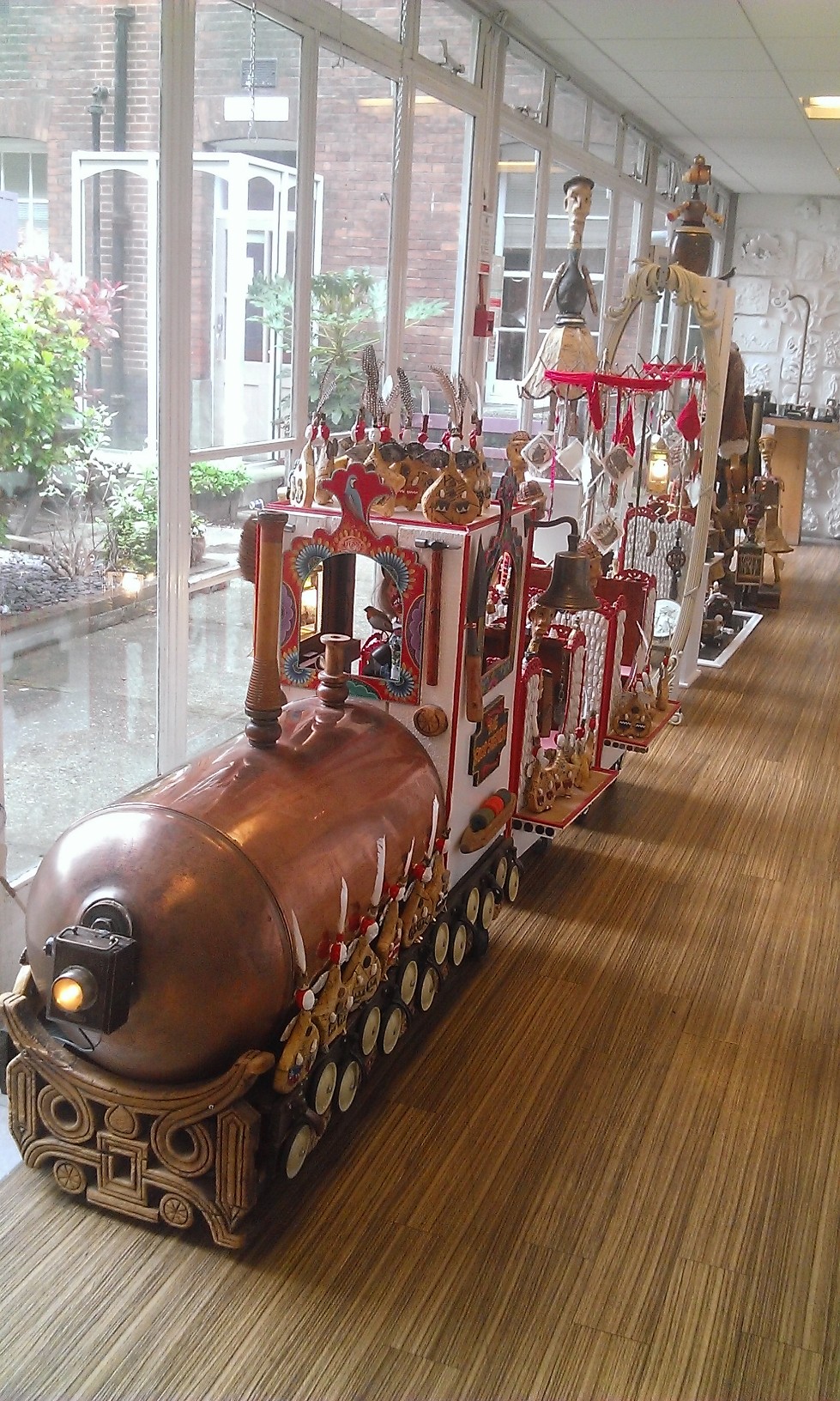
    During a recent trip to Slovenia, I visited ‘Circus Terminal’ at Gallery Kud Esko in Piran (17 – 25 May 2014). The artist-led project, an initiative of ‘Uncooked Culture’, is a collaborative travelling art mission, which disregards academic background and aims to celebrate the differences and similarities of all human beings through their creations. Since 2012, the exhibition – which was launched in the UK at The Tabernacle in London in March of that year – has visited eight countries: Spain, France, Thailand, USA, Holland, New Zealand, and Slovenia. It has grown from 41 artists living in 12 different countries to a project exhibiting more than 350 works by over 85 artists. The final stop on the tour will be Suriname in July 2014.

    In every country, local artists are invited to participate in the exhibition and other collaborative activities; an indicator of how the project has grown so fruitfully during its lifetime. Once the artist has had work exhibited in their home town, they are invited to put their work in founder and curator Chutima Kerdpitak’s suitcase to be shown on the next legs of the tour. Alongside Chutima (Nok), each regional exhibition has a lead artist –in New Zealand it was Wellington artist Lynn Todd, in London Miranda Sky, and in Spain Gustav Glander – as well as invited artists who exhibit alongside the international collective. The project has had one guest artist; Sue Kreitzman in London.
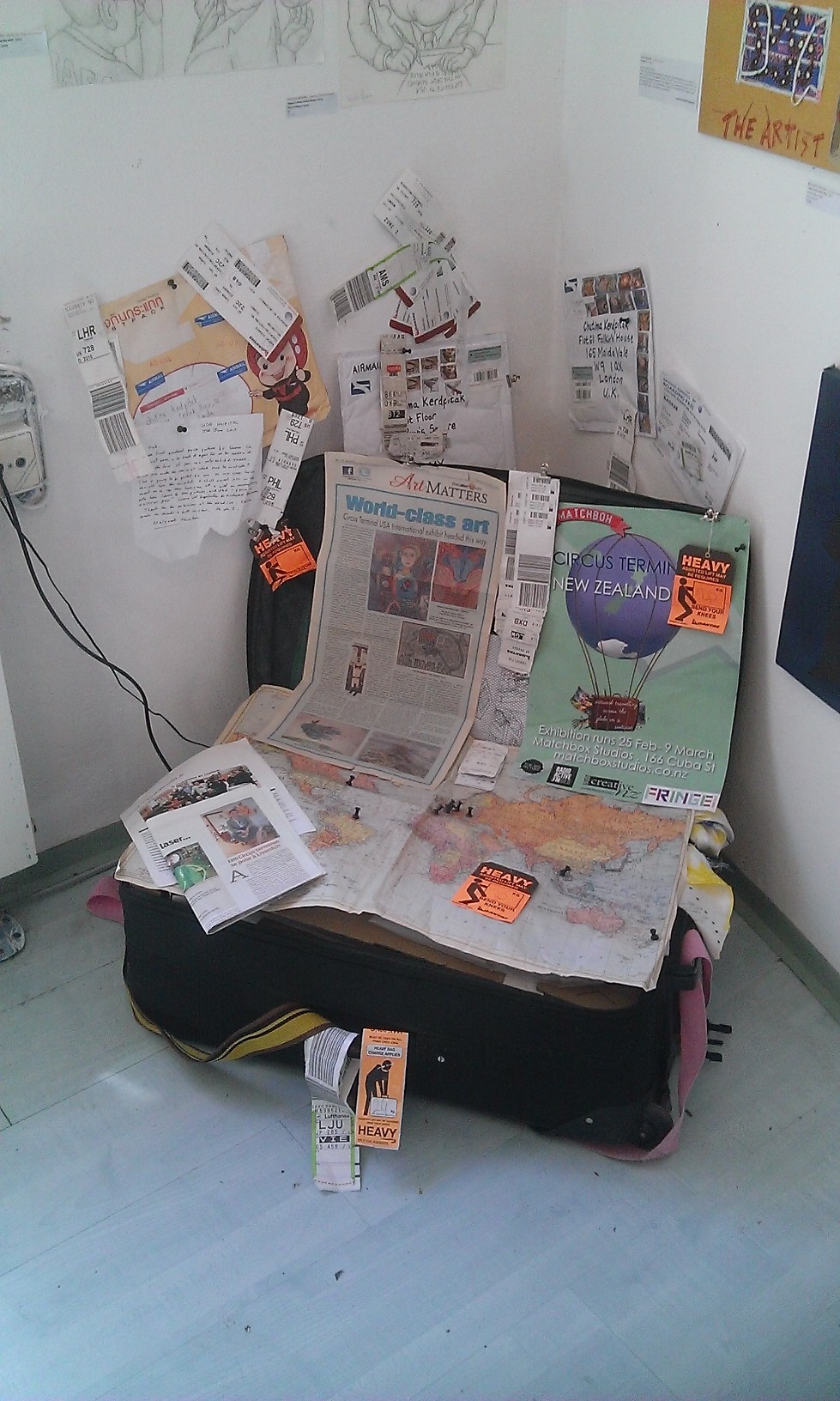
    Chutima's suitcase
    Chutima’s suitcase

    The exhibition in Piran was sat back just off of the main Venetian-style square of the town. Chalked directions marked the walls in the alleyways: ‘Art Exhibition This Way.’ Through a deserted basement and up a flight of stairs, art work began springing up on the walls. The main room was, in every sense, a white cube. But the difference here was that art washed the walls on all sides, including the pillars in the centre. There was colour, ink, sculpture, photography, intricate models, big pieces, small pieces. Almost too overwhelming at first glance, with works piled from floor to ceiling – though not offensively. It was going to take a few circuits to take everything in.
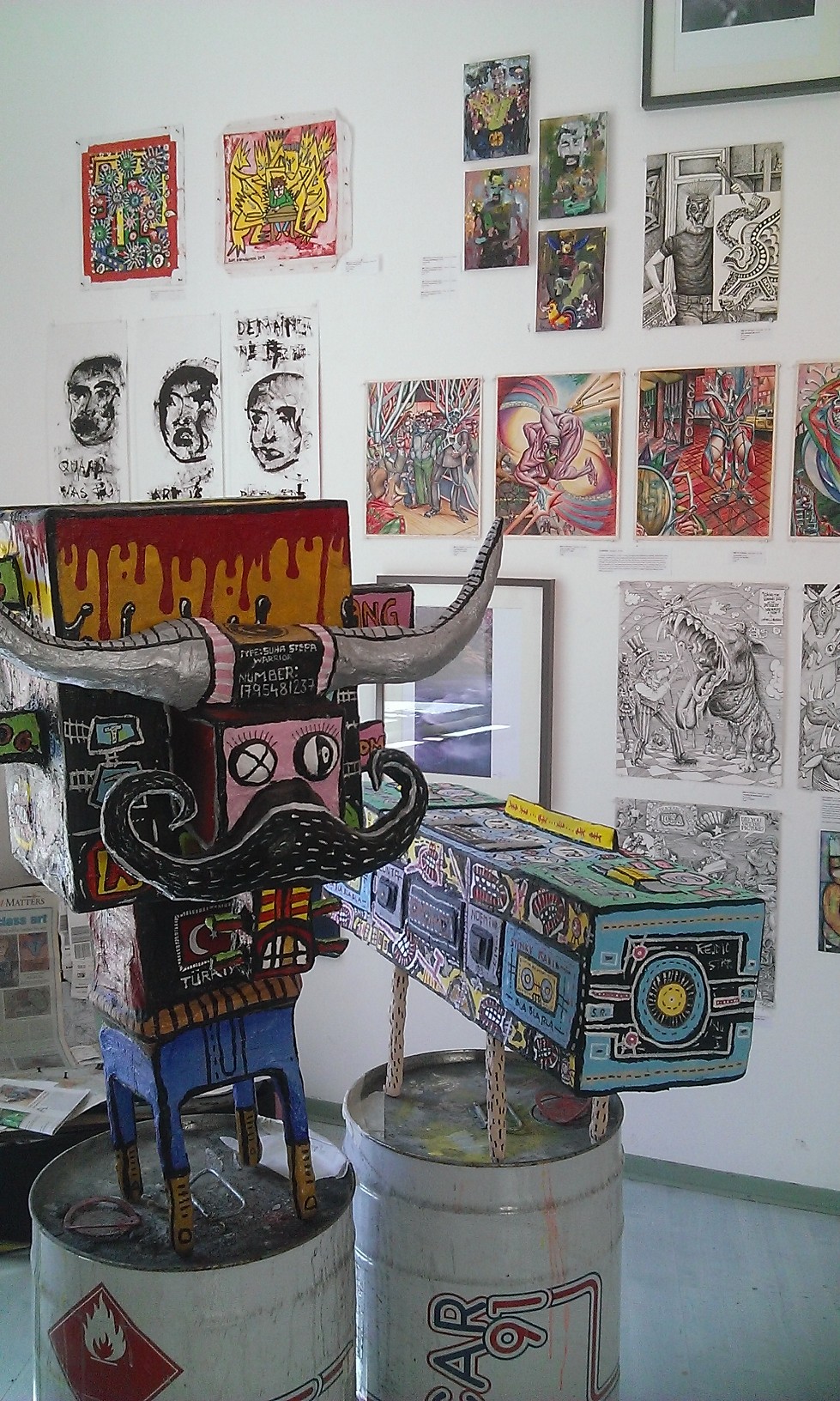
    WP_20140525_012

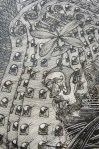
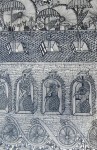
    Some of the highlights of the Piran show were works by Carlo Keshishian, Dan Casado and the graphic works of Jim Meehan; about whom Nok shared an interesting story during my visit. Jim was discovered in Pennsylvania during Circus Terminal USA in 2013. Chris and Paul Czainski (two UK artists) had been offered a residency at Clay on Main in Pennsylvania near Boyertown where Circus Terminal was being held. They came across Jim at a community event they ran, after which he invited them to his house. The next day, the artists told Nok that Jim’s house was covered in thousands of works that had rarely been seen by anyone – let alone exhibited anywhere. Jim then visited Circus Terminal and has been involved with the project ever since.

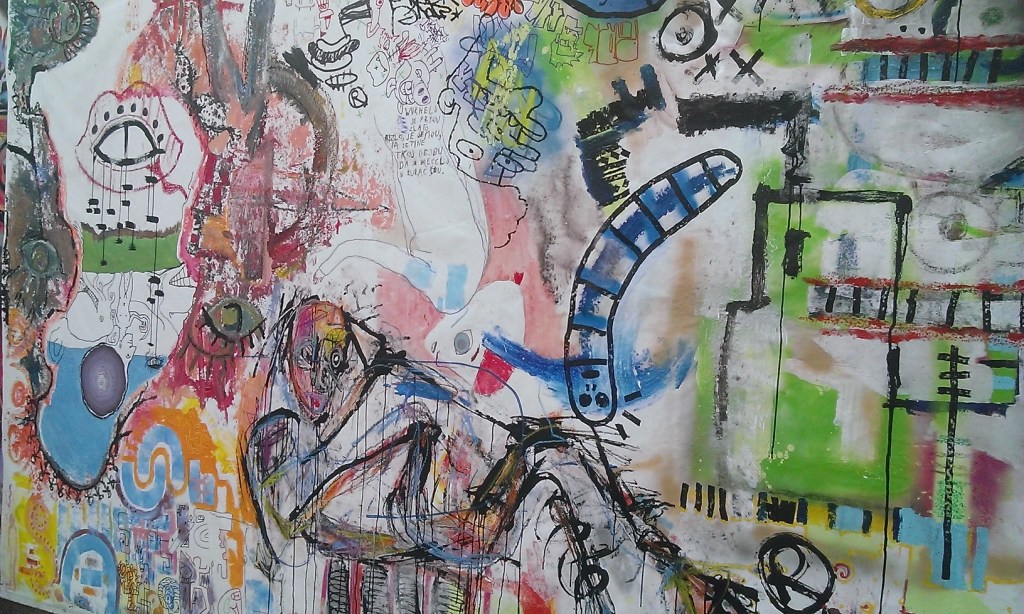
    Back to the show in Piran: outside in the yard, a collaborative graffiti wall. Here, several artists had worked on one canvas; painting, drawing, splashing, spraying, to create a large melting pot that could quite easily have been chopped into several smaller, self-sufficient pieces. This outdoor masterpiece embodied the mission of the project; collaboration, togetherness, and an indifference to academic and personal backgrounds. Here, trained artists worked alongside self-taught artists, ‘outsiders’ and ‘insiders’ rubbed shoulders.

    Founder Nok says the initiative’s set up was – somewhat – a response to the dog-eat-dog nature of the mainstream art world: “To rely on the establishment to value our art cannot be justified by any creative individual. Rejection discourages creative passion and inspiration. Most artists wish to show their creations to the eyes of the world, creating our own opportunities BY and FOR artists is a sustainable route to building confidence and as a way of progression as an artist instead of being passive and counting on ready-made opportunities.”

    “The particular purpose of Uncooked Culture is inclusion,” Nok continues. “We want to assist artists by encouraging them to either start or continue their passion in creating art without putting personal curatorial judgement on their practice and art educational background. I see the process of curated exhibitions; whether by independent curators, a group of curators, a jury, or an organisation as a judgement made from personal taste, preference, and to fit a theme that is inclusive to the ones that meet the criteria. At the same time, it excludes those individuals who may have created distinctive work, but who do not fall under the specific criteria.”

    WP_20140525_005

    ‘Circus Terminal’ builds a worldwide community of artists using social media to create physical collaborative activities amongst its members at hosted destinations across the globe. The project has showcased works from ‘outsiders’, ‘neo-outsiders’ and ‘insiders’ and is a fine example of how to globally dismiss the labels we have become so used to bandying around. The inclusion of ‘insiders’ and ‘outsiders’ – and everything in between – as well as artists from a huge number of countries and cultures, leads to an innovative barrier-breaking project that epitomises collaboration, inspiration and overwhelming creativity.

    When the exhibition travels to Suriname, South America, it will be joined by work from the following artists: Dhiradj Ramsamoedj, George Struikelblok, Hanka Wolterstorff, Kenneth Flijders, Kit-Ling Tjon Pian Gie, Kurt Nahar, Reinier Asmoredjo, Roddney Tjon Poen Gie and Sri Irodikromo.


    The exhibition will run from 22 – 27 July 2014 at De Hal Muti-Purpose Hall in Paramaribo, Suriname, and will be led by Rinaldo Klas in collaboration with Readytex Gallery.

    Click here for information on the beginnings of Circus Terminal

    Circus Terminal Worldwide on Facebook

    This slideshow requires JavaScript.

  • Otto Dix: The ‘Madness’ of Modern Warfare

    Otto Dix: The ‘Madness’ of Modern Warfare

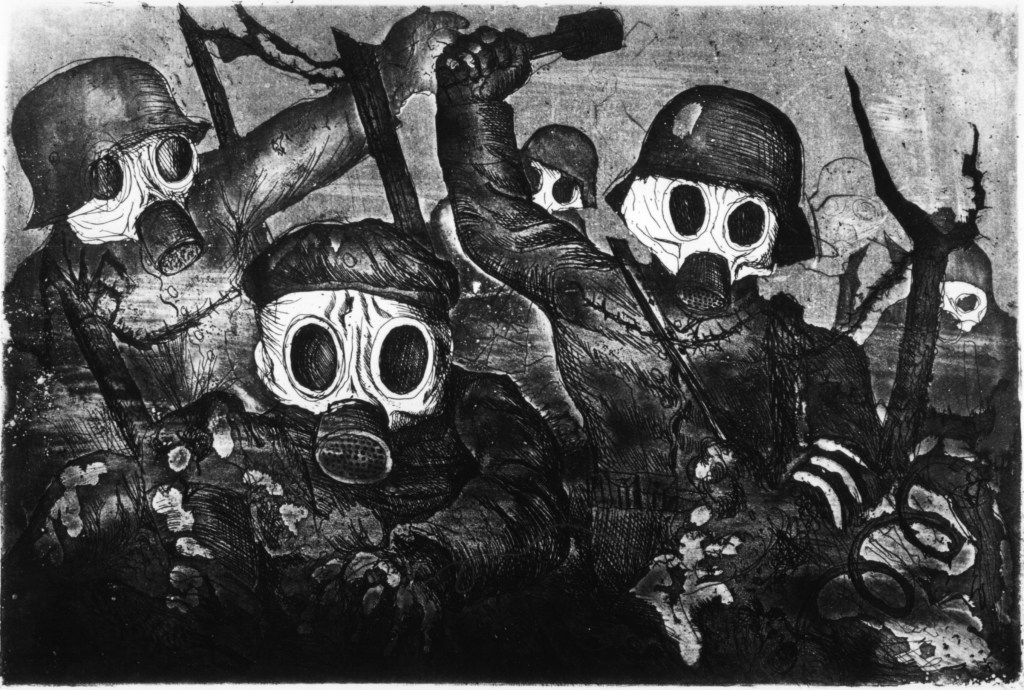
    Above image: Otto Dix, Sturmtruppe geht unter Gas vor (Stormtroops advancing under a gas attack), 1924 [Courtesy of: lewebpedagogique.com]


    I recently visited an exhibition of German artist Otto Dix’s series of prints entitled Der Krieg (The War) at the De La Warr Pavilion in Bexhill, East Sussex. I studied this series for my undergraduate dissertation a while back; where I focused on the links between German Expressionism and Outsider Art – more specifically the impact that experiences such as war can have on our mental health and how this makes the distinction between Outsider Art and ‘other’ art movements ever more intangible.


    During the First World War Dix volunteered to join the German army and was assigned to a field artillery regiment in Dresden. He took part in the Battle of the Somme before being transferred to the Eastern Front. He then returned to fight on the Western Front in 1918. In this year, he was wounded in the neck before being discharged from service in the December. His exposure to warfare had a profound impact, resulting in recurring nightmares in which he crawled through destroyed houses.

    Otto Dix, Schädel (Skull), 1924 [Courtesy of: www.deborahfeller.com]
    Otto Dix, Schädel (Skull), 1924 [Courtesy of: http://www.deborahfeller.com]

    “For all its waste, the war provided a windfall for scavengers. The First World War produced generations of happy worms and maggots. Trench rats roamed as big as beavers. Gas was sometimes a welcome respite as it decimated these pests.”

    – Taken from Otto Dix: Der Krieg exhibition pamphlet from the De La Warr Pavilion.


    Between 1915 and 1925, Dix created a significant group of paintings as a way of coming to terms with his harrowing wartime experiences. He began painting in a new style; a style which combined certain stylistic tropes and aspects of both Futurism and Expressionism, and in 1924 he produced Der Krieg –  a collection of fifty etchings and aquatints. The series is possibly one of the greatest anti-war depictions ever to be made, and is often compared to Francisco Goya’s Los Desastres. 

    This idea of the depiction of destruction and trauma as a source of creative impulse was widely common during the years following the First World War, resulting in a different kind of Expressionism emerging within Germany. At this time, there was a clear shift from a primitive, nostalgic, almost disengaged pre-war Expressionism, to a much angrier, political, ravaged Expressionism in the years following the First World War. Expressionist artists at this time seemed – quite understandably – engulfed by a ‘madness’ brought on by the normalisation of warfare and everything that came with it.

    Notably, in 1937, Dix’s work was included in the Nazi generated Entartete Kunst (Degenerate Art) exhibition in Munich. Even before the party had come to power in 1933, they had begun comparing images by avant-garde artists with those of the ‘clinically insane.’ Paul Schultze-Naumburg, a Nazi architect, was well known for contrasting the works of modern artists, such as Emil Nolde, with photographs of patients with physical disabilities with the intention of proving that modern art was pathological and degenerate.[1]

    The Nazis used modern art; Cubist, Expressionist and Dadaist works amongst others, as a scapegoat for the country’s economic collapse – a supposed conspiracy by Communists and Jews, and instead attempted to bring the focus of art back to the ideals of the human body.[2]

    Otto Dix, Mahlzeit in der Sappe (Mealtime in the Trenches), 1924
    Otto Dix, Mahlzeit in der Sappe (Mealtime in the Trenches), 1924 [Courtesy of: arttattler.com]

    “A trench soldier quickly gulps a meal in the company of a human skeleton trapped in the frozen landscape beside him.”

    – Taken from Otto Dix: Der Krieg exhibition pamphlet from the De La Warr Pavilion.


    July 19 1937 in Munich: more than 650 paintings, sculptures and prints taken from large German public collections were put on display with the aim of showing the German population what kind of art was to be considered inherently ‘un-German.’ Both abstract and representational works, including pieces by Dix, were condemned – as were the attempts to combine art and industry that had been pioneered by the Bauhaus artists. The exhibition, however regrettably, has made a place for itself as the most visited and viewed exhibition of modern art, with two million visitors in Munich, and a further one million viewers as it travelled across Germany and Austria.

    The works of George Grosz and Dix – and Expressionism more generally as a movement – were singled out to exemplify the idea of degeneracy within modern art.[3] Dix was particularly condemned due to his ‘defeatist’ attitude towards the war. His paintings The Seven Deadly Sins (1933) and The Triumph of Death (1934) portray the dangers of Nazism, and because of this, he was treated with utmost suspicion throughout the Third Reich.

    The Nazis saw ‘degenerate’ art as a “metaphor of the madman as the artist,” with Adolf Hitler developing a dialogue that insinuated that the avant-garde artist should be considered as an ‘outsider.'[4]

    Otto Dix, Gastpte - Templeux-la-Fosse, August 1916 (Gas Victims - Templeux-la-Fosse, August 1916), 1924 [Courtesy of: www.port-magazine.com]
    Otto Dix, Gastpte – Templeux-la-Fosse, August 1916 (Gas Victims – Templeux-la-Fosse, August 1916), 1924 [Courtesy of: http://www.port-magazine.com]

    “By 1924, people were aware of the horrors of gas but censored wartime reporting spared many from its ghastly details. Here the results are depicted with raw clarity of someone who was there. Indeed, much of Der Krieg was based on Dix’s wartime diary drawings. Many were probably struck by the appearance of the victims, darkened for lack of oxygen and the nonchalance of the medical staff who had seen it many times before.”

    – Taken from Otto Dix: Der Krieg exhibition pamphlet from the De La Warr Pavilion.


    A certain political and social ‘madness’ continued for the people of Germany throughout the reign of Hitler and his National Socialist Party. The extermination of German citizens based solely on race, ethnicity or religion was widely executed, as well as the mass rejection of works by some of the leading avant-garde artists. The whole era was epitomised by what defined ‘madness’, with the line between the ‘sane’ and ‘normal’ – if we are even able to define these terms – and that of the ‘pathological’ becoming increasingly blurred.

    The work of the German Expressionists, and the artists themselves, may have been deemed ‘insane’ by many critics at the time, but, as Jean Dubuffet claims, “very often the most delirious, most feverish works, those that are apparently stamped most clearly with the characteristics ascribed to madness, have as their authors people considered as normal.”[5]

    Annette Becker, writing in The Avant-Garde, Madness and the Great War, claims that “there is hardly more sense in the claim that there is an insane art as there is a dyspeptic art, or the art of those with knee troubles.”[6] Jon Thompson, curator of the Inner Worlds Outside exhibition at the Whitechapel Gallery, London in 2006 insinuates that “all human minds are fundamentally the same,” we are all the product of modernity and, influenced by Marx he “speaks to the degrees to which we are all alienated in one way or another, or in many ways at once.”[7] German Expressionism – and the work of Dix – was essentially a product of its time; a time that was characterised by alienation, discontent and the ‘madness’ of political instability and mechanical warfare.


    Otto Dix: Der Krieg continues at the De La Warr Pavilion in Bexhill until 27 July 2014. Click here for more information on the exhibition.

    References

    [1] Berthold Hinz, “‘Degenerate’ and ‘Authentic’: Aspects of Art and Power in the Third Reich,” Art and Power: Europe under the dictators 1930 – 45. Eds. Ades, Dawn, Tim Benton, David Elliott and Iain Boyd White, The Southbank Centre, 1995.

    [2] Stephanie Barron, ed. German Expressionism 1915 – 1925: The Second Generation, Los Angeles County Museum of Art, 1988.

    [3] Hinz, “‘Degenerate’ and ‘Authentic’: Aspects of Art and Power in the Third Reich.”

    [4] Sander Gilman, “The Mad Man as Artist: Medicine, History and Degenerate Art,” Journal of Contemporary History, Vol. 20, No. 4 (1985): p594

    [5] David Maclagan, Outsider Art: from the Margins to the Marketplace, Reaktion Books, 2009: p38

    [6] Annette Becker, “The Avant-Garde, Madness and the Great War,” Journal of Contemporary History, Vol. 35, No. 1 (2000): p81

    [7] Adrian Searle, Meet the Misfits


  • Manuel Bonifacio: My Imaginary Cave

    Manuel Bonifacio: My Imaginary Cave

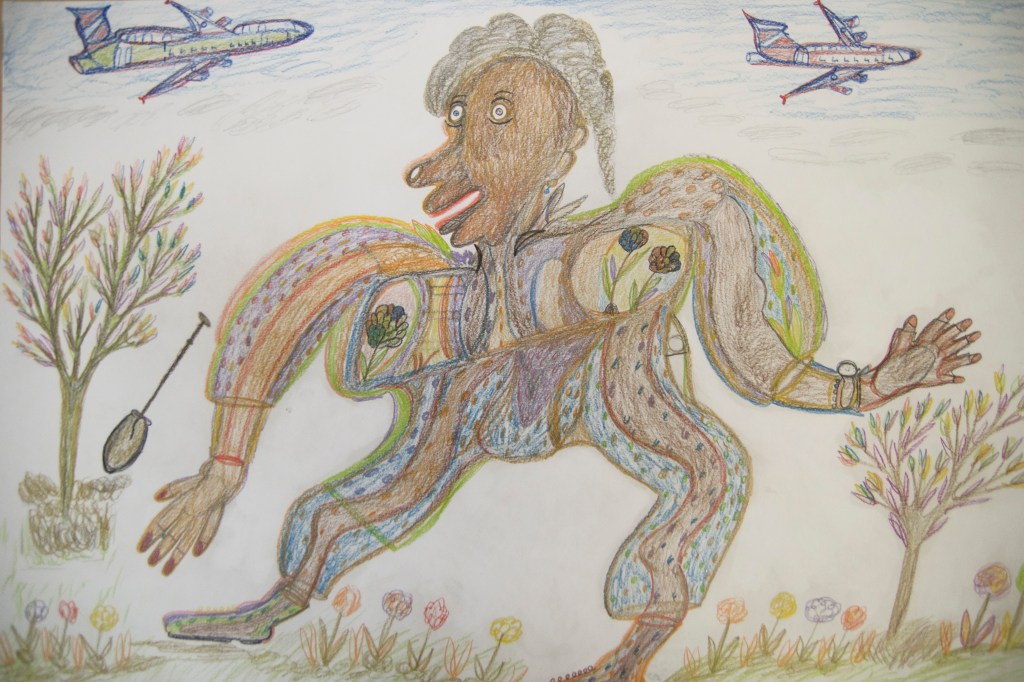
    Above image: Manuel Bonifacio, Aeroplanes and Spades


    On 29 April, Pallant House Gallery welcomed a new exhibition showcasing the work of Manuel Bonifacio; one of six Outside In 2012 Award Winners. The exhibition is a colourful array of Bonifacio’s imaginative characters and creatures, and is definitely a must-see if you’re down on the south coast in the next month.

    Born in December 1947 near Lisbon, Portugal, Bonifacio pursued his interest in drawing and pottery after dropping out of school at the age of eight. His most recent collection of work, which features the award winning ‘Mermaid’ and a selection of pottery, is inspired by his passion for archaeology and animals. Bonifacio paints, draws, sculpts and makes at ArtVenture – a creative day centre for adults with learning difficulties – for four hours every Wednesday and Friday. Since his Award win, Bonifacio has exhibited in Birmingham and London and now has work in collections in Switzerland and New York. In recognition of Bonifacio’s talent, an Outsider Art collector will be travelling over from Switzerland to attend this much-anticipated exhibition.

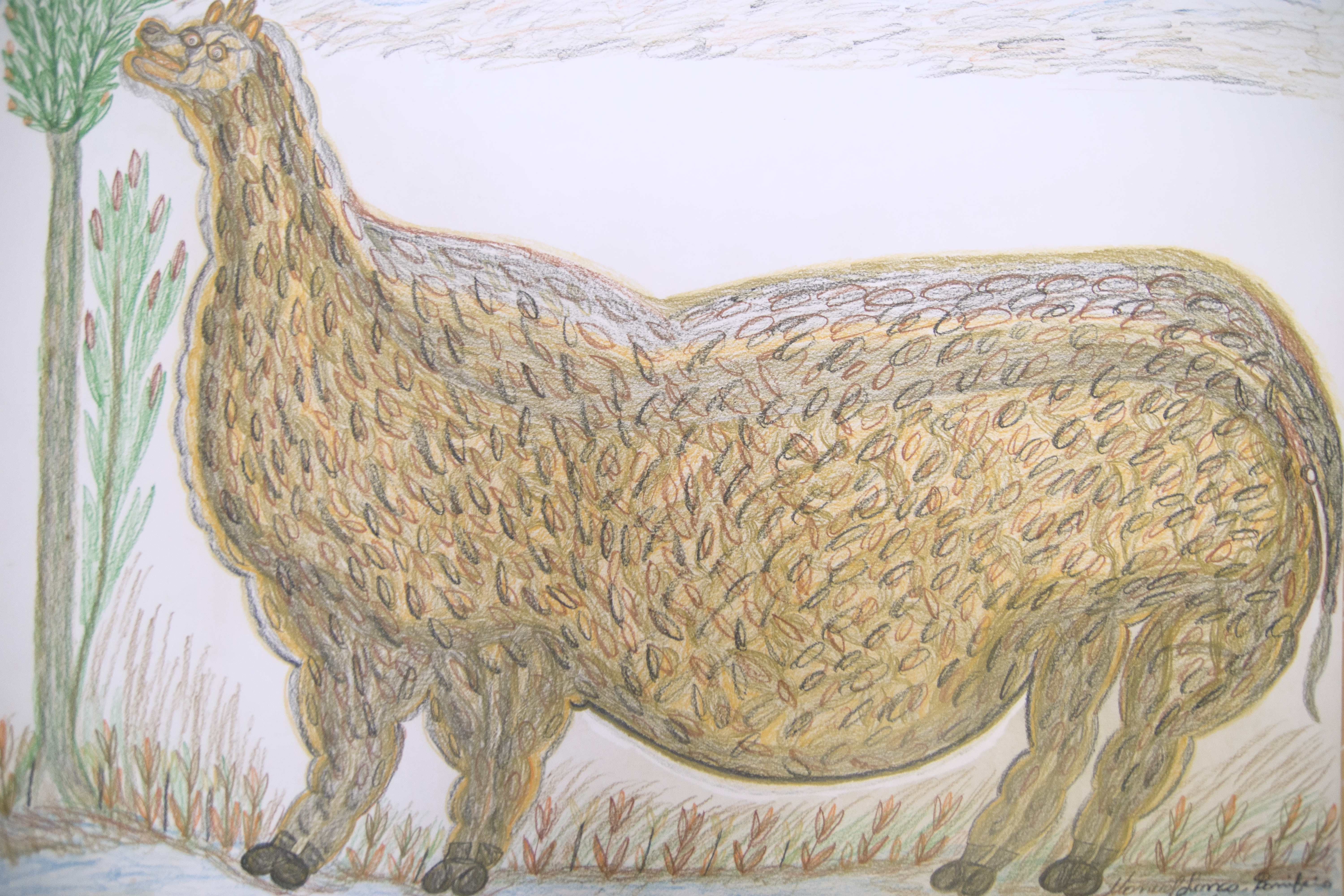
    Manuel Bonifacio, Jungle Animal
    Manuel Bonifacio, Jungle Animal

    “Manuel’s thing at the moment is mermaids, but he loves motorbikes,” his niece says. “He likes to do things his own way; he thinks ‘I’m the artist and I know what I’m doing’!” Bonifacio’s mermaids (one of which one him the Award in 2012) have an interesting narrative all of their own. “They live in Lisbon, but they go all over the world,” says Bonifacio. Lisbon is in fact populated with several mermaid statues, including eight in the large fountains in Rossio Square. Bonifacio adds: “All the children used to say ‘Look, there she  is – the mermaid!’ She waves to the people, and then goes under water again when the boats pass.”

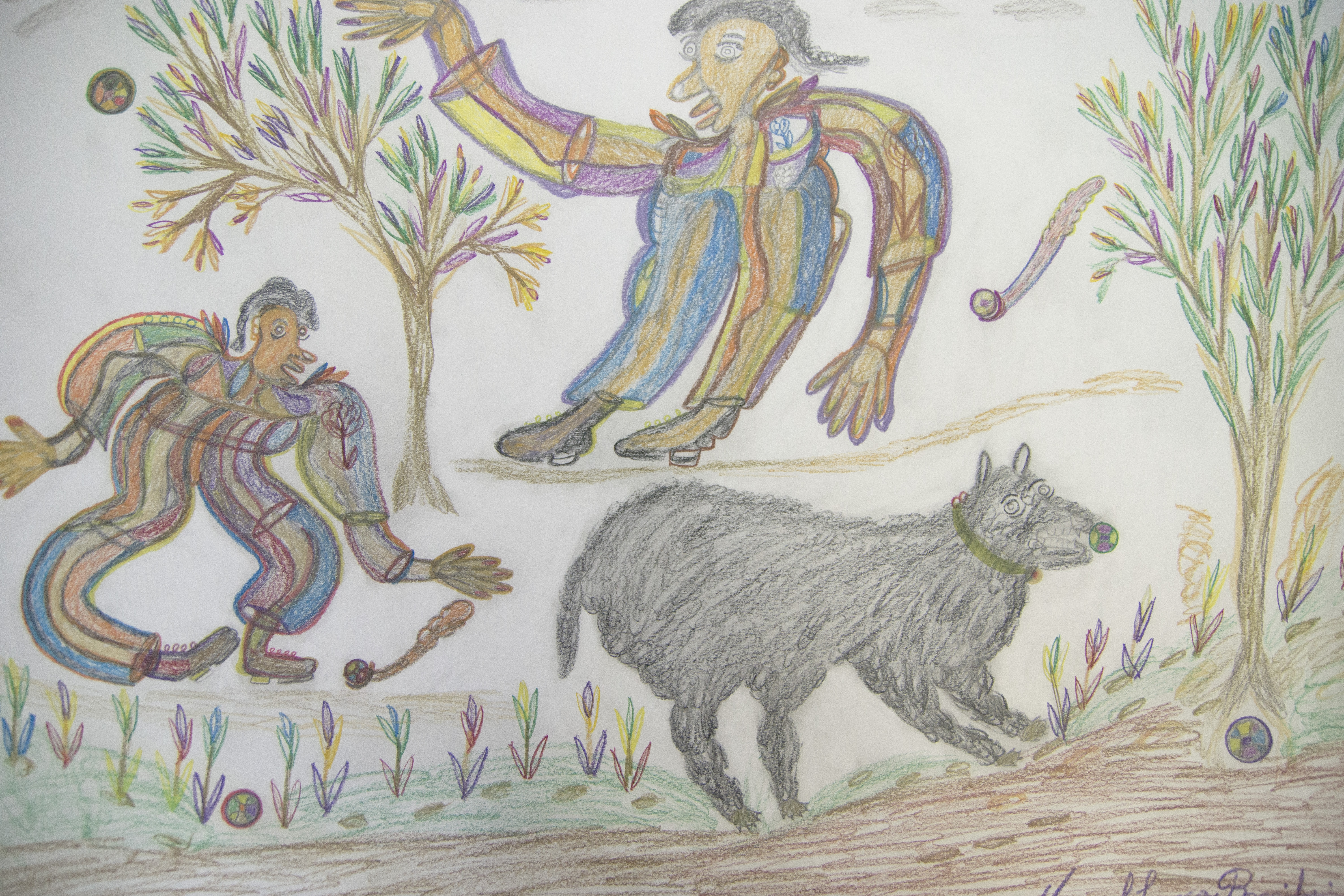
    At a young age, Bonifacio joined the fire brigade as a volunteer and his life’s ambition was to be in the army. Many of his works reflect his passion for army transportation, depicting helicopters, aeroplanes, motorbikes and boats. His work is also inspired by politics and everything he sees on television, but most of it comes straight from his colourful imagination. His sister describes the huge variety of subject matter he depicts: “The birth of Jesus, the circus, the Pope, the Queen, Margaret Thatcher and David Cameron, dancers, Christmas-inspired pieces, motorcycles, musicians, buskers, birds, divers, fish, helicopters, dogs, horses, wolves, mermaids, and always people. There are faces in most of his work.”

    Manuel Bonifacio, Motorbike and Man
    Manuel Bonifacio, Motorbike and Man

    Keen to explore and take on a challenge, Bonifacio has previously experimented with printmaking and wood carving and he occasionally dabbles in watercolours and oils. His portfolio also includes an array of distinctive ceramic mugs, vessels and faces. Walking from Cobham to Kingston regularly – a 20 minute drive – Bonifacio notes down road names, makes sketches and absorbs nature and life, which are ever present in his work. One of his figures was inspired by a statue on a roundabout in his hometown, but more generally, the characters he so vividly creates come straight from his mind. There is a sense that he could conjure anything; a donkey, a bullfighter, or various forms of transport.

    Bonifacio’s sister, Maria Odone, says: “Manuel’s work has been a valuable asset to everyone who knows him as it is also a way he likes to communicate. His ideas and perception of what is going on around him both locally and nationally are very unique. His ambition as an artist is to travel around the world, finding places and people that will inspire him.”

    Manuel Bonifacio, Ball Games
    Manuel Bonifacio, Ball Games

    Roger Cardinal, who coined the term Outsider Art in 1972 as the English equivalent of Jean Dubuffet’s Art Brut, was one of the Outside In: National judges. He speaks of the moment he first saw Bonifacio’s Mermaid at the Gallery: “It struck me as entirely familiar and made me think of the Frenchman Guillaume Pujolle, an early star of Art Brut whose lyrical images I cherish. This brief and decisive moment established Bonifacio as my top choice. The Mermaid is a perfect reality for him [Bonifacio]. I see her arms and elongated fingers as enacting the motions of swimming, although she can also be said to be flying. Hence she is capable of traversing earth, sea and air, and becomes and emblem of the artist’s unfettered imagination.”


    Entry to Manuel Bonifacio: My Imaginary Cave is free. The exhibition continues in the Studio at Pallant House Gallery until 1 June 2014.


    To see more of Manuel’s work, click here.

  • 2013: A Year of Outsider Art

    2013: A Year of Outsider Art

    Featured Image: Marcel Storr


    It’s certainly true; the past year has been an incredible one in terms of raising the profile of outsider art. It came from almost complete obscurity into the limelight with multiple London-based exhibitions and more national coverage at the Venice Biennale. Here’s a bit of a recap of what happened. Sorry for the UK-centric view here – it’s only because I’m based here! Let me know of any major outsider art events that took place in the last year where you are in the comments below.

    In March, ‘Souzou: Outsider Art from Japan’ opened at the esteemed Wellcome Collection in London. This display showcased the creations of Japanese artists working at day centres in Japan and was extremely successful in its aim of highlighting the complex intersections between health and creativity, work and wellbeing and mainstream and marginality. It also gave us the word ‘Souzou’, which is perhaps a somewhat better reference for what we currently recognise as Outsider Art, although it has no direct translation in English. In Japanese, depending on how it is written, it can mean creation or imagination. The term itself, I think, goes part of the way in distilling any preconceptions about this type of art because it is a word that the Western world has (somewhat unknowingly) needed for so long.

    The exhibition was a timely reminder of the importance of displaying works created by those who cannot so easily align themselves with the mainstream art world. It blew away the hierarchical idea of biographical context and focused on the achievements of these artists and their incredible creations.

    NorimitsuKokubo
    Norimitsu Kokubo

    Following on from this majorly important exhibition at the Wellcome Collection, the Hayward Gallery hosted ‘Alternative Guide to the Universe’; an exploration of the work of self-taught artists and architects, fringe physicists and visionary inventors. The Hayward Gallery is no stranger to outsider art, having hosted the UK’s first major exhibition of outsider art thirty four years ago, and it certainly did the subject justice once more.

    The show was an incredible display of the power of imagination, most aptly illustrated, perhaps, by ‘gothic futurist’ and hip-hop pioneer Rammellzee’s ‘Letter Racers’, which depicts how the alphabet might look if the letters were to become mechanised and able to fly into battle. It was without a doubt an innovative combination of art and science and re-imagined worlds, of artists and inventors who want to better understand the universe.

    Of course, probably the biggest event in the outsider art calendar this year was the Venice Biennale. The Biennale, which ran from 1 June – 24 November, was titled ‘The Encyclopedic Palace’ by curator Massimiliano Gioni after self-taught artist Marino Auriti’s Palazzo Enciclopedico design for an imaginary museum meant to house all worldly knowledge. The Palace showed works from the past century alongside several new commissions, showcasing one hundred and fifty artists from more than thirty-eight countries. Blurring the line between professional artists and amateurs, outsiders and insiders, the exhibition took an anthropological approach to the study of images, focussing in particular on the realms of the imaginary and the functions of the imagination.

    From 26 September – 28 November, self-proclaimed ‘Outsider Curator’ Sue Kreitzman organised ‘Epiphanies! Secrets of Outsider Art’ at the St. Pancras Hospital Conference Centre in London. The show revealed works covering an impressive range of content, media and style by almost 25 artists, all of whom Kreitzman had personally befriended.

    Orleans House Gallery in Twickenham hosted (and still are hosting!) a major retrospective of the work of Madge Gill, who without training or aspirations for fame produced  thousands of ink drawings during her lifetime. The focal point of the exhibition was The Crucifixion of the Soul, which had not been on display in the UK since 1979. Over ten metres long, this immense calico is inscribed with Gill’s finely wrought doodle-like drawings and is testament to Gill’s commitment to creativity.

    Face to Face with the Outsiders’ at the Julian Hartnoll Gallery in London beautifully brought together a vast and varied range of portraits created by those considered to be on the ‘margins’ of the art world, and ‘The Gravy Train and Roads to Recovery’ in the St. Pancras Hospital Conference Centre in London was an eclectic mix of work by Service Users at the Margarete Centre and Kate Bradbury’s dervishes. Organised by The Arts Project, the exhibition aimed to highlight the idea that whilst treatment for substance misuse historically focussed on harm reduction and substitute prescribing, other recovery methods emphasis equality, opportunity and equal access to society.

    Kate Bradbury's 'Goats'
    Kate Bradbury’s ‘Goats’

    Throughout the year, Outside In ran a touring show as a follow on from their National exhibition in 2012. The show displayed work by twenty artists facing barriers to art world who were selected through the open national competition. Running parallel to this, the organisation also held regional exhibitions which allowed people all over Scotland and England to experience this incredible work.

    So, this is just a brief round-up – and certainly doesn’t cover everything that happened! Here’s to an even better 2014 – we already have a lot to look forward to, including ‘Intuitive Folk’ at Pallant House Gallery and ‘British Folk Art’ at the Tate.


    I would like to take this opportunity wish you all a very Happy New Year, and thank you for reading. I hope you’ve enjoyed all that has been on the Blog this year, and that you will join us again next year. If you have anything you would like to see on here, please do not hesitate to get in touch.
  • Kate Bradbury: Squalls and Murmurations

    Kate Bradbury: Squalls and Murmurations

    Open until 1 December 2013 at Pallant House Gallery, Chichester, Kate Bradbury: Squalls and Murmurations is the second exhibition in a series celebrating the Six Award Winners of Outside In: National 2012, a triennial competition for artists from the margins.

    Art Historian Roger Cardinal, performance artist Bobby Baker and ex-Director of Pallant House Gallery, Stefan van Raay, chose Kate Bradbury as one of six Outside In Award Winners as part of the 2012 National exhibition, for which one of the prizes was a solo exhibition in the Studio. Cardinal said of the competition and the subsequent winners: “It is about showing the public that ordinary people without training can produce great work. Art can happen anywhere in all sorts of places.”

    Bradbury’s art career began some years ago in a run-down house in North London, where she started to intuitively make pictures and sculptures from abandoned belongings. Unearthing a role of thin Chinese paper and a well of black ink, an unforeseen tide of repetitive image and pattern-making promptly began. Bradbury also created sculptures from salvaged litter found in the tall, crumbling house.

    This obsession with found objects can perhaps be traced back to Bradbury’s childhood, where some family friends who were archaeologists would take her off into caves where she witnessed cave paintings with crude handprints and began finding and collecting things. Now, Bradbury collects material on her way to work, or on her way home from work – whatever she can find and wherever she can find it.

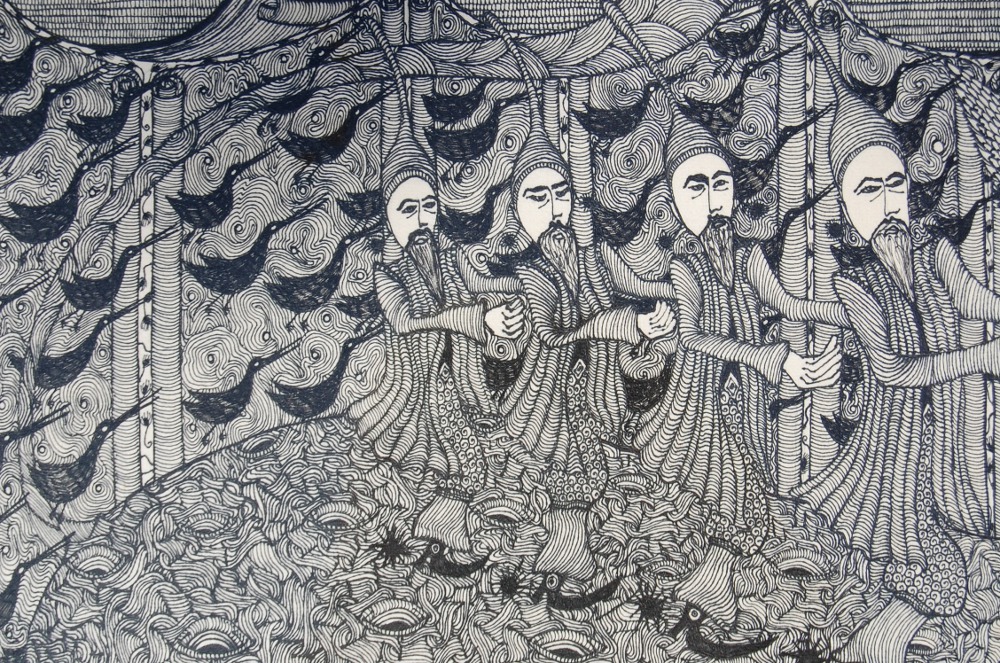
    Her suitcase people – the doctor, the artist, and Railroad Jim – all have their own personalities, each with a story inside their box-bodies. New additions to Bradbury’s family of sculptures are her ‘goat’ creatures. Constructed from the bristle-end of brushes, severed musical instruments and human faces, they came to life after Bradbury happened upon the ‘disembodied goat heads’ at her local car boot sale. Not wanting to separate a few goats from the herd, Bradbury took the lot before restoring them: “I have gifted them legs and bodies and I hope that one day soon I will have identified and practised the Holler that will alert a distant herdsman to their whereabouts, so that they may return to their native hills.”

    To complement her trademark sculptures, the exhibition also includes some of Bradbury’s trademark ink drawings. It was one of these fantastical black and white worlds; The ones that I’ve been saving to make a feather bed, for which Bradbury was granted Outside In: Award Winner status. Bradbury says of her contrasting practices (sculpture and ink): “Both of these have become passions that fill both my waking and sleeping hours with ink-stains and splinters.”

    It is this diverse creativity that gives the exhibition its name. Bradbury explains: “A squall is a storm and that suited the swirly patterns in my drawings. The monoprints often have a stormy sky and a lot of the sculptures are crude and brutal in texture. Murmuration is playing on the word murmur, a much quieter space like the fine lines and delicate paper that I draw with. So it’s loud and quiet and reflects both sides of my work.”

    With no formal art education, Bradbury is inspired by known – Klee, Miro, Franz Kline – and unknown artists, stage sets, archaeology, visions, inventions, and by music and song. She thinks about ideas for her work whilst at her day job – in a sandwich shop – where she has the space to go to a different place in her head. She doesn’t make work to please an audience; she makes it because it needs to be made. She explains: “I get a picture of something in my head and then need to make it, to offload it and then I can think about something else. I get obsessed with an idea and try to see it through. I’d love to get a studio and be able to make some bigger or noisier work and I like the idea of making a stage set, working with animation and just to keep finding inspiration.”


    Outside In was set up by Pallant House Gallery in 2006 to provide opportunities for artists with a desire to create who see themselves as facing a barrier to the art world. The project’s main vehicle is a triennial open art exhibition which was first held in 2007 and featured 100 artists from across Sussex. By 2012, the project had gone national, engaging more than 1,500 artists and 13,000 audience members.


    Kate Bradbury: Squalls and Murmurations will be on in the Studio at Pallant House Gallery until 1 December 2013. Entry is free. Click here for more information.
    Outside In website
  • Art by Offenders: Strength, Vulnerability, and Forgiveness

    Art by Offenders: Strength, Vulnerability, and Forgiveness

    Above image: Lost Fruit | Thornford Park Hospital, The Tolkien Trust Silver Award for Drawing


    The Koestler Trust’s sixth annual UK showcase this year takes the form of ‘The Strength and Vulnerability Bunker’, curated by Mercury prize-winning rapper, Speech Debelle. The national exhibition, which is moulded yearly by a different group or individual, displays work by prisoners, offenders on community sentences, secure mental health patients and immigration detainees. 

    This year’s theme – the relationship between strength and vulnerability – was chosen as it threads together the work on display with Debelle’s music. Debelle’s political interventions (which include three albums pinpointing areas of social justice and injustice), make her the perfect candidate to provide a voice for those whose lives are being transformed by the power of art.


    “The Koestler Awards represent an injection of creativity, humanity and empowerment into the closed world of prisons” – Stephen Shaw, Prisons and Probation Ombudsman.

    This year’s exhibition has some strong, undeniably prison-centric, work. ‘Untitled’ by Patrick from HMP Leeds starkly shows the divide between the inside and outside. In it, a figure looks solemnly (although this is only an assumption, as all we can see is the back of his head) through the bars of what we can ascertain to be his cell. On the ‘outside’, skyscrapers loom above luscious green trees and two magpies – which symbolise joy in the well-known rhyme – perch on the prison boundary. There are, however, signs of life and hope within the confines of this prisoner’s cell. A butterfly rests on an arm, and two ladybirds and a spider scale the inside of the bars.

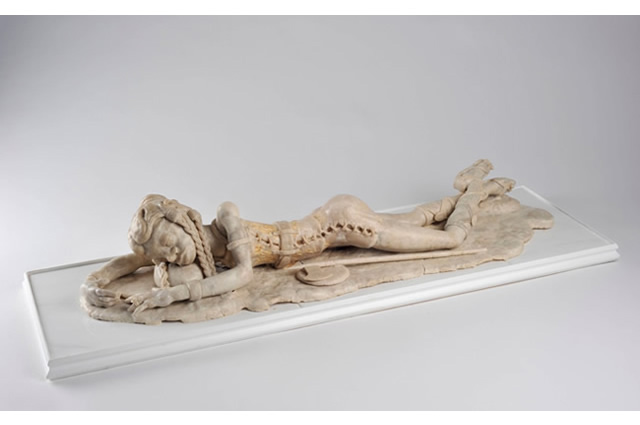
    Sleeping Brunnhilde | Derbyshire Probation Service, The Anne Peaker Platinum Award for Sculpture
    Sleeping Brunnhilde | Derbyshire Probation Service, The Anne Peaker Platinum Award for Sculpture

    ‘Not of the World’, by an inmate at HM Prison Cookham Wood, reflects “how far away the earth is when you’re locked up. Also, how far anything and anyone are from your reach in jail.” These are the artist’s own words. In the piece, a figure, plagued by darkness, looks longingly (again, maybe my assumption) towards the whole of the earth which sits uncomfortably out of reach on the horizon line.

    These two pieces quite obviously describe feelings of isolation, incarceration, and the loss of freedom. But there are more subtle pieces. ‘First Hour’, by an artist from Prison Littlehey and made entirely from chicken bones and glue, represents the feelings of a prisoner during the first hour of being ‘inside.’ Crouched over, the perfectly executed figure is both strong and incredibly vulnerable at the same time. Single chicken bones are extremely robust, but put them together as has been done with this sculpture, and they are fragile; the piece could topple or crack at any moment.

    The Dancers | HMP Brixton, The Patrick Holmes Platinum Award for Oil or Acrylic
    The Dancers | HMP Brixton, The Patrick Holmes Platinum Award for Oil or Acrylic

    Similarly to ‘First Hour’, other works on display are made out of any material that the artists could get their hands on. ‘Escape with a Book’, by an artist at HM Prison and Young Offender Institution Exeter is made entirely from soap, with the hands stained using tea bags. It was probably carved, as suggested by the exhibition host (an ex-offender employed to enhance the audience’s experience whilst gaining CV building skills), using a smuggled razor blade – something which makes it all the more intriguing. The artist was prepared to create this piece regardless of the rules.  ‘Sleeping Brunnhilde’,  by an artist from the Derbyshire Probation Service, was created using bread and PVA glue; such simple materials.

    The works on display were chosen from more than 7000 pieces of art created by prisoners, secure patients and immigration detainees, and each and everyone follows a personal journey reflecting on the meaning of both strength and vulnerability. The arts have been proven, more so in recent years, to be an incredibly effective way of engaging with offenders who are feeling isolated or alienated from mainstream education and employment.

    Creativity flourishes in prisons, more so than in any other institution; perhaps as a result of the physical incarceration.  This exhibition provides an opportunity for the artists to have their talents showcased, and is an example of how prisoners work through their feelings – in this instance strength, vulnerability and forgiveness – as part of their rehabilitation. Creativity and self-expression can often be the key to increasing self-esteem and self-efficacy; all proven factors in reducing rates of re-offending. Not to mention, the works in this exhibition are absolutely fantastic to look at – these artists are incredibly talented. Maybe once they have served their sentences, they can shake off that label of ‘prisoner’ ‘convict’ or even ‘ex-criminal’ and ‘ex-offender’ and instead be known more positively as ‘artists.’

    Garden of Eden, HM Prison Styal, Dalrymple Bronze Award for Sculpture
    Garden of Eden, HM Prison Styal, Dalrymple Bronze Award for Sculpture

    The exhibition is running until 1 December at the Southbank Centre, London. Click here for opening times and other information. 


    Exhibited artists on what the words ‘strength’ and ‘vulnerability’ mean to them

    “Without strength, you can’t go on. Without vulnerability, you can’t grow as a person. “

    “Being able to take a ‘warts and all’ look at myself through art does leave me feeling vulnerable to emotions I’ve closed off for years. However, I feel I’m in a safe environment with supportive peers and tutors. That is the strength of art.”

    “Strength means to me, someone who keeps going and keeps trying, no matter what obstacles they may face. Vulnerability means to me, someone who is human. Everyone is vulnerable and we all deal with it every day.”


    More information


  • Epiphanies! Secrets of Outsider Art

    Epiphanies! Secrets of Outsider Art

    Above Image: Kate Bradbury (courtesy of julianhartnoll.com)


    “Outsider Art is a movement of untrained artists with a burning desire and passion for expression that features art of an obsessive nature. Often this involves collecting debris shaped to express the inner thoughts and feelings of the creator. Some artists may suffer from mental health issues, others simply have no interest in conventional art practice.”

    Sue Kreitzman, a self-proclaimed ‘Outsider Curator’, and an Outsider Artist in her own right, is the co-creator of a very refreshing new Outsider Art exhibition; ‘Epiphanies! Secrets of Outsider Art’ opening at The Conference Centre at St Pancras Hospital on 25 September. Sue calls herself a ‘Typhoid Mary’: “People meet me and they catch the art virus. If they are established artists, they meet me and their work gets stranger.” She wants people to be inspired by her exhibitions, and for them to see what art can be – or what it really is.

    The exhibition aims to be an educational tool. For those who have not experienced Outsider Art, Sue wants to illustrate the scope of this genre. The show will include works covering a considerable range of content, media and style by almost 25 artists, all of whom Sue has personally befriended. “I love the art and I love the artists,” she says. There will be 3D pieces, drawings, paintings, and installations; a cornucopia of passionate works. The exhibition’s theme, as Sue puts it, is “art, the exhibition is about art.” It is possibly the first exhibition of Sue’s that has had such an open criteria – WOW was for ‘Wild Old Women’, and ‘Flashier and Trashier’ expanded on this to include ‘Wild Old Men’. However, all of the artists involved in ‘Epiphanies!’ have not had a formal art training.

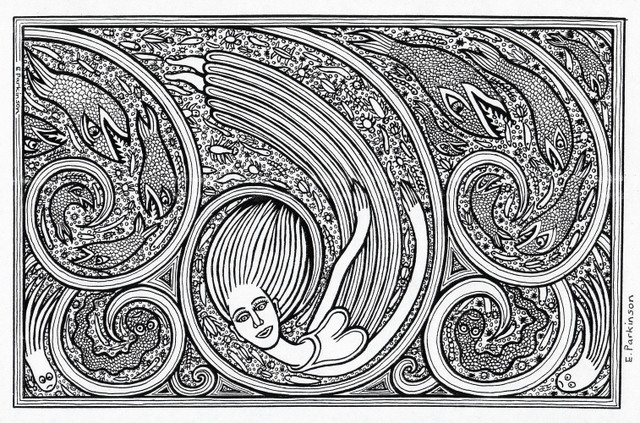
    One of the artists taking part is Valerie Potter. Valerie’s work is, Sue says, “like that of an angst ridden teenage boy, but then she comes in with the Jane Austen cross stitching. It’s very emotional to look at.” Liz Parkinson’s works are obsessive, repetitive, symmetrical depictions of faces with snakes and reptiles. “She sits at my kitchen table and she draws and draws.” Art critics have previously disregarded Liz’s snakes as ‘Freudian’ – in fact, Liz has suffered with eczema for many years, creating an emotional attachment to the image of a snake shedding its skin. Other artists involved in the show include Claudia Benassai, Kate Bradbury, Manuel Bonifacio, and Judith McNicol – plus many more.

    Liz Parkinson, Tsunami (courtesy of uncookedculture.ning.com)
    Liz Parkinson, Tsunami (courtesy of uncookedculture.ning.com)

    Talking about the – very topical – debate surrounding Outsider Art, Sue says that the subject is simultaneously complicated and uncomplicated. Originally, it best described work that was completely outside of the mainstream; it described artists with mental ill health, those who were isolated or not aware of the bigger, wider art world. Although there are hints of this today, it is not nearly as extreme. “When you discover an Outsider Artist,” Sue says, “suddenly they’re not outside anymore – they are not as naïve as they used to be.”

    Sue is keen on anything that gives a voice to Outsider Art – the recent spate of mainstream Outsider Art exhibitions, for example; Souzou at the Wellcome Collection and the Alternative Guide to the Universe. However, she warns us of the involvement of academics or curators, people who are likely to make rules: “I don’t like people saying ‘this is what it is’. It becomes meaningless when there are rules.”

    The mainstream art world, to Sue, is – and should remain – completely disparate to the world of Outsider Art. The conventional art world revolves around money, around prestige, and around the commercial, or commodity. Outsider Artists are driven to create – not for money, but for sanity; it comes “from their gut.” They create as a way of expressing their angst. “Creating art for Outsider Artists is self-medication,” says Sue, “just in the same way that alcoholics and drug addicts self-medicate.”

    Claudia Benassai, 'Peeping Tom'
    Claudia Benassai, ‘Peeping Tom’

    “If you hang out with us, you may experience epiphanies, revelations and visions. Visit us and you might burst into art, aflame with colour, exaltation and obsessive creativity. We are Outsider Artists, working far beyond the margins of the conventional art world. Untutored, obsessive, producing art for our own pleasure and therapy, inventing techniques, scavenging for unexpected materials, we are united in our need to express beliefs, angst, political and spiritual views, through art.”

    Sue’s ultimate concern is that Outsider Art, the only ‘real’ art, will be engulfed by the ‘rule-setting’ conventional art world. “I want to stay outside. I want to find people who are obsessive, who have to do it. I will remain outside.”

    ‘Epiphanies! Secrets of Outsider Art’ is on from 26 September – 28 November 2013 at The Conference Centre, St Pancras Hospital, London. Click here for more information

    Read my review for Raw Vision Magazine here.
  • Madge Gill: Medium and Visionary

    Madge Gill: Medium and Visionary

    5 October 2013 – 26 January 2014
    Orleans House Gallery, Twickenham


    A new exhibition opening on 5 October at Orleans House Gallery, Twickenham, will bring together little-seen works and archival material by prolific (and perhaps the best known) British ‘outsider artist’ Madge Gill.

    With no training and no aspirations to fame, Madge Gill produced thousands of ink drawings during her lifetime. Her work remains an enigma: is it true she was inspired by an ethereal spirit guide? Was she genuinely in touch with ‘the beyond’, or was art-making a form of self therapy?

    Orleans House Gallery invites you to delve into the world of Madge Gill (1882 – 1961) in this major retrospective exhibition supported by the Wellcome Trust. Featuring over 100 original artworks, and contextual photographs and documents, this exhibition is the first of its kind. Madge Gill was championed and collected by Jean Dubuffet, who coined the term ‘art brut’ (raw art), the precursor to the term ‘Outsider Art’. Gill is considered the most important, influential and recognised British ‘outsider artist.’ This project explores Gill’s work, history and psychic / mediumistic context in-depth, in order to question the use of such terms, whilst celebrating the benefits of creativity for wellbeing.

    Working mainly on paper, card and textiles, Gill used pen to create maze-like surfaces with a glittering, almost hallucinatory quality that often reveal a female face. Ranging from postcard size to over 10 metres long, her work immerses the eye in a dark world of mystery, beauty and obsession. Her work has been included in previous Orleans House Gallery Outsider and Visionary art exhibitions, the Tate Gallery, and more recently at the Whitechapel Art Gallery , Museum of Everything and Nunnery Gallery.

    The focal point of the exhibition will be The Crucifixion of the Soul, which has not been on display in the UK since 1979, and is Gill’s most important work. Over ten metres long, this immense calico is inscribed with Gill’s finely wrought doodle-like drawings and is testament to Gill’s commitment to creativity.

    The project has been generously funded by a People Award from the Wellcome Trust. Curators have worked with psychologists, medical historians, biographers, art historians and art psychotherapists to bring different approaches to Gill together within the exhibition and accompanying catalogue. Present day artists from the Art & Soul group, who celebrate mental and emotional wellbeing through the arts, are also represented in the project.

    Bringing together little-seen loans from the Newham Archive; the College of Psychic Studies in South Kensington; the Henry Boxer Gallery and other archival material and artworks from private collections, this exhibition is a must-see for all those interested in art, psychology, spiritualism, social history or all of the above.


    For more information on what promises to be an unmissable exhibition, please visit http://www.richmond.gov.uk/arts
    The exhibition will be open to the public Tuesday – Saturday 1pm – 4.30pm and Sundays 2pm – 4.30pm.
  • Bold Vision: Outsiders in Black and White

    Bold Vision: Outsiders in Black and White

    Above Image: Kate Bradbury, ‘Underground’


    From 7-14 July a collaborative exhibition between Julian Hartnoll Gallery and Outside In will showcase the work of 12 artists from the margins. From intuitive artists to self-taught visionaries, ‘Bold Vision’ provides a unique insight into the black and white world of these artists.

    Seven Outside In artists will have their work shown alongside five Outsider Artists’ works at Julian Hartnoll Gallery. Outside In works with artists who face barriers to the art world for reasons including health, disability and social circumstance.

    The artists in the exhibition create for numerous different reasons, one of the most common being as a release or a way of finding balance. Albert’s pen and pencil drawings of imagined buildings act as a form of meditation for the artist, a release from the boredom and tedium of hospital life, whilst Chris Neate’s automatic ink doodles help him maintain a calm stability. Albert says of his work: “I start with a vision in my mind and it blossoms from there … I imagine the building being constructed in brick and brought to life.”

    Similarly, Roy fights his low moments by drawing heads and faces, houses and fidgety lines in an effort to describe elements of his past, or his visions for the future.

    Roy, 'Shadow'
    Roy, ‘Shadow’
    Roy, 'Caveman'
    Roy, ‘Caveman’

    Intricately designed faces and the human figure make reoccurring appearances throughout the show. A fascination with the female form inspires Nigel Kingsbury to create drawings with a frequently mysterious and eerie quality, although his idolisation of the figure in such a rare and carefully observed manner is far removed from contemporary issues of gender stereotyping.

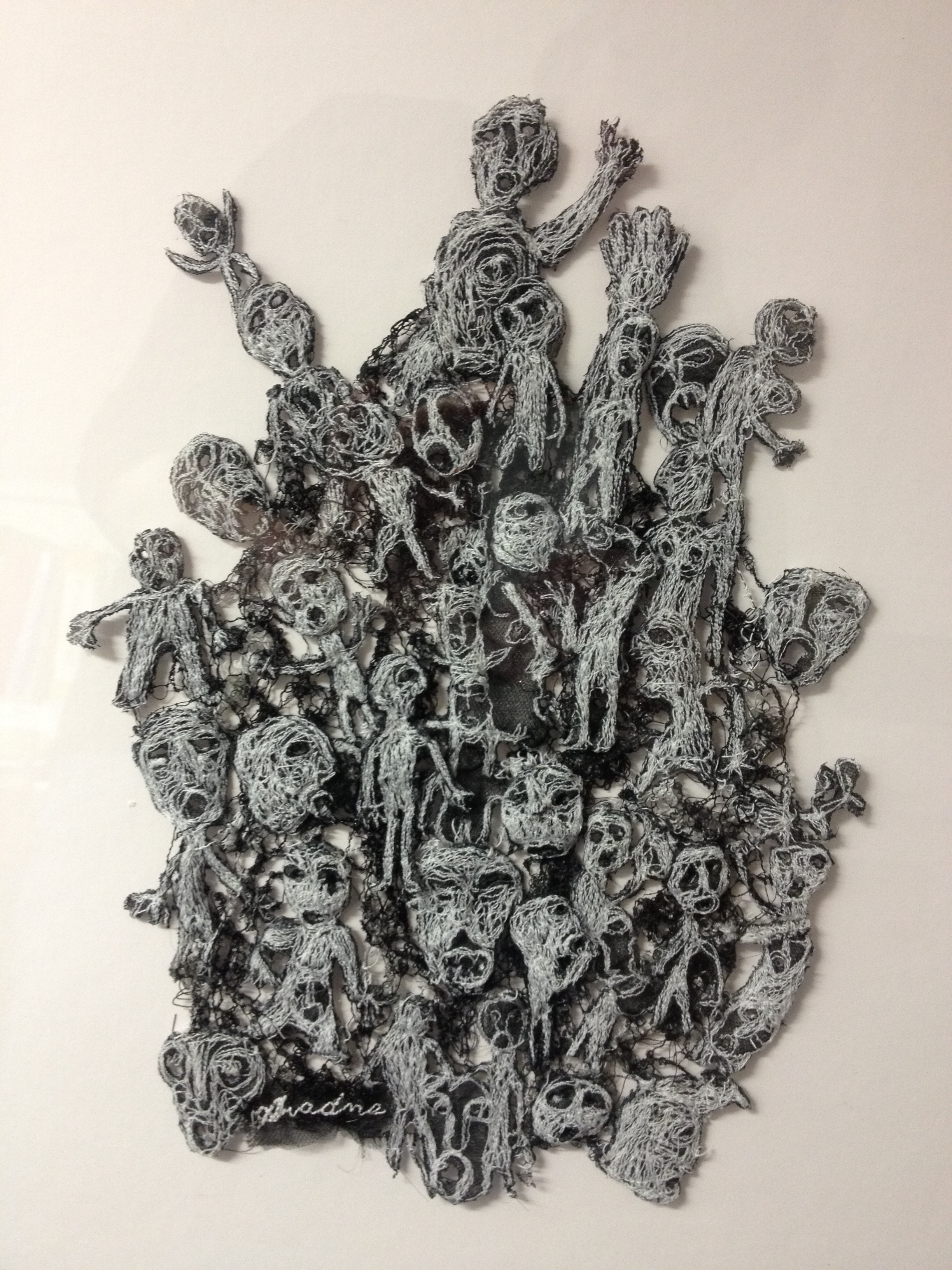
    Both Valerie Potter and Aradne use embroidery techniques to, in the case of Aradne, create figures, birds, insects, flowers and text, which all come together in her web-like structures, and in the case of Potter, keep herself sane.

    Kate Bradbury’s intricate black and white creations began when the artist unearthed rolls of Chinese paper and a well of black ink during time spent in a run-down house in London. The discovery of this new medium followed on from her intuitive creation of pictures and assemblages from abandoned belongings, leading to a tidal rhythmic pattern and repetitive form of image making.

    This idea of repetition crops up regularly throughout the exhibition, alongside strong compulsion, a desirable lack of intention and incredible imagination. Ted Gordon, one of the five Outsider Artists, is a self-taught draughtsman whose spontaneous, unmonitored creation enables the mind to give free rein to the hand. He becomes, as described by his biographer, Roger Cardinal, absorbed by his image-making, a “perpetual motion machine, an instrument of what the Surrealists called ‘automatism’.”

    Similarly, British Outsider Artist Nick Blinko draws intensely dense and detailed compositions of faces, figures and obsessive patterns. His art conjures a nightmarish, anxiety-ridden world where inner demons might be exorcised through repetitive graphic marks. Reminiscent of the macabre images of Goya or James Ensor, Blinko creates a personal iconography that evokes the magic and menace of rich imagination.

    Aradne, 'Communion'
    Aradne, ‘Communion’

    The form and content of the work is greatly varied, from Kingsbury’s loosely drawn female figures and Aradne’s hand and machine embroidered web structures to ‘time traveller’ George Widener’s bold compositions of dates and imagery and Ben Wilson’s black and white prints.

    Both Widener and Wilson often use found objects as their source of inspiration; with Wilson’s distaste for industrial waste, cars and rubbish eventually turning into an art form. Widener, a calendar savant, or ‘lightning calendar calculator’, creates mixed-media works on found paper, or layers of tea-stained napkins, that give aesthetic, visual form to complex calculations based on dates and historical events.

    Chris Neate, 'Untitled'
    Chris Neate, ‘Untitled’

    The exhibition will run from 7 – 14 July at Julian Hartnoll Gallery, 37 Duke Street, St. James’, London, SW1Y 6DF. Call 07973 932271 for more information. Opening tims are 10am – 2.30pm Monday – Friday and 11am – 5pm on Saturday. Visits can be arranged by appointment outside of these times.
  • Double Review: Face to Face with the Outsiders… and The Gravy Train

    Double Review: Face to Face with the Outsiders… and The Gravy Train

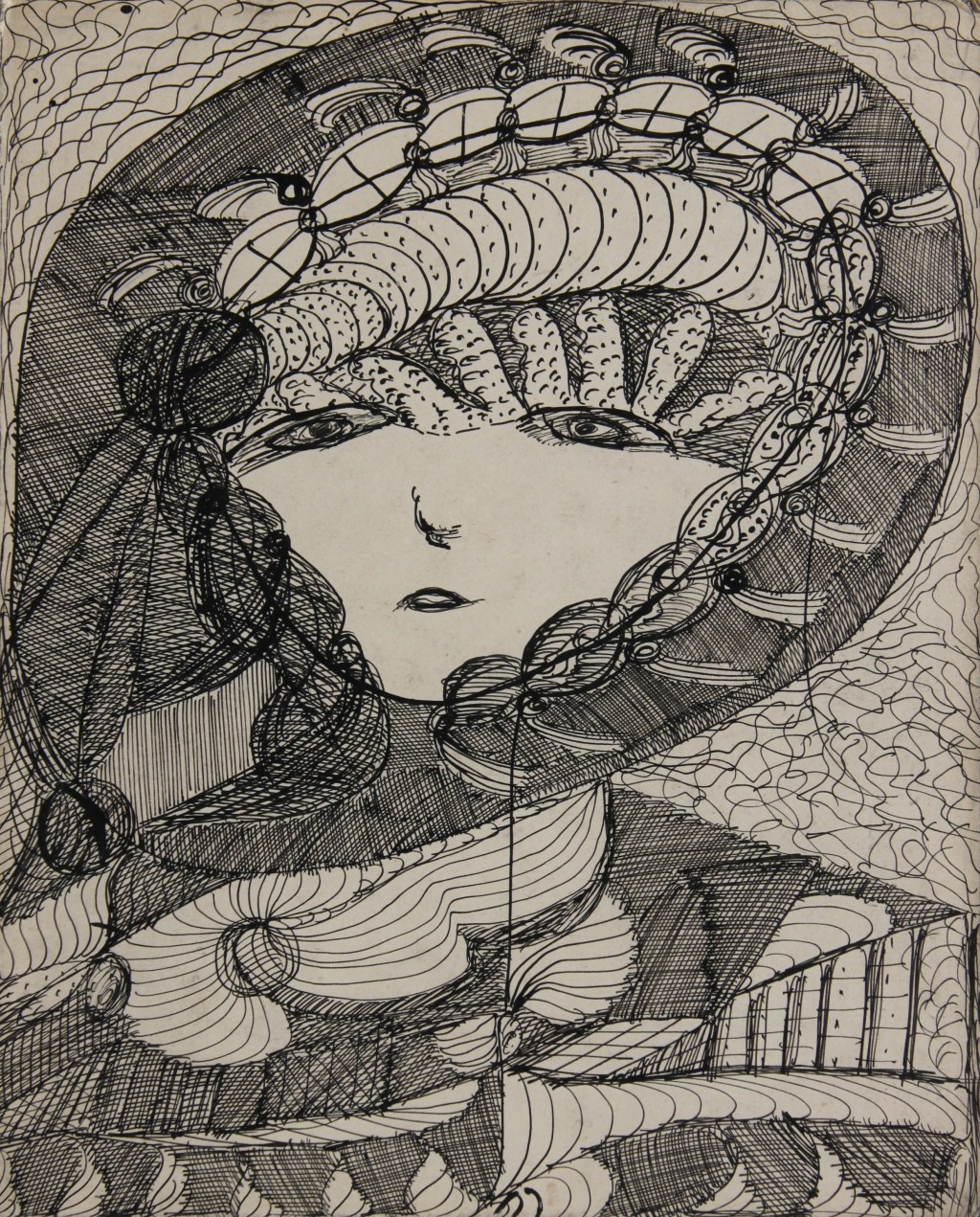
    (Image Credit: Nick Blinko – not from exhibition)


    Recently, I participated in a bit of a London exhibition marathon. I had been planning the day for a while, hoping to fit in a third visit to the Wellcome Collection’s fantastic ‘Souzou’ exhibition, as well as popping in to various other smaller shows whilst I had possession of a London Travel Card.

    The first stop was ‘Face to face with the Outsiders’ at the Julian Hartnoll Gallery just by Green Park tube station. The Gallery, I found, is a tiny treasure amidst the corporate, expensive world of Old Bond Street and Jermyn Street; both just around the corner. The exhibition beautifully brought together a vast and varied range of portraits created by those considered to be on the ‘margins’ of the art world. Amazing matchstick men, carved and coloured by Pradeep Kumar, required a (thankfully supplied) magnifying glass to experience the intricacies, and Tim Holliman’s portraits of well-known celebrities and sports stars encouraged a who’s who guessing game. However, I was particularly taken with a piece by Nick Blinko: a monochrome ink drawing made up of hundreds and hundreds of tiny – but perfectly formed – faces.

    Madge Gill (not from exhibition)
    Madge Gill (not from exhibition)

    There was also work from renowned ‘outsider artist’ Madge Gill, whose female faces peer pensively from the depths of the pen shrubbery, and up and coming ‘outsider’ superstar Kate Bradbury, as well as a colourful splash of Ben Wilson’s chewing gum pieces. The monochrome works by Blinko and Gill – amongst others – were set off perfectly against the bright, whimsical figures produced by Martha Grunenwaldt, whose ethereal people almost swim, or float, through an array of colours.

    The gallery was so intimately tiny, but it seemed like the perfect place to be surrounded by these beautifully curious faces. The contrast of bright, electric colours (Wilson, Grunenwaldt, Holliman, and Shafique Uddin) and moody ink drawings (Blinko, Gill, and Bradbury), all depicting the same thing – the human face – perfectly highlighted the huge variety of work produced by ‘outsider artists.’

    Martha Grunenwaldt (not in exhibition)
    Martha Grunenwaldt (not in exhibition)

    Next, I visited the ‘Souzou: Outsider Art from Japan’ at the Wellcome Collection for the third time. Still amazing. Still would like to have the twist-tie figure display cabinet as my dining table. You can read my previous review of this exhibition here.

    The third – and final – exhibition on the day’s agenda was ‘The Gravy Train and Roads to Recovery’ in the Conference Centre at St. Pancras Hospital. This exhibition was an eclectic mix of work by Service Users at the Margarete Centre and Kate Bradbury’s dervishes (and, of course, some of her much-loved black and white inks). Organised by The Arts Project, the exhibition aimed to highlight the idea that whilst treatment for substance misuse historically focussed on harm reduction and substitute prescribing, other recovery methods emphasise equality, opportunity and equal access to society. The Arts Project say of the show:

    “The artwork in this exhibition has been made by service users who, of their own volition, and without necessarily involving training or teaching, replace problematic substance use with creativity. This exhibition showcases outsider art work covering a range of years and artists reflecting a broad spectrum of style and creativity. This work combined with the visionary creativity of Kate Bradbury makes for a fascinating multi-layered experience.”

    And that it certainly was. Bradbury’s Gravy Train was in situ, looking magical as it transported a selection her dervishes down towards the reception area. I actually got to meet Kate at the exhibition, which was fantastic. She spoke a bit about her work, telling me that The Gravy Train had recently been displayed in The Crypt Gallery, St. Pancras, where it had visually resembled a train travelling through a tunnel. In fact, The Gravy Train quite aptly symbolises the journey to recovery experienced by many of the artists from the Margarete Centre – “where art becomes a skill with which to embrace opportunity and achievement,” The Arts Project say. The resulting exhibition is a fascinating installation exploring the very nature of journey.

    Kate Bradbury, 'The Gravy Train'
    Kate Bradbury, ‘The Gravy Train’

    These three exhibitions highlight the fact that 2013 is a big year for ‘outsider art.’ Of course, there’s the blockbuster Wellcome Collection show, but these smaller exhibitions were well worth a visit, highlighting the huge variety and overwhelming talent of ‘outsider artists.’ The tone seems to have been set for the rest of the year with two much anticipated solo shows coming up at Pallant House Gallery in Chichester to look forward to; Phil Baird in August and Kate Bradbury in November as well as a Madge Gill exhibition at Orleans House opening in October.


    ‘Face to Face with the Outsiders’ finished on 11 May, but you can visit the British Outsider Art website for more information. Click here.
    ‘Souzou: Outsider Art from Japan’ is on until 30 June 2013, for more information click here.
    ‘The Gravy Train and Roads to Recovery’ is on until 22 June 2013, for more information click here