Category: Artists’ Showcase

  • Nikifor (1895 – 1968)

    Nikifor (1895 – 1968)

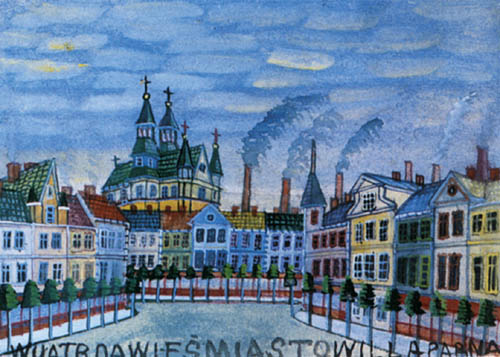
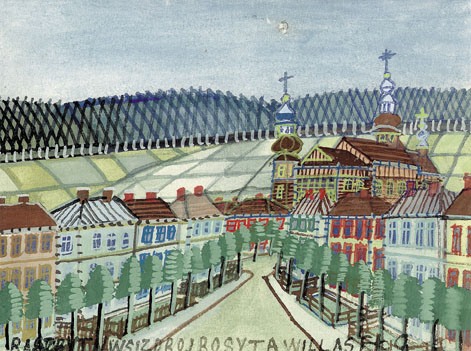
    Nikifor was born in Poland to a domestic servant and an unknown father. His mother died during his childhood, meaning he was left to rely on the goodwill of his community for survival; poor, illiterate and with a severe speech impediment. Nikifor began to provide for himself by begging, before a stay in hospital introduced him to watercolours. By 13, Nikifor was painting on discarded paper and cigarette packets which he would then stamp the back of and sell to people passing by. He then travelled from village to village trying to sell his art, using the name Nikifor Matejko; the surname of a famous Polish artist – possibly highlighting how strongly he considered himself to be a professional artist. He used a variety of materials to create his work, including watercolour, gouache and crayon; works which portrayed the countryside or intricately detailed buildings.

    You might notice there are inscriptions that lie along the bottom of many of Nikifor’s works; these often do not make any sense or do not mean anything in particular. It has been noted that he may have added these to his pieces to give the illusion of his literacy.

    Nikifor’s work did receive some interest during his lifetime, and was even exhibited across Europe as well as in America. However, it wasn’t until much later in his life that people began to take a serious interest in his work; at a point when creating was becoming a burden to him.

    Nikifor considered himself superior to others because he was an artist; despite the little acclaim and acknowledgement he receieved really right up until the end of his artistic career. He is however very well known in Poland, with a museum dedicated to his work in his hometown of Krynica.

    Below are some of Nikifor’s cityscapes and intricately painted buildings:


    Sources:

    • Outsider Art Sourcebook, published by RawVision

  • Mr Imagination (1948 – 2012)

    Mr Imagination (1948 – 2012)

    “Years ago my great aunt predicted I was going to be a minister, and in a way she was right,” Warmack said. “I think every artist is a minister and a messenger in a way.”


    Gregory Warmack, better known as Mr. Imagination, died on 30th May 2012 in an Atlanta Hospital aged 64.

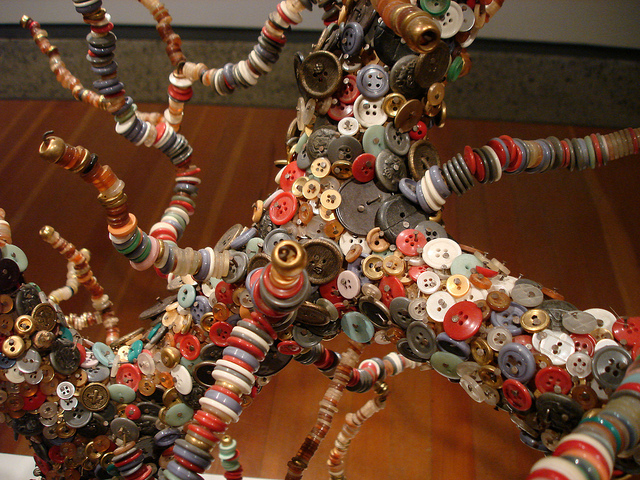
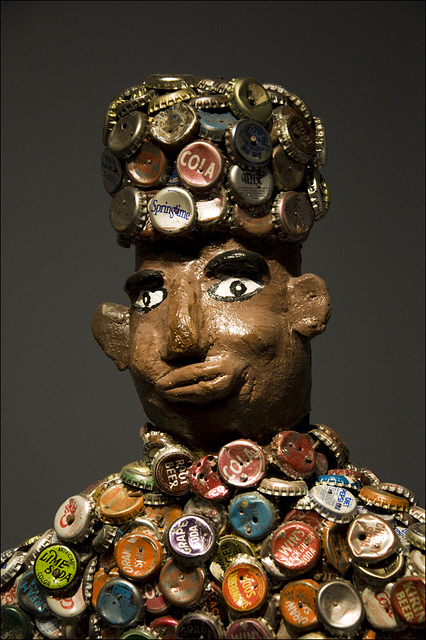
    Dedicating his life to creating spiritually powerful art, Mr. I’s creations consisted of discarded items such as bottle caps and paintbrushes which he began to make after he woke from a coma following a robbery in the late 1970s.

    Contemporary American Folk Art: A Collector’s Guide, a 1996 book, claimed that Mr. I “beats the Chicago Sanitation Department to back-alley waste and assembles what most of us would consider trash into sculptures of great power… Warmack’s work is beautiful, but it has another level as well – it is about the black experience and Warmack’s search for his African roots.”[1]

    In the later years of his life, Warmack set up and ran workshops for children; Carl Hammer, a gallery owner claims that “he was very effective in communicating to children the idea that your imagination can allow you to create art from any material….it wasn’t just something you did with a brush and paint.” [2]

    Some of his works are shown below:


    References:

    [1] http://www.suntimes.com/news/obituaries/12871422-418/chicago-artist-famed-for-using-bottle-caps-was-known-as-mr-imagination.html

    [2] http://articles.chicagotribune.com/2012-05-31/entertainment/ct-mov-0601-mr-imagination-obit-20120531_1_bottle-caps-community-arts-center-outsider-art

  • “Life – It’s all writ out for you, the moves you make…” – Scottie Wilson

    “Life – It’s all writ out for you, the moves you make…” – Scottie Wilson

    Image

    (1891 – 1972)

    Scottie Wilson, probably one of the better known Outsider Artists grew up in Glasgow before moving to Canada to set up a second hand store in Toronto.

    Wilson’s works are iconic within Outsider Art; and his unique cross hatching technique instantly makes them recognisable as Wilson’s. The work is usually centred around a face; which he called ‘Greedies’, which is surrounded by natural forms such as flowers or birds. His work is predominantly very bright, with clashing colours and thick black lines.His earlier work is much freer in terms of line, with his later work becoming more visible controlled with tighter, more intricate line detail.

    Wilson claims he felt compelled to paint after discovering a fountain pen in his store. He claimed he felt the urge to draw, or doodle, and never stopped since that day.

    Despite being considered an Outsider Artist due to his lack of formal training, Wilson became accepted into the Surrealist art scene on his return to London in the 1950s. His work was collected by Andre Breton and Picasso amongst many others. Often disinclined to part with his drawings, Wilson would curate exhibitions of his work on buses or in disused shop windows and would charge visitors to view his pieces.

  • Ismond Rosen

    (1924 – 1996): Psychiatrist, Psychotherapist, Psychoanalyst, Artist.

    Born in 1924 in Johannesburg, Rosen was just six years old when he began making clay figures in the style of his African neighbours. Although particularly talented and creative, his parents insisted that his academic talent was far more important. So, at the age of 17, Rosen went to train at Wits Medical School.

    Despite studying academically rigorous medicine, Rosen realised that he need not leave his passion for creativity behind. He decided that the two did not have to be mutually exclusive and during his placement at a Community Health Centre he began to make sculptures of the patients and staff.

    After coming to England in 1951, Rosen travelled to Paris where he studied at the Academie Julien and the Ecole des Beaux Arts. After working at the Maudsley & Bethlem Hospital in England for 6 years, Rosen began to specialise in sexual deviation and psychiatry whilst also training as a psychoanalyst.

    The 1970s were very much Rosen’s ‘creative’ years. He had begun running his own private psychotherapy practice, but during his spare time he was devoted to his art. He created works for an exhibition at the Camden Arts Centre and even wrote papers for huge art institutes in London on Richard Dadd and Otto Dix.

    One of Rosen’s most prominent sculpture, Civilisation, can be found in South Africa’s National Botanical Gardens

    .

  • Eric G. C. Weets

    This is Eric. G. C. Weets producing some of his fascinating work. For more information on the artist himself, please visit: http://ericgcweets.weebly.com/index.html

  • Vojislav Jakic

    Vojislav Jakic

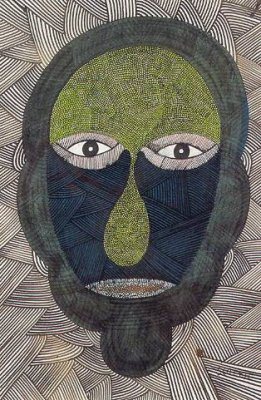
    I thought I would begin a little feature, where every week I include a short biography and some works from various ‘Outsider Artists’. Today, I am going to begin with the work and life of Vojislav Jakic.

    Vojislav Jakic (1932-2003)

    Moving to Montenegro from Serbia when he was three years old, Jakic was the son of a strict Serbian Orthodox father. His brother and sister died from scarlet fever and diphtheria respectively and his father’s profession was frowned upon by communist authorities; he was an ‘outsider’ even at school. Experiencing poverty in his early life, Jakic managed to scrape together money by painting portraits of the dead for their grieving families. He often created these portraits using the deceased’s passport photographs and it was during his time creating these works that his exceptional drawing talent was really first identified. Jakic left for Belgrade in 1952 where learned how to draw and sculpt.

    In 1970, Jakic produced his semi-autobiographical book entitled Nemanikuce (Homeless), where themes of suffering, pain and death were prominent. His paintings continually focused on similar themes, filling the pages he worked on completely. This concept of leaving no area of the page untouched is something that is commonly found amongst the works of ‘Outsider Artists’. It suggests a compulsion to fill every gap; to leave no free space – perhaps, much like the thoughts inside our brain.

    Jakic most typically created impressive, large scale pieces with ballpoint pen, pastels or gouache. The pieces were principally nightmarishly dark in the content, focusing on motifs such as human insides, insects, death and bones. His paintings are raw, portraying the suffering and fear of death he felt as a person. One of his works he describes as being ‘neither a drawing nor a painting, but a sedimentary deposit of suffering.’