Category: Art Theory

  • Valid Art: creativity and affirmation

    Valid Art: creativity and affirmation

    A new qualitative study, commissioned by Axisweb, focuses on how artists receive validation for their work outside of the ‘traditional’ gallery setting. I think this is particularly poignant for all artists including self-taught artists and those who are not or do not wish to be aligned with the gallery agenda.


    The researchers working on the study interviewed producers, commissioners and artists, seeking views on how different people receive validation for their creative endeavours, and whether the existing structures have – or had – an impact on how they seek or receive validation. The main findings are outlined below in a brief summary:


    “The findings reveal an ad-hoc and informal approach to validation in the field. The commissioners, producers and artists interviewed agreed that the responsibility for seeking and maintaining validation falls largely to artists. While this was accepted as the norm, the majority of artists perceive a lack of support structures to help those operating outside the gallery system achieve and maintain external validation.”

    gallery

    There a few interesting things to take away from this in terms of thinking about validation and how artists receive it, seek it, and ultimately whether they need it at all. Traditionally, one of the key characteristics of the ‘outsider artist’ is their ability to create for themselves; because they need to, because they want to, rather than creating a saleable object or a commodity item. So where do they get their validation from? It may even be more difficult for them to find validation, with many not having not had the ‘rite of passage’ that is art school.

    Does validation come with a price tag? Is work of a higher monetary value confirmation of a valid and successful artist? It, thankfully, seems not. In the report, artist Joshua Sofaer is quoted as saying: “Amongst me and my peers, we might consider somebody that goes towards gallery representation, starts making discrete objects, as somebody who has sold out.Although he does go on to say that “other people might think they’ve arrived.” Additionally, many respondents felt that gallery backing was “more meaningful to others than to the artists themselves,” with many claiming that “the commercial numbers-led art world was potentially detrimental to the development of a high quality and original artistic practice.”
    paint1

    It is refreshing to see that although gallery representation is often sought after, many of the respondents did not “view gallery validation as a good fit for their values and practices.” Increasingly, it is perhaps true to say that artists are needing gallery representation less and less; for many, it is no longer the gold at the end of the rainbow. With the burgeoning use of the internet for self-promotion, artists can market and sell their work without the middle man, creating and selling on their own terms. This does, however, require the artist to have some knowledge of utilising internet marketing tools, a hurdle to overcome if you’re working towards self-representation.

    Although it is comforting to see the findings highlight the differing value systems amongst artists “from those they see underpinning mainstream galleries and the work shown there,” to me it seems there is still some way to go. Take, for example, the difference in status between community and educational art and a ‘national gallery commission,’ the former is still looked upon as lesser form of art than the latter, despite the inclusion of community and learning programmes in most major national and regional art galleries and museums. Worryingly, artist Ania Bas acknowledged that “A lot of artists that I know… don’t talk about any work that they would do for the education department… In fear that this would mean that they would never… be invited to do a show in the gallery.”

    gallery2

    So it seems from the report that whether validation is based on monetary value, visibility or gallery representation, there still seems to be an apparent separation, in terms of both support and funding, between work traditionally included in the ‘gallery agenda’ and art produced by socially engaged artists or those working outside of the mainstream. How do we overcome this? There certainly needs to be some sort of reform in terms of what high quality, valid art looks like, and in terms of who gets to decide. Rather than a sellable end item, perhaps a focus on process and idea needs to come to the fore. After all, if the only art seen as valid is the art that ‘sells’ and the only successful artists are those with a nose for business, we will continue to miss out on so much rich, unique and meaningful creativity.

    The concluding paragraph of the Axisweb report mentions that to encourage a rethinking of current validation systems, any new provision should be artist-led, because “without this, artists could be disenfranchised through external values being imposed on them in ‘top down’ regulatory ways. This in turn might undermine the existing quality and nature of artists’ work occurring within the broad category of socially engaged or non-gallery art.”

    creativity

    I’d be interested to know what validation looks like to you. Does it come from the art world, does it come from yourself, and how do you go about finding it? Please post any responses you might have in the comments below – thank you!


    Axisweb commissioned Validation beyond the gallery (June 2015) from Manchester School of Art, focusing on artists working outside of the gallery system. The report was written by Amanda Ravetz and Lucy Wright. You can read the full report by clicking here.

  • Brian Gibson: Real Art… Really?

    Brian Gibson: Real Art… Really?

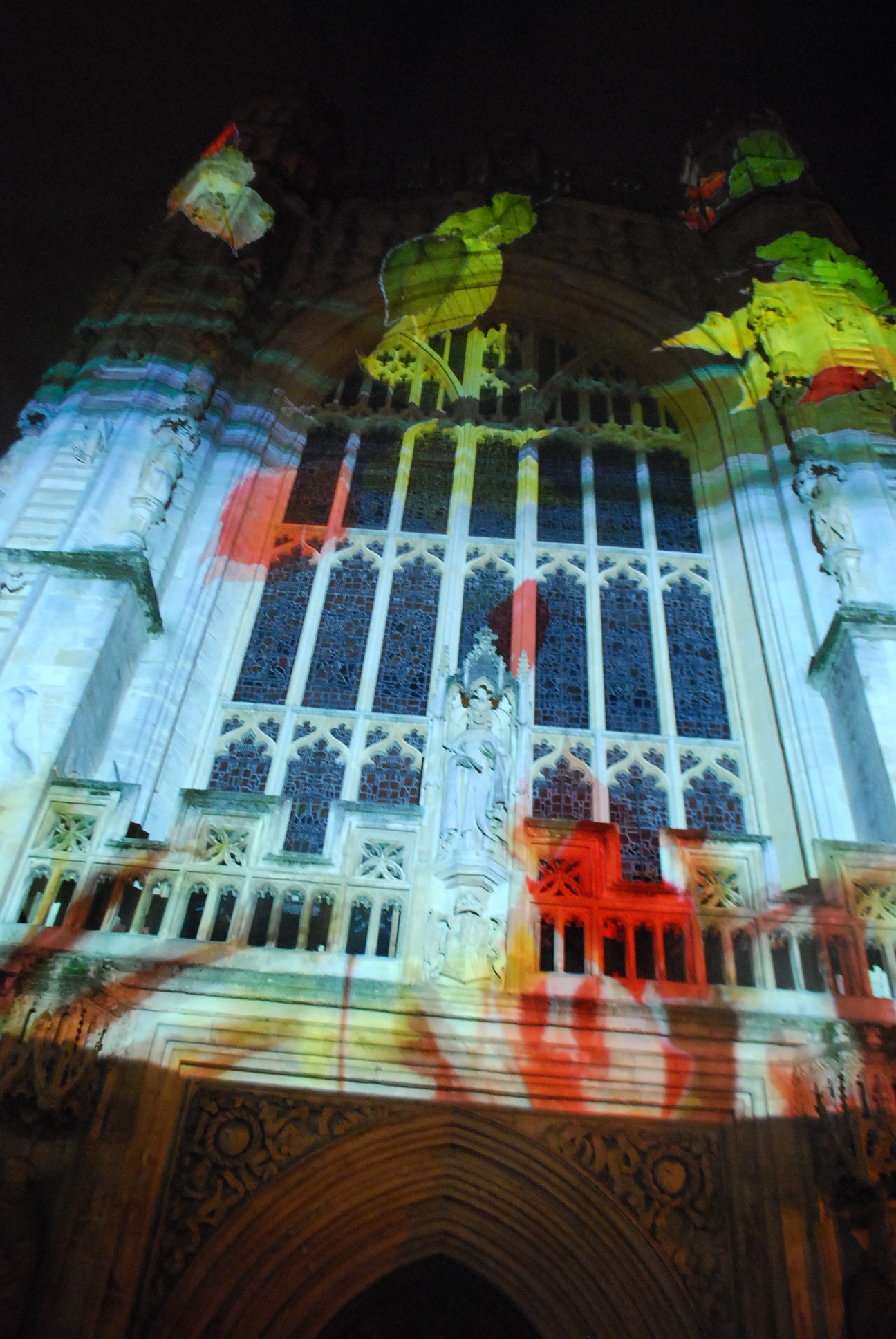
    Above image: Transient Graffiti on Bath Abbey (courtesy of http://www.suitedandbooted.org)


    Brian Gibson: “It’s 2015 now and after recent events the world seems a lot more complex … so I’m heading back to the relative calm of late 2014. Like a lot of people over the festive break I got myself hooked into various forms of social media, reaching saturation point – bloated with meaningful and quirky distractions offering opinions on this that and the other, making me feel futile in the ever-expanding and absorbing world of news feeds and interesting information. I was, however, able to break away from such infectious technology and get back on track, find my bearings and find some time to make a little bit of artwork, engage in some art dialogue and do a bit of offline viewing, that is to say look at some art situated in the real world.

    Image from the Transient Graffiti project
    Image from the Transient Graffiti project

    It was early December, when listening to the radio, I heard a series of broadcasts on Radio 4’s A Point of View by Philosopher Roger Scruton. Someone that I had not heard of but assumed he must be quite learned and well informed to get such a slot. He began with the subject of ‘fake art’ and, as I’ve had a number of conversations with people on the possibility of faking Outsider Art, I thought that this series would be interesting.

    His intent from the start was to clear some ground between what he sees as ‘original art’ that is genuine, sincere and truthful, but difficult to achieve, and the much easier ‘fake art’ that appeals to many critics today. His ire was directed towards the slick world of Jeff Koons and Damien Hirst and the art market that supports them. Cries of the emperor’s new clothes ensued – easy targets, I thought, why mention them now? Ok, they may well represent a particular brand of slick and successful art that looks like a product rather than anything hand made but any real significance either of these two monoliths had in the art world was decades ago. But this high-end financial world is so alien to me and those I know, that I cannot think of a single person who really cares that much about this type of work or what these artists are up to. The likes of Koons and Hirst are really not that important in the world of art that I and many other creative people inhabit. Sure, they are incredibly wealthy but they are old news.

    Image from Transient Graffiti project
    Image from Transient Graffiti project

    Next Scruton, in a sweeping gesture, guns for the faceless bureaucrats of the Arts Council who, he implies, fund only that which is unpopular with the public and is therefore arcane, excruciating and meaningless. I find this both insulting and a little disturbing as the Arts Council also funds a number of arts projects for historically marginalised communities who would remain hidden without their support. I have personally been involved in a number of projects, including Transient Grafitti, an animation created by Deaf Adults With Additional Needs, which was projected onto the face of Bath Abbey with additional artwork displayed inside Baths 44AD Gallery. A bringing together various organisations including Action On Hearing Loss and Suited and Booted Studios CLC, this project provided opportunities for a range of creative people to work with each other, developing ideas; going out into the community; being taken seriously; making it happen and showing it to the public who loved it. This would never have happened without their support. It does make me wonder what such an apparently erudite and influential thinker makes of Outsider art? Who knows? Despite listening to all three broadcasts I never get to find out. He does mention in his final broadcast that ‘real art’ (as opposed to ‘fake art’) has to have lasting appeal with three essential factors: beauty, form and redemption. I do not dispute the value of such qualities but they are not the only ingredients that make art real, tangible and meaningful. In the end I found his views quite narrow and patronising, the all-knowing expert dispensing his wisdom to the great unwashed telling us what real art is …really?”


    Post by Brian Gibson

  • Brian Gibson: Fessing Up

    Brian Gibson: Fessing Up

    Featured image: Agnes Richter, needlepoint jacket [notmodernart.tumblr.com]


    Following Brian Gibson’s fantastic previous post, entitled ‘What does it mean to be an Outsider?‘, he has written again for kdoutsiderart. This time, focusing on ‘confessional’ art. Here, her discusses whether artists who have experienced trauma or health issues feel ‘obliged’ to create art that is overtly confessional?

    There are a lot of people (past and present) whom I really admire who have the ability to write down, draw and paint to reveal a deeply personal, integral part of themselves succinctly and often explicitly. I have the greatest respect for those people who have such courage, placing a personal account of a particular aspect of their life in the public realm. There are certain works that have completely stirred me emotionally: Frida Kahlo’s drawing of her miscarriage and a painting of an abusive relationship by an artist showing at the Outside In Exhibition at Pallant House Gallery and the Outside In: West exhibition at the Somerset Museum are but two.

    When so much art of the modern era can be said to be autobiographical and increasingly stacked online into categories, is it wrong or demeaning to place such works into a genre defined as ‘confessional art’? I certainly don’t think that the two works which I have mentioned were specifically created to fit a market within a particular realm of art practice, even so, there are some artists such as Tracy Emin who seem to have made a very successful career out of  ‘fessing up’.

    Personally, I don’t know what to make of Tracy Emin anymore. She is now very much part of the art world establishment (I don’t begrudge her success), having evolved from what could be considered a quasi-outsider stance, in part due to the way in which she presents herself and her  work, tapping into the psychoanalytic influenced work of Louise Bourgeois and such works from the Prinzhorn collection as Agnes Richter’s needlepoint jacket. Whatever one thinks of Ms Emin herself or her work, she  seems to know how to profit from fessing up her past, whilst remaining in the driving seat. Likewise, the pianist James Rhodes has spoken openly about his experiences of abuse and mental health issues, he too seems to be in the driving seat, which to be honest is a pretty enviable position. Whilst this tack might work for some individuals, I am not so sure if this should be considered a creative formula for all those artists who have experienced mental health issues or trauma of some kind.  Even so, it can be tempting to mis-read such paths to success, acceptance and acknowledgement as being primarily down to being completely open; revealing your trauma, displaying it in your artwork, and putting it in the public realm for all to see.

    I fundamentally believe that people should not be silenced for what they have experienced. I have heard enough about people in glass houses and it being better to remain silent than be thought a fool. However, with the increase of social media platforms, I have noticed an increase in people telling their story because they can, but I wonder what happens after the rush of ‘likes’, when people find something new to share, does anything change significantly for the person concerned?  There are some wonderful blogs out there with some incredibly powerful images; there are also other stories which I fear will go unheard and unseen.  It takes a lot of courage to fess up, to speak out and say something but my concern is that a lot of confessional art will over time be reduced to the status of another form of ‘the selfie’.


  • Process Vs. Product in Creative Practice

    Process Vs. Product in Creative Practice

    Recently, I have been considering the importance of process and product with reference to art making. Is the process of making the art the most important thing for the artist, or is there something equally as important in having this work shown to the public – whether this is an exhibition, a performance or a publication? Would some, perhaps, even say this public exposure is more important? I am talking in this post about all artists and creative practitioners.

    I’m of the opinion that having work exhibited (or performed, or published) is an important part of any artists’ creative practice. It provides the opportunity for the artist to have a voice in the world, and increases their feeling of self-worth. I do, however, have absolutely no doubt about the importance of the creative process – for Outsider Artists; for all artists. For everybody. It allows self-exploration, self-expression, communication and so much more. But, I am interested to know the impact exhibiting has on an artist. As a writer (although not a creative writer), I find that having work published helps me think I am doing something right. This is not to say that if I didn’t have work published, I would cease writing – as this is certainly not the case; I would write regardless of whether anyone was taking a blind bit of notice.  But it encourages me to write more, particularly for this blog, where I have an interested following. Publication also means my work can be seen by a wider audience and that means my voice is being shared with more people.

    Mr Imagination
    Mr Imagination

    Having conducted some research into the subject, I have found that most of the literature on the process versus product idea comes from art therapy schools. As art therapy is not something I am going to discuss in this article, I am taking process to mean the action of creating art (often a very therapeutic undertaking), and I am taking product to mean an exhibition, performance or publication which means the work created can be accessed by the general public.

    My decision to write on this topic came about somewhat from bits of my current work. Specifically, looking at the impact a publicly-accessible product can have on offenders and ex-offenders. I think this group highlights my point most succinctly. If works by offenders and ex-offenders – a notoriously stigmatised and marginalised group – can be experienced by the average passer-by, this can have an overwhelming impact on their self-image and, fundamentally, their personal journey towards rehabilitation. Having work displayed/published/performed in a ‘space’ dedicated to the arts means they have a legitimate place in society, and a new ‘label’ (despite my disdain for labels) that is profoundly less negative than the one that society has previously given them. For prisoners, having work and feedback from those ‘on the outside’, can provide links with the community and a huge surge in self-worth: they see themselves as worthy of having their work seen by society.

    This is not to say that we still need to think about the ethics of displaying work by Outsider Artists – or any artists for that matter. We must still ensure we are always working towards an ethically considered way of approaching the curation of art by vulnerable people. For more on this, you may like to have a browse through the ‘Curatorial Questions’ section of the blog.

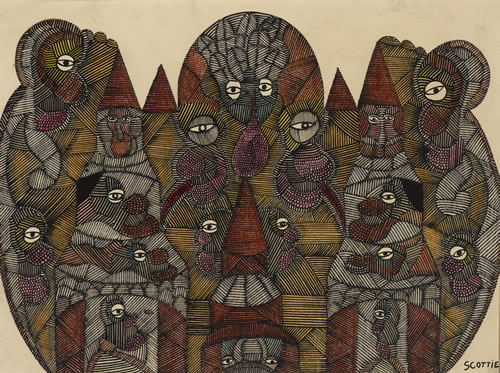
    Scottie Wilson, Greedies
    Scottie Wilson, Greedies

    I think the internet has certainly had a large part to play in the ‘product’ side of the argument. Now, artists, writers, performers, etc., can upload their work to a website or a blog for the world to see. It is not so dependent on having an exhibition in a sought after location, or having your book published by a well-known publishing house. Perhaps there are artists out there who prior to the internet may not have considered ever having their work seen (perhaps due to a lack of opportunity or luck in the art world), who are now able to share what they are doing with a wider audience. But this, I think, is a technological tangent, albeit an interesting one that I might explore further in future.

    Anyway, I think I have said as much as I can, and now it’s over to you. I would be very interested to hear from artists about their thoughts on this subject. Does exhibiting/performing your work provide something extra outside of the creative process? Is feedback important? Is sharing your voice and your thoughts a vital part of your practice?

    Please do comment below, write to me on Twitter: @kd_outsiderart, or if you would prefer, send me an email: kdoutsiderart@yahoo.com. Looking forward to hearing your thoughts!

  • Brian Gibson: What does it mean to be an ‘Outsider’?

    Brian Gibson: What does it mean to be an ‘Outsider’?

    I asked artist Brian Gibson for his thoughts on the term ‘Outsider Art’ and what it means to him as a practising artist.​ Below is his response and a display of his own artwork. Click here for more information on Brian and his work.

    I have never been quite certain as to where I fit as an Artist. For a long time the thought of being an artist felt very alien to me, it was after all another culture. Artists were clever, confident, sophisticated and well educated people. That was not how I saw myself; I was just some lone youth from a council estate on the outskirts of Newcastle from a single parent household who had a history of truancy with little to show in terms of qualifications.

    On the domestic front it was my Father who could draw, he was very gifted, he could draw calligraphy free hand or paint golden Celtic knots or Spanish dancers onto painted egg shells and all sorts of other intricacies. He was a gifted man who never really dared to share or show his talent beyond the garden gate. In comparison my creative efforts were never so precise. My handwriting was spidery and I never could quite get the hang of perspective; such things didn’t come natural to me, so the notion of becoming an artist wasn’t even on the radar for me. However there was a creative flame that flickered within me and I was fortunate that my efforts were never discouraged and even if the end results often fell short of how I wanted things to be, I was at least able to lose myself in what I would later know as “the creative process.”

    Brian Gibson, White Rabbit
    Brian Gibson, White Rabbit

    Art became less of an alien culture, as I got to know various accomplished works of art via my regular city visits to the art galleries and libraries when absconding from school. Also importantly for me was the fact that I had met someone who had decided to embark on their own creative path; he was a poet by the name of Barry MacSweeny. He lived on the adjacent Council Estate and was the elder cousin of two of my school friends, so occasionally we could find him in his mother’s kitchen writing away whenever we called round for a biscuit and drink of pop.  As one of the emerging 60’s poets, his first book of poems was published when he was just 19 years old. Being older he didn’t have much to do with us, appearance wise he looked a bit like Terry Collier from the TV series “The Likely Lads”; dapper and wiry.

    Having known such a person in my youth left a simmering impression on me. Why I mention him here is that he chose to do something creative and that was influential for me and secondly, if he were a visual artist he might now be considered posthumously to be some kind of Outsider. Although he never went to University, he was nominated for the poetry chair at Oxford. This however turned out to be just a cynical publicity stunt concocted by his publisher. This humiliation along with his own personal demons contributed to him remaining a marginalised poet for over 25 years. He died in 2002 aged 52.

    Brian Gibson, Those Late John Garfield Blues
    Brian Gibson, Those Late John Garfield Blues

    The original definition of  term “Outsider” set out by Roger Cardinal back in the 1970s seems to have evolved and undergone a seismic transformation in recent years, particularly with the expansion of social media. Such connectivity has meant that creative people working outside the mainstream are no longer so dependent on the nod of the well informed to decide whether this or that piece is an actual work of art.

    Now individuals can link up with other individuals, share ideas, post up images, form groups, put together exhibitions and even sell their work. Autonomy, self-empowerment and money – it all sounds rather good but the reality may be a little different. To be an Outsider Artist seems to have become incredibly fashionable of late, numerous tee-shirts and accessories in Selfridges and articles in Sunday supplements seems to be of good indicator of this.

    Outsider Art is now being presented as the more rebellious sibling to the established world of fine art, with Folk art the more amenable earthy but less noteworthy cousin. Outsider Art is more rock and roll, more edgy, and people are proud to wear their Outsiderness like a badge of honour. Now and this may not be a bad thing but I am aware that anyone can get in on the act.  I have seen a lot of savvy websites by individuals where the work veers into being more about a product in a particular style that happens to look like Outsider Art. As a trained artist who was dealing with his or her own mental health issues once said to me: “Outsider Art is easy to fake,” or at least it might seem that way. So a question that I have is “What does it means when such work becomes an entrepreneurial enterprise?”

    Brian Gibson, Candy Says
    Brian Gibson, Candy Says

    There are many other questions regarding the increasing popularity and branding of Outsider Art. I can envisage a future where a retailer such as Primark would be either selling tee-shirts cheaply of original prints from acknowledged Outsiders such as Madge Gill or  Jean Dubuffett and the like or, more likely – to save on copy write issues – just employing some people to produce something that looks a bit  like  the work of an Outsider Artist. Is this any more different than buying an original reprint from a more exclusive and prestigious source or to put it another way, who gets the money and what is the money the measure of ?

    Despite its current popularity, Outsider Artists tend to be Outsiders for a reason. It may well be that the making of work is the sole or soul reason why a person pursues a creative path, everything else may well be an after thought. The poet Barry MacSweeny could write and he could rant and he had his own demons so there were times when he just couldn’t get much of any thing together. I don’t think that this lessened the quality of his work, but I doubt if it served him very well in getting his work published. This seems to be the reality for a number of visual artists that I know, making the work is one thing, doing the rest is another. The added pressures of presenting work to a public audience to a deadline and dealing with unknown people, along with all the other stuff can be more than enough for most.

    Brian Gibson, Way Down in a Hole
    Brian Gibson, Way Down in a Hole

    For a good while now marginalised individuals and groups have worked hard to put themselves in the frame work so to speak in a way in which they feel represents them in the way that they wish to be seen and valued. It can take a lot of time and thought to develop environments where people feel safe and supported but I am sure that I am not the only one to have heard stories of unscrupulous figures waiting in the wings who are only too willing to put their profit and their own prestige way before the people they purport to represent. Having worked with vulnerable adults for over ten years now, I am just a little concerned that with so many self proclaimed Outsiders seeking centre stage, individuals and groups who have been historically marginalised may once again find them selves out of the picture.

    Brian Gibson, Sometimes I Feel Like a Motherless Child
    Brian Gibson, Sometimes I Feel Like a Motherless Child

    A note on Brian’s work (presented in this blog post):


    Earlier this year I produced six pieces with the overall title of  “I am frightened and timid and I don’t want to play” specifically for an exhibition as part of Fringe Arts Bath. Some of  the works are named after the titles of songs but don’t really have much to do with the songs themselves, if at all.


    Click here for Brian’s website
  • Otto Dix: The ‘Madness’ of Modern Warfare

    Otto Dix: The ‘Madness’ of Modern Warfare

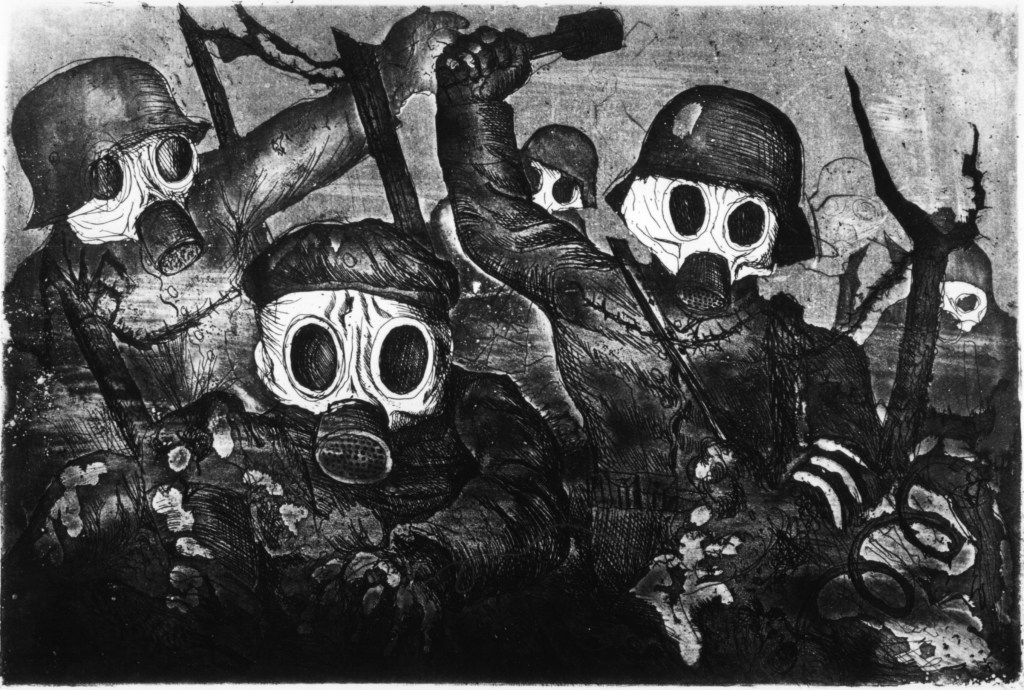
    Above image: Otto Dix, Sturmtruppe geht unter Gas vor (Stormtroops advancing under a gas attack), 1924 [Courtesy of: lewebpedagogique.com]


    I recently visited an exhibition of German artist Otto Dix’s series of prints entitled Der Krieg (The War) at the De La Warr Pavilion in Bexhill, East Sussex. I studied this series for my undergraduate dissertation a while back; where I focused on the links between German Expressionism and Outsider Art – more specifically the impact that experiences such as war can have on our mental health and how this makes the distinction between Outsider Art and ‘other’ art movements ever more intangible.


    During the First World War Dix volunteered to join the German army and was assigned to a field artillery regiment in Dresden. He took part in the Battle of the Somme before being transferred to the Eastern Front. He then returned to fight on the Western Front in 1918. In this year, he was wounded in the neck before being discharged from service in the December. His exposure to warfare had a profound impact, resulting in recurring nightmares in which he crawled through destroyed houses.

    Otto Dix, Schädel (Skull), 1924 [Courtesy of: www.deborahfeller.com]
    Otto Dix, Schädel (Skull), 1924 [Courtesy of: http://www.deborahfeller.com]

    “For all its waste, the war provided a windfall for scavengers. The First World War produced generations of happy worms and maggots. Trench rats roamed as big as beavers. Gas was sometimes a welcome respite as it decimated these pests.”

    – Taken from Otto Dix: Der Krieg exhibition pamphlet from the De La Warr Pavilion.


    Between 1915 and 1925, Dix created a significant group of paintings as a way of coming to terms with his harrowing wartime experiences. He began painting in a new style; a style which combined certain stylistic tropes and aspects of both Futurism and Expressionism, and in 1924 he produced Der Krieg –  a collection of fifty etchings and aquatints. The series is possibly one of the greatest anti-war depictions ever to be made, and is often compared to Francisco Goya’s Los Desastres. 

    This idea of the depiction of destruction and trauma as a source of creative impulse was widely common during the years following the First World War, resulting in a different kind of Expressionism emerging within Germany. At this time, there was a clear shift from a primitive, nostalgic, almost disengaged pre-war Expressionism, to a much angrier, political, ravaged Expressionism in the years following the First World War. Expressionist artists at this time seemed – quite understandably – engulfed by a ‘madness’ brought on by the normalisation of warfare and everything that came with it.

    Notably, in 1937, Dix’s work was included in the Nazi generated Entartete Kunst (Degenerate Art) exhibition in Munich. Even before the party had come to power in 1933, they had begun comparing images by avant-garde artists with those of the ‘clinically insane.’ Paul Schultze-Naumburg, a Nazi architect, was well known for contrasting the works of modern artists, such as Emil Nolde, with photographs of patients with physical disabilities with the intention of proving that modern art was pathological and degenerate.[1]

    The Nazis used modern art; Cubist, Expressionist and Dadaist works amongst others, as a scapegoat for the country’s economic collapse – a supposed conspiracy by Communists and Jews, and instead attempted to bring the focus of art back to the ideals of the human body.[2]

    Otto Dix, Mahlzeit in der Sappe (Mealtime in the Trenches), 1924
    Otto Dix, Mahlzeit in der Sappe (Mealtime in the Trenches), 1924 [Courtesy of: arttattler.com]

    “A trench soldier quickly gulps a meal in the company of a human skeleton trapped in the frozen landscape beside him.”

    – Taken from Otto Dix: Der Krieg exhibition pamphlet from the De La Warr Pavilion.


    July 19 1937 in Munich: more than 650 paintings, sculptures and prints taken from large German public collections were put on display with the aim of showing the German population what kind of art was to be considered inherently ‘un-German.’ Both abstract and representational works, including pieces by Dix, were condemned – as were the attempts to combine art and industry that had been pioneered by the Bauhaus artists. The exhibition, however regrettably, has made a place for itself as the most visited and viewed exhibition of modern art, with two million visitors in Munich, and a further one million viewers as it travelled across Germany and Austria.

    The works of George Grosz and Dix – and Expressionism more generally as a movement – were singled out to exemplify the idea of degeneracy within modern art.[3] Dix was particularly condemned due to his ‘defeatist’ attitude towards the war. His paintings The Seven Deadly Sins (1933) and The Triumph of Death (1934) portray the dangers of Nazism, and because of this, he was treated with utmost suspicion throughout the Third Reich.

    The Nazis saw ‘degenerate’ art as a “metaphor of the madman as the artist,” with Adolf Hitler developing a dialogue that insinuated that the avant-garde artist should be considered as an ‘outsider.'[4]

    Otto Dix, Gastpte - Templeux-la-Fosse, August 1916 (Gas Victims - Templeux-la-Fosse, August 1916), 1924 [Courtesy of: www.port-magazine.com]
    Otto Dix, Gastpte – Templeux-la-Fosse, August 1916 (Gas Victims – Templeux-la-Fosse, August 1916), 1924 [Courtesy of: http://www.port-magazine.com]

    “By 1924, people were aware of the horrors of gas but censored wartime reporting spared many from its ghastly details. Here the results are depicted with raw clarity of someone who was there. Indeed, much of Der Krieg was based on Dix’s wartime diary drawings. Many were probably struck by the appearance of the victims, darkened for lack of oxygen and the nonchalance of the medical staff who had seen it many times before.”

    – Taken from Otto Dix: Der Krieg exhibition pamphlet from the De La Warr Pavilion.


    A certain political and social ‘madness’ continued for the people of Germany throughout the reign of Hitler and his National Socialist Party. The extermination of German citizens based solely on race, ethnicity or religion was widely executed, as well as the mass rejection of works by some of the leading avant-garde artists. The whole era was epitomised by what defined ‘madness’, with the line between the ‘sane’ and ‘normal’ – if we are even able to define these terms – and that of the ‘pathological’ becoming increasingly blurred.

    The work of the German Expressionists, and the artists themselves, may have been deemed ‘insane’ by many critics at the time, but, as Jean Dubuffet claims, “very often the most delirious, most feverish works, those that are apparently stamped most clearly with the characteristics ascribed to madness, have as their authors people considered as normal.”[5]

    Annette Becker, writing in The Avant-Garde, Madness and the Great War, claims that “there is hardly more sense in the claim that there is an insane art as there is a dyspeptic art, or the art of those with knee troubles.”[6] Jon Thompson, curator of the Inner Worlds Outside exhibition at the Whitechapel Gallery, London in 2006 insinuates that “all human minds are fundamentally the same,” we are all the product of modernity and, influenced by Marx he “speaks to the degrees to which we are all alienated in one way or another, or in many ways at once.”[7] German Expressionism – and the work of Dix – was essentially a product of its time; a time that was characterised by alienation, discontent and the ‘madness’ of political instability and mechanical warfare.


    Otto Dix: Der Krieg continues at the De La Warr Pavilion in Bexhill until 27 July 2014. Click here for more information on the exhibition.

    References

    [1] Berthold Hinz, “‘Degenerate’ and ‘Authentic’: Aspects of Art and Power in the Third Reich,” Art and Power: Europe under the dictators 1930 – 45. Eds. Ades, Dawn, Tim Benton, David Elliott and Iain Boyd White, The Southbank Centre, 1995.

    [2] Stephanie Barron, ed. German Expressionism 1915 – 1925: The Second Generation, Los Angeles County Museum of Art, 1988.

    [3] Hinz, “‘Degenerate’ and ‘Authentic’: Aspects of Art and Power in the Third Reich.”

    [4] Sander Gilman, “The Mad Man as Artist: Medicine, History and Degenerate Art,” Journal of Contemporary History, Vol. 20, No. 4 (1985): p594

    [5] David Maclagan, Outsider Art: from the Margins to the Marketplace, Reaktion Books, 2009: p38

    [6] Annette Becker, “The Avant-Garde, Madness and the Great War,” Journal of Contemporary History, Vol. 35, No. 1 (2000): p81

    [7] Adrian Searle, Meet the Misfits


  • Outsider Art.. or ‘Inside’ Art: January Thoughts

    Outsider Art.. or ‘Inside’ Art: January Thoughts

    Above image: Henry Darger


    Happy New Year everyone – I hope you are all enjoying what 2014 has had to offer so far. I thought I would do a bit of an off the cuff ‘rambling’ blog post talking about a couple of ideas I have recently had relating to the term ‘outsider art’. Hopefully you will share your ideas and opinions on these below.

    The festive period brought a bit of a break from blogging and the art world in general, so, as I rekindled old and started new conversations about ‘outsider art’ in the new year, I had some fresh ideas that I wanted to share with you. The first came to me earlier in the week, when I was thinking about how I would now – two years on from starting the blog – describe the term ‘outsider art.’ This is an art that categorically comes from within, an art that (according to Dubuffet) isn’t influenced by art history or external factors. Despite my absolute disagreement with this idea of Dubuffet’s, I do believe that one of the reasons I am so drawn to ‘outsider art’ is because it epitomises raw communication from the heart and soul. Why then, do we call it ‘outsider art’ – shouldn’t it be ‘inside art’ or ‘art from within’? It seems absurd to me, as someone who enjoys using words, that the term itself should be so contradictory to the work caught beneath this umbrella.

    Often, when I tell people that I write about ‘outsider art’, they’ll ask: “Is that open-air art?” Hmm, it would make sense, wouldn’t it? I think someone also shared this opinion on BBC Imagine’s recent programme dedicated to ‘outsider art’; ‘Turning the Art World Inside Out’ (I think you can still catch it here on Youtube). So why, I wonder, can’t we give it a more deserving, fitting, and altogether less controversial name? ‘Art from within’ or ‘Inside’ art might go some of the way to distilling visions of the ‘societal outsider’ and alleviate the current separation between ‘outsider art’ and the ‘mainstream’ art world. Or, to play devil’s advocate, do we even need a label at all? I’m not so sure any more… Let me know what you think.

    Bill Traylor
    Bill Traylor

    The second thing I wanted to write about stems from a conversation I had on a recent visit to a prison. I was asked how artists who are also offenders or ex-offenders could ever shake the label of being an offender or an ex-offender if they are continuously associated with organisations who are known to work with these groups. This is something I have thought about previously, but to have someone who is potentially in that position to voice their concerns made me re-evaluate its importance. I know a lot of fantastic organisations working with ‘marginalised’ groups, but I wonder if perhaps there is something in this idea that people don’t want to be associated with their past or known by one label that doesn’t encompass everything they are or can be. For example, if art is marketed as ‘offender art’, does that mean the creator’s image is tainted; that they are not seen simply as an artist working within the art world?

    I have always wanted ‘outsider art’ to be exhibited and publicised in a way that eliminates in-depth biographies, and instead just focusses on the art as a captivating piece of work created by a talented individual. There are plenty of organisations operating across the country that do a fantastic job in supporting artists who are perhaps facing barriers to the ‘mainstream’ art world for whatever reason, and I think that these charities and groups are undoubtedly needed; in particular to encourage and nurture an artist’s first steps into, or a return to, the art world. The conversation in the prison concluded with a suggested solution that these organisations are invaluable as a springboard towards a career as an artist. By becoming an artist unwanted labels can be lost; replaced, if necessary, with more favourable and accurate ones.

    I would really value and appreciate your ideas on either of these thoughts, so please post any comments below. Happy New Year!

  • Pre-World War I: Primitivism, Nostalgia and the Rise of German Expressionism

    German Expressionism was born out of the influence of a variety of earlier movements, styles and subject matter, and of course, through the discontent of many avant-garde artists with recent modernisation and the alienation of urban living. Paul Gauguin (1848 – 1903), a French Post-Impressionist, proved significantly influential on the works of German Expressionists. Gauguin developed the visual language of ‘syntheticism.’ German Expressionism also undoubtedly takes some inspiration from Gauguin’s use of primitive artefacts and colour symbolism, as well as his use of nature without “(falling into) the abominable error of naturalism.” Vincent van Gogh (1853 – 90), was an incredibly important figure in the development of Expressionism, with the vibrant energy and colours found in his work. German Expressionists such as Ernst Ludwig Kirchner (1880 – 1938), Emil Nolde (1857 – 1956) and Ludwig Meidner (1884 – 1966) greatly identified with van Gogh’s alienation and isolation from the world, and his reliance on the ‘inner world’ to create, rather than external stimulation.

    The Brucke group, named after a quote by Friedrich Nietzsche, in which he states that “what is great in man is that he is a bridge and not a goal,” was founded in 1905, after the meeting of Fritz Bleyl (1880 – 1966), Kirchner, Karl Schmidt-Rottluff (1884 – 1976) and Erich Heckel (1883 – 1970) at the Dresden Technical College during their time there as architecture students. However, Bleyl left the group in 1907 to pursue a career in architecture, so the core group always remembered is made up of Kirchner, Heckel, Schmidt-Rottluff and Max Pechstein (1881 – 1955). These Expressionist artists were not content with the technical innovations and modern advancements that the early twentieth-century carried with it. The idea of the primitive was very much a basis for a large amount of the Brücke artists’ work. German Expressionists used the notion of timeless primitivism, and the borrowing from other traditions and cultures as a way to ignore what was actually occurring in Germany at the time, as well as to show their adversity to the modern world.

    The idea of the artist’s rejection of society and the urban city crop up throughout the history of art in Germany, for example, prior to Die Brücke, was Wilhelm Riehl’s Land und Leute (1857 – 63), which advocated traditional countryside living as the ultimate symbol of German tradition, as well as Carl Vinnen’s Worpswede Stimmungsladschaften (mood landscapes) and Arnold Bocklin’s mythological landscapes, which showed a romantic and untainted vision of countryside living. The notion of returning to nature is also highlighted in Adolf von Menzel’s a Journey Through Beautiful Nature, of 1892, which depicts figures in elegant clothing aboard a crowded train, desperately yearning to catch a glimpse of the countryside through the windows, yet irreparably isolated from it. Kirchner’s own figures in the countryside represent the unity of the human race with the natural environment, for example, Four Bathers of 1910, which was created during one of the Brucke artists’ summer trips to the Moritzburg lakes. His urban figures, however, show the alienation felt by people during the years of modernisation, like his piece entitled Five Women on the Street of 1913, part of his Street Scene series, which has defining primitive aspects and characteristics which Kirchner has used in attempt to highlight the contradictions of modernity.

    Emil Nolde, one of the most well-known German Expressionists, who was also a member of Die Brücke between 1906 and 1907, often showed his disdain for technological advancement and modern society within his work. He seldom depicted huge technological developments, such as that of the automobile or the aeroplane, and the hustle and bustle of city life goes undetected in his work. Nolde successfully avoided any representation of the modern world, even during his journey to New Guinea in 1913, where he chose to depict Russian peasants, and ignore the train and tracks his wife and he were travelling across. Despite spending every winter in the city of Berlin, the only signs of city life within Nolde’s work were the interiors of cafes and cabarets.

    Cesare Lombroso, an Italian psychiatrist, understood ‘madness’ to be a descent back into a primitive, or child-like stage of growth, and similar to this descent, was the use of primitivism by German Expressionists to represent their nostalgia for an earlier time; a time before modernisation. Similarly, Adolf Wolfli (1864 – 1930), a Swiss Outsider Artist, created art after his psychotic collapse as a way to emerge from chaos into stability. In a similar way, the German Expressionists escaped from the isolation and alienation of modern urban living through nostalgic primitive painting. Pascal Maisonneuve (1863 – 1934), a French Outsider Artist, portrayed his defiance and discontent with society and politics through his ‘shell faces,’ which he created by collecting strange objects and shells and arranging them into faces. These ‘shell faces’ defied conventional representation and ridiculed political figures, much in the same way as Expressionism was used as a new form of representation that was ideal for portraying discontent and frustration.

    A “direct and unadulterated” creative urge was crucial to the Brucke programme. Nolde would often concentrate exclusively on a specific subject matter in intense bursts of activity and in his autobiography, the artist conjures up images of himself as being “preoccupied only with his art.” Similarly, Kirchner would work obsessively, without taking notice of the time, and would often emphasise his mental distress as a key driving force behind his work; just as Outsider Artist, Wolfli, never planned in advance. In fact, one of the defining characteristics of Outsider Art is the appearance of compulsion; the need to fill in the gaps and continually create. Of course, the term Expressionism itself insinuates the “urge to express oneself,” and this urge is what enabled the German Expressionists to work without inhibitions, painting directly from the nude in the studio for bursts of approximately fifteen minutes, putting their own subjective stamp on the subject matter.

    The years directly prior to the break out of the First World War saw an escalation and intensification within Kirchner’s work, which eventually led to his prominent Street Scenes; of which there are eleven works, all executed between the years of 1913 and 1915.  The members of Die Brücke had moved to Berlin in 1911, following Max Pechstein who had relocated in 1908, where they had worked together as a group for another couple of years before dividing and going their separate ways. The last recorded work by the Brücke artists jointly was the poster for the exhibition entitled ‘Neuer Kunstsalon’ dated the 27th May 1913. In the pre-war climate of Berlin, the artists became withdrawn. Kirchner began his Street Scenes, which included his Berlin Street Scene of 1913.

    Kirchner reportedly took to stimulants such as alcohol, sex and morphine during his time in Berlin, and right up until his suicide in 1938 he was continually fighting a battle with loneliness and alienation, and his frustration and discontent with modern city life. Kirchner was keen to emphasise the dangers of modernisation within society, which he managed not only in his Street Scenes, but also in his colour lithograph of The Railway Accident of 1914. Here, a freight train is shown colliding with a horse drawn carriage, with Kirchner illustrating the destruction that can be associated with modernisation. The imminent outbreak of the First World War saw a huge shake up in the way people saw modern life, the city and their country. Inevitably, the War had a huge impact on everything from culture to the economy and as a result of this; the Weimar era would see a whole new side of German Expressionism.

  • Social and Political Theories of Alienation and the Appearance of ‘Madness’

    Germany, at the turn of the twentieth century saw major shifts from an agrarian economy to a modern industrial economy. Under Otto von Bismarck, who oversaw the unification of Germany in the late nineteenth century, the years 1870 until 1890 saw a huge period of transformation and an increase in Bourgeois power; these years were known as the ‘taking off period,’ or the Grunderzeit. During the first decades of the twentieth century, Germany experienced the apocalyptic destruction of war, and the rising social and economic upheaval of the Weimar period and as a result of this, German art appeared to mirror the tensions and divisions within German politics and society.

    One explanation for the changing process and apparent ‘insanity’ within modern art, particularly German Expressionism, is the ‘kunstwollen’ theory, or the “Immanent artistic drive.” This principle of ‘kunstwollen’ began with Alois Reigl and was extended by Wilhelm Worringer (1881 – 1965) in his thesis Abstraction and Empathy (1908), where Worringer claimed that the political and social contextual background at the time of the production of a work had a huge impact on the outcome; and, he claimed, this was the reason for revolving themes and styles within the art world. Worringer pushed the notion that classical art, such as Greek or Roman sculpture was the product of a harmonious society, whereas, in times of economical or political hardship, art would become much more angular; as seen in Dadaism, Cubism, Futurism, Vorticism, and to some extent, Expressionism. This thesis was popular amongst both the British and German avant-garde, and goes some extent of the way in explaining why German Expressionism was often particularly violent, angry and ‘insane’ just after the First World War. In Germany at this point, the relationship between the artist and his community was not harmonious, and political and economical circumstances were not favourable, therefore soft curves and pleasant colours were replaced with sharp, angular and complex works of art.

    During the nineteenth century, there was a definite drift towards a more materialist philosophy in the Western world. The emergence at this time of the social revolutionary works of Karl Marx, Sigmund Freud’s creative impulse theories and the Apollonian (idealist) versus Dionysian (realist) debate raised by Friedrich Nietzsche had a huge impact on the cultural avant-garde. These theorists and philosophers ultimately defined the world by what they could see, rather than with the optimism of idealism. This, of course, directly opposed the idealist philosophies of previous decades; of which Kant and Hegel were visionaries.

    This sudden progression of industrialisation and capitalism in Germany left German Expressionist artists feeling isolated and alienated from their own society. Die Brücke, founded in Dresden in 1905, had seen most of its members move north to Berlin by 1911. Max Weber claimed that human behaviour was being altered by the demands of industrialisation and capitalism. Stephen R. Marks also claims that alienation can be a considerable resulting factor of industrialisation and commercialisation; group life, particularly during times of industrialisation can cause group members to feel purposelessness or normlessness. Georg Simmel – interested in the modern urban individual – states that the metropolitan dweller must exaggerate his own personal qualities in order to be heard in the vast society of the metropolis.

    Primitivism, Lloyd claims, was used by German Expressionists to question values held by Western society. The use of primitivism in their work sees the Expressionists looking for inspiration from already alienated groups. Outsider Artists and primitive artists were already isolated from society, and somewhat untouched by industrialisation and capitalism. German Expressionists used similar techniques to portray their discontent with society and their rejection of modernity. Art and creativity, it seems, was an acceptable way for the alienated man to channel his discontent. Emile Durkheim’s ‘Theory of Anomie’ outlines this idea of alienation from society. Alienation is a feeling whereby the socialised man no longer feels a sense of belonging within his own community. This need to channel feelings of alienation in some form or another sees a similarity between Outsider Art and German Expressionism. Creativity was a socially acceptable way to challenge society and explore the alienation that one felt, and one that both Expressionists and Outsider Artists shared. Although Outsider Artists may not have been aware of societal and economic changes, they were still part of an alienated group within society, and because of this, German Expressionists could relate to their work.

    Social, political and cultural factors played a huge role in the shaping of German Expressionism as an art movement. It was wholly built upon foundations of discontent and the rejection of modernity, rather than technique or subject matter. Peter Bürger, in Theorie der Avantgarde (1974), confirms that contextual factors, predominantly social, political and economical factors, certainly have a profound effect on artistic style and subject matter.

  • Introduction to the Links and Similarities Between German Expressionism and Outsider Art

    I am going to begin a series that looks at the links and similarities between German Expressionism and Outsider Art particularly between the years of 1905 and 1945. This will include contextual factors, pre-world war one, the Weimar period and then finally, the Degenerate Art exhibition organised by the National Socialist Party in Germany. Here is the first installment… just a quick intro…

    German Expressionism, rather than being a distinct movement, with clear defining factors, was in fact the result of a whole host of contributing factors. Expressionism, similar, in fact, to Outsider Art, had no essential programme; instead, it was identified by content. David Elliott describes it as “paradigmatically asocial, the voice above all of the individual.”

    When discussing the time period that German Expressionism spanned, it is important to define two key words at the forefront of German vocabulary at the time. The birth of a new Europe, industrialisation, modernisation, and social and economical change all define the era in which this movement was prevalent; these all characterise the spirit of the time, or Zeitgeist. Another German word, Kultur, which has no direct links with the broad English term culture, is also important when discussing German Expressionism. Kultur implies that which is generically German; seen during the reign of the National Socialist Party as superior to that of other nations. Kultur can be seen as bringing the individual and wider society together by providing mutual interests.

    The birth of modernisation, which was spreading rapidly throughout Europe at this point, was the source of discontent for many and the continual growth of towns and cities often led to the public feeling isolated and alienated from the rest of this ever expanding society. This feeling of alienation was noted by many sociologists, psychologists and philosophers at the time, including Georg Simmel and Max Weber; it can also be seen described in much of Karl Marx’s work. The sense of alienation felt by many in a way turned them into outsiders; much like the Outsider Artists of the same period.

    Artists at this point were becoming aware of Outsider Art, and were taking aspects of these works to inspire and enhance their own creations. Exhibitions of this art were being held for the first time, drastically changing the attitude of the public towards minority groups, such as the insane; finally, the ‘madman’ was becoming the romantic ideal.

    Max Beckmann, a German Expressionist artist, can be seen relating to the work of outsider artists in his Self-Portrait with a Saxophone of 1930, in which he is almost representing himself as an outsider. The painting shows Beckmann slouched, clutching a saxophone below waist height, wearing very basic clothing. The artist appears distant and melancholic, with the painting portraying an overall sense of confusion and bizarreness. What Beckmann appears to be looking for is a new language for continuing contextual dilemmas. German Expressionists looked to convey certain aspects of outsider art in their own quest to create a language that was undoubtedly a critical response to contemporary political and social problems. The first exhibition of Expressionism in 1906 goaded the public and art critics to assume that the artists were of ill mental health, and it is obvious that Expressionist painters were in fact trying to imitate the often closed off worlds of the mentally ill.

    The idea of alienation is a mutual factor of both German Expressionism and Outsider Art. Fired by a feeling of discontent with their current world, the German Expressionists sought something much more original and primitive to inform their works, and it seemed Outsider Artists could effortlessly achieve this much-desired uniqueness. German Expressionist art was not ‘insane;’ rather, it was reflecting the contextual tensions and conflicts occurring within politics and society in Germany at the time. To portray this conflict, a new style was needed, and Expressionists looked to the originality of Outsider Art for inspiration. The exploration of madness, alienation and discontent within the works of German Expressionism is one that is inevitable due to the political strife and social instability of the time, and it seems apt to look at ‘madness’ in terms of those who were often in fact clinically insane; the Outsider Artists.

     Max Beckmann, Self Portrait with a Saxophone

    Follow me on twitter!: @kd_outsiderart