Tag: pallant house

  • Outside In: National 2012

    Outside In: National 2012

    Outside In‘s National Exhibition will take place between the 27th October 2012 and 3rd February 2013 at Pallant House Gallery in Chichester. Outside In work to provide a platform for artists who are marginalised from sociaty due to a number of reasons including mental health issues, social circumstances and disability. The deadline for applications for the exhibition is Friday 20th July 2012, and there is no submission fee for entering the competition. There will be six award winners who will receive a month long solo exhibition in the Studio at Pallant House.

    Accompanying the Outside In: National will be other exhibitions based around the idea of ‘outsider’ art. Pallant House will be exhibiting the work of Jean Dubuffet, who originally coined the term Art Brut. He was a painter and sculptor as well as a collector of ‘outsider’ art in the early 20th century. As an artist, Dubuffet disregarded traditional ideals of beauty and instead focused on what he believed to be a more authentic and ‘raw’ approach to creating art. The exhibition at Pallant House will focus on the L’Horloupe series within Dubuffet’s collection.

    Also accompanying Outside In: National will be an exhibition of Pat Douthwaite’s prints. Douthwaite is considered both a ‘self-taught’ and ‘outsider’ artist after starting her life as a dancer and aspiring actress. After giving up the stage to focus on her art, Douthwaite was encouraged not to attend art school by fellow Scottish artist J. D. Ferguson. Lacking a permanent base, Douthwaite worked from numerous cities and countries including England, Scotland, North Africa, India and South America, but eventually struggled with physical illness after an attack she suffered in Edinburgh. Douthwaite exhibited regularly within the art world, but her work and its unique style was not considered to fit into the artistic conventions of her day. She was uninterested in becoming caught up in the art world, instead being comfortable being linked to ‘outsider’ art.

    Douthwaite’s early work was heavily influenced by the work of Dubuffet – something which connects the two exhibitions at Pallant House which are accompanying Outside In: National this coming Autumn/Winter.

    This series of exhibitions is something not to be missed by those interested in the work of ‘outsider’ artists. For more information on the exhibitions, and to keep up to date when information is released about them, please visit Outside In‘s website.
  • Edward Burra (1905 – 1976) – Modern Connections

    Edward Burra (1905 – 1976) – Modern Connections

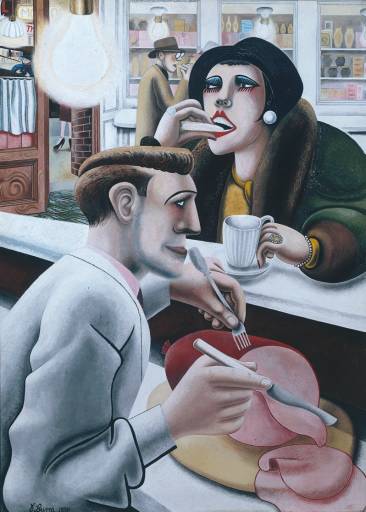
    Edward Burra, The Snack Bar (1930)

    Edward Burra, not exactly an ‘Outsider Artist’, never seemed to quite fit in to any particular art canon. After visiting the first solo exhibition of his work in 25 years at Pallant House Gallery in Chichester earlier this year, I could see connections with German Expressionism, Surrealism, and potentially Impressionism – connections which I will discuss in more detail later in this post. However, despite being named one of the most acclaimed modern British artists, his work is somewhat unknown to the majority.

    Working predominantly in watercolour, Burra’s work is unlike any other pieces found in this medium. He uses the paint to produce a bold, solid colour – a characteristic that made his work centre stage at Tate Britain’s recent ‘Watercolour’ exhibition. Burra’s work encompasses four main themes; the first being the almost voyeuristic depictions of prostitutes and drinkers, then there are his more macabre, surrealist works, then his landscapes and, finally, his theatre designs.

    His depictions of the Hollywood scene and life in Harlem – in which he represents drinkers, prostitutes and immigrants – are almost comparable to the work of early Impressionists working in Paris in the late nineteenth century. The voyeuristic, almost flaneur-like gaze of the artist represents the woes and tribulations of modern industrial life. Similarly to Eduard Manet and Pierre-Auguste Renoir, Burra plays the flaneur in these works, for example in his piece entitled The Snack Bar (1930), which depicts a prostitute in a café-bar. Comparable to Manet’s scenes of café-life, such as At a Corner Café-Concert (1878), Burra’s work unashamedly depicts working-class urban life. The idea of the flaneur, a theory highlighted in the work of Charles Baudelaire, is that the artist depicts fleeting moments in time; capturing everyday life on the canvas – or in Burra’s case, on paper.

    Burra’s work has already been compared by many to the work of the German Expressionists Otto Dix, George Grosz and Max Beckmann. The German Expressionists used their art to portray their discontent with the rapid modernisation and industrialisation that was taking place in Germany during the early twentieth-century. Similarly to Burra, they worked in bold, solid colour, with harsh lines and also depicted the turmoil and dissatisfaction that is often a companion to the loneliness of modern city life. Dix, Grosz and Beckmann, amongst other Expressionists, were not afraid to show the dark side of urban life; the back streets, the macabre and the poverty; subject matter that resulted in the their inclusion in the 1937 Degenerate Art exhibition in Munich.

    Despite the difficulty to place Burra within the traditional art historical canon, his work is definitely something to be celebrated. His use of watercolours can only be admired; from a distance, it is impossible to tell that his courageous use of colour is produced using this medium. His work shamelessly depicts the underworld of modern urban life; a theme that is iconic and almost representative of works produced during the early twentieth-century in Western cities.

    The Edward Burra Exhibition, which began at Pallant House Gallery, Chichester earlier this year is now touring. You can see this exhibition at the Djanogly Art Gallery until the 27th of May 2012.