Tag: insider art

  • Nick Moss: Insider Art

    Nick Moss: Insider Art

    In this post, writer Nick Moss responds to Cornelia Parker’s current installation at Frith Street Gallery and reflects on how, in opposition to Parker’s ‘insider art’ – which feeds us messages of unquestioned assumption – outsider art has the power to contain the multitude of voices that go unheard in the art world.


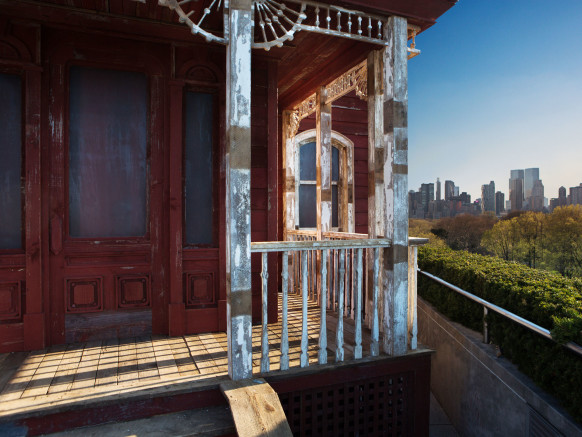
    The first reaction of anyone who sees themselves as “progressive” when first encountering Cornelia Parker’s current installation at Frith Street Gallery (28 April 2017-21 June 2017) will doubtless be euphoric.  All the right boxes are ticked- it’s a mocked-up nightmare of  the USA under President Donald Trump. In 2016 Parker was commissioned by the Metropolitan Museum of Art to create a site-specific installation for the museum’s roof garden. The ensuing work, Transitional Object (PsychoBarn) was apparently inspired by the paintings of Edward Hopper and by the Bates family’s mansion from Alfred Hitchcock’s 1960 film Psycho. According to the press blurb “PsychoBarn loomed on the city’s skyline as a harbinger of things to come – signalling that all was not so well in the American psyche.”

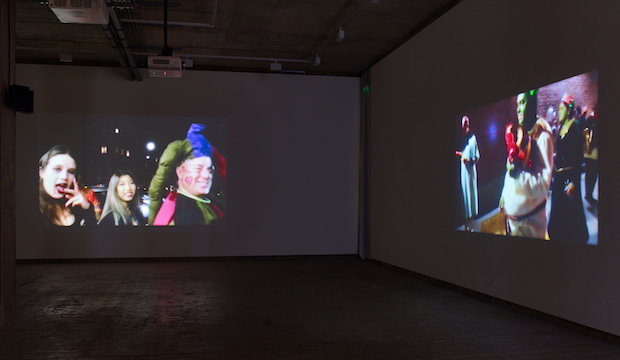
    Parker visited New York at the end of October 2016 to give lectures about the PsychoBarn prior to its de-installation. Its closing date was Halloween, “the old festival of All Saint’s Eve, which has been famously elevated in the USA to a theatrical celebration far removed from its folkloric and religious origins.” Parker and her husband used their iPhones to film people dressed up on the streets. The resulting video American Gothic 2017 “captures ghoulish revellers having their last hurrah, mingling with the crowds of the un-dead. On All Hallows night in Greenwich Village every American archetype, good and bad, seemed to be out promenading the sidewalks, from superheroes, vampires, clowns, ghouls, trolls, Freddie Krueger and Hannibal Lecter, Uncle Sam, Dorothy and the characters from The Wizard of Oz.” The scenes are displayed in slow motion  and accompanied by a slowed-down location soundtrack, which provides a low drone as background noise. On a 4th screen is footage of Trump supporters outside Trump Towers, celebrating his election. This is shown in real time, but without sound.

    HouseClose-582x437
    Cornelia Parker, PsychoBarn (Image courtesy of wired.com)

    I have no axe to grind against Cornelia Parker. I have been moved by some of her previous work-Anti-Mass particularly. This is therefore not a critique of her work per se. It is, however, written as Parker takes up her role as 2017 official election artist, and reflects therefore, necessarily, on the politics inherent to American Gothic, and what they say about “progressives’” responses to the Trump election.

    The first thing to note is that, were the Halloween scenes to be played in real time they would show happy, pissed revellers looking to dress up and party. This is no pre-apocalyptic “last hurrah” , no mournful parade-it’s a time when the streets are taken over by ordinary people, masking themselves and taking advantage of their anonymity to get absolutely wasted ! In slowing down the footage Parker is passing judgement on the revellers purported departure from the “folkloric and religious origins” of the festival. I’m always bemused by the fact that people who describe themselves using that mealy-mouthed  epithet “progressive” stop seeing  the liberatory element of the  abandonment of “tradition”, when said liberation involves working class people behaving riotously in the street. George Orwell , in Down and Out in Paris and London, contends that “Fear of the mob is a superstitious fear. It is based on the idea that there is some mysterious, fundamental difference between rich and poor, as though they were two different races.” Parker manipulates her footage of the crowd and in doing so her fear of  that crowd (and eo ipso that of her presumed audience) is made apparent.

    So the procession of ghouls is manipulated to meet the need of another crowd-that embodied in disillusioned progressive opinion- who want to see their passive despair reflected back at them in the comfort of the gallery space. And on the 4th screen they get to stare open-mouthed at the crowds of ecstatic Trump supporters. As already noted, this footage is silent. This is a shame-as we see groups such as Blacks for Trump and Latinos For Trump  actively explaining their motivations to the camera, but are denied the chance to hear them. Presumably we are supposed to be already part of a consensus that they have nothing to say worth hearing. It is worth noting though, that the primary claim  of the working class and poor people who voted for Trump, for Le Pen, for Brexit, was that thy were “the forgotten”-the casualties of deindustrialisation whose voices now counted for nothing. A working class vote for A right wing politics that in the long run are against the voters’ interests is,in essence, an expression of powerlessness. It is a gesture against the political Establishment, for sure, but more than that, it demonstrates a belief that change can no longer be effected by solidarity-that you can only , for instance,get new housing stock   by driving out the family next door. It is the beginning of the war of the poor against the poor. Such being the case, we might want to consider how “progressive” is an artwork that actively erases the voices of those who are already “the forgotten.”
    american gothic
    Cornelia Parker, American Gothic (Image courtesy of culturewhisper.com)

    In his Outline of a Theory of Practice (1977) Pierre Bourdieu noted that “The most successful ideological effects are those which have no need for words, and ask no more than complicitous silence”. American Gothic demonstrates this precisely by engaging us in the act of “complicitous silencing” of the voices of the Trump supporters. We are seduced again into the act of ignoring those who feel themselves “forgotten”, while the parade of slow-motion grotesques goes on around us.

    What we have then is the opposite of what first appearances lead us to believe. Once all of the manipulation of footage, all the technological mediation is stripped away, the 4 screens show the raucous celebrations of Trump supporters, and the Halloween debaucheries of the costumed revellers of New York. What we have in fact is a 4 screen technological effacement of the voice of the working class, a 4 screen installation that doesn’t challenge its anticipated audience , doesn’t provoke, but tells them just what they want to hear. Trump is bad, and these are frightening times. We can agree. We can accept that it’s not Cornelia Parker’s role to point us towards a way out of the Bad Times. But we should surely expect more from art than a (perhaps unconscious) reproduction of Bourdieu’s “complicitous silence”-in this case in fact a “complicitous silencing.”

    As much as we might flinch at the difficulties inherent in the use of the descriptor “outsider art”, we might best see the logic of the term  in relation to those art forms antonymous to it.  There is a sense in which much art now-the Hirsts, the Quinns etc-by virtue of their cost, their materials, their intended audience, might best be called “oligarch art.”  But if outsider art has an antonymous counterpart art form, then that must be, logically, something like an “insider art”-and American Gothic is insider art paradeigma. It does nothing other than offer platitudes to an audience who will already agree with the point it so clumsily makes. Outsider art, then, must be the opposite of this. It will contain the multitude of voices that go unheard in the art world. The loud, the ugly, the distressed, the vicious,as well as the sublime, the beautiful, the soothing. It will admit all that is excluded from the discourse of the mainstream. It may do this therapeutically, as pharmakon, as celebration. What it will not do is silence, look away from or exclude. In that sense then, as opposition to insider art, we might still make positive usage of the term.
  • Diego Samper – Panopticon

    Diego Samper – Panopticon

    In 2003, Diego Samper was given the opportunity to tour a recently closed 120 year old Columbian prison in the town of Ibague, which was based on the idea of the British Panopticon prison; as its design allowed for increased surveillance and enabled hidden jailers to see every cell from a single position. The building itself housed political prisoners in the late nineteenth century.

    The prisoners who were incarcerated within this jail were allowed to freely express themselves on the walls of their cells; the idea being that they could create their own ‘space.’

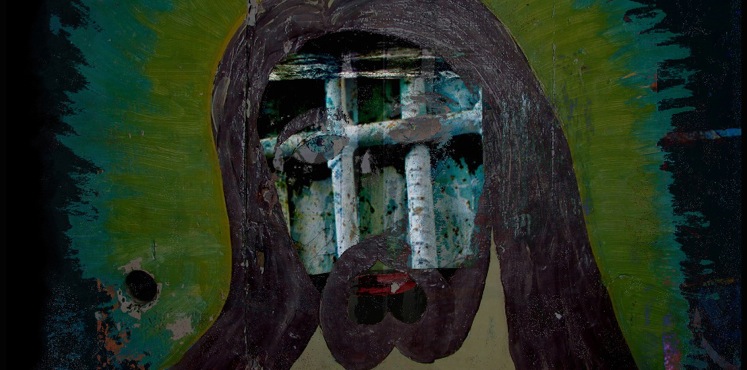
    Within the confines of the Ibague jail, prisoners seeking subjective freedom and solace, protested and expressed their opposition by richly decorating every surface. They deluged the prison with flowers, stars, saints, birds, fishes, mermaids and peacocks. The captive population asserted the significance of decoration for the soul in opposition to the machine aesthetic stripped down by the philosophy of modernism.[1]

    On his visit, Samper may have anticipated hard core pornography, but apart from the representation of a few nude females, the art was predominantly religious, or based on the idea of freedom. He was surprised by the vividness of colour used – he even claimed to have only taken a black and white film, on the assumption that the works would all be muted greys. [2]

    Samper photographed many of the works he encountered, realising that they were evidence of the abundant freedom that our own imagination can bestow upon us. In a place of isolation and incarceration, many of the prisoners sought out solace and salvation through religion, or indeed simply the momentary experience of freedom through their own creativity.

    Fascinated by the idea of increased surveillance and how it is in human nature to express or seek freedom even in the most hopeless states of oppression, Samper used 80 of the images to create a film entitled Panopticon, which is described as “a kind of visual dreamy sequence that occasionally turns into a nightmare.” [3]

    The film journeys through a rich visual underworld of prisoner art and psychology and through it, reveals aspects of contemporary Columbian social and political realities. [4]

    The idea of the Panopticon design itself has perhaps come to be a representation of the modern, technological world we now live in. With CCTV cameras around every corner, the average person can expect to be captured between 70 and 300 times per day in the UK. There is the feeling of a general global loss of freedom. Samper’s film is an evidential example of the freedom and escape that our own imagination and creativity can give us; particularly in today’s world where the margins of freedom, privacy and escape are becoming increasingly narrow.

    References:

    [1] from Notes Concerning the Panopticon, by Geoffrey Smedley, available online at: http://www.diegosamper.com/panopticonEn.html

    [2] http://www.coastreporter.net/article/20120615/SECHELT0501/306159998/-1/sechelt/prison-art-in-samper-film

    [3] http://www.coastreporter.net/article/20120615/SECHELT0501/306159998/-1/sechelt/prison-art-in-samper-film

    [4] http://www.diegosamper.com/panopticonEn.html

    FOR MORE INFORMATION ON DIEGO SAMPER’S WORK, PLEASE VISIT: www.diegosamper.com

  • ‘Insider Art’: The Work of Artists in Prison

    ‘Insider Art’: The Work of Artists in Prison

    Matthew Meadows’ book entitled ‘Insider Art’ looks at the rise in art made by prisoners and how this work has come to take a prominent place within the contemporary art world. Grayson Perry writes the foreword for the book, in which he notes that in this ‘Insider Art’ he sees “the basic human desire to make something tangible out of thoughts and feelings.” [1] These works remind Perry of where he came from and are a sobering reminder that perhaps at one point in his life he could have taken a “darker turn” but instead he chose art; much as many of these prisoners who create this ‘Insider Art’ have done, but perhaps a little later than Perry did.

    I’m an artist, and it’s a passion which burns with me to the point that it hurts. I am self-taught through books and many a long night and a short pencil. [2]

    This statement highlighted by Meadows in his first chapter is written by an inmate at HMP Wealstun. In the UK in 2009, 90,000 men and women were in custody, on remand sentenced or detained; 3,000 of which were young people. But why is ‘Insider Art’ so popular?

    Meadows argues that the “risk taking and rule breaking” appear within some of these works and that we “respond to its conviction, originality and often compelling content.” [3] In recent years, we have seen the establishment of prison arts charities; one of the most predominant being The Koestler Trust which was founded in 1962 by Arthur Koestler. In the USA, ‘Insider Art’ has established a market for itself both online and within galleries and in Holland, plans are in place to open a permanent collection of prison art from Europe in an unused prison building.

    Meadows also broaches the subject of victim responses to the exhibition and promotion of work created by those incarcerated in prisons across the world. Kelly Flyn of Victim Support claims that there is no unanimous thought held by victims:

    Victims’ views are extremely diverse and range from lifelong anger to total disinterest and feelings are likely to change over time. Therefore it’s just not possible to be able to say what victims might or might not think of prisoners’ art – there would be those who’d think it outrageous that prisons provide art courses, those who have no view one way or another, and those who’d say it’s a good idea. [4]

    It is a very sensitive subject. When the artist of a very well-known piece of art hanging in the Royal Festival Hall was revealed to be a child murderer and sex offender serving a life sentence, many were outraged that he was able to exhibit his work and even earn money from it. After much protestation, his work was removed from the gallery and the Royal Festival Hall issued a formal apology to the families of his victims.

    It can be difficult for people in society to see the possible benefit that might come out of exhibiting ‘Insider Art’. An article written for the Guardian in 2007 entitled ‘Arts in Prison Can Bring Hope to Broken Lives’ claims that whilst there is no excuse for committing crime or causing harm, “it’s usually the case that those who do behave badly towards others lack any real sense of self-worth or self-respect. And people who do not feel good about themselves are hardly likely to feel empathy or consideration for others.” [5] Creative activity in itself considerably aids personal development and it can bring hope or meaning to “broken, dysfunctional lives.” [6] A lot of people who begin creating art, or undertaking any creative activity, in the prison environment often have not had any experience of it beforehand. The opportunity for them to try such things can have spectacular results.

    Stretch, like The Koestler Trust, is another charity that aims to bring art into prisons. Recognising that art galleries and museums were out of bounds to prisoners, Stretch established a way to take the museum to the prisoners. They created virtual tours of museums such as the V&A, as well as asking artists to go into the prisons and share their ideas and head workshops with the prisoners. The workshops have even led to prisons gaining work placements on their release.

    Erwin James, author of the Guardian article, closes with:

    Engaging with art can restore confidence and self-worth; it can improve sociability and generate aspiration. Art and creative activity can be the perfect vehicle for revealing the complexities of the human condition. Prisons should open their doors wide to anyone who wants to promote it, and the government should recognise its value as an effective deterrent to re-offending.

    Afterall, “prisoner lives enhanced bring enhancement to the wider community.” [7]

    References:

    [1] Matthew Meadows, Insider Art, (A & C, 2010) p 8

    [2] Meadows, Insider Art, p 11

    [3] Meadows, Insider Art, p 11

    [4] Meadows, Insider Art, p 12

    [5] http://www.guardian.co.uk/artanddesign/artblog/2007/jul/19/artsinprisoncanbringhope

    [6] http://www.guardian.co.uk/artanddesign/artblog/2007/jul/19/artsinprisoncanbringhope

    [7] http://www.guardian.co.uk/artanddesign/artblog/2007/jul/19/artsinprisoncanbringhope