Category: Relationships

  • Relationships: Alfred Wallis and Ben Nicholson

    Relationships: Alfred Wallis and Ben Nicholson

    ‘Outsider art’ in the traditional sense – i.e. Jean Dubuffet’s description – alludes to an isolated artist, working on the periphery of the mainstream art world. Contrary to this controversial belief, many of the most notable ‘outsider artists’ of the twentieth century were supported, encouraged and ‘outed’ by some of the most famous ‘mainstream’ artists of the same century. This series of blog posts will highlight a few of these relationships, in the hope of rectifying the general thought that artists that often sit under the umbrella of ‘outsider art’ were completely immune to and separate from the twentieth century ‘mainstream’ art world.  In fact, many of the ‘masters’ of modern art were hugely influenced by these relationships.

    #1 Bill Traylor and Charles Shannon
    #2 Alfred Wallis and Ben Nicholson


    # 2: Alfred Wallis and Ben Nicholson
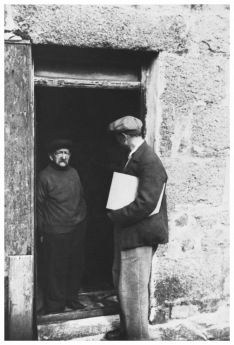
    Meeting: Alfred Wallis and Ben Nicholson (Tate)
    Meeting: Alfred Wallis and Ben Nicholson (Tate)

    In St. Ives in 1928 came another chance meeting of two celebrated twentieth century artists – that of self-taught Cornish fisherman Alfred Wallis (1855 – 1942) and modern favourite, Ben Nicholson (1894 – 1982). This union occurred when Nicholson and a friend, Christopher Wood, came across Wallis’s paintings nailed to a wall beside an old fisherman’s cottage during a visit to the area. Nicholson saw in Wallis’s work what he wanted to achieve in his own – a certain fresh naivety.  Nicholson documented their meeting: “On the way back from Porthmeor Beach, we passed an open door in Back Road West and through it saw some paintings of ships and houses on odd pieces of paper and cardboard nailed up all over the wall, with particularly large nails through the smallest ones. We knocked on the door and inside found Wallis, and the paintings we got from him then were the first he made.”[1]

    Much like Bill Traylor, Wallis is another artist who discovered his creative side later on in life, at the age of 68 after the death of his wife. In his earlier years, it is thought that Wallis went to sea as a fisherman – possibly even from the age of nine. Taking up painting after his retirement from a shop selling salvaged marine goods in St. Ives, Wallis used old torn boxes and ship paints to create his masterpieces.

    In an article authored by Nicholson in 1948, the artist compared Wallis’s style of working to that of Paul Klee:


    “He would cut out the top and bottom of an old cardboard box, and sometimes the four sides, into irregular shapes, using each shape as the key to the movement in a painting, and using the colour and texture of the board as the key to its colour and texture. When the painting was completed, what remained of the original board, a brown, a grey, a white or a green board, sometimes in the sky, sometimes in the sea, or perhaps in a field or a lighthouse, would be as deeply experienced as the remainder of the painting.”[2]

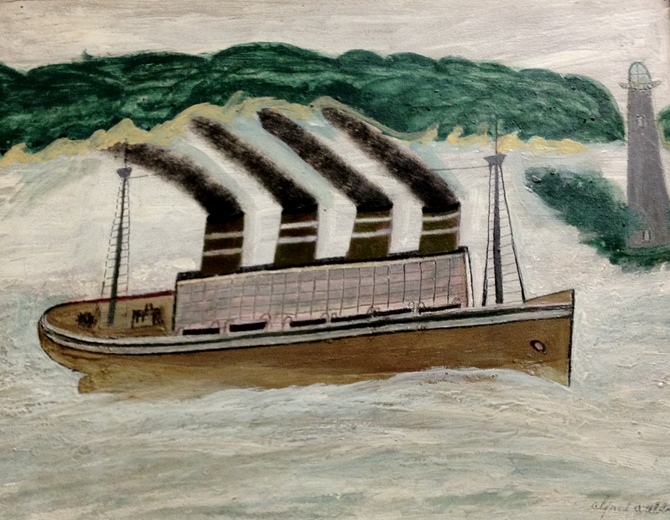
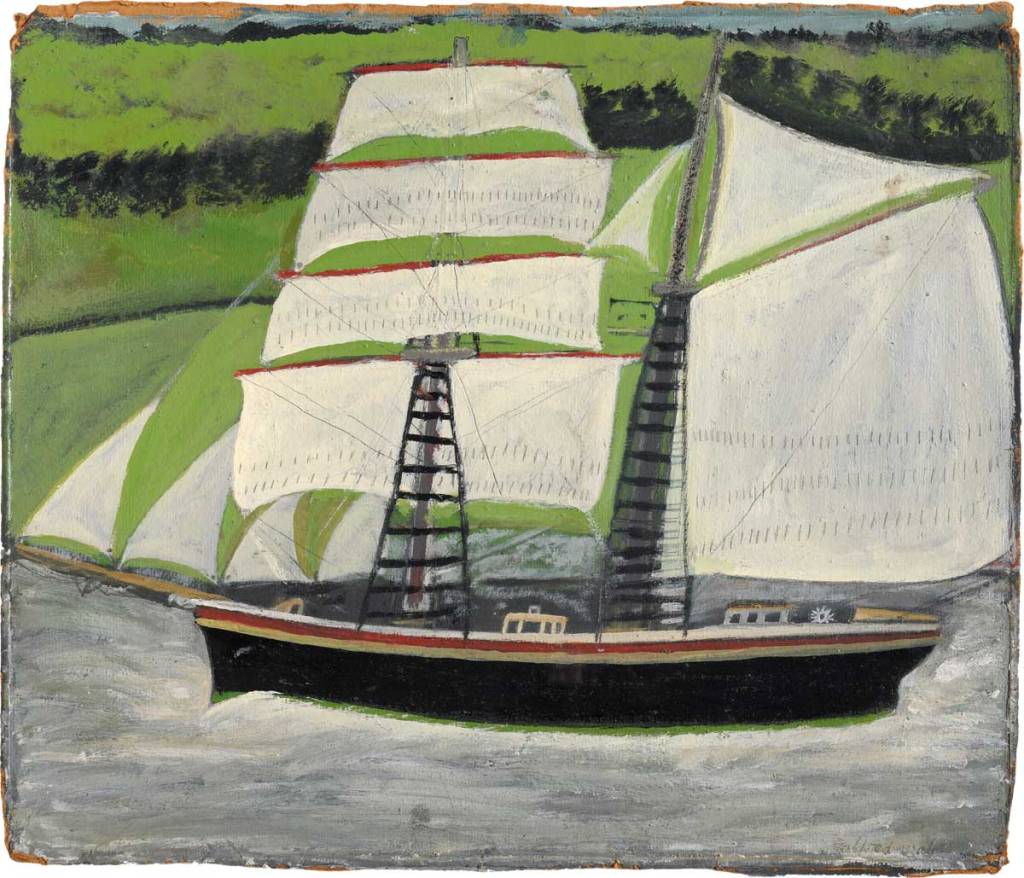
    Wallis’s works are incredibly evocative of what we now see as a self-taught, uninhibited, and untutored style. He largely ignores perspective and often, the objects depicted will vary in size depending on how much importance the artist gave to them.[3]

    Michael Glover, writing for the Independent during a joint exhibition celebrating the works of both Wallis and Nicholson at Compton Verney in 2011, speaks of Nicholson’s behaviour towards the older artist: “He began to patronize the old man, and to buy his paintings for the price of a meal or two. After he returned to his smart home in London, Wallis continues to send him batches, bound up with string and brown paper. Nicholson’s friends bought them too. Wallis began to be lionised a bit by the London avant-garde – Herbert Read and his friends.”[4]

    Nicholson’s interest in Wallis didn’t bring his work great recognition during his lifetime – Wallis continued to live in poverty after the meeting, despite Nicholson’s valiant attempts to promote the self-taught artist’s work and bring it to the attention of the burgeoning modern art scene. We know now, however, that that fateful chance meeting between the two – patronising aside – would in fact set the older artist up to become recognised as one of the most prolific and original 20th Century British artists. His unique ‘primitive’ portrayal of boats and ships provided inspiration to many artists, and his work is undoubtedly considered highly influential in the development of British Modernism.

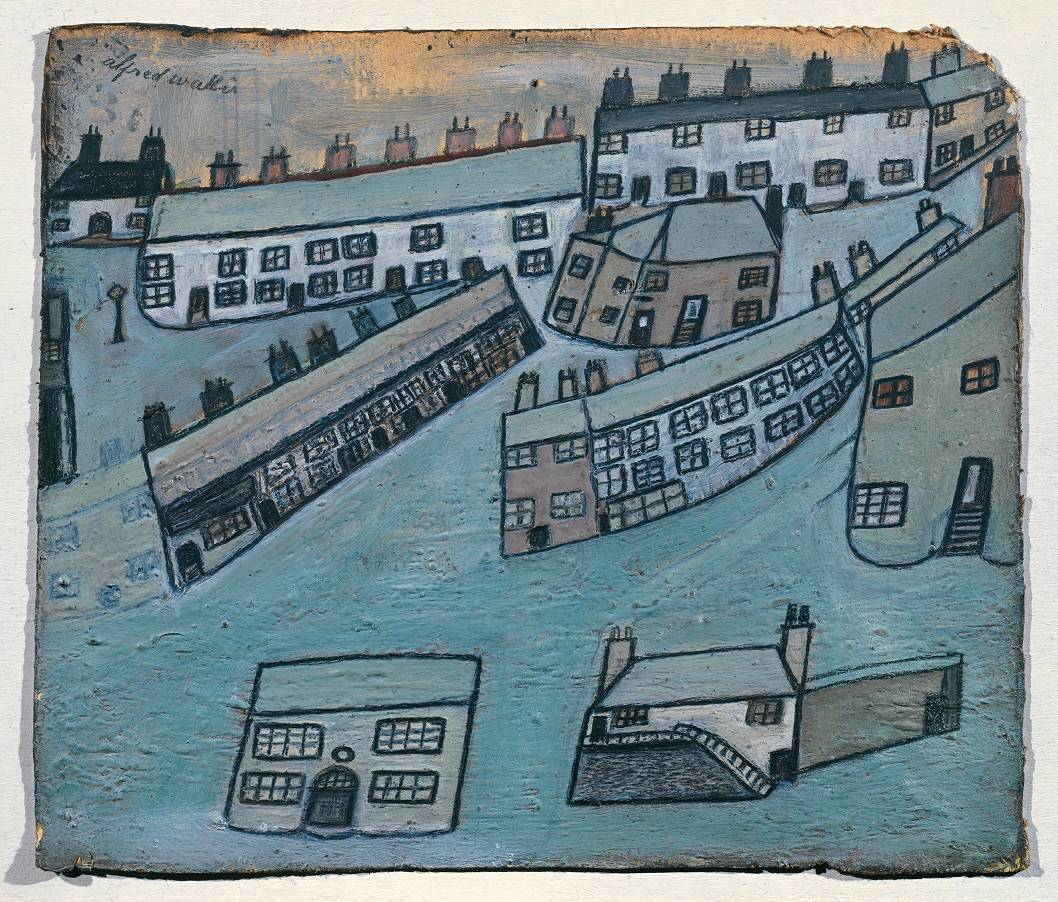
    Alfred Wallis, 'Harbour Scene'
    Alfred Wallis, ‘Harbour Scene’

    Alfred Wallis, 'House at St. Ives'

    Alfred Wallis, ‘House at St. Ives’
    Alfred Wallis, 'The Blue Ship'
    Alfred Wallis, ‘The Blue Ship’
    Alfred Wallis, 'The Steamer'
    Alfred Wallis, ‘The Steamer’

    ‘Relationships’ series:

    #1 Bill Traylor and Charles Shannon

    #2 Alfred Wallis and Ben Nicholson


     References

    [1] Cornwall Calling

    [2] Ben Nicholson, ‘Alfred Wallis’ in Horizon, Vol. VII, No. 37, 1943

    [3] After Alfred Wallis

    [4] Michael Glover, ‘Alfred Wallis and Ben Nicholson, Compton Verney, Warwickshire’ . 31 March 2011 [Available Online]

  • Relationships: Bill Traylor and Charles Shannon

    Relationships: Bill Traylor and Charles Shannon

    ‘Outsider art’ in the traditional sense – i.e. Jean Dubuffet’s description – alludes to an isolated artist, working on the periphery of the mainstream art world. Contrary to this controversial belief, many of the most notable ‘outsider artists’ of the twentieth century were supported, encouraged and ‘outed’ by some of the most famous ‘mainstream’ artists of the same century. This series of blog posts will highlight a few of these relationships, in the hope of rectifying the general thought that artists that often sit under the umbrella of ‘outsider art’ were completely immune to and separate from the twentieth century ‘mainstream’ art world.  In fact, many of the ‘masters’ of modern art were hugely influenced by these relationships.

    #1 Bill Traylor and Charles Shannon
    #2 Alfred Wallis and Ben Nicholson


    # 1: Bill Traylor and Charles Shannon

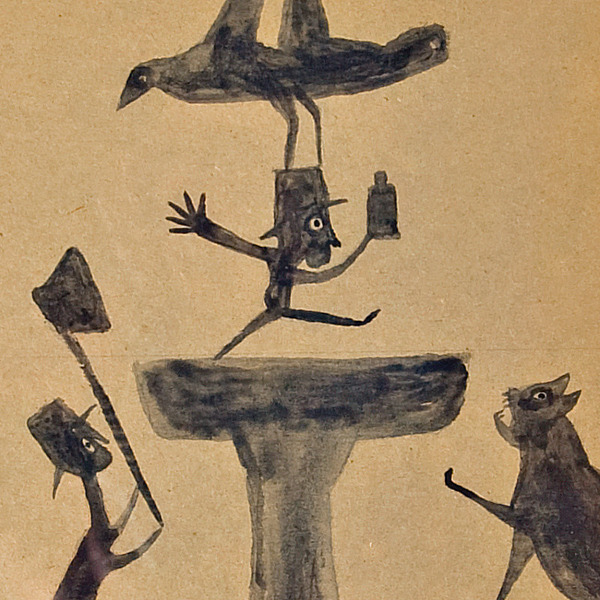
    Born into slavery on a plantation in Alabama, Bill Traylor is perhaps one of the best known self-taught artists of the twentieth century. Working on the plantation he was born onto for many years of his life, Traylor moved to Montgomery in 1928 where he worked as a labourer until he became physically unable to continue. Only beginning to produce art when he was 85 years old, Traylor used mainly modest, everyday materials to create a unique portfolio of his experiences – both past and present. He recorded events from the everyday, of life in Montgomery, which he attempted to sell to passers-by on a sidewalk. It was on this sidewalk that a unique meeting would change the fate of his artistic career.

    Bill Traylor
    Bill Traylor

    Charles Shannon – a painter and teacher – discovered Bill Traylor in 1939, as Traylor was perched on a box, drawing in the street near a fish market in his native Montgomery. Shannon supported the artist financially, and provided Traylor with materials as well as his first exhibiting opportunity at the New South Gallery in 1940. Despite full recognition of Traylor’s career as an artist not occurring until the 1980s (long after his death in 1947), Shannon is credited as having contributed significantly to the artist’s support network and therefore his later recognition.

    Shannon was fascinated by the seemingly innate creativity that Traylor had discovered at such a late stage in his life, despite having never drawn or even been able to write beforehand. Shannon, in his article ‘Bill Traylor’s Triumph’, published in Art and Antiques in 1988, speaks of his experience of Traylor as an artist: “He worked all day; some evenings I would drop by around ten o’clock and he would still be there, his drawing board in his lap, a brush in his hand. He was calm and right with himself, beautiful to see.”[1]

    Bill Traylor
    Bill Traylor

    Traylor was not known for talking about his work, but Shannon noted that he talked almost continuously whilst he worked – but, regretfully, he only recorded a very small number of these comments: “Now, I sometimes wish that I had [asked him questions]. I only knew what he volunteered to tell me.”[2]

    After Traylor’s death in 1949, Shannon continued to be an advocate for his work despite the lack of public attention and interest. Many members of Traylor’s family in fact had no idea that he had been an artist, they were not aware of Shannon’s support of the artist, and they were not aware that it was Shannon who had saved his work. It wasn’t until 1979 that Shannon – in possession of 1200 – 1500 works by the self-taught artist – managed to secure an exhibition at the R. H. Oosterom Gallery in New York. Today, Traylor’s work is often considered as an important part of the development of twentieth century art – despite the Museum of Modern Art, NY, offering Shannon one dollar per piece in 1942; something the advocate was incensed by, returning the cheque and taking back possession of the works himself.

    In 1986, when Michael Bonsteel asked Shannon what he thought made Traylor’s work great, he responded: “What made his work great is like trying to answer ‘what is grass?’ The rhythm, the interesting shapes, the composition, the endless inventiveness – it all reflects such a wonderful joy of living. His whole sense of life comes through. It was just the man. I think he was a great man. It’s not so much how he depicted or what he did. It was just the soul of the man.”[3]

    Bill Traylor
    Bill Traylor

    ‘Relationships’ series:

    #1 Bill Traylor and Charles Shannon

    #2 Alfred Wallis and Ben Nicholson


     References:

    [1] Charles Shannon, ‘Bill Traylor’s Triumph,’ in Art and Antiques, 1988, p 88.

    [2] Mechal Sobel, Painting a Hidden Life: The Art of Bill Traylor, (Louisiana State University Press, 2009), p. 6

    [3] Op. Cit., p 130

    General References:

    New York Times

    Petullo Art Collection

    High