Category: Prison Art

  • Julio Cesar Osorio: Communicating from the Subconscious

    Julio Cesar Osorio: Communicating from the Subconscious

    In light of his two current exhibitions in London, Julio Cesar Osorio talks about finding inspiration in the darkest of places and his want to portray his own unique journey, inviting the viewer to jump in and join him – not unquestioningly – on his travels to a more vibrant world.


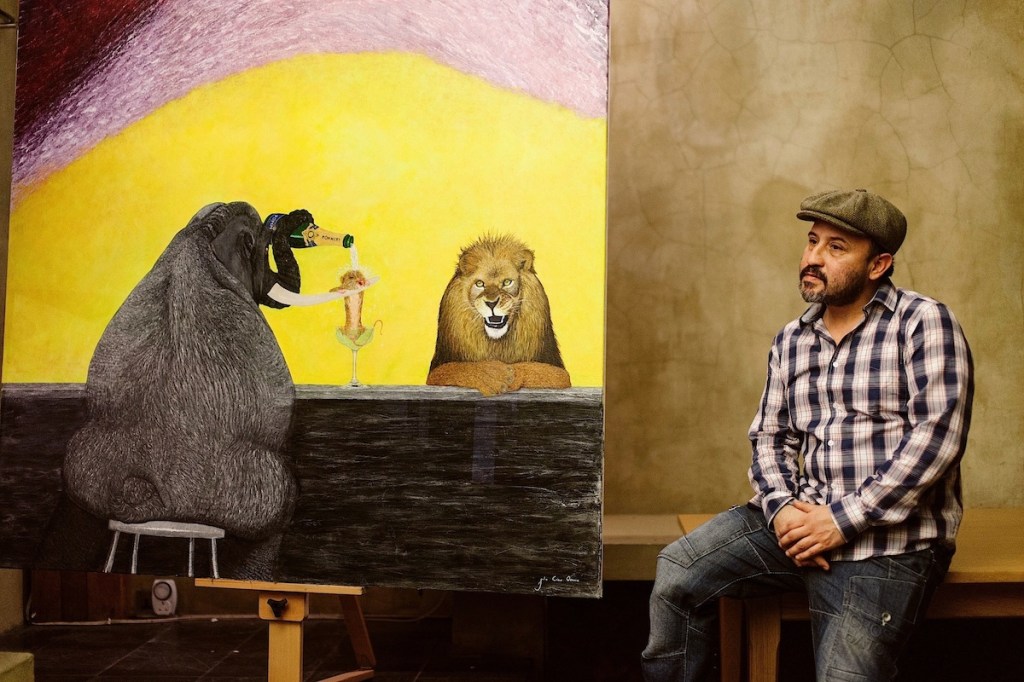
    Elephant final web
    Elephant

    When did you first start making art?

    Looking back at my life I can honestly say that I have always been very analytical about my surroundings. I have always looked for the beauty within things; even at a microscopic level, like when I looked at an onion skin under a microscope for the first time in biology class and thought that the shapes and patterns looked lovely. I have always visually admired things, but it wasn’t really until I landed in prison that I took up art. From the word go I was over taken by the therapeutic power of painting; it became my passion and provided an escape from where I was.

    What originally inspired you, and what inspires you now?

    I did a degree in photography and digital imaging 15 years ago and during that time Dali became my inspiration to create surreal work; to carve one’s own story to illustrate what’s on one’s mind. This was exactly what I did when I discovered that I could paint in prison. This would be the tool I would use to create – even in the environment I was in.

    To this day, surrealism has been the genre I have chosen to work in and a surrealist is the type of artist I wish to be classed as.

    Lionpotrait w
    Julio with his Lion Portrait

    What is your process – from starting to finishing? How long does it take?

    I write down ideas or do small sketches of what the idea involves, and then look for relevant imagery; photos, magazine cuttings, etc., that I think might work in my painting and then I’ll start by painting the background. Then I’ll move on to sketch the subject matter, making sure it’s all in the ideal place and when I’m happy with the layout, I’ll go on to paint them.

    Each piece has varied in the time it’s taken to produce. Most of my work was produced in prison, where I became so prolific that I would work at least 10 hours a day seven day a week. As a result, I would produce at least two pieces a month. Since my release in September 2013, I have only produced one 190 x 190cm painting completed over a period of one year.

    What do you hope viewers get from your work?

    I produced all of my work and honed my skills in prison. I used the medium of painting to transport my mind with the goal of taking the viewer on my journey, encouraging them to place themselves in the work, to read and question all the thoughts and feeling that I used in every one of my pieces.
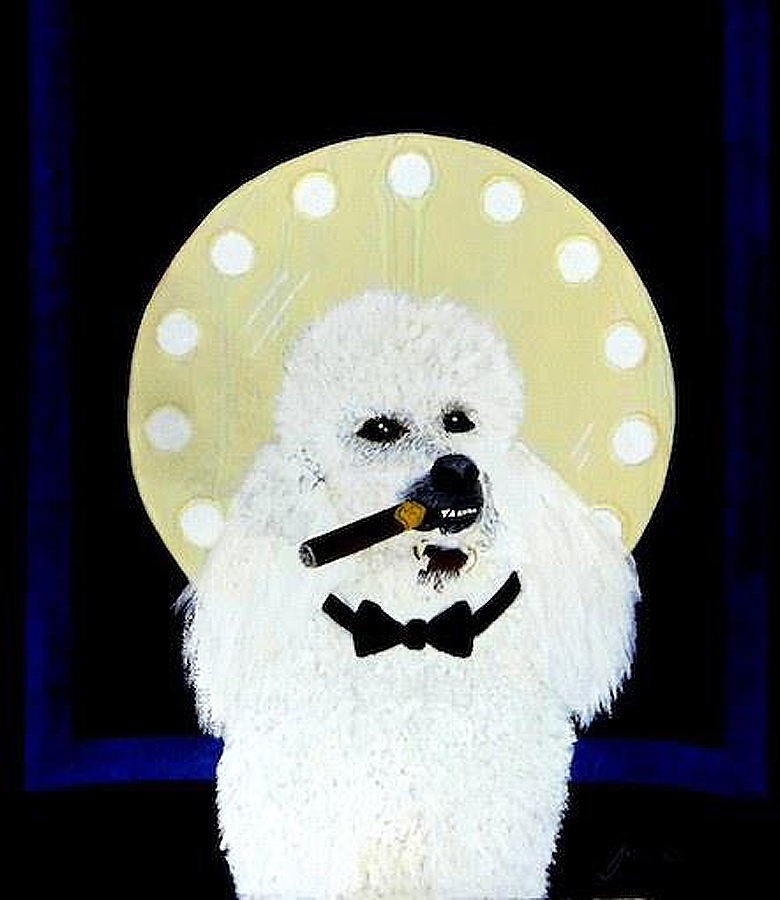
    Fat dog
    Fat Dog

    What are you working on at the moment?

    At present I am working on promoting my work and my name through social media, and I am preparing a marketing strategy to generate sales.
    I am also working on a series of photographs that I have of body painting on females. I am adding paint to these so they become mixed media pieces.

    Tell us a bit about your current exhibitions?

    At present I have got two exhibitions running concurrently in two different parts of London looking at two different themes.


    See Julio Cesar Osorio’s work in London…


    The Communication of Colours from a Very Dull Place

    Until 31st January at Coffee Wake Cup, 14 Clapham Park Road, London, SW4 7BB. Open daily from 7am – 7pm.

    Concentrating on the use of colours in the works on display and how Julio used them vibrantly whilst in prison; a very dark and dull environment. Julio wanted to show the polar opposite of what he was experiencing at the time.

    The Artist’s Subconscious

    Until 31st January at Freud Bar/Gallery, 198 Shaftesbury Avenue, London, WC2H 8JL.
    “The liberty of the individual is no gift of civilisation. It was greatest before there was any civilisation.” – Sigmund Freud.
    This exhibition concentrates on Julio’s works that evolved from his inner thoughts during his time in prison.

  • Process Vs. Product in Creative Practice

    Process Vs. Product in Creative Practice

    Recently, I have been considering the importance of process and product with reference to art making. Is the process of making the art the most important thing for the artist, or is there something equally as important in having this work shown to the public – whether this is an exhibition, a performance or a publication? Would some, perhaps, even say this public exposure is more important? I am talking in this post about all artists and creative practitioners.

    I’m of the opinion that having work exhibited (or performed, or published) is an important part of any artists’ creative practice. It provides the opportunity for the artist to have a voice in the world, and increases their feeling of self-worth. I do, however, have absolutely no doubt about the importance of the creative process – for Outsider Artists; for all artists. For everybody. It allows self-exploration, self-expression, communication and so much more. But, I am interested to know the impact exhibiting has on an artist. As a writer (although not a creative writer), I find that having work published helps me think I am doing something right. This is not to say that if I didn’t have work published, I would cease writing – as this is certainly not the case; I would write regardless of whether anyone was taking a blind bit of notice.  But it encourages me to write more, particularly for this blog, where I have an interested following. Publication also means my work can be seen by a wider audience and that means my voice is being shared with more people.

    Mr Imagination
    Mr Imagination

    Having conducted some research into the subject, I have found that most of the literature on the process versus product idea comes from art therapy schools. As art therapy is not something I am going to discuss in this article, I am taking process to mean the action of creating art (often a very therapeutic undertaking), and I am taking product to mean an exhibition, performance or publication which means the work created can be accessed by the general public.

    My decision to write on this topic came about somewhat from bits of my current work. Specifically, looking at the impact a publicly-accessible product can have on offenders and ex-offenders. I think this group highlights my point most succinctly. If works by offenders and ex-offenders – a notoriously stigmatised and marginalised group – can be experienced by the average passer-by, this can have an overwhelming impact on their self-image and, fundamentally, their personal journey towards rehabilitation. Having work displayed/published/performed in a ‘space’ dedicated to the arts means they have a legitimate place in society, and a new ‘label’ (despite my disdain for labels) that is profoundly less negative than the one that society has previously given them. For prisoners, having work and feedback from those ‘on the outside’, can provide links with the community and a huge surge in self-worth: they see themselves as worthy of having their work seen by society.

    This is not to say that we still need to think about the ethics of displaying work by Outsider Artists – or any artists for that matter. We must still ensure we are always working towards an ethically considered way of approaching the curation of art by vulnerable people. For more on this, you may like to have a browse through the ‘Curatorial Questions’ section of the blog.

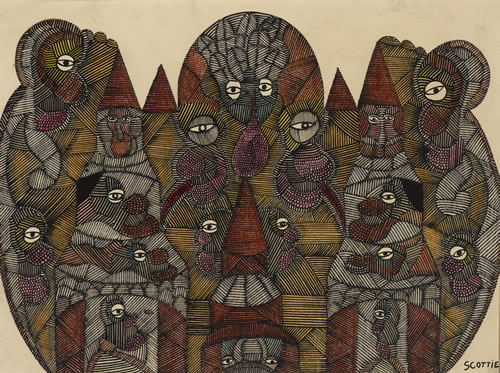
    Scottie Wilson, Greedies
    Scottie Wilson, Greedies

    I think the internet has certainly had a large part to play in the ‘product’ side of the argument. Now, artists, writers, performers, etc., can upload their work to a website or a blog for the world to see. It is not so dependent on having an exhibition in a sought after location, or having your book published by a well-known publishing house. Perhaps there are artists out there who prior to the internet may not have considered ever having their work seen (perhaps due to a lack of opportunity or luck in the art world), who are now able to share what they are doing with a wider audience. But this, I think, is a technological tangent, albeit an interesting one that I might explore further in future.

    Anyway, I think I have said as much as I can, and now it’s over to you. I would be very interested to hear from artists about their thoughts on this subject. Does exhibiting/performing your work provide something extra outside of the creative process? Is feedback important? Is sharing your voice and your thoughts a vital part of your practice?

    Please do comment below, write to me on Twitter: @kd_outsiderart, or if you would prefer, send me an email: kdoutsiderart@yahoo.com. Looking forward to hearing your thoughts!

  • Outsider Art.. or ‘Inside’ Art: January Thoughts

    Outsider Art.. or ‘Inside’ Art: January Thoughts

    Above image: Henry Darger


    Happy New Year everyone – I hope you are all enjoying what 2014 has had to offer so far. I thought I would do a bit of an off the cuff ‘rambling’ blog post talking about a couple of ideas I have recently had relating to the term ‘outsider art’. Hopefully you will share your ideas and opinions on these below.

    The festive period brought a bit of a break from blogging and the art world in general, so, as I rekindled old and started new conversations about ‘outsider art’ in the new year, I had some fresh ideas that I wanted to share with you. The first came to me earlier in the week, when I was thinking about how I would now – two years on from starting the blog – describe the term ‘outsider art.’ This is an art that categorically comes from within, an art that (according to Dubuffet) isn’t influenced by art history or external factors. Despite my absolute disagreement with this idea of Dubuffet’s, I do believe that one of the reasons I am so drawn to ‘outsider art’ is because it epitomises raw communication from the heart and soul. Why then, do we call it ‘outsider art’ – shouldn’t it be ‘inside art’ or ‘art from within’? It seems absurd to me, as someone who enjoys using words, that the term itself should be so contradictory to the work caught beneath this umbrella.

    Often, when I tell people that I write about ‘outsider art’, they’ll ask: “Is that open-air art?” Hmm, it would make sense, wouldn’t it? I think someone also shared this opinion on BBC Imagine’s recent programme dedicated to ‘outsider art’; ‘Turning the Art World Inside Out’ (I think you can still catch it here on Youtube). So why, I wonder, can’t we give it a more deserving, fitting, and altogether less controversial name? ‘Art from within’ or ‘Inside’ art might go some of the way to distilling visions of the ‘societal outsider’ and alleviate the current separation between ‘outsider art’ and the ‘mainstream’ art world. Or, to play devil’s advocate, do we even need a label at all? I’m not so sure any more… Let me know what you think.

    Bill Traylor
    Bill Traylor

    The second thing I wanted to write about stems from a conversation I had on a recent visit to a prison. I was asked how artists who are also offenders or ex-offenders could ever shake the label of being an offender or an ex-offender if they are continuously associated with organisations who are known to work with these groups. This is something I have thought about previously, but to have someone who is potentially in that position to voice their concerns made me re-evaluate its importance. I know a lot of fantastic organisations working with ‘marginalised’ groups, but I wonder if perhaps there is something in this idea that people don’t want to be associated with their past or known by one label that doesn’t encompass everything they are or can be. For example, if art is marketed as ‘offender art’, does that mean the creator’s image is tainted; that they are not seen simply as an artist working within the art world?

    I have always wanted ‘outsider art’ to be exhibited and publicised in a way that eliminates in-depth biographies, and instead just focusses on the art as a captivating piece of work created by a talented individual. There are plenty of organisations operating across the country that do a fantastic job in supporting artists who are perhaps facing barriers to the ‘mainstream’ art world for whatever reason, and I think that these charities and groups are undoubtedly needed; in particular to encourage and nurture an artist’s first steps into, or a return to, the art world. The conversation in the prison concluded with a suggested solution that these organisations are invaluable as a springboard towards a career as an artist. By becoming an artist unwanted labels can be lost; replaced, if necessary, with more favourable and accurate ones.

    I would really value and appreciate your ideas on either of these thoughts, so please post any comments below. Happy New Year!

  • Art by Offenders: Strength, Vulnerability, and Forgiveness

    Art by Offenders: Strength, Vulnerability, and Forgiveness

    Above image: Lost Fruit | Thornford Park Hospital, The Tolkien Trust Silver Award for Drawing


    The Koestler Trust’s sixth annual UK showcase this year takes the form of ‘The Strength and Vulnerability Bunker’, curated by Mercury prize-winning rapper, Speech Debelle. The national exhibition, which is moulded yearly by a different group or individual, displays work by prisoners, offenders on community sentences, secure mental health patients and immigration detainees. 

    This year’s theme – the relationship between strength and vulnerability – was chosen as it threads together the work on display with Debelle’s music. Debelle’s political interventions (which include three albums pinpointing areas of social justice and injustice), make her the perfect candidate to provide a voice for those whose lives are being transformed by the power of art.


    “The Koestler Awards represent an injection of creativity, humanity and empowerment into the closed world of prisons” – Stephen Shaw, Prisons and Probation Ombudsman.

    This year’s exhibition has some strong, undeniably prison-centric, work. ‘Untitled’ by Patrick from HMP Leeds starkly shows the divide between the inside and outside. In it, a figure looks solemnly (although this is only an assumption, as all we can see is the back of his head) through the bars of what we can ascertain to be his cell. On the ‘outside’, skyscrapers loom above luscious green trees and two magpies – which symbolise joy in the well-known rhyme – perch on the prison boundary. There are, however, signs of life and hope within the confines of this prisoner’s cell. A butterfly rests on an arm, and two ladybirds and a spider scale the inside of the bars.

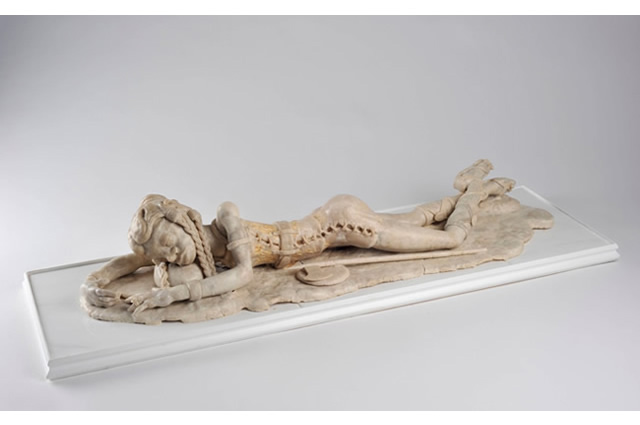
    Sleeping Brunnhilde | Derbyshire Probation Service, The Anne Peaker Platinum Award for Sculpture
    Sleeping Brunnhilde | Derbyshire Probation Service, The Anne Peaker Platinum Award for Sculpture

    ‘Not of the World’, by an inmate at HM Prison Cookham Wood, reflects “how far away the earth is when you’re locked up. Also, how far anything and anyone are from your reach in jail.” These are the artist’s own words. In the piece, a figure, plagued by darkness, looks longingly (again, maybe my assumption) towards the whole of the earth which sits uncomfortably out of reach on the horizon line.

    These two pieces quite obviously describe feelings of isolation, incarceration, and the loss of freedom. But there are more subtle pieces. ‘First Hour’, by an artist from Prison Littlehey and made entirely from chicken bones and glue, represents the feelings of a prisoner during the first hour of being ‘inside.’ Crouched over, the perfectly executed figure is both strong and incredibly vulnerable at the same time. Single chicken bones are extremely robust, but put them together as has been done with this sculpture, and they are fragile; the piece could topple or crack at any moment.

    The Dancers | HMP Brixton, The Patrick Holmes Platinum Award for Oil or Acrylic
    The Dancers | HMP Brixton, The Patrick Holmes Platinum Award for Oil or Acrylic

    Similarly to ‘First Hour’, other works on display are made out of any material that the artists could get their hands on. ‘Escape with a Book’, by an artist at HM Prison and Young Offender Institution Exeter is made entirely from soap, with the hands stained using tea bags. It was probably carved, as suggested by the exhibition host (an ex-offender employed to enhance the audience’s experience whilst gaining CV building skills), using a smuggled razor blade – something which makes it all the more intriguing. The artist was prepared to create this piece regardless of the rules.  ‘Sleeping Brunnhilde’,  by an artist from the Derbyshire Probation Service, was created using bread and PVA glue; such simple materials.

    The works on display were chosen from more than 7000 pieces of art created by prisoners, secure patients and immigration detainees, and each and everyone follows a personal journey reflecting on the meaning of both strength and vulnerability. The arts have been proven, more so in recent years, to be an incredibly effective way of engaging with offenders who are feeling isolated or alienated from mainstream education and employment.

    Creativity flourishes in prisons, more so than in any other institution; perhaps as a result of the physical incarceration.  This exhibition provides an opportunity for the artists to have their talents showcased, and is an example of how prisoners work through their feelings – in this instance strength, vulnerability and forgiveness – as part of their rehabilitation. Creativity and self-expression can often be the key to increasing self-esteem and self-efficacy; all proven factors in reducing rates of re-offending. Not to mention, the works in this exhibition are absolutely fantastic to look at – these artists are incredibly talented. Maybe once they have served their sentences, they can shake off that label of ‘prisoner’ ‘convict’ or even ‘ex-criminal’ and ‘ex-offender’ and instead be known more positively as ‘artists.’

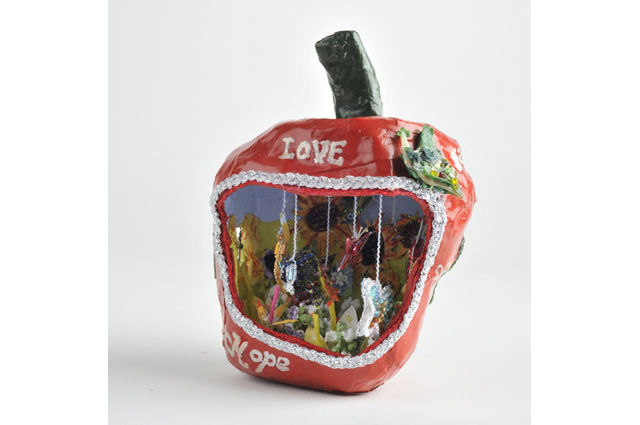
    Garden of Eden, HM Prison Styal, Dalrymple Bronze Award for Sculpture
    Garden of Eden, HM Prison Styal, Dalrymple Bronze Award for Sculpture

    The exhibition is running until 1 December at the Southbank Centre, London. Click here for opening times and other information. 


    Exhibited artists on what the words ‘strength’ and ‘vulnerability’ mean to them

    “Without strength, you can’t go on. Without vulnerability, you can’t grow as a person. “

    “Being able to take a ‘warts and all’ look at myself through art does leave me feeling vulnerable to emotions I’ve closed off for years. However, I feel I’m in a safe environment with supportive peers and tutors. That is the strength of art.”

    “Strength means to me, someone who keeps going and keeps trying, no matter what obstacles they may face. Vulnerability means to me, someone who is human. Everyone is vulnerable and we all deal with it every day.”


    More information


  • Diego Samper – Panopticon

    Diego Samper – Panopticon

    In 2003, Diego Samper was given the opportunity to tour a recently closed 120 year old Columbian prison in the town of Ibague, which was based on the idea of the British Panopticon prison; as its design allowed for increased surveillance and enabled hidden jailers to see every cell from a single position. The building itself housed political prisoners in the late nineteenth century.

    The prisoners who were incarcerated within this jail were allowed to freely express themselves on the walls of their cells; the idea being that they could create their own ‘space.’

    Within the confines of the Ibague jail, prisoners seeking subjective freedom and solace, protested and expressed their opposition by richly decorating every surface. They deluged the prison with flowers, stars, saints, birds, fishes, mermaids and peacocks. The captive population asserted the significance of decoration for the soul in opposition to the machine aesthetic stripped down by the philosophy of modernism.[1]

    On his visit, Samper may have anticipated hard core pornography, but apart from the representation of a few nude females, the art was predominantly religious, or based on the idea of freedom. He was surprised by the vividness of colour used – he even claimed to have only taken a black and white film, on the assumption that the works would all be muted greys. [2]

    Samper photographed many of the works he encountered, realising that they were evidence of the abundant freedom that our own imagination can bestow upon us. In a place of isolation and incarceration, many of the prisoners sought out solace and salvation through religion, or indeed simply the momentary experience of freedom through their own creativity.

    Fascinated by the idea of increased surveillance and how it is in human nature to express or seek freedom even in the most hopeless states of oppression, Samper used 80 of the images to create a film entitled Panopticon, which is described as “a kind of visual dreamy sequence that occasionally turns into a nightmare.” [3]

    The film journeys through a rich visual underworld of prisoner art and psychology and through it, reveals aspects of contemporary Columbian social and political realities. [4]

    The idea of the Panopticon design itself has perhaps come to be a representation of the modern, technological world we now live in. With CCTV cameras around every corner, the average person can expect to be captured between 70 and 300 times per day in the UK. There is the feeling of a general global loss of freedom. Samper’s film is an evidential example of the freedom and escape that our own imagination and creativity can give us; particularly in today’s world where the margins of freedom, privacy and escape are becoming increasingly narrow.

    References:

    [1] from Notes Concerning the Panopticon, by Geoffrey Smedley, available online at: http://www.diegosamper.com/panopticonEn.html

    [2] http://www.coastreporter.net/article/20120615/SECHELT0501/306159998/-1/sechelt/prison-art-in-samper-film

    [3] http://www.coastreporter.net/article/20120615/SECHELT0501/306159998/-1/sechelt/prison-art-in-samper-film

    [4] http://www.diegosamper.com/panopticonEn.html

    FOR MORE INFORMATION ON DIEGO SAMPER’S WORK, PLEASE VISIT: www.diegosamper.com

  • ‘Insider Art’: The Work of Artists in Prison

    ‘Insider Art’: The Work of Artists in Prison

    Matthew Meadows’ book entitled ‘Insider Art’ looks at the rise in art made by prisoners and how this work has come to take a prominent place within the contemporary art world. Grayson Perry writes the foreword for the book, in which he notes that in this ‘Insider Art’ he sees “the basic human desire to make something tangible out of thoughts and feelings.” [1] These works remind Perry of where he came from and are a sobering reminder that perhaps at one point in his life he could have taken a “darker turn” but instead he chose art; much as many of these prisoners who create this ‘Insider Art’ have done, but perhaps a little later than Perry did.

    I’m an artist, and it’s a passion which burns with me to the point that it hurts. I am self-taught through books and many a long night and a short pencil. [2]

    This statement highlighted by Meadows in his first chapter is written by an inmate at HMP Wealstun. In the UK in 2009, 90,000 men and women were in custody, on remand sentenced or detained; 3,000 of which were young people. But why is ‘Insider Art’ so popular?

    Meadows argues that the “risk taking and rule breaking” appear within some of these works and that we “respond to its conviction, originality and often compelling content.” [3] In recent years, we have seen the establishment of prison arts charities; one of the most predominant being The Koestler Trust which was founded in 1962 by Arthur Koestler. In the USA, ‘Insider Art’ has established a market for itself both online and within galleries and in Holland, plans are in place to open a permanent collection of prison art from Europe in an unused prison building.

    Meadows also broaches the subject of victim responses to the exhibition and promotion of work created by those incarcerated in prisons across the world. Kelly Flyn of Victim Support claims that there is no unanimous thought held by victims:

    Victims’ views are extremely diverse and range from lifelong anger to total disinterest and feelings are likely to change over time. Therefore it’s just not possible to be able to say what victims might or might not think of prisoners’ art – there would be those who’d think it outrageous that prisons provide art courses, those who have no view one way or another, and those who’d say it’s a good idea. [4]

    It is a very sensitive subject. When the artist of a very well-known piece of art hanging in the Royal Festival Hall was revealed to be a child murderer and sex offender serving a life sentence, many were outraged that he was able to exhibit his work and even earn money from it. After much protestation, his work was removed from the gallery and the Royal Festival Hall issued a formal apology to the families of his victims.

    It can be difficult for people in society to see the possible benefit that might come out of exhibiting ‘Insider Art’. An article written for the Guardian in 2007 entitled ‘Arts in Prison Can Bring Hope to Broken Lives’ claims that whilst there is no excuse for committing crime or causing harm, “it’s usually the case that those who do behave badly towards others lack any real sense of self-worth or self-respect. And people who do not feel good about themselves are hardly likely to feel empathy or consideration for others.” [5] Creative activity in itself considerably aids personal development and it can bring hope or meaning to “broken, dysfunctional lives.” [6] A lot of people who begin creating art, or undertaking any creative activity, in the prison environment often have not had any experience of it beforehand. The opportunity for them to try such things can have spectacular results.

    Stretch, like The Koestler Trust, is another charity that aims to bring art into prisons. Recognising that art galleries and museums were out of bounds to prisoners, Stretch established a way to take the museum to the prisoners. They created virtual tours of museums such as the V&A, as well as asking artists to go into the prisons and share their ideas and head workshops with the prisoners. The workshops have even led to prisons gaining work placements on their release.

    Erwin James, author of the Guardian article, closes with:

    Engaging with art can restore confidence and self-worth; it can improve sociability and generate aspiration. Art and creative activity can be the perfect vehicle for revealing the complexities of the human condition. Prisons should open their doors wide to anyone who wants to promote it, and the government should recognise its value as an effective deterrent to re-offending.

    Afterall, “prisoner lives enhanced bring enhancement to the wider community.” [7]

    References:

    [1] Matthew Meadows, Insider Art, (A & C, 2010) p 8

    [2] Meadows, Insider Art, p 11

    [3] Meadows, Insider Art, p 11

    [4] Meadows, Insider Art, p 12

    [5] http://www.guardian.co.uk/artanddesign/artblog/2007/jul/19/artsinprisoncanbringhope

    [6] http://www.guardian.co.uk/artanddesign/artblog/2007/jul/19/artsinprisoncanbringhope

    [7] http://www.guardian.co.uk/artanddesign/artblog/2007/jul/19/artsinprisoncanbringhope