I am really pleased to be co-leading a new Research Group on behalf of Outside In for Tate and the Paul Mellon Centre’s British Art Network. The Research Groups typically run for one year, and offer an opportunity for an in depth focus on a particular part of British art history, providing new perspectives and new ways of engaging academically and curatorially with often overlooked areas of history. I am delighted to be co-leading this group with Jo Doll, an Outside In artist and Ambassador, and participant in Heritage Lottery Funded New Dialogues project.
From 4th – 6th May 2018, Outside In is hosting the European Outsider Art Association (EOA) conference at Pallant House Gallery, Chichester. This year’s conference focuses on ‘the Artist’s Voice,’ celebrating the work of excluded and non-traditional artists and sharing best practice in the field through a series of presentations, key note speeches, and workshops delivered by artists and practitioners.
Bobby Baker’s Diary Drawings, Mental Illness and Me, 1997 – 2008, Day 579 Cathedral of the Mind. Image Andrew Whittuck, 2009
The keynote speech to open the conference will be delivered by multi-disciplinary British artist Bobby Baker, and panel discussions during the conference will focus on ‘supporting the artist’s voice’ and ‘exhibiting the artist’s voice.’ Presenters at the conference include the Living Museum (the Netherlands), Out By Art (Sweden), Venture Arts (UK), Joy of Sound (UK) and Look Kloser (UK). Panellists will include Garvald Artists (Scotland), Headway East London (UK), Arts Project Australia (Australia), Blue Circus (Finland), Creahm/MadMusee (Belgium), and Creative Minds (UK). In addition to all of this, there are dedicated slots for artist presentations that will be happening throughout the conference.
There will also be an opportunity to find out more about the work of Outside In through presentations from director Marc Steene, and by taking part in creative workshops and tours led by Outside In artists. The conference will run alongside a new exhibition of work by renowned outsider artist Scottie Wilson at Pallant House Gallery, which in turn will be accompanied by a special commissioned work by an Outside In artist in response to Wilson’s practice.
In the run up to the conference (2nd and 3rd May), you can join a VIP programme of activities that will include trips to Bethlem Museum of the Mind, ActionSpace, an opening of an Outside In exhibition at Long and Ryle Gallery, an outsider environment in Brighton, and a tour of a renowned collection of modern British and outsider art.
For more information and a full programme of events, please click here.
REDEFINING OUTSIDER ART: LOOKING AT LANGUAGE
AN ONLINE EXHIBITION LOOKING AT THE TERM OUTSIDER ART AND WHAT IT MEANS IN THE 21ST CENTURY
Call out for submissions to an online exhibition focusing on the term outsider art and what it means to YOU as an artist.
Bill Traylor, Brown Mule, 1939 [source: http://www.petulloartcollection.org]kdoutsiderart.com regularly focuses on the ambiguities of the term outsider art and what potential impact it might have on the artists it aims to ‘define.’ In late 2015, I posted a blog that outlined the thoughts of six artists who find themselves housed under this ‘outsider’ umbrella. Following on from this, I’d like to expand this idea, and am inviting artists who might in some way align themselves with the term outsider art to tell me what they think. I’d like to know what you think of the term outsider art, and – if you have an idea – what a better term might be.
I’m looking for responses in a variety of media – using words, images, sculpture, performance, sound – to contribute to an online exhibition challenging the term outsider art. Unlike other conversations around the term, I’d like us to work together to break down the term outsider art and for you to really think about what it means to you as an artist. By providing real-life responses from artists as well as potential alternatives, we can be a positive addition to the continuing conversation.
Submissions Submitted work must be in a digital format – this can be images, a sound or movie file, or a PDF or Word Document. Each artist can submit one piece, and all pieces must be accompanied with a brief description of how it relates to the continuing conversation around outsider art. Please email all submissions to kdoutsiderart@yahoo.com by 1st July 2016.
This post focuses on the relationship between art and catharsis and is a precursor to an exhibition I will be co-curating with Daniella Norton in June/July this year at Now and Again Gallery in Brighton, UK (see below for information on how to submit). The exhibition is currently open for submissions, and we are looking for artists who consider their work to be the result of catharsis or a cathartic act to submit. Catharsis is a term widely recognised to have originated in Aristotle’s work; most notably, his text Poetics. It is, in short, a process that provides relief (often psychological) through the expression of emotions or repressed experiences.
Most writings on catharsis – historical and philosophical – speak of catharsis as a process that affects those experiencing or viewing a work of art or a play (see Aristotle’s writings on catharsis which focus mainly on the act of catharsis taking place for observers of tragedies). For the exhibition, we are taking this one step further (or perhaps one step sideways), and looking predominantly at the aesthetic result of a cathartic act in visual art.
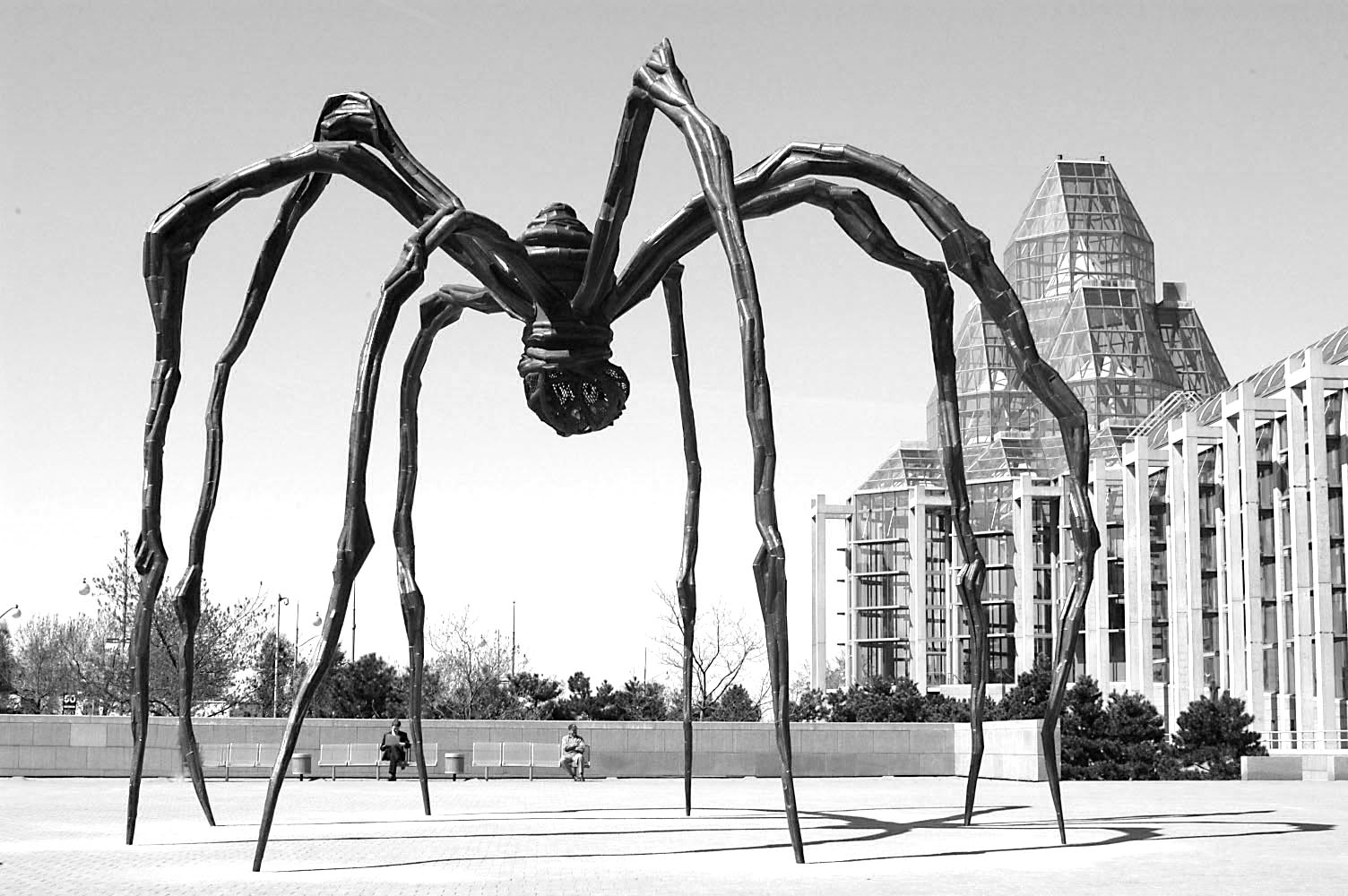
Louise Bourgeois
There is a long history and much research into the cathartic effect of art-making and art as a therapeutic act has long been taken seriously by arts and health professionals. There are many curatorial angles, but with this show our main hope is to highlight how making work that has a cathartic impact is something many artists do regardless of what their ‘commercial’ practice is about, as well as reiterating its equal visual importance. We hope it will also raise other questions – for example, whether a cathartic moment for the artist during the process of making directly translates into an ‘Aristotlean’ response for the viewer – a ‘chain of catharsis.’
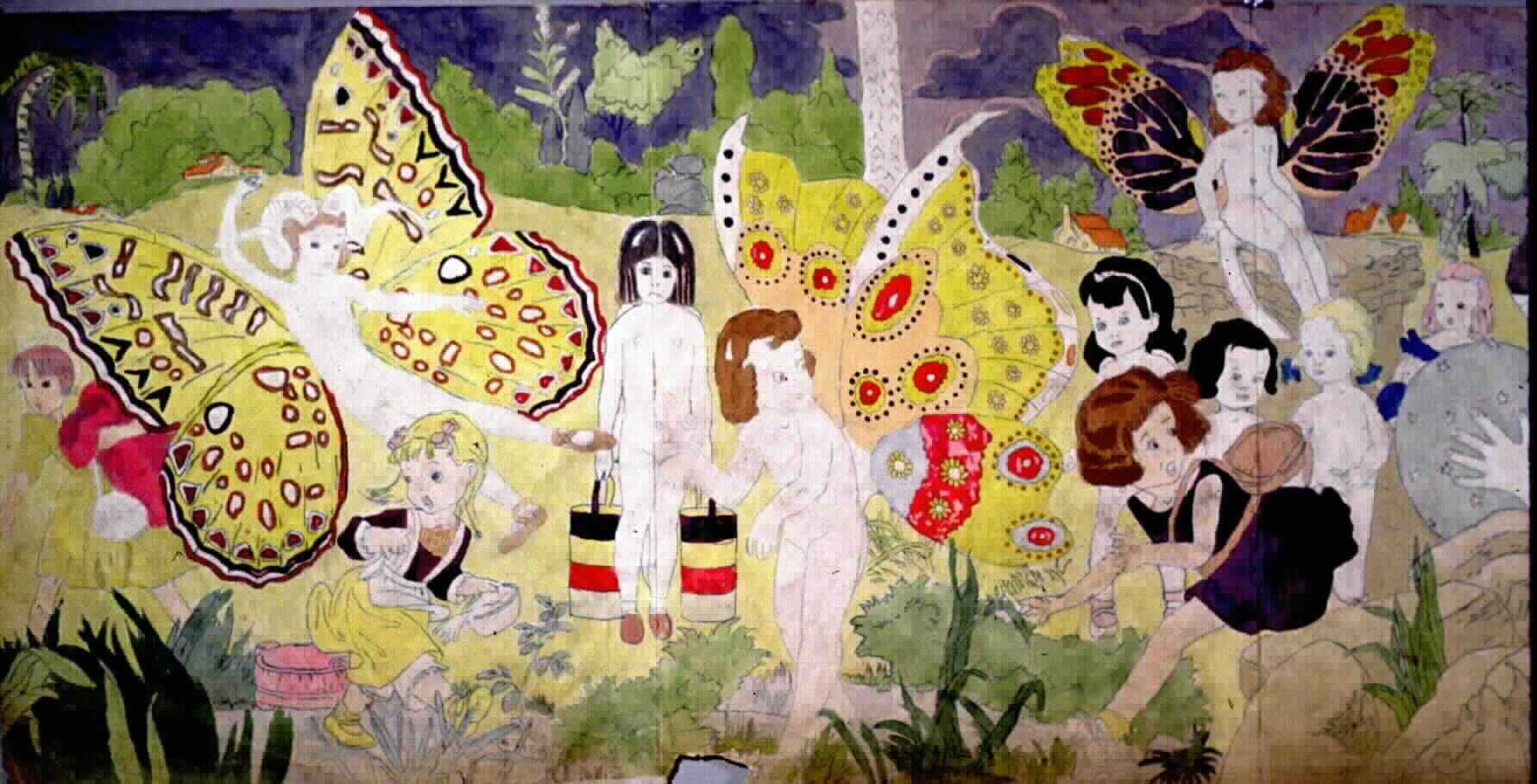
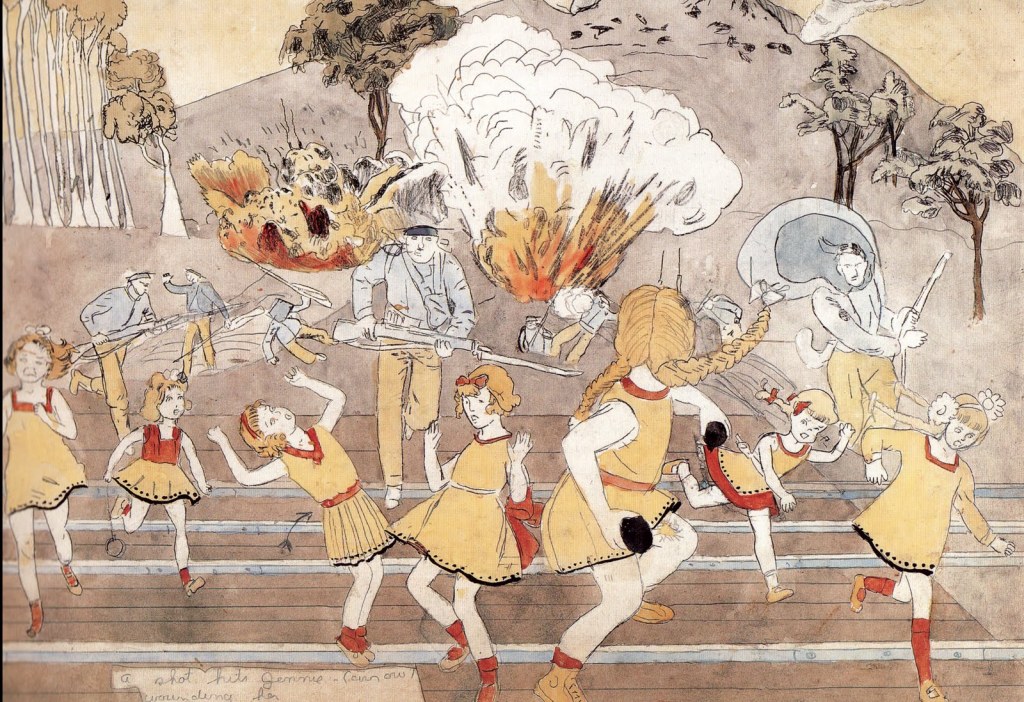
This idea of catharsis is something that links both the ‘mainstream’ art world and the ‘outsider’ art world; in fact, it links all artists, or, to go even further, every human. It is a universal process – and is something that reiterates the widely held belief that every human has the potential to be creative. Many well-known outsider artists did not create with an audience in mind. Henry Darger is a case in point – he never thought his work would be seen by anyone. So why create the vivid world of the Vivien Girls in the Realms of the Unreal for such a long time? Similarly, there are many ‘mainstream’ artists whose work is the result of a cathartic act. Louise Bourgeois’ work was “heavily influenced by traumatic, psychological events from her childhood,” [1] and the artist herself considered her practice to be highly therapeutic or cathartic.
Henry Darger [courtesy of http://www.carlhammergallery.com]Sometimes, it is not the end result that is most important to the artist, but the intangible ‘middle-part’ in which that very end result is created. In this instance, the end result might be discarded, or not looked upon as ‘proper art’ (whatever that is) – or even art. With this exhibition, we want to shine a light on this very important – and interesting – work, because after all, why shouldn’t it have as much precedence as its ‘commercial’ counterpart?
Submissions: an opportunity for artists
The dictionary definition of cathartic is: “providing psychological relief through the open expression of strong emotions.” It is the purging, or evacuation, of feelings and emotions.
Work created as catharsis by artists might differ from their general artistic practice. It might be the work that is created for more personal reasons, the sort of work that is created regardless of whether anyone was ever going to see it or not. Or perhaps the term catharsis covers an artist’s whole practice. Maybe it is a piece that was the result of a powerful reaction to something whether made at the time or a later date.
Perhaps many artists operate in a more ‘Brechtian’ state of unresolved or subverted catharsis, whereby there is no relief or rebalancing through the work at least; they carry on making and making and thinking and thinking. The viewer might leave the piece with unresolved thoughts akin to Brecht’s ‘activated’ audiences. However, this exhibition seeks introspective moments within artistic practice, where for whatever reason, a cathartic practice has taken place.
We are keen to find artists willing to share work that they consider to have been made with some cathartic intent or result. To submit work, please send a jpeg image no larger than 1MB to: daniellacnorton@gmail.com.
Please include: title, materials, dimensions, and state whether the work is framed or unframed. The deadline for submissions is Sunday 26 April 2015. Selected works will need to be delivered to the Gallery in Brighton by Sunday 24 May 2015.
The exhibition will be held in mid-June through to July in Brighton and if your piece is selected you will need to pay the postage/courier costs and insurance to and from the venue. Please get in touch for further details.


![Henry Darger [courtesy of www.carlhammergallery.com]](https://kdoutsiderart.com/wp-content/uploads/2015/03/henry-darger1.jpg)
 KDOA
KDOA 