Category: Curatorial Questions

  • Outsider Art.. or ‘Inside’ Art: January Thoughts

    Outsider Art.. or ‘Inside’ Art: January Thoughts

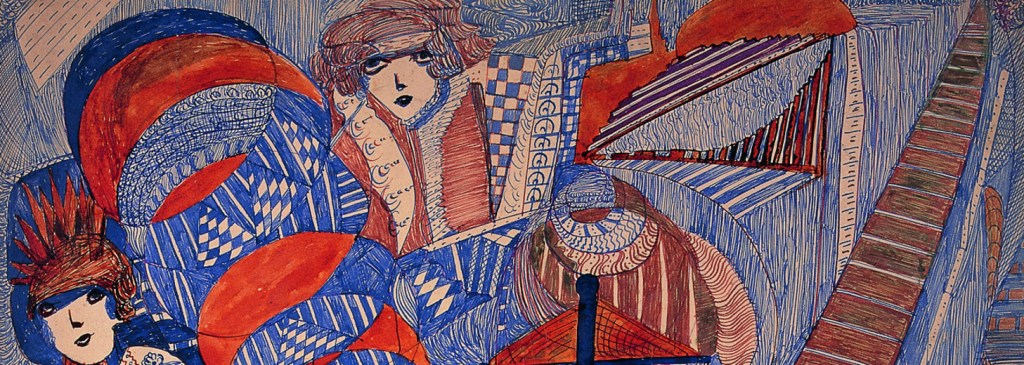
    Above image: Henry Darger


    Happy New Year everyone – I hope you are all enjoying what 2014 has had to offer so far. I thought I would do a bit of an off the cuff ‘rambling’ blog post talking about a couple of ideas I have recently had relating to the term ‘outsider art’. Hopefully you will share your ideas and opinions on these below.

    The festive period brought a bit of a break from blogging and the art world in general, so, as I rekindled old and started new conversations about ‘outsider art’ in the new year, I had some fresh ideas that I wanted to share with you. The first came to me earlier in the week, when I was thinking about how I would now – two years on from starting the blog – describe the term ‘outsider art.’ This is an art that categorically comes from within, an art that (according to Dubuffet) isn’t influenced by art history or external factors. Despite my absolute disagreement with this idea of Dubuffet’s, I do believe that one of the reasons I am so drawn to ‘outsider art’ is because it epitomises raw communication from the heart and soul. Why then, do we call it ‘outsider art’ – shouldn’t it be ‘inside art’ or ‘art from within’? It seems absurd to me, as someone who enjoys using words, that the term itself should be so contradictory to the work caught beneath this umbrella.

    Often, when I tell people that I write about ‘outsider art’, they’ll ask: “Is that open-air art?” Hmm, it would make sense, wouldn’t it? I think someone also shared this opinion on BBC Imagine’s recent programme dedicated to ‘outsider art’; ‘Turning the Art World Inside Out’ (I think you can still catch it here on Youtube). So why, I wonder, can’t we give it a more deserving, fitting, and altogether less controversial name? ‘Art from within’ or ‘Inside’ art might go some of the way to distilling visions of the ‘societal outsider’ and alleviate the current separation between ‘outsider art’ and the ‘mainstream’ art world. Or, to play devil’s advocate, do we even need a label at all? I’m not so sure any more… Let me know what you think.

    Bill Traylor
    Bill Traylor

    The second thing I wanted to write about stems from a conversation I had on a recent visit to a prison. I was asked how artists who are also offenders or ex-offenders could ever shake the label of being an offender or an ex-offender if they are continuously associated with organisations who are known to work with these groups. This is something I have thought about previously, but to have someone who is potentially in that position to voice their concerns made me re-evaluate its importance. I know a lot of fantastic organisations working with ‘marginalised’ groups, but I wonder if perhaps there is something in this idea that people don’t want to be associated with their past or known by one label that doesn’t encompass everything they are or can be. For example, if art is marketed as ‘offender art’, does that mean the creator’s image is tainted; that they are not seen simply as an artist working within the art world?

    I have always wanted ‘outsider art’ to be exhibited and publicised in a way that eliminates in-depth biographies, and instead just focusses on the art as a captivating piece of work created by a talented individual. There are plenty of organisations operating across the country that do a fantastic job in supporting artists who are perhaps facing barriers to the ‘mainstream’ art world for whatever reason, and I think that these charities and groups are undoubtedly needed; in particular to encourage and nurture an artist’s first steps into, or a return to, the art world. The conversation in the prison concluded with a suggested solution that these organisations are invaluable as a springboard towards a career as an artist. By becoming an artist unwanted labels can be lost; replaced, if necessary, with more favourable and accurate ones.

    I would really value and appreciate your ideas on either of these thoughts, so please post any comments below. Happy New Year!
  • Life vs Work: The Dangers of a Biographical Interpretative Approach

    Life vs Work: The Dangers of a Biographical Interpretative Approach

    “The centrality of biography to Outsider Art is not only an integral component of its categorization and valuation, but something which, through autofictional praxis, can be deliberately co-opted as a savvy marketing device, or made to function as a potent mechanism for a critique of the category itself and the foundations on which this particular classification are predicated.”[1] – M. Kjellman-Chapin.

    The above quote by Kjellman-Chapin highlights one of the most prevalent questions surrounding the exhibiting of ‘Outsider Art’; whether the ‘story’ or the artist’s biography should be displayed alongside the work.  Many believe that without the biographical context, we cannot really place works into the ‘Outsider Art’ category. But with a focus on biography, surely we are eliminating the formal and visual elements as the most important parts of the work?

    There has been great controversy surrounding the use of biography with regards to Outsider Art exhibitions; particularly if the biography is not written by the artist. Create, an exhibition which took place in 2011 at the Berkeley Art Museum was a survey of work by 3 local disability-focused arts centres: Creative Growth, the National Institute for Arts and Disability (NAID) and Creativity Explored. The exhibition received great criticism for exacerbating the idea of ‘us’ and ‘them’ with its excessive medical labelling. Lawrence Rinder, co-curator of the exhibition used an abundance of medical language in his interpretation of the works on display. He wanted to put definitive labels on people by making clear the difference between developmental disability and mental illness. Rinder continued to exacerbate the idea of the ‘isolated outsider artist’ by claiming that artists such as Judith Scott created their work from nowhere when in fact, many of the artists would regularly go on museum visits and have access to art books. It seems a little naïve to assume that the artists were cut off completely from the world particularly in the twenty-first century. On a visit in 2012 to the Halle Saint Pierre in Paris, I noticed a similar thing. The artists whose works were on display were all named as ‘anonymous,’ yet a rich biography was provided about them all.

    It is this use of the biography that worries me the most. Not only are the artists’ voices being taken away, they are being given a projected voice from someone who appears to be of higher authority. This is the danger with supplying a biography; even more so perhaps with regards to the sensitive realm of Outsider Art.

    Galleries and curators can sometimes be guilty of playing on the biographical history of an Outsider Artist to raise the status of an exhibition.  Andrea Fritsch has identified an interpretative strategy related to Outsider Art which is based on Pierre Bourdieu’s The Forms of Capital (1986). The approach “offers a framework that allows the economic value of activity outside the realm of normal market transactions to be discussed in economic terms.”[2] More simply, using the term Outsider Art can ascribe artists with a status, or cultural capital, that curators, collectors and other art world insiders can benefit from. By highlighting the biography of the artist more than the art work itself, the work is second to the status of the artist. In essence, the artist becomes the ‘art’, which reduces the worth of the actual work’s formal, stylistic and aesthetic properties.

    Although in some cases it might be apt or relevant to supply an artist’s biography; after all, art is an extremely effective educational tool that can teach us a great deal about social history, it should never overshadow the credit the work itself is due. A patrimonial approach to interpretation, as suggested by Anthony Fitzpatrick in Framing Marginalised Art, is perhaps the way forward. This approach focuses on “fostering relationships with artists grounded in a profound respect for their creative processes and social/cultural environments that inform their work.”[3] This is a technique most commonly employed by community arts organisations who aim to promote the work of Outsider Art because of its intense visual power. They do not, however, ignore the voice of the artist, but instead support the artist in their creative endeavours because of the exploitation they are potentially vulnerable to.


    References

    [1] M. Kjellman-Chapin, Fake Identity, Real Work: Authenticity, Autofiction, and Outsider Art [Available online: http://scholarship.rollins.edu/cgi/viewcontent.cgi?article=1151&context=specs], p 148

    [2] A. Fritsch, ‘Almost There: A Portrait of Peter Anton’, A Journal of Collegiate Anthropology, No. 4, Vol.1, 2012 p 97

    [3] K. Jones et al., Framing Marginalised Art, UoM Custom Book Centre, 2010, p 30

    P. Kuppers, Nothing About Us Without Us: A Disability Arts Exhibit in Berkeley, California, Disability Studies, Vol. 32, No. 1 (2012) [Available online: http://dsq-sds.org/article/view/1733/3041]

  • Accessible Exhibitions: Outsider Art For All

    Accessible Exhibitions: Outsider Art For All

    ‘For, if outsider art arises from people who have no connection to the established art world, it ought to return to that world as well.’ This sentence, found in an article focusing on Intuit’s current constant struggle to ‘get people in the door’ got me thinking about interpretative curatorial techniques with relation to outsider art exhibitions. Straying slightly from the direct meaning behind this interesting sentence, I started to think about how outsider art exhibitions should be curated in a way that makes them accessible to those who have little to no art historical education.

    During research for my MA dissertation, I was looking into the idea of voyeurism and how a voyeuristic audience response with regards to outsider art exhibitions can be reduced by utilising different curatorial techniques. I have to say, I got a bit caught up with the whole voyeurism issue, until it was brought to my attention (partially by the Bethlem Heritage Blog) that we have to, in theory, provide biographical information about outsiders artists – or at the very least provide information on the ambiguity of the term itself, otherwise exhibitions on the subject would be incredibly inaccessible for those with no prior knowledge of the subject.

    Bethlem Heritage’s Curatorial Conversations (which I have been avidly following), focused last month on the often dangerous use of the term ‘voyeurism’ and how it can potentially stigmatise visitors; particularly those who ‘may have a general interest but little knowledge of the realities of mental health experiences and treatment.’ It is in essence, the post claims, pointless to preach to the converted – those who already have prior knowledge of mental illness. The aim of Bethlem is to ‘contribute towards the destigmatisation of mental health’, and this can only really be done by opening access to those with no prior knowledge on or experience of the matter.

    Similarly to this, Intuit’s new executive director, Joel Mangers, notes how he wants to attract people, ‘the bikers who go up and down Milwaukee Avenue, for instance’, who perhaps wouldn’t normally find themselves entering a space exhibiting outsider art; one of Mangers plans to do just this is to ‘bring Intuit exhibitions into public spaces.’

    Jean Dubuffet, in his 1949 manifesto Art brut in Preference to the Cultural Arts claimed that when he used the term Art Brut he was referring to works ‘produced by persons unscathed by artistic culture’. This highlights the traditional view that outsider art comes from a place where there is no mainstream cultural influence (perhaps not particularly relevant in the present day, however); and in essence, it should be able to return to a place (or to people) who are not predisposed to ideas of art or art theory from the contemporary mainstream.

    References

    http://art.newcity.com/2012/08/28/eye-exam-outsider-art-for-all/ – ‘Eye Exam: Outsider Art for All’ by Jason Foumberg

    http://bethlemheritage.wordpress.com/tag/curatorial-conversations/ – Bethlem Heritage’s Curatorial Conversations

    Fitzpatrick, Anthony, ‘Research Assistant Report’, in Framing Marginalised Art, ed. by. K. Jones et al., (Australian Research Council, 2007).

  • ‘Framing Marginalised Art’

    ‘Framing Marginalised Art’

    I have just been doing some research for my dissertation into the different display techniques used by curators when exhibiting ‘outsider’ art and I came across the following categories in a book entitled Framing Marginalised Art by Karen Jones, Eugen Koh, Nurin Veis, Anthony White, Rosalind Hurworth, Johanna Bell, Brad Shrimpton and Anthony Fitzpatrick.

    1) Biographical Emphasis

    This way of exhibiting the work focuses on the biography of the artist. Although this is often viewed as a negative way to display the work of marginalised artists, Marcus Davies, in his 2007 book On Outsider Art and the Margins of the Mainstream, claims that it has some positives.

    One of the positive points that Davies focuses on is the way that this form of framing can make the work of ‘outsiders’ become more understandable, as the viewer can begin to see the circumstances from which the work is created. It is a also a way to show work that is perhaps culturally and aesthetically complex and it can also give the artist a voice; a voice with which they can tell their story.

    However, this display technique can “add to preconceptions that Outsider Art comes from a place of extreme otherness; the life of the artist may overshadow the actual artwork.”[1] Using a biographical emphasis can often be a substitute for real engagement with the work; however, this method is extremely popular when it comes to exhibiting ‘outsider’ art, and it has raised the marketability of work and exhibitions of the kind.

    2) Formal Emphasis

    This emphasis tries to eliminate the distraction or substitution of a biographical context and instead encourage a direct and uninterrupted engagement with the work itself on an aesthetic level. This method allows the work to speak for itself and lets the audience make a decision for themselves based on “the product of the individual’s art-making process and the intended use of the art object.”[2] Here, “formal considerations function to level the playing field between inside and out.”[3]

    An example of the use of a formal emphasis within an exhibition is the Musgrave Kinley Outsider Art Collection at the Irish Museum of Modern Art in Dublin, where ‘outsider’ art was displayed alongside the work of mainstream artists. Another viable example of this framing technique is the Inner Worlds Outside exhibition held at Whitechapel Gallery in London – where works by ‘outsider’ artists were displayed alongside the work of German Expressionists.

    However, Framing Marginalised Art argues that despite being the most aligned with the contemporary art world, this method also has its downsides. Using a formal emphasis can, argue the authors, do a disservice to the artist; “muting their individual voices and ‘obscuring important ethical questions about the personal and social costs of the production of this art’.”[4]

    3) Appropriate Emphasis

    This emphasis focuses on the individual relationship between the artwork and the audience. An example of this emphasis used within an exhibition can be seen in Parallel Visions: Modern Artists and Outsider Art held at the Los Angeles County Museum of Art in 1992. Davies claims that “in recasting the relationship between modern and Outsider Art, the exhibition replaced the standard frameworks of biographical and formal analysis with a more flexible model based on meaningful interactions between artwork, beholder, and context.”[5]

    Maurice Tuchman, co-curator of the exhibition, noted that by displaying ‘outsider’ art alongside ‘established, canonical’ artists, “all works are equally valid as art…. aesthetically challenging and intensely involving.”[6]

    4) Patrimonial Emphasis

    The emphasis here is on the promotion and preservation of ‘outsider’ art. It is “concerned with the ‘far-reaching cultural implications of outsider production’ which provides ‘a philosophical outlook premised on the preservation of culturally significant creations in deference to their specific social contexts’.”[7]

    I would be very interested to hear your thoughts on these ’emphases’; whether you think they are a valid way of ‘categorising’ ‘outsider’ art exhibitions, or, perhaps, you think there are other techniques used commonly within the exhibition of marginalised art?

    References:

    [1] Framing Marginalised Art by Jones Veis, White, Hurworth, Bell, Shrimpton and Fitzpatrick (2010), p 29 (Appendix 2)

    [2] Ibid.

    [3] Ibid.

    [4] Ibid.

    [5] Framing Marginalised Art by Jones Veis, White, Hurworth, Bell, Shrimpton and Fitzpatrick (2010), p 30 (Appendix 2)

    [6] Ibid.

    [7] Ibid.