Category: German Expressionism and Outsider Art

  • Otto Dix: The ‘Madness’ of Modern Warfare

    Otto Dix: The ‘Madness’ of Modern Warfare

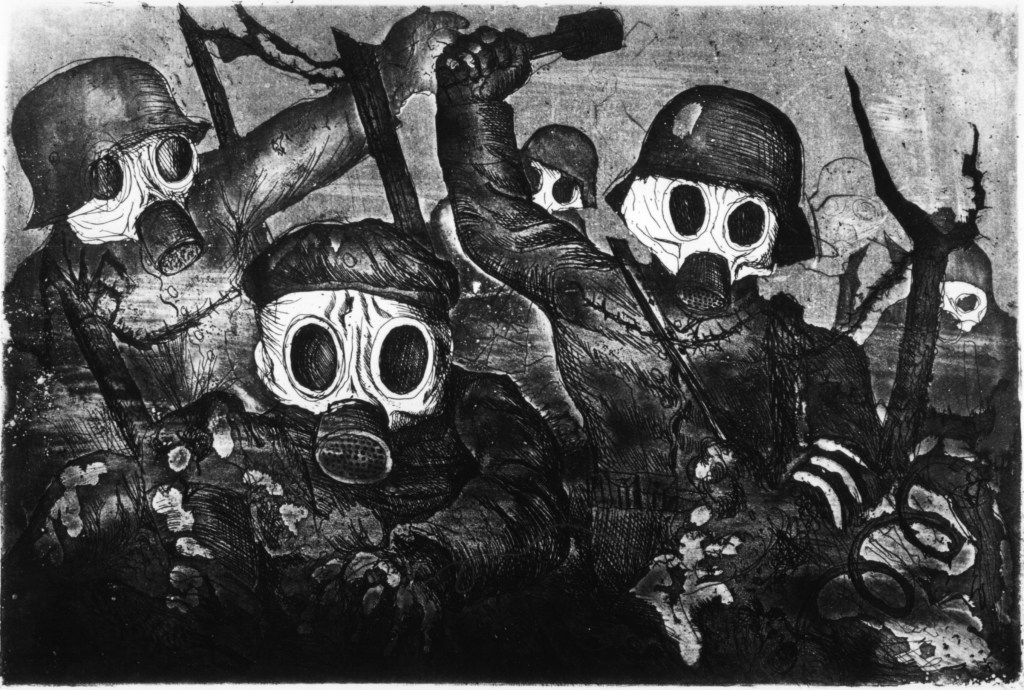
    Above image: Otto Dix, Sturmtruppe geht unter Gas vor (Stormtroops advancing under a gas attack), 1924 [Courtesy of: lewebpedagogique.com]


    I recently visited an exhibition of German artist Otto Dix’s series of prints entitled Der Krieg (The War) at the De La Warr Pavilion in Bexhill, East Sussex. I studied this series for my undergraduate dissertation a while back; where I focused on the links between German Expressionism and Outsider Art – more specifically the impact that experiences such as war can have on our mental health and how this makes the distinction between Outsider Art and ‘other’ art movements ever more intangible.


    During the First World War Dix volunteered to join the German army and was assigned to a field artillery regiment in Dresden. He took part in the Battle of the Somme before being transferred to the Eastern Front. He then returned to fight on the Western Front in 1918. In this year, he was wounded in the neck before being discharged from service in the December. His exposure to warfare had a profound impact, resulting in recurring nightmares in which he crawled through destroyed houses.

    Otto Dix, Schädel (Skull), 1924 [Courtesy of: www.deborahfeller.com]
    Otto Dix, Schädel (Skull), 1924 [Courtesy of: http://www.deborahfeller.com]

    “For all its waste, the war provided a windfall for scavengers. The First World War produced generations of happy worms and maggots. Trench rats roamed as big as beavers. Gas was sometimes a welcome respite as it decimated these pests.”

    – Taken from Otto Dix: Der Krieg exhibition pamphlet from the De La Warr Pavilion.


    Between 1915 and 1925, Dix created a significant group of paintings as a way of coming to terms with his harrowing wartime experiences. He began painting in a new style; a style which combined certain stylistic tropes and aspects of both Futurism and Expressionism, and in 1924 he produced Der Krieg –  a collection of fifty etchings and aquatints. The series is possibly one of the greatest anti-war depictions ever to be made, and is often compared to Francisco Goya’s Los Desastres. 

    This idea of the depiction of destruction and trauma as a source of creative impulse was widely common during the years following the First World War, resulting in a different kind of Expressionism emerging within Germany. At this time, there was a clear shift from a primitive, nostalgic, almost disengaged pre-war Expressionism, to a much angrier, political, ravaged Expressionism in the years following the First World War. Expressionist artists at this time seemed – quite understandably – engulfed by a ‘madness’ brought on by the normalisation of warfare and everything that came with it.

    Notably, in 1937, Dix’s work was included in the Nazi generated Entartete Kunst (Degenerate Art) exhibition in Munich. Even before the party had come to power in 1933, they had begun comparing images by avant-garde artists with those of the ‘clinically insane.’ Paul Schultze-Naumburg, a Nazi architect, was well known for contrasting the works of modern artists, such as Emil Nolde, with photographs of patients with physical disabilities with the intention of proving that modern art was pathological and degenerate.[1]

    The Nazis used modern art; Cubist, Expressionist and Dadaist works amongst others, as a scapegoat for the country’s economic collapse – a supposed conspiracy by Communists and Jews, and instead attempted to bring the focus of art back to the ideals of the human body.[2]

    Otto Dix, Mahlzeit in der Sappe (Mealtime in the Trenches), 1924
    Otto Dix, Mahlzeit in der Sappe (Mealtime in the Trenches), 1924 [Courtesy of: arttattler.com]

    “A trench soldier quickly gulps a meal in the company of a human skeleton trapped in the frozen landscape beside him.”

    – Taken from Otto Dix: Der Krieg exhibition pamphlet from the De La Warr Pavilion.


    July 19 1937 in Munich: more than 650 paintings, sculptures and prints taken from large German public collections were put on display with the aim of showing the German population what kind of art was to be considered inherently ‘un-German.’ Both abstract and representational works, including pieces by Dix, were condemned – as were the attempts to combine art and industry that had been pioneered by the Bauhaus artists. The exhibition, however regrettably, has made a place for itself as the most visited and viewed exhibition of modern art, with two million visitors in Munich, and a further one million viewers as it travelled across Germany and Austria.

    The works of George Grosz and Dix – and Expressionism more generally as a movement – were singled out to exemplify the idea of degeneracy within modern art.[3] Dix was particularly condemned due to his ‘defeatist’ attitude towards the war. His paintings The Seven Deadly Sins (1933) and The Triumph of Death (1934) portray the dangers of Nazism, and because of this, he was treated with utmost suspicion throughout the Third Reich.

    The Nazis saw ‘degenerate’ art as a “metaphor of the madman as the artist,” with Adolf Hitler developing a dialogue that insinuated that the avant-garde artist should be considered as an ‘outsider.'[4]

    Otto Dix, Gastpte - Templeux-la-Fosse, August 1916 (Gas Victims - Templeux-la-Fosse, August 1916), 1924 [Courtesy of: www.port-magazine.com]
    Otto Dix, Gastpte – Templeux-la-Fosse, August 1916 (Gas Victims – Templeux-la-Fosse, August 1916), 1924 [Courtesy of: http://www.port-magazine.com]

    “By 1924, people were aware of the horrors of gas but censored wartime reporting spared many from its ghastly details. Here the results are depicted with raw clarity of someone who was there. Indeed, much of Der Krieg was based on Dix’s wartime diary drawings. Many were probably struck by the appearance of the victims, darkened for lack of oxygen and the nonchalance of the medical staff who had seen it many times before.”

    – Taken from Otto Dix: Der Krieg exhibition pamphlet from the De La Warr Pavilion.


    A certain political and social ‘madness’ continued for the people of Germany throughout the reign of Hitler and his National Socialist Party. The extermination of German citizens based solely on race, ethnicity or religion was widely executed, as well as the mass rejection of works by some of the leading avant-garde artists. The whole era was epitomised by what defined ‘madness’, with the line between the ‘sane’ and ‘normal’ – if we are even able to define these terms – and that of the ‘pathological’ becoming increasingly blurred.

    The work of the German Expressionists, and the artists themselves, may have been deemed ‘insane’ by many critics at the time, but, as Jean Dubuffet claims, “very often the most delirious, most feverish works, those that are apparently stamped most clearly with the characteristics ascribed to madness, have as their authors people considered as normal.”[5]

    Annette Becker, writing in The Avant-Garde, Madness and the Great War, claims that “there is hardly more sense in the claim that there is an insane art as there is a dyspeptic art, or the art of those with knee troubles.”[6] Jon Thompson, curator of the Inner Worlds Outside exhibition at the Whitechapel Gallery, London in 2006 insinuates that “all human minds are fundamentally the same,” we are all the product of modernity and, influenced by Marx he “speaks to the degrees to which we are all alienated in one way or another, or in many ways at once.”[7] German Expressionism – and the work of Dix – was essentially a product of its time; a time that was characterised by alienation, discontent and the ‘madness’ of political instability and mechanical warfare.


    Otto Dix: Der Krieg continues at the De La Warr Pavilion in Bexhill until 27 July 2014. Click here for more information on the exhibition.

    References

    [1] Berthold Hinz, “‘Degenerate’ and ‘Authentic’: Aspects of Art and Power in the Third Reich,” Art and Power: Europe under the dictators 1930 – 45. Eds. Ades, Dawn, Tim Benton, David Elliott and Iain Boyd White, The Southbank Centre, 1995.

    [2] Stephanie Barron, ed. German Expressionism 1915 – 1925: The Second Generation, Los Angeles County Museum of Art, 1988.

    [3] Hinz, “‘Degenerate’ and ‘Authentic’: Aspects of Art and Power in the Third Reich.”

    [4] Sander Gilman, “The Mad Man as Artist: Medicine, History and Degenerate Art,” Journal of Contemporary History, Vol. 20, No. 4 (1985): p594

    [5] David Maclagan, Outsider Art: from the Margins to the Marketplace, Reaktion Books, 2009: p38

    [6] Annette Becker, “The Avant-Garde, Madness and the Great War,” Journal of Contemporary History, Vol. 35, No. 1 (2000): p81

    [7] Adrian Searle, Meet the Misfits


  • Pre-World War I: Primitivism, Nostalgia and the Rise of German Expressionism

    German Expressionism was born out of the influence of a variety of earlier movements, styles and subject matter, and of course, through the discontent of many avant-garde artists with recent modernisation and the alienation of urban living. Paul Gauguin (1848 – 1903), a French Post-Impressionist, proved significantly influential on the works of German Expressionists. Gauguin developed the visual language of ‘syntheticism.’ German Expressionism also undoubtedly takes some inspiration from Gauguin’s use of primitive artefacts and colour symbolism, as well as his use of nature without “(falling into) the abominable error of naturalism.” Vincent van Gogh (1853 – 90), was an incredibly important figure in the development of Expressionism, with the vibrant energy and colours found in his work. German Expressionists such as Ernst Ludwig Kirchner (1880 – 1938), Emil Nolde (1857 – 1956) and Ludwig Meidner (1884 – 1966) greatly identified with van Gogh’s alienation and isolation from the world, and his reliance on the ‘inner world’ to create, rather than external stimulation.

    The Brucke group, named after a quote by Friedrich Nietzsche, in which he states that “what is great in man is that he is a bridge and not a goal,” was founded in 1905, after the meeting of Fritz Bleyl (1880 – 1966), Kirchner, Karl Schmidt-Rottluff (1884 – 1976) and Erich Heckel (1883 – 1970) at the Dresden Technical College during their time there as architecture students. However, Bleyl left the group in 1907 to pursue a career in architecture, so the core group always remembered is made up of Kirchner, Heckel, Schmidt-Rottluff and Max Pechstein (1881 – 1955). These Expressionist artists were not content with the technical innovations and modern advancements that the early twentieth-century carried with it. The idea of the primitive was very much a basis for a large amount of the Brücke artists’ work. German Expressionists used the notion of timeless primitivism, and the borrowing from other traditions and cultures as a way to ignore what was actually occurring in Germany at the time, as well as to show their adversity to the modern world.

    The idea of the artist’s rejection of society and the urban city crop up throughout the history of art in Germany, for example, prior to Die Brücke, was Wilhelm Riehl’s Land und Leute (1857 – 63), which advocated traditional countryside living as the ultimate symbol of German tradition, as well as Carl Vinnen’s Worpswede Stimmungsladschaften (mood landscapes) and Arnold Bocklin’s mythological landscapes, which showed a romantic and untainted vision of countryside living. The notion of returning to nature is also highlighted in Adolf von Menzel’s a Journey Through Beautiful Nature, of 1892, which depicts figures in elegant clothing aboard a crowded train, desperately yearning to catch a glimpse of the countryside through the windows, yet irreparably isolated from it. Kirchner’s own figures in the countryside represent the unity of the human race with the natural environment, for example, Four Bathers of 1910, which was created during one of the Brucke artists’ summer trips to the Moritzburg lakes. His urban figures, however, show the alienation felt by people during the years of modernisation, like his piece entitled Five Women on the Street of 1913, part of his Street Scene series, which has defining primitive aspects and characteristics which Kirchner has used in attempt to highlight the contradictions of modernity.

    Emil Nolde, one of the most well-known German Expressionists, who was also a member of Die Brücke between 1906 and 1907, often showed his disdain for technological advancement and modern society within his work. He seldom depicted huge technological developments, such as that of the automobile or the aeroplane, and the hustle and bustle of city life goes undetected in his work. Nolde successfully avoided any representation of the modern world, even during his journey to New Guinea in 1913, where he chose to depict Russian peasants, and ignore the train and tracks his wife and he were travelling across. Despite spending every winter in the city of Berlin, the only signs of city life within Nolde’s work were the interiors of cafes and cabarets.

    Cesare Lombroso, an Italian psychiatrist, understood ‘madness’ to be a descent back into a primitive, or child-like stage of growth, and similar to this descent, was the use of primitivism by German Expressionists to represent their nostalgia for an earlier time; a time before modernisation. Similarly, Adolf Wolfli (1864 – 1930), a Swiss Outsider Artist, created art after his psychotic collapse as a way to emerge from chaos into stability. In a similar way, the German Expressionists escaped from the isolation and alienation of modern urban living through nostalgic primitive painting. Pascal Maisonneuve (1863 – 1934), a French Outsider Artist, portrayed his defiance and discontent with society and politics through his ‘shell faces,’ which he created by collecting strange objects and shells and arranging them into faces. These ‘shell faces’ defied conventional representation and ridiculed political figures, much in the same way as Expressionism was used as a new form of representation that was ideal for portraying discontent and frustration.

    A “direct and unadulterated” creative urge was crucial to the Brucke programme. Nolde would often concentrate exclusively on a specific subject matter in intense bursts of activity and in his autobiography, the artist conjures up images of himself as being “preoccupied only with his art.” Similarly, Kirchner would work obsessively, without taking notice of the time, and would often emphasise his mental distress as a key driving force behind his work; just as Outsider Artist, Wolfli, never planned in advance. In fact, one of the defining characteristics of Outsider Art is the appearance of compulsion; the need to fill in the gaps and continually create. Of course, the term Expressionism itself insinuates the “urge to express oneself,” and this urge is what enabled the German Expressionists to work without inhibitions, painting directly from the nude in the studio for bursts of approximately fifteen minutes, putting their own subjective stamp on the subject matter.

    The years directly prior to the break out of the First World War saw an escalation and intensification within Kirchner’s work, which eventually led to his prominent Street Scenes; of which there are eleven works, all executed between the years of 1913 and 1915.  The members of Die Brücke had moved to Berlin in 1911, following Max Pechstein who had relocated in 1908, where they had worked together as a group for another couple of years before dividing and going their separate ways. The last recorded work by the Brücke artists jointly was the poster for the exhibition entitled ‘Neuer Kunstsalon’ dated the 27th May 1913. In the pre-war climate of Berlin, the artists became withdrawn. Kirchner began his Street Scenes, which included his Berlin Street Scene of 1913.

    Kirchner reportedly took to stimulants such as alcohol, sex and morphine during his time in Berlin, and right up until his suicide in 1938 he was continually fighting a battle with loneliness and alienation, and his frustration and discontent with modern city life. Kirchner was keen to emphasise the dangers of modernisation within society, which he managed not only in his Street Scenes, but also in his colour lithograph of The Railway Accident of 1914. Here, a freight train is shown colliding with a horse drawn carriage, with Kirchner illustrating the destruction that can be associated with modernisation. The imminent outbreak of the First World War saw a huge shake up in the way people saw modern life, the city and their country. Inevitably, the War had a huge impact on everything from culture to the economy and as a result of this; the Weimar era would see a whole new side of German Expressionism.

  • Social and Political Theories of Alienation and the Appearance of ‘Madness’

    Germany, at the turn of the twentieth century saw major shifts from an agrarian economy to a modern industrial economy. Under Otto von Bismarck, who oversaw the unification of Germany in the late nineteenth century, the years 1870 until 1890 saw a huge period of transformation and an increase in Bourgeois power; these years were known as the ‘taking off period,’ or the Grunderzeit. During the first decades of the twentieth century, Germany experienced the apocalyptic destruction of war, and the rising social and economic upheaval of the Weimar period and as a result of this, German art appeared to mirror the tensions and divisions within German politics and society.

    One explanation for the changing process and apparent ‘insanity’ within modern art, particularly German Expressionism, is the ‘kunstwollen’ theory, or the “Immanent artistic drive.” This principle of ‘kunstwollen’ began with Alois Reigl and was extended by Wilhelm Worringer (1881 – 1965) in his thesis Abstraction and Empathy (1908), where Worringer claimed that the political and social contextual background at the time of the production of a work had a huge impact on the outcome; and, he claimed, this was the reason for revolving themes and styles within the art world. Worringer pushed the notion that classical art, such as Greek or Roman sculpture was the product of a harmonious society, whereas, in times of economical or political hardship, art would become much more angular; as seen in Dadaism, Cubism, Futurism, Vorticism, and to some extent, Expressionism. This thesis was popular amongst both the British and German avant-garde, and goes some extent of the way in explaining why German Expressionism was often particularly violent, angry and ‘insane’ just after the First World War. In Germany at this point, the relationship between the artist and his community was not harmonious, and political and economical circumstances were not favourable, therefore soft curves and pleasant colours were replaced with sharp, angular and complex works of art.

    During the nineteenth century, there was a definite drift towards a more materialist philosophy in the Western world. The emergence at this time of the social revolutionary works of Karl Marx, Sigmund Freud’s creative impulse theories and the Apollonian (idealist) versus Dionysian (realist) debate raised by Friedrich Nietzsche had a huge impact on the cultural avant-garde. These theorists and philosophers ultimately defined the world by what they could see, rather than with the optimism of idealism. This, of course, directly opposed the idealist philosophies of previous decades; of which Kant and Hegel were visionaries.

    This sudden progression of industrialisation and capitalism in Germany left German Expressionist artists feeling isolated and alienated from their own society. Die Brücke, founded in Dresden in 1905, had seen most of its members move north to Berlin by 1911. Max Weber claimed that human behaviour was being altered by the demands of industrialisation and capitalism. Stephen R. Marks also claims that alienation can be a considerable resulting factor of industrialisation and commercialisation; group life, particularly during times of industrialisation can cause group members to feel purposelessness or normlessness. Georg Simmel – interested in the modern urban individual – states that the metropolitan dweller must exaggerate his own personal qualities in order to be heard in the vast society of the metropolis.

    Primitivism, Lloyd claims, was used by German Expressionists to question values held by Western society. The use of primitivism in their work sees the Expressionists looking for inspiration from already alienated groups. Outsider Artists and primitive artists were already isolated from society, and somewhat untouched by industrialisation and capitalism. German Expressionists used similar techniques to portray their discontent with society and their rejection of modernity. Art and creativity, it seems, was an acceptable way for the alienated man to channel his discontent. Emile Durkheim’s ‘Theory of Anomie’ outlines this idea of alienation from society. Alienation is a feeling whereby the socialised man no longer feels a sense of belonging within his own community. This need to channel feelings of alienation in some form or another sees a similarity between Outsider Art and German Expressionism. Creativity was a socially acceptable way to challenge society and explore the alienation that one felt, and one that both Expressionists and Outsider Artists shared. Although Outsider Artists may not have been aware of societal and economic changes, they were still part of an alienated group within society, and because of this, German Expressionists could relate to their work.

    Social, political and cultural factors played a huge role in the shaping of German Expressionism as an art movement. It was wholly built upon foundations of discontent and the rejection of modernity, rather than technique or subject matter. Peter Bürger, in Theorie der Avantgarde (1974), confirms that contextual factors, predominantly social, political and economical factors, certainly have a profound effect on artistic style and subject matter.

  • Introduction to the Links and Similarities Between German Expressionism and Outsider Art

    I am going to begin a series that looks at the links and similarities between German Expressionism and Outsider Art particularly between the years of 1905 and 1945. This will include contextual factors, pre-world war one, the Weimar period and then finally, the Degenerate Art exhibition organised by the National Socialist Party in Germany. Here is the first installment… just a quick intro…

    German Expressionism, rather than being a distinct movement, with clear defining factors, was in fact the result of a whole host of contributing factors. Expressionism, similar, in fact, to Outsider Art, had no essential programme; instead, it was identified by content. David Elliott describes it as “paradigmatically asocial, the voice above all of the individual.”

    When discussing the time period that German Expressionism spanned, it is important to define two key words at the forefront of German vocabulary at the time. The birth of a new Europe, industrialisation, modernisation, and social and economical change all define the era in which this movement was prevalent; these all characterise the spirit of the time, or Zeitgeist. Another German word, Kultur, which has no direct links with the broad English term culture, is also important when discussing German Expressionism. Kultur implies that which is generically German; seen during the reign of the National Socialist Party as superior to that of other nations. Kultur can be seen as bringing the individual and wider society together by providing mutual interests.

    The birth of modernisation, which was spreading rapidly throughout Europe at this point, was the source of discontent for many and the continual growth of towns and cities often led to the public feeling isolated and alienated from the rest of this ever expanding society. This feeling of alienation was noted by many sociologists, psychologists and philosophers at the time, including Georg Simmel and Max Weber; it can also be seen described in much of Karl Marx’s work. The sense of alienation felt by many in a way turned them into outsiders; much like the Outsider Artists of the same period.

    Artists at this point were becoming aware of Outsider Art, and were taking aspects of these works to inspire and enhance their own creations. Exhibitions of this art were being held for the first time, drastically changing the attitude of the public towards minority groups, such as the insane; finally, the ‘madman’ was becoming the romantic ideal.

    Max Beckmann, a German Expressionist artist, can be seen relating to the work of outsider artists in his Self-Portrait with a Saxophone of 1930, in which he is almost representing himself as an outsider. The painting shows Beckmann slouched, clutching a saxophone below waist height, wearing very basic clothing. The artist appears distant and melancholic, with the painting portraying an overall sense of confusion and bizarreness. What Beckmann appears to be looking for is a new language for continuing contextual dilemmas. German Expressionists looked to convey certain aspects of outsider art in their own quest to create a language that was undoubtedly a critical response to contemporary political and social problems. The first exhibition of Expressionism in 1906 goaded the public and art critics to assume that the artists were of ill mental health, and it is obvious that Expressionist painters were in fact trying to imitate the often closed off worlds of the mentally ill.

    The idea of alienation is a mutual factor of both German Expressionism and Outsider Art. Fired by a feeling of discontent with their current world, the German Expressionists sought something much more original and primitive to inform their works, and it seemed Outsider Artists could effortlessly achieve this much-desired uniqueness. German Expressionist art was not ‘insane;’ rather, it was reflecting the contextual tensions and conflicts occurring within politics and society in Germany at the time. To portray this conflict, a new style was needed, and Expressionists looked to the originality of Outsider Art for inspiration. The exploration of madness, alienation and discontent within the works of German Expressionism is one that is inevitable due to the political strife and social instability of the time, and it seems apt to look at ‘madness’ in terms of those who were often in fact clinically insane; the Outsider Artists.

     Max Beckmann, Self Portrait with a Saxophone

    Follow me on twitter!: @kd_outsiderart