From 4th – 6th May 2018, Outside In is hosting the European Outsider Art Association (EOA) conference at Pallant House Gallery, Chichester. This year’s conference focuses on ‘the Artist’s Voice,’ celebrating the work of excluded and non-traditional artists and sharing best practice in the field through a series of presentations, key note speeches, and workshops delivered by artists and practitioners.
Bobby Baker’s Diary Drawings, Mental Illness and Me, 1997 – 2008, Day 579 Cathedral of the Mind. Image Andrew Whittuck, 2009
The keynote speech to open the conference will be delivered by multi-disciplinary British artist Bobby Baker, and panel discussions during the conference will focus on ‘supporting the artist’s voice’ and ‘exhibiting the artist’s voice.’ Presenters at the conference include the Living Museum (the Netherlands), Out By Art (Sweden), Venture Arts (UK), Joy of Sound (UK) and Look Kloser (UK). Panellists will include Garvald Artists (Scotland), Headway East London (UK), Arts Project Australia (Australia), Blue Circus (Finland), Creahm/MadMusee (Belgium), and Creative Minds (UK). In addition to all of this, there are dedicated slots for artist presentations that will be happening throughout the conference.
There will also be an opportunity to find out more about the work of Outside In through presentations from director Marc Steene, and by taking part in creative workshops and tours led by Outside In artists. The conference will run alongside a new exhibition of work by renowned outsider artist Scottie Wilson at Pallant House Gallery, which in turn will be accompanied by a special commissioned work by an Outside In artist in response to Wilson’s practice.
In the run up to the conference (2nd and 3rd May), you can join a VIP programme of activities that will include trips to Bethlem Museum of the Mind, ActionSpace, an opening of an Outside In exhibition at Long and Ryle Gallery, an outsider environment in Brighton, and a tour of a renowned collection of modern British and outsider art.
For more information and a full programme of events, please click here.
In this post, Jeremy Davies writes about two upcoming exhibitions in Morocco featuring the work of self-taught ‘junk market artist’ Ben Ali.
Ben Ali
“It is rare to find an artistic genius; still rarer to find two in the same family. But leading Italian art critic Corrado Levi believes he has done just that, in a junk market in Morocco.
The geniuses in question are Ben Ali (Abdelghani Didouh, born 1966) and his late father Ali; the junk market is in Essaouira, a fishing port and seaside resort on Morocco’s Atlantic coast, around 200km west of Marrakech.
Ben Ali
Ben Ali has been painting in his tiny, one-room studio in the junk market since the mid-2000s. This is a humble place, one of around 30 semi-derelict fishermen’s huts sandwiched between the abandoned sardine canning factories of Essaouira’s former industrial quarter and the vast wilderness of the Atlantic Ocean.
A gentle, soft-spoken man, Ben Ali is a self-taught painter, who turned to art after his previous career as a fisherman came to an abrupt end when the sea stole his boat, his friends and one of his brothers.
Ben Ali
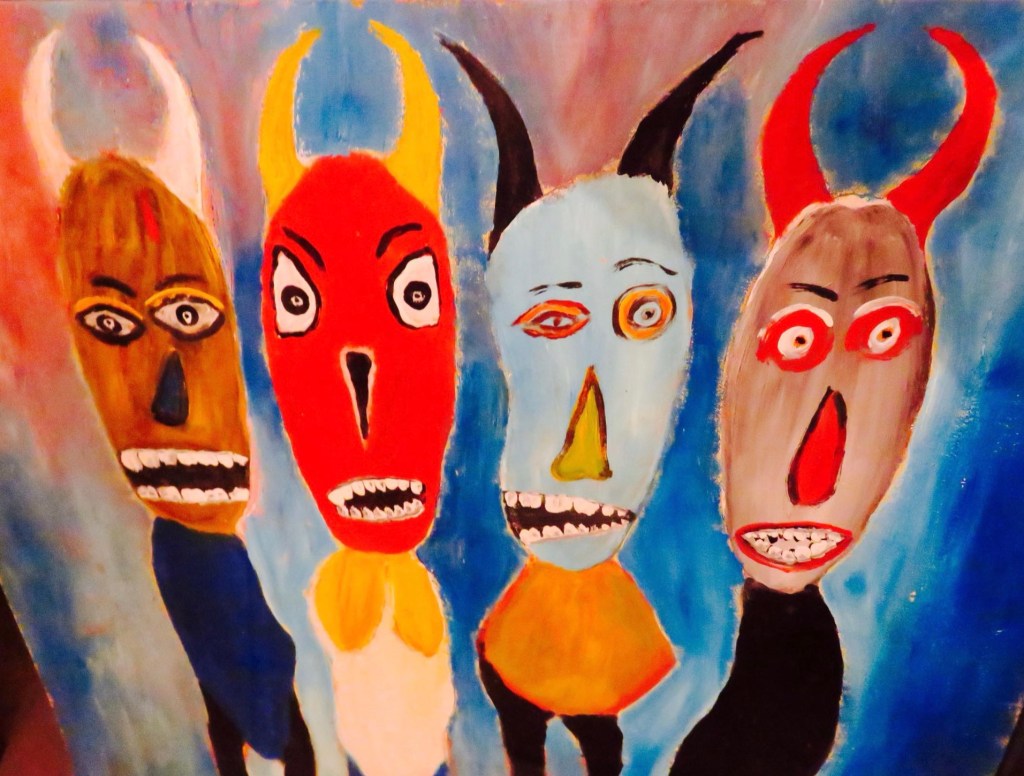
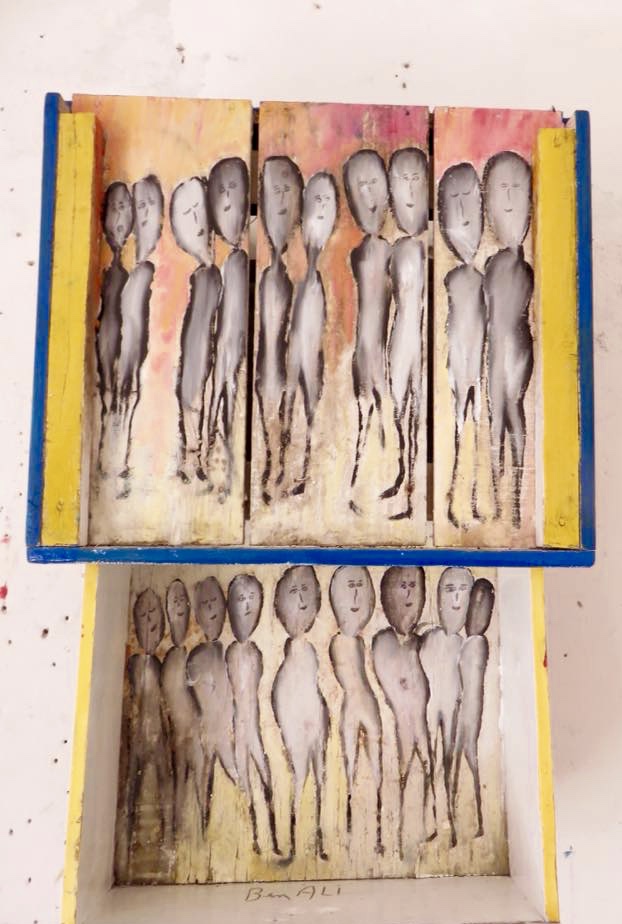
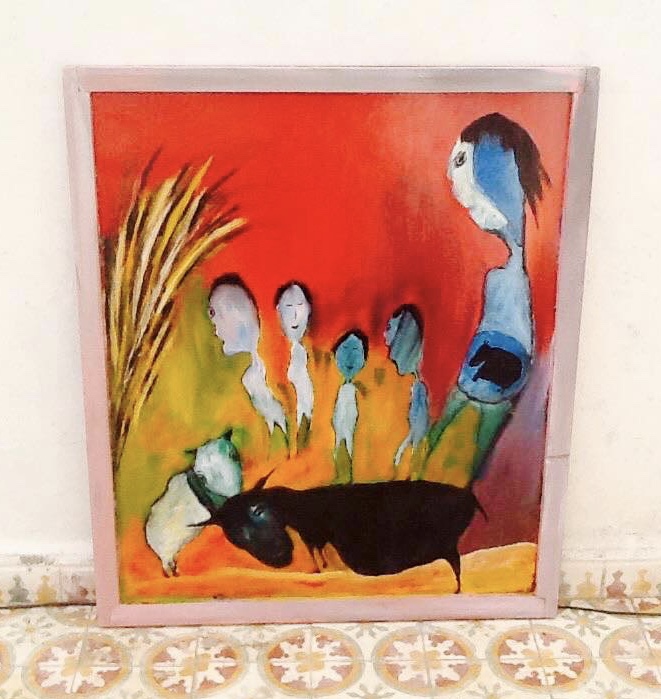
He paints from tiny pots of enamel, mixing the colours on cardboard and brushing straight onto canvas, wooden panels and objects bought or found in the joteya (junk market): old TVs, boat oars, wooden washboards, doors, cupboards and gas canisters. His emphasis is on shape and colour, with little in the way of perspective.
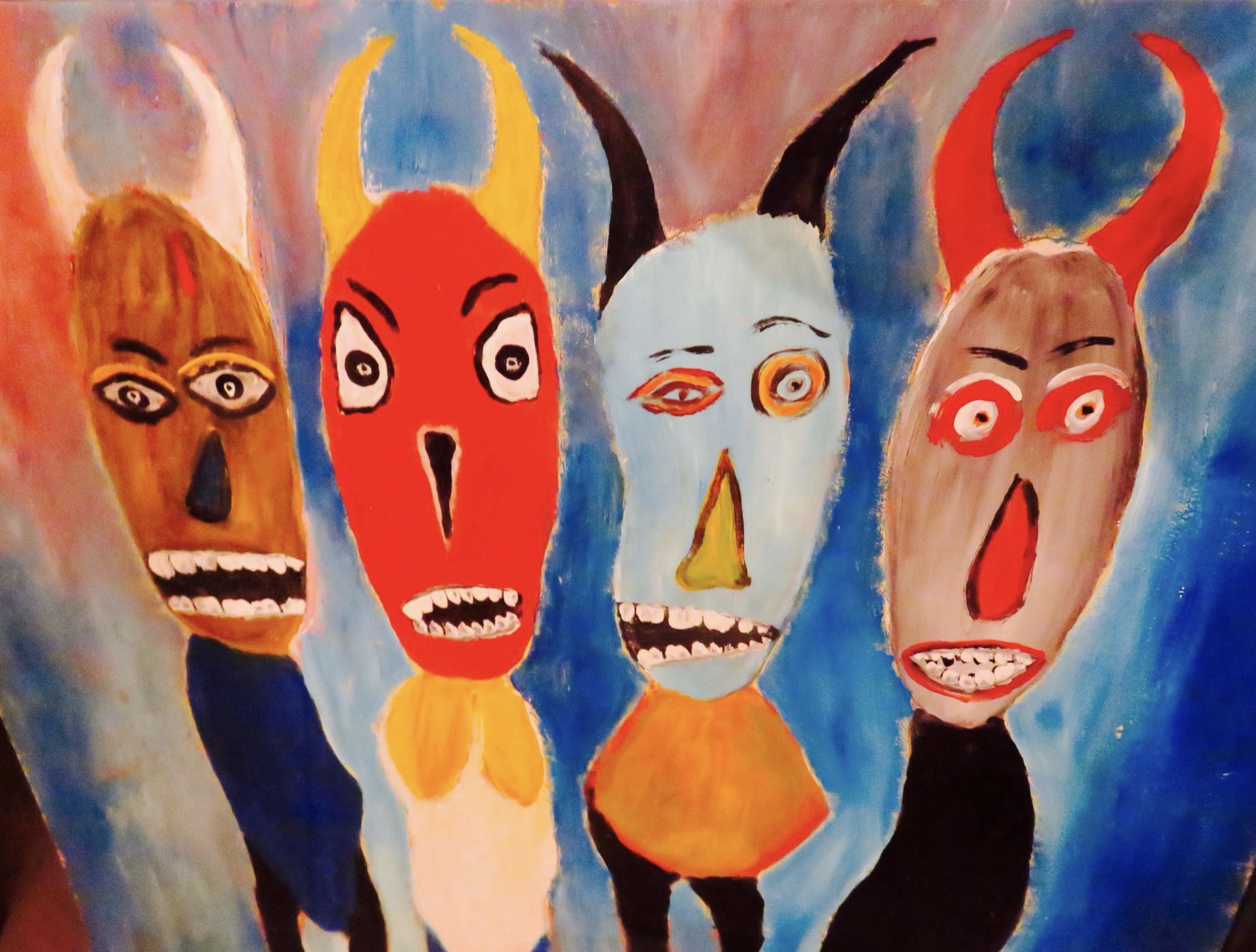
The results are bold, thoughtful, and often quietly disturbing. His characters are ethereal and amorphous; some are human, some animal and some both. There are skull-like faces; dark, sharp-eyed figures, both male and female; shadowy wraiths with thin, elongated legs; horned goats, donkeys and huge, legless cows. We see tiny details too, like recurring motifs: guns, flowers, a key, a dentist’s pliers.
Ben Ali
As viewers we sense strongly that Ben Ali is painting to exorcise his demons. Indeed, while reticent about explaining his art, he almost admits as much: “In my paintings there are all the ghosts, that little by little appear on the canvas like the memories of a childhood dream.”
From an early age Ben Ali watched and learned from his father Ali, a former Vietnam veteran who effectively founded a ‘school’ of artists in the joteya during the 1970s.
Ben Ali
Ali’s art, which broke all the rules of Muslim culture by presenting graphic depictions of human sexuality, remains largely hidden from public view but is highly prized by collectors, who believe Ali warrants international recognition as a major artist.
Ben Ali’s imagined worlds undoubtedly draw inspiration from the work of his father.
“When I saw the work of my father I loved it,” he says. “More than anything else, his work was simple, it made me laugh or hurt me, and this is the reason I loved his work. Every time I passed by to see him, it inspired me more and more. I chose the name Ben Ali (the son of Ali) because I am my father’s son. I work in my father’s studio and I continue the work of my father.”
Ben Ali
But Corrado Levi – an architect, artist, teacher, theorist, curator, freethinker and intellectual, who is one of Italy’s most respected art critics – says Ben Ali has built on his heritage and transcended it to find his own style.
“The father Ali paints a humanity possessed of sexuality: men display their sex provocatively, and women show theirs without shame. The son Ben Ali, meanwhile, paints figures that don’t show their sex, and so the male/female identity remains nuanced.
“The father Ali spreads out the paint with repeated brush strokes, creating a delicacy and vibrancy that contrasts with the violence of his representation. The son Ben Ali, on the other hand, uses dense and glossy paint, and so his ghostly subjects seem to wander in an unlimited space.
Ben Ali
“The bodies of the father Ali push themselves into bold, distorted shapes (think of the later Matisse gouache cut-outs). The bodies of the son Ben Ali have threadlike legs, accentuating their formlessness.
“To simplify: Ali: the body and substance. Ben Ali: the spirit and transparency. Two geniuses.”
This summer Essaouira is hosting two exhibitions of Ben Ali’s works, curated by two local galleries, Elizir and Mashi Mushki: a retrospective at the swanky Sofitel Essaouira Mogador Golf and Spa (15 July to 4 September), and a collection of new works at Dar Souiri, a cultural centre in the walled old town (26 August to 4 September).
The exhibitions are being held to raise money for Project 91, a local charity which is setting up a fund for the widows of fishermen lost at sea.
‘Life is Your Very Own Canvas’ is an exhibition showcasing expressive art created by individuals somewhere along the road to recovery. The exhibition has been organised by Penumbra Art; a new collective of artists who are exploring the creative path together in a supportive, encouraging and safe environment. The exhibition is happening from 27 May – 3 June 2016 at Seventeen in Aberdeen.
3D dragon sculptures, high quality black and white street photography and a time travelling comic strip are but a few of the eclectic works on show.
Mid-exhibition, on 31 May, there will be a showcase event where I will be talking about outsider art: then and now, and Best Girl Athlete will be performing.
REDEFINING OUTSIDER ART: LOOKING AT LANGUAGE
AN ONLINE EXHIBITION LOOKING AT THE TERM OUTSIDER ART AND WHAT IT MEANS IN THE 21ST CENTURY
Call out for submissions to an online exhibition focusing on the term outsider art and what it means to YOU as an artist.
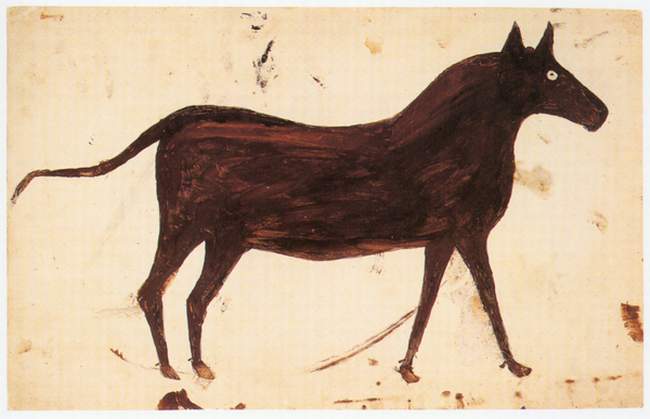
Bill Traylor, Brown Mule, 1939 [source: http://www.petulloartcollection.org]kdoutsiderart.com regularly focuses on the ambiguities of the term outsider art and what potential impact it might have on the artists it aims to ‘define.’ In late 2015, I posted a blog that outlined the thoughts of six artists who find themselves housed under this ‘outsider’ umbrella. Following on from this, I’d like to expand this idea, and am inviting artists who might in some way align themselves with the term outsider art to tell me what they think. I’d like to know what you think of the term outsider art, and – if you have an idea – what a better term might be.
I’m looking for responses in a variety of media – using words, images, sculpture, performance, sound – to contribute to an online exhibition challenging the term outsider art. Unlike other conversations around the term, I’d like us to work together to break down the term outsider art and for you to really think about what it means to you as an artist. By providing real-life responses from artists as well as potential alternatives, we can be a positive addition to the continuing conversation.
Submissions Submitted work must be in a digital format – this can be images, a sound or movie file, or a PDF or Word Document. Each artist can submit one piece, and all pieces must be accompanied with a brief description of how it relates to the continuing conversation around outsider art. Please email all submissions to kdoutsiderart@yahoo.com by 1st July 2016.
A new exhibition organised by Outside In and Craftspace is launching at Pallant House Gallery on 12 March 2016, illustrating the different and more alternative ways material and craft techniques can be utilised by artists and makers. ‘Radical Craft: Alternative Ways of Making’ will showcase work by historically renowned artists associated with the Outsider Art field alongside contemporary self-taught artists who see themselves as facing barriers to the art world; 21 of whom have been selected through an open submission process.
Aradne, The Gathering
Outside In, a project based at Pallant House Gallery, Chichester (UK), that supports artists who see themselves as facing barriers to the art world for reasons including health, disability, social circumstance or isolation, facilitated the open submission section of the exhibition, calling on the 2,000 UK-based artists with online galleries on their website to submit their craft based work for possible inclusion in the show. There were over 200 submissions, and the final works were selected by a panel including textile artist Alice Kettle; artist and Outside In Award Winner Phil Bard; Laura Hamilton, Co-Curator of ‘Radical Craft’; Katy Norris, Curator at Pallant House Gallery; and Deirdre Figueiredo, Director of Craftspace.
The incredibly diverse work by UK artists will sit alongside pieces by artists of international renown from Asia, North America and Europe. The artists in this section of the exhibition include Dalton Ghetti, whose intricate pencil-graphite carvings are inspired by what he experiences on a day-to-day basis, and Julia Krause-Harder, who creates gigantic dinosaurs in mixed media.
Julia Krause-Harder, Stegosaurus, Image courtesy of Atelier Goldstein
What ties the work in this exhibition together is the radical missions and processes that underlie each creation. These include intuitive responses to textiles; autobiographical responses to the natural or urban environment; and folkloric or surreal perceptions of the world. The exhibition’s aims lie most significantly in wanting to break down barriers. These barriers are two-fold. Firstly, there is a want to challenge preconceptions surrounding who can be considered an artist and what can be considered art – does someone need to have been to art school? Do they need to have exhibited in a high profile venue? – and secondly, the different but related question of why craft is often considered a ‘lesser’ form of art. Although the latter – and in many ways the former – are not directly answered within the show, the inclusion of both untrained artists and craft works within a nationally renowned modern British art gallery leaves some pause for thought.
The exhibition will reveal not just who makes radical craft, but why they do, what they are inspired by, and ultimately, what the finished pieces – tied up as they are in the hopes, dreams and experiences of each maker – look like aesthetically.
Beth Hopkins, Found Object Figure
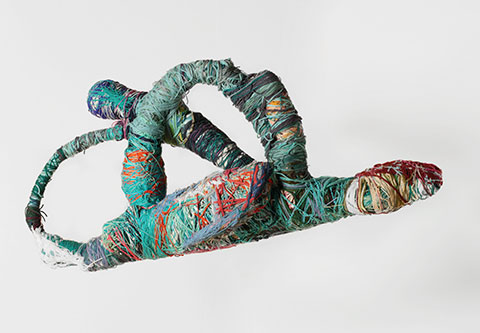
There are works in the exhibition which literally take this idea of being tied up in and with the history and context of the maker. In Nnena Kalu’s work, wound and bound bodies emerge as she builds and layers material upon material. Somewhat aesthetically similar, Judith Scott starts with an object hidden deep within the wraps and binds of her 3D sculptures. She repetitively hides and covers, whereas Kalu keeps building and building. Michael Smith’s customised jeans embody another form of wrapping. In his work, Smith alters something that already exists (in this case clothing), making his mark with masking tape, in the process creating the appearance of mythical creatures and new human-esque characters.
From the above, you can see that textiles and fabric-based work will make up a large chunk of the show. In addition to the wrapping and winding of Kalu, Scott and Smith, there will be the machine embroidered web-like worlds of UK-based Aradne, and the impressive woven birch bark clothing of Finland’s Erkki Pekkarinen. Other materials and processes utilised in a radical way within the exhibition are Horace Lindezey’s wire drawings of the seven suits he owns for special occasions, and the found objects and discarded electrical gadgets that are given a new lease of life by Beth Hopkins.
Erkki Pekkarinen, Photograph of the artist wearing woven birch bark suit, Image courtesy of Veli Grano
The exhibition is going to be key in the field, both in its attempt to raise the profile of artists working outside of the mainstream, and in its bold and courageous move to highlight the importance of craft within the art world. Much of work in the exhibition is primarily a form of communication; it is how the artist is most able to convey their unique messages, emotions and perspectives. With this end, craft enables the maker to create something that is wholly sincere. Working directly with the material; pulling, sewing, sticking, moulding, touching, feeling, their product is unavoidably connected to their physical being.
Excitingly, the work in ‘Radical Craft: Alternative Ways of Making’ is the aesthetic and tangible result of unheard voices, radical imaginations, and – perhaps most poignantly – incredible creativity that, until now, has been overlooked by much of the art world.
The exhibition is at Pallant House Gallery from 12 March – 12 June 2016, before touring around the UK. For more information, please click here.
Featured Image: Nnena Kalu with one of her bound sculptures
This month sees the opening of an Outside In exhibition in collaboration with Bethlem Gallery. Outside In: Bethlem will showcase the work of Daniel and Rodney, who have refined yet differing perspectives on geometric form. The exhibition will run from 19 August – 11 September at Bethlem Gallery, which is situated within the grounds of the Bethlem Royal Hospital in Beckenham, Kent.
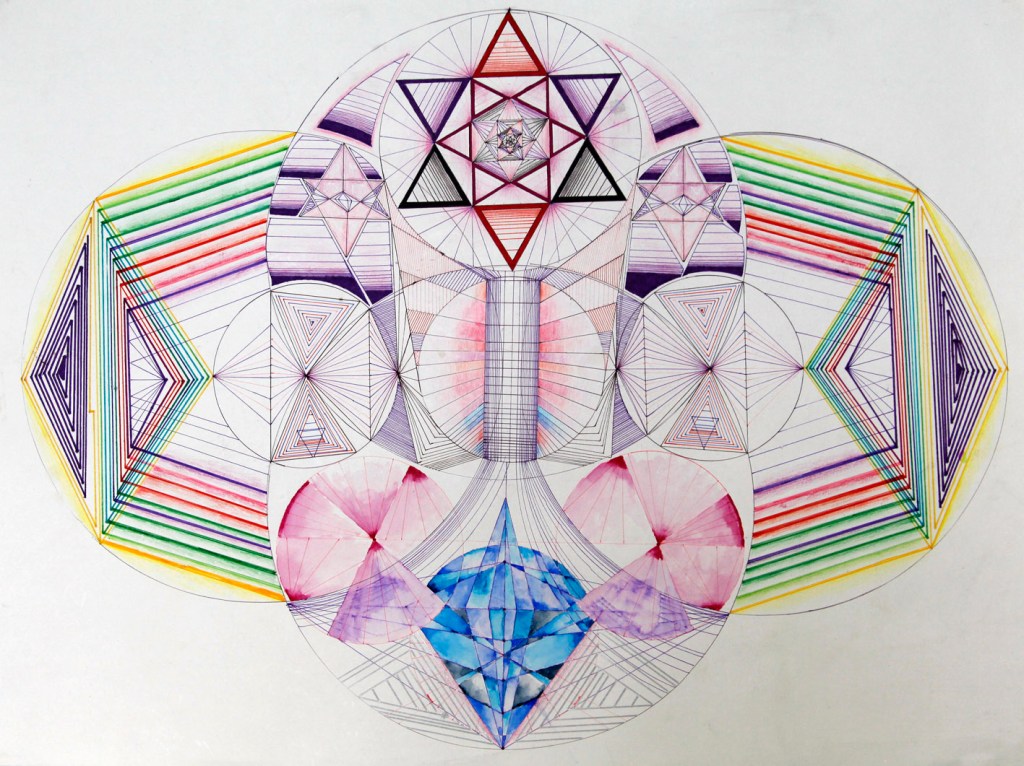
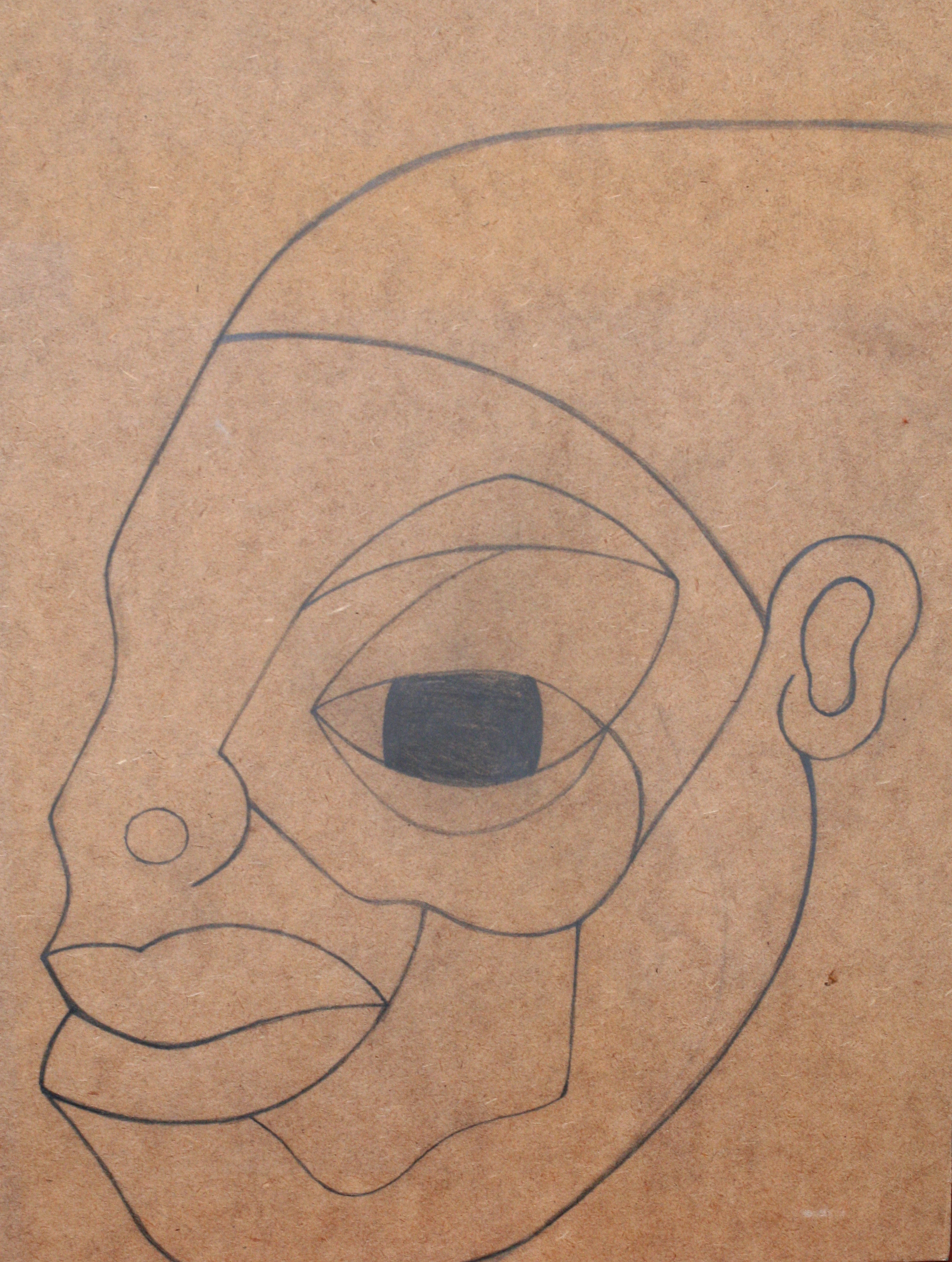
Daniel and Rodney were selected for the exhibition by Simon Martin, Artistic Director of Pallant House Gallery, who was drawn to the idea of two artists using drawing within their work, but to different ends. Both Daniel and Rodney use linear marks to create sophisticated images, but whilst Daniel builds up complex mandala-like structures, Rodney pares back all detail to the simplest of forms.
Rodney, Untitled
Daniel’s Metatron works form a series of drawings that all use geometric shapes, lines and vivid colour. With a tightly developed methodology for constructing structures and composing forms, Daniel has created a strong visual identity for his work. “It takes me a couple of months to do one piece, as I do it bit by bit in my own time and space,” Daniel says. “You can always find a face in my drawings that for me represents Archangel Metatron, accompanied by the third eye.”
Daniel, Metatronic Circuit 2
Simon says of Daniel’s work: “It has a remarkable precision and control, and yet it seems imaginatively free. The abstract forms and colours in his drawings and paintings seem to exist without reference to the physical world and they remind us that the artist can be like a shaman to the unconscious and a deeper spirituality.”
Rodney, Jamaican Head
Similar in their use of geometric forms to Daniel’s pieces, the beautifully precise and simple forms of Rodney’s work come from his studies of the world around him and include people, interiors, guns, stereos, boxes and locks. His sophisticated process of distilling complex forms down to something more refined and elegant is carried out quietly and without any formal training. “Rodney’s drawings have a powerful simplicity,” says Simon. “He seems to distill the physical world down to the simplest scaffold of linear forms.”
Daniel, Pink Metatronic Circuit 3
Outside In and Bethlem Gallery both have the same ethos when it comes to promoting work by artists facing barriers to the mainstream art world, and this exhibition will combine these efforts for the second time, resulting in a high-quality show with a focus on geometric forms created in two unique styles.
Featured Image: Martin Phillimore, All the Fun at the Fair
Two new exhibitions opening in Brighton this weekend illustrate the fantastic work being created by artists represented on the Outside In website. Both exhibitions are taking place during May – famously ‘Brighton Festival’ month. One is in partnership with HOUSE Festival 2015; the visual arts arm of Brighton Festival, and the other in collaboration with Brighton’s Artists Open Houses, another Festival related endeavour which sees artists of Brighton and Hove throw open the front doors of their homes.
‘Intuitive Visions: Shifting the Margins’
‘Intuitive Visions: Shifting the Margins’, in collaboration with HOUSE 2015, will take place at Phoenix Brighton from 3 – 31 May, showcasing the work of nine Outside In artists: Aradne, Blair McCormick, John Ackhurst, Jonathan Kenneth William Pettitt, Luc Raesmith, Martin Phillimore, Michelle Roberts, Paul Bellingham and Sally Ward. Curated by Katy Norris, curator at Pallant House Gallery, the exhibition includes a host of intuitive works, including Paul Bellingham’s ‘blind drawings’, which he creates by closing his eyes and drawing a head, before opening his eyes and filling any extraneous space with colour.
Paul Bellingham, Comfort Comes
The utilisation of found objects and materials is common in the show, with Luc Raesmith working quickly and intuitively with available recycled and found materials: “I am a colour obsessive, as well as a ‘magpie’ for images, textiles and metals, plus beach and street plastic flotsam.” Similarly, Sally Ward will often pick up materials from charity shops; fabrics that already have a history of their own, before stamping, spraying and sewing them to give them a new lease of life.
Colour is abundant in the exhibition, with the likes of Jonathan Kenneth William Pettitt’s ‘Love Tears’ and ‘Pee Thrips,’ and Martin Phillimore’s untitled doodles. Similarly, Michelle Roberts’ colourful and complex worlds have a distinct logic and meaning that connect to her own life. Working methodically across each canvas, Michelle starts by building layers of patterns, working from left to right and top to bottom, before selectively filling the shapes with colour.
Jonathan Kenneth William Pettitt, Love Tears
The exhibition is a culmination of a burgeoning relationship between Outside In and HOUSE 2015 – something that will undoubtedly benefit both the public and the two organisations by offering new audiences the opportunity to engage with exciting contemporary work.
‘Being Creative is Good For You!’ sees Outside In and The Wellbeing Gallery – based at Brighton Health and Wellbeing Centre – collaborate for the second time as part of Brighton’s Artists Open Houses. Showcasing work by four Outside In artists: Aradne, Annika Malmqvist, Anthony Stevens and Valerie Potter, the exhibition aims to highlight how these four artists have discovered their own personal fabric-based techniques to channel their creativity and improve their wellbeing.
Aradne, Aureola 3
From Aradne’s technique of utilising a sewing machine as a drawing implement, to Anthony Stevens’ textiles imbued with deep, symbolic meanings, this exhibition pivots around the notion that using your hands and creating can be incredibly beneficial to health and wellbeing. Anthony says: “To create is one of the fundamental experiences of being human. It feels so much more invigorating to create from the nuts and bolts of our own lives, than to just stagnate and consume what is made available to us.”
Anthony Stevens, Culture Vulture
The exhibition will be accompanied by a series of related events, including an interactive, creative workshop led by artist and curator Jude Hart, as well as mini-workshops led by exhibiting artists Aradne and Anthony Stevens. In these mini-workshops, participants will have the chance to learn a new technique or simply enjoy being creative.
Founded by Pallant House Gallery in 2006, Outside In provides a platform for those who define themselves as facing barriers to the art world due to health, disability, social circumstance or isolation. The goal of the project is to create a fairer art world which rejects traditional values and institutional judgements about whose work can and should be displayed.
First of all – Happy New Year everyone! As we welcome in 2015, here’s a brief list of a few of the must-see outsider art exhibitions taking place this year.
Judith Scott: Bound and Unbound
Brooklyn Museum, New York, US Until 29 March 2015
Judith Scott, Untitled
This exhibition is the first comprehensive US survey of the work of Judith Scott and includes Judith’s three dimensional works as well as a selection of works on paper.
This show will feature paintings and drawings by prolific outsider artist Mary Barnes. The works are predominantly from the collection of Dr Joseph Berke, her therapist and friend, and the exhibition will bring together works spanning her artistic career.
There will be more must-see outsider art exhibitions popping up throughout the year, so please do follow me on twitter: @kd_outsiderart for all the latest news, or check out the ‘Links’ page (by clicking here) to see what the organisations dedicated to showcasing outsider art are up to in 2015.
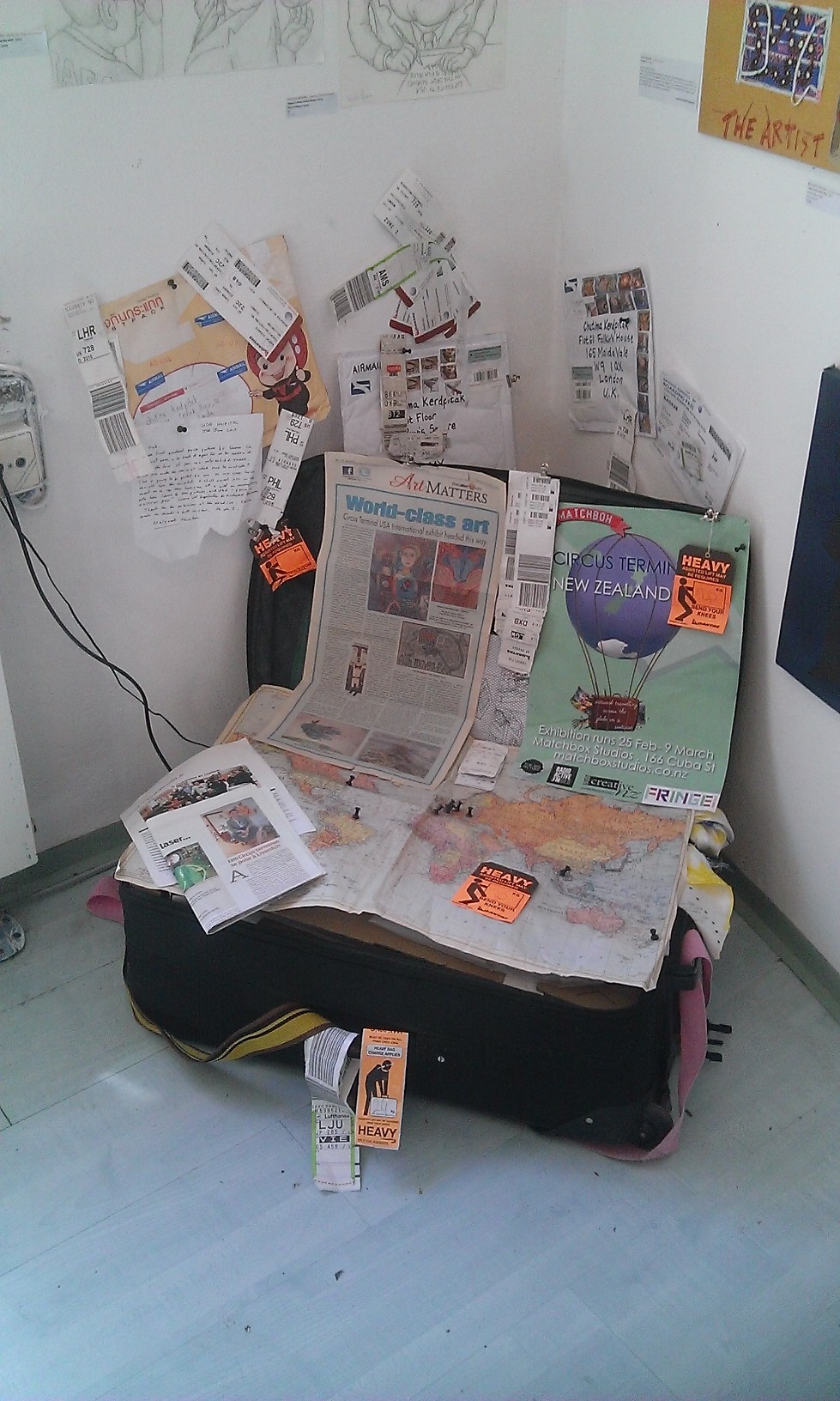
During a recent trip to Slovenia, I visited ‘Circus Terminal’ at Gallery Kud Esko in Piran (17 – 25 May 2014). The artist-led project, an initiative of ‘Uncooked Culture’, is a collaborative travelling art mission, which disregards academic background and aims to celebrate the differences and similarities of all human beings through their creations. Since 2012, the exhibition – which was launched in the UK at The Tabernacle in London in March of that year – has visited eight countries: Spain, France, Thailand, USA, Holland, New Zealand, and Slovenia. It has grown from 41 artists living in 12 different countries to a project exhibiting more than 350 works by over 85 artists. The final stop on the tour will be Suriname in July 2014.
In every country, local artists are invited to participate in the exhibition and other collaborative activities; an indicator of how the project has grown so fruitfully during its lifetime. Once the artist has had work exhibited in their home town, they are invited to put their work in founder and curator Chutima Kerdpitak’s suitcase to be shown on the next legs of the tour. Alongside Chutima (Nok), each regional exhibition has a lead artist –in New Zealand it was Wellington artist Lynn Todd, in London Miranda Sky, and in Spain Gustav Glander – as well as invited artists who exhibit alongside the international collective. The project has had one guest artist; Sue Kreitzman in London.
Chutima’s suitcase
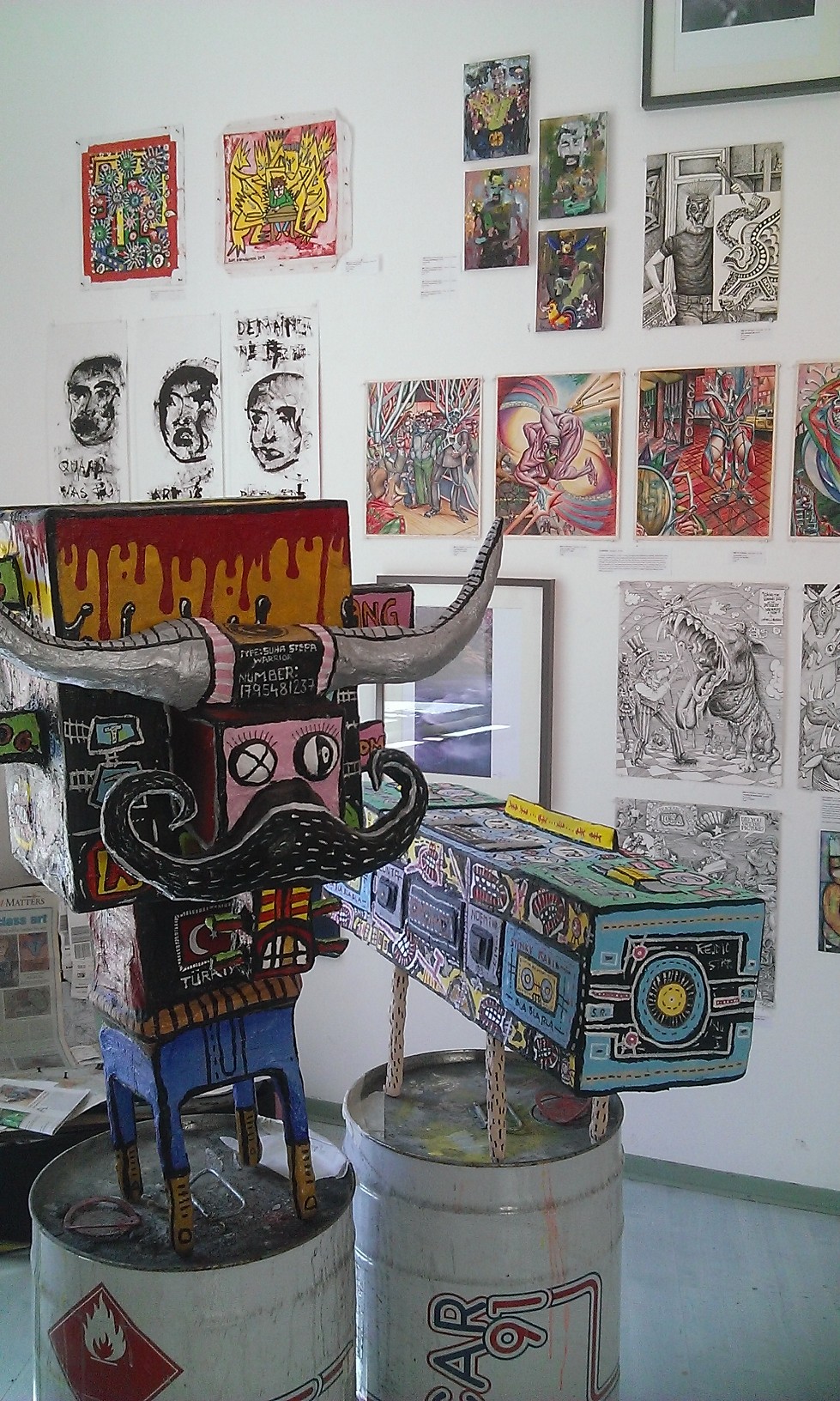
The exhibition in Piran was sat back just off of the main Venetian-style square of the town. Chalked directions marked the walls in the alleyways: ‘Art Exhibition This Way.’ Through a deserted basement and up a flight of stairs, art work began springing up on the walls. The main room was, in every sense, a white cube. But the difference here was that art washed the walls on all sides, including the pillars in the centre. There was colour, ink, sculpture, photography, intricate models, big pieces, small pieces. Almost too overwhelming at first glance, with works piled from floor to ceiling – though not offensively. It was going to take a few circuits to take everything in.
Some of the highlights of the Piran show were works by Carlo Keshishian, Dan Casado and the graphic works of Jim Meehan; about whom Nok shared an interesting story during my visit. Jim was discovered in Pennsylvania during Circus Terminal USA in 2013. Chris and Paul Czainski (two UK artists) had been offered a residency at Clay on Main in Pennsylvania near Boyertown where Circus Terminal was being held. They came across Jim at a community event they ran, after which he invited them to his house. The next day, the artists told Nok that Jim’s house was covered in thousands of works that had rarely been seen by anyone – let alone exhibited anywhere. Jim then visited Circus Terminal and has been involved with the project ever since.
Back to the show in Piran: outside in the yard, a collaborative graffiti wall. Here, several artists had worked on one canvas; painting, drawing, splashing, spraying, to create a large melting pot that could quite easily have been chopped into several smaller, self-sufficient pieces. This outdoor masterpiece embodied the mission of the project; collaboration, togetherness, and an indifference to academic and personal backgrounds. Here, trained artists worked alongside self-taught artists, ‘outsiders’ and ‘insiders’ rubbed shoulders.
Founder Nok says the initiative’s set up was – somewhat – a response to the dog-eat-dog nature of the mainstream art world: “To rely on the establishment to value our art cannot be justified by any creative individual. Rejection discourages creative passion and inspiration. Most artists wish to show their creations to the eyes of the world, creating our own opportunities BY and FOR artists is a sustainable route to building confidence and as a way of progression as an artist instead of being passive and counting on ready-made opportunities.”
“The particular purpose of Uncooked Culture is inclusion,” Nok continues. “We want to assist artists by encouraging them to either start or continue their passion in creating art without putting personal curatorial judgement on their practice and art educational background. I see the process of curated exhibitions; whether by independent curators, a group of curators, a jury, or an organisation as a judgement made from personal taste, preference, and to fit a theme that is inclusive to the ones that meet the criteria. At the same time, it excludes those individuals who may have created distinctive work, but who do not fall under the specific criteria.”
‘Circus Terminal’ builds a worldwide community of artists using social media to create physical collaborative activities amongst its members at hosted destinations across the globe. The project has showcased works from ‘outsiders’, ‘neo-outsiders’ and ‘insiders’ and is a fine example of how to globally dismiss the labels we have become so used to bandying around. The inclusion of ‘insiders’ and ‘outsiders’ – and everything in between – as well as artists from a huge number of countries and cultures, leads to an innovative barrier-breaking project that epitomises collaboration, inspiration and overwhelming creativity.
When the exhibition travels to Suriname, South America, it will be joined by work from the following artists: Dhiradj Ramsamoedj, George Struikelblok, Hanka Wolterstorff, Kenneth Flijders, Kit-Ling Tjon Pian Gie, Kurt Nahar, Reinier Asmoredjo, Roddney Tjon Poen Gie and Sri Irodikromo.
The exhibition will run from 22 – 27 July 2014 at De Hal Muti-Purpose Hall in Paramaribo, Suriname, and will be led by Rinaldo Klas in collaboration with Readytex Gallery.
Click here for information on the beginnings of Circus Terminal
It’s certainly true; the past year has been an incredible one in terms of raising the profile of outsider art. It came from almost complete obscurity into the limelight with multiple London-based exhibitions and more national coverage at the Venice Biennale. Here’s a bit of a recap of what happened. Sorry for the UK-centric view here – it’s only because I’m based here! Let me know of any major outsider art events that took place in the last year where you are in the comments below.
In March, ‘Souzou: Outsider Art from Japan’ opened at the esteemed Wellcome Collection in London. This display showcased the creations of Japanese artists working at day centres in Japan and was extremely successful in its aim of highlighting the complex intersections between health and creativity, work and wellbeing and mainstream and marginality. It also gave us the word ‘Souzou’, which is perhaps a somewhat better reference for what we currently recognise as Outsider Art, although it has no direct translation in English. In Japanese, depending on how it is written, it can mean creation or imagination. The term itself, I think, goes part of the way in distilling any preconceptions about this type of art because it is a word that the Western world has (somewhat unknowingly) needed for so long.
The exhibition was a timely reminder of the importance of displaying works created by those who cannot so easily align themselves with the mainstream art world. It blew away the hierarchical idea of biographical context and focused on the achievements of these artists and their incredible creations.
Norimitsu Kokubo
Following on from this majorly important exhibition at the Wellcome Collection, the Hayward Gallery hosted ‘Alternative Guide to the Universe’; an exploration of the work of self-taught artists and architects, fringe physicists and visionary inventors. The Hayward Gallery is no stranger to outsider art, having hosted the UK’s first major exhibition of outsider art thirty four years ago, and it certainly did the subject justice once more.
The show was an incredible display of the power of imagination, most aptly illustrated, perhaps, by ‘gothic futurist’ and hip-hop pioneer Rammellzee’s ‘Letter Racers’, which depicts how the alphabet might look if the letters were to become mechanised and able to fly into battle. It was without a doubt an innovative combination of art and science and re-imagined worlds, of artists and inventors who want to better understand the universe.
Of course, probably the biggest event in the outsider art calendar this year was the Venice Biennale. The Biennale, which ran from 1 June – 24 November, was titled ‘The Encyclopedic Palace’ by curator Massimiliano Gioni after self-taught artist Marino Auriti’s Palazzo Enciclopedico design for an imaginary museum meant to house all worldly knowledge. The Palace showed works from the past century alongside several new commissions, showcasing one hundred and fifty artists from more than thirty-eight countries. Blurring the line between professional artists and amateurs, outsiders and insiders, the exhibition took an anthropological approach to the study of images, focussing in particular on the realms of the imaginary and the functions of the imagination.
From 26 September – 28 November, self-proclaimed ‘Outsider Curator’ Sue Kreitzman organised ‘Epiphanies! Secrets of Outsider Art’ at the St. Pancras Hospital Conference Centre in London. The show revealed works covering an impressive range of content, media and style by almost 25 artists, all of whom Kreitzman had personally befriended.
Orleans House Gallery in Twickenham hosted (and still are hosting!) a major retrospective of the work of Madge Gill, who without training or aspirations for fame produced thousands of ink drawings during her lifetime. The focal point of the exhibition was The Crucifixion of the Soul, which had not been on display in the UK since 1979. Over ten metres long, this immense calico is inscribed with Gill’s finely wrought doodle-like drawings and is testament to Gill’s commitment to creativity.
‘Face to Face with the Outsiders’ at the Julian Hartnoll Gallery in London beautifully brought together a vast and varied range of portraits created by those considered to be on the ‘margins’ of the art world, and ‘The Gravy Train and Roads to Recovery’ in the St. Pancras Hospital Conference Centre in London was an eclectic mix of work by Service Users at the Margarete Centre and Kate Bradbury’s dervishes. Organised by The Arts Project, the exhibition aimed to highlight the idea that whilst treatment for substance misuse historically focussed on harm reduction and substitute prescribing, other recovery methods emphasis equality, opportunity and equal access to society.
Kate Bradbury’s ‘Goats’
Throughout the year, Outside In ran a touring show as a follow on from their National exhibition in 2012. The show displayed work by twenty artists facing barriers to art world who were selected through the open national competition. Running parallel to this, the organisation also held regional exhibitions which allowed people all over Scotland and England to experience this incredible work.
So, this is just a brief round-up – and certainly doesn’t cover everything that happened! Here’s to an even better 2014 – we already have a lot to look forward to, including ‘Intuitive Folk’ at Pallant House Gallery and ‘British Folk Art’ at the Tate.
I would like to take this opportunity wish you all a very Happy New Year, and thank you for reading. I hope you’ve enjoyed all that has been on the Blog this year, and that you will join us again next year. If you have anything you would like to see on here, please do not hesitate to get in touch.


















 KDOA
KDOA 