Blog

  • “Life – It’s all writ out for you, the moves you make…” – Scottie Wilson

    “Life – It’s all writ out for you, the moves you make…” – Scottie Wilson

    Image

    (1891 – 1972)

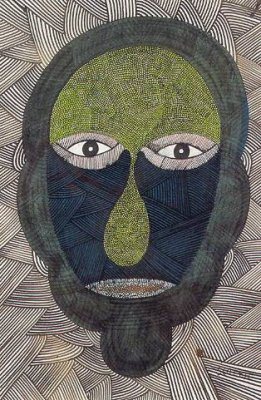
    Scottie Wilson, probably one of the better known Outsider Artists grew up in Glasgow before moving to Canada to set up a second hand store in Toronto.

    Wilson’s works are iconic within Outsider Art; and his unique cross hatching technique instantly makes them recognisable as Wilson’s. The work is usually centred around a face; which he called ‘Greedies’, which is surrounded by natural forms such as flowers or birds. His work is predominantly very bright, with clashing colours and thick black lines.His earlier work is much freer in terms of line, with his later work becoming more visible controlled with tighter, more intricate line detail.

    Wilson claims he felt compelled to paint after discovering a fountain pen in his store. He claimed he felt the urge to draw, or doodle, and never stopped since that day.

    Despite being considered an Outsider Artist due to his lack of formal training, Wilson became accepted into the Surrealist art scene on his return to London in the 1950s. His work was collected by Andre Breton and Picasso amongst many others. Often disinclined to part with his drawings, Wilson would curate exhibitions of his work on buses or in disused shop windows and would charge visitors to view his pieces.

  • Social and Political Theories of Alienation and the Appearance of ‘Madness’

    Germany, at the turn of the twentieth century saw major shifts from an agrarian economy to a modern industrial economy. Under Otto von Bismarck, who oversaw the unification of Germany in the late nineteenth century, the years 1870 until 1890 saw a huge period of transformation and an increase in Bourgeois power; these years were known as the ‘taking off period,’ or the Grunderzeit. During the first decades of the twentieth century, Germany experienced the apocalyptic destruction of war, and the rising social and economic upheaval of the Weimar period and as a result of this, German art appeared to mirror the tensions and divisions within German politics and society.

    One explanation for the changing process and apparent ‘insanity’ within modern art, particularly German Expressionism, is the ‘kunstwollen’ theory, or the “Immanent artistic drive.” This principle of ‘kunstwollen’ began with Alois Reigl and was extended by Wilhelm Worringer (1881 – 1965) in his thesis Abstraction and Empathy (1908), where Worringer claimed that the political and social contextual background at the time of the production of a work had a huge impact on the outcome; and, he claimed, this was the reason for revolving themes and styles within the art world. Worringer pushed the notion that classical art, such as Greek or Roman sculpture was the product of a harmonious society, whereas, in times of economical or political hardship, art would become much more angular; as seen in Dadaism, Cubism, Futurism, Vorticism, and to some extent, Expressionism. This thesis was popular amongst both the British and German avant-garde, and goes some extent of the way in explaining why German Expressionism was often particularly violent, angry and ‘insane’ just after the First World War. In Germany at this point, the relationship between the artist and his community was not harmonious, and political and economical circumstances were not favourable, therefore soft curves and pleasant colours were replaced with sharp, angular and complex works of art.

    During the nineteenth century, there was a definite drift towards a more materialist philosophy in the Western world. The emergence at this time of the social revolutionary works of Karl Marx, Sigmund Freud’s creative impulse theories and the Apollonian (idealist) versus Dionysian (realist) debate raised by Friedrich Nietzsche had a huge impact on the cultural avant-garde. These theorists and philosophers ultimately defined the world by what they could see, rather than with the optimism of idealism. This, of course, directly opposed the idealist philosophies of previous decades; of which Kant and Hegel were visionaries.

    This sudden progression of industrialisation and capitalism in Germany left German Expressionist artists feeling isolated and alienated from their own society. Die Brücke, founded in Dresden in 1905, had seen most of its members move north to Berlin by 1911. Max Weber claimed that human behaviour was being altered by the demands of industrialisation and capitalism. Stephen R. Marks also claims that alienation can be a considerable resulting factor of industrialisation and commercialisation; group life, particularly during times of industrialisation can cause group members to feel purposelessness or normlessness. Georg Simmel – interested in the modern urban individual – states that the metropolitan dweller must exaggerate his own personal qualities in order to be heard in the vast society of the metropolis.

    Primitivism, Lloyd claims, was used by German Expressionists to question values held by Western society. The use of primitivism in their work sees the Expressionists looking for inspiration from already alienated groups. Outsider Artists and primitive artists were already isolated from society, and somewhat untouched by industrialisation and capitalism. German Expressionists used similar techniques to portray their discontent with society and their rejection of modernity. Art and creativity, it seems, was an acceptable way for the alienated man to channel his discontent. Emile Durkheim’s ‘Theory of Anomie’ outlines this idea of alienation from society. Alienation is a feeling whereby the socialised man no longer feels a sense of belonging within his own community. This need to channel feelings of alienation in some form or another sees a similarity between Outsider Art and German Expressionism. Creativity was a socially acceptable way to challenge society and explore the alienation that one felt, and one that both Expressionists and Outsider Artists shared. Although Outsider Artists may not have been aware of societal and economic changes, they were still part of an alienated group within society, and because of this, German Expressionists could relate to their work.

    Social, political and cultural factors played a huge role in the shaping of German Expressionism as an art movement. It was wholly built upon foundations of discontent and the rejection of modernity, rather than technique or subject matter. Peter Bürger, in Theorie der Avantgarde (1974), confirms that contextual factors, predominantly social, political and economical factors, certainly have a profound effect on artistic style and subject matter.

  • Ismond Rosen

    (1924 – 1996): Psychiatrist, Psychotherapist, Psychoanalyst, Artist.

    Born in 1924 in Johannesburg, Rosen was just six years old when he began making clay figures in the style of his African neighbours. Although particularly talented and creative, his parents insisted that his academic talent was far more important. So, at the age of 17, Rosen went to train at Wits Medical School.

    Despite studying academically rigorous medicine, Rosen realised that he need not leave his passion for creativity behind. He decided that the two did not have to be mutually exclusive and during his placement at a Community Health Centre he began to make sculptures of the patients and staff.

    After coming to England in 1951, Rosen travelled to Paris where he studied at the Academie Julien and the Ecole des Beaux Arts. After working at the Maudsley & Bethlem Hospital in England for 6 years, Rosen began to specialise in sexual deviation and psychiatry whilst also training as a psychoanalyst.

    The 1970s were very much Rosen’s ‘creative’ years. He had begun running his own private psychotherapy practice, but during his spare time he was devoted to his art. He created works for an exhibition at the Camden Arts Centre and even wrote papers for huge art institutes in London on Richard Dadd and Otto Dix.

    One of Rosen’s most prominent sculpture, Civilisation, can be found in South Africa’s National Botanical Gardens

    .

  • Eric G. C. Weets

    This is Eric. G. C. Weets producing some of his fascinating work. For more information on the artist himself, please visit: http://ericgcweets.weebly.com/index.html

  • Definitely a must see – also, have a look at my article on Richard Dadd which explores the common fantasies regarding art and madness.

  • Introduction to the Links and Similarities Between German Expressionism and Outsider Art

    I am going to begin a series that looks at the links and similarities between German Expressionism and Outsider Art particularly between the years of 1905 and 1945. This will include contextual factors, pre-world war one, the Weimar period and then finally, the Degenerate Art exhibition organised by the National Socialist Party in Germany. Here is the first installment… just a quick intro…

    German Expressionism, rather than being a distinct movement, with clear defining factors, was in fact the result of a whole host of contributing factors. Expressionism, similar, in fact, to Outsider Art, had no essential programme; instead, it was identified by content. David Elliott describes it as “paradigmatically asocial, the voice above all of the individual.”

    When discussing the time period that German Expressionism spanned, it is important to define two key words at the forefront of German vocabulary at the time. The birth of a new Europe, industrialisation, modernisation, and social and economical change all define the era in which this movement was prevalent; these all characterise the spirit of the time, or Zeitgeist. Another German word, Kultur, which has no direct links with the broad English term culture, is also important when discussing German Expressionism. Kultur implies that which is generically German; seen during the reign of the National Socialist Party as superior to that of other nations. Kultur can be seen as bringing the individual and wider society together by providing mutual interests.

    The birth of modernisation, which was spreading rapidly throughout Europe at this point, was the source of discontent for many and the continual growth of towns and cities often led to the public feeling isolated and alienated from the rest of this ever expanding society. This feeling of alienation was noted by many sociologists, psychologists and philosophers at the time, including Georg Simmel and Max Weber; it can also be seen described in much of Karl Marx’s work. The sense of alienation felt by many in a way turned them into outsiders; much like the Outsider Artists of the same period.

    Artists at this point were becoming aware of Outsider Art, and were taking aspects of these works to inspire and enhance their own creations. Exhibitions of this art were being held for the first time, drastically changing the attitude of the public towards minority groups, such as the insane; finally, the ‘madman’ was becoming the romantic ideal.

    Max Beckmann, a German Expressionist artist, can be seen relating to the work of outsider artists in his Self-Portrait with a Saxophone of 1930, in which he is almost representing himself as an outsider. The painting shows Beckmann slouched, clutching a saxophone below waist height, wearing very basic clothing. The artist appears distant and melancholic, with the painting portraying an overall sense of confusion and bizarreness. What Beckmann appears to be looking for is a new language for continuing contextual dilemmas. German Expressionists looked to convey certain aspects of outsider art in their own quest to create a language that was undoubtedly a critical response to contemporary political and social problems. The first exhibition of Expressionism in 1906 goaded the public and art critics to assume that the artists were of ill mental health, and it is obvious that Expressionist painters were in fact trying to imitate the often closed off worlds of the mentally ill.

    The idea of alienation is a mutual factor of both German Expressionism and Outsider Art. Fired by a feeling of discontent with their current world, the German Expressionists sought something much more original and primitive to inform their works, and it seemed Outsider Artists could effortlessly achieve this much-desired uniqueness. German Expressionist art was not ‘insane;’ rather, it was reflecting the contextual tensions and conflicts occurring within politics and society in Germany at the time. To portray this conflict, a new style was needed, and Expressionists looked to the originality of Outsider Art for inspiration. The exploration of madness, alienation and discontent within the works of German Expressionism is one that is inevitable due to the political strife and social instability of the time, and it seems apt to look at ‘madness’ in terms of those who were often in fact clinically insane; the Outsider Artists.

     Max Beckmann, Self Portrait with a Saxophone

    Follow me on twitter!: @kd_outsiderart

  • Vojislav Jakic

    Vojislav Jakic

    I thought I would begin a little feature, where every week I include a short biography and some works from various ‘Outsider Artists’. Today, I am going to begin with the work and life of Vojislav Jakic.

    Vojislav Jakic (1932-2003)

    Moving to Montenegro from Serbia when he was three years old, Jakic was the son of a strict Serbian Orthodox father. His brother and sister died from scarlet fever and diphtheria respectively and his father’s profession was frowned upon by communist authorities; he was an ‘outsider’ even at school. Experiencing poverty in his early life, Jakic managed to scrape together money by painting portraits of the dead for their grieving families. He often created these portraits using the deceased’s passport photographs and it was during his time creating these works that his exceptional drawing talent was really first identified. Jakic left for Belgrade in 1952 where learned how to draw and sculpt.

    In 1970, Jakic produced his semi-autobiographical book entitled Nemanikuce (Homeless), where themes of suffering, pain and death were prominent. His paintings continually focused on similar themes, filling the pages he worked on completely. This concept of leaving no area of the page untouched is something that is commonly found amongst the works of ‘Outsider Artists’. It suggests a compulsion to fill every gap; to leave no free space – perhaps, much like the thoughts inside our brain.

    Jakic most typically created impressive, large scale pieces with ballpoint pen, pastels or gouache. The pieces were principally nightmarishly dark in the content, focusing on motifs such as human insides, insects, death and bones. His paintings are raw, portraying the suffering and fear of death he felt as a person. One of his works he describes as being ‘neither a drawing nor a painting, but a sedimentary deposit of suffering.’

  • Can the work of Richard Dadd be seen to stand outside of the popular fantasies about art and madness?

    David Maclagan, in his text The Art of Madness, discusses the myths surrounding madness and art. He claims that there are assumptions that many people make about artists in general, with the common idea that all those who create art tend to have some kind of psychotic tendency. The first idea that many hold regarding artists is that they feel more intensely than the average person, that they are hyper-sensitive, and tend to live in a world of their own. Many have the notion that artists ‘suffer’ and this suffering is often seen as a trigger for their work. These assumptions about artists link in very closely to the assumptions made about those who are mentally ill. The mad person is alleged to be a victim of very strong emotional feelings, like the artist. Artists are imagined to obsessively create and psychotic art is traditionally thought of as ultimately being driven by an even larger compulsion.

    French artist Jean Dubuffet noted that works of art that are described as ‘Art Brut’ or ‘Raw Art’ were “created from solitude and from pure and authentic creative impulses.” Outsider art, or raw art, as Dubuffet defines above, is a much discussed area within psychoanalysis and art, as outsider art is a key link between the two, as the majority of institutionalised patients are untrained ‘outsider’ artists. There is much debate as to whether madness, or a mental illness, can compel a person to create art, or whether they create art in spite of their illness, with continuing evidence linking the creation of art with mental health problems, whether it is a compulsion, or used as a personal therapy. There is evidence that creative people often have a history of psychological problems within their family, for example, the author Virginia Woolf suffered sexual abuse in her childhood. Psychiatrist Kay Jamison studied the lives of famous artists, poets and musicians in 1992, and found a strong link between disorders such as bipolar disorder and creativity or artistic achievement, and David Maclagan, writing in his article The Art of Madness, states that madness can act as an extreme form of inspiration, and can result from, as well as be a cause for, creating art. He goes on to state that many artists have a working relationship with madness.

    The beginning of the nineteenth century saw the awakening interest in insane art. The Romantic Movement saw madness as liberating, and the emergence of asylums saw a place for those who were mentally ill to be able to produce art. Plato originally equated madness with genius, and it was becoming logical to ask whether mad people created works of genius. Many branches of ‘insane’ art were developing, such as Surrealism, where artists were inspired by Freud’s texts on the unconscious and dreams. Bethlem Royal Hospital, opened for the insane at the end of the 14th century and currently located in Beckenham, Kent, has a museum and archives full of work created by its patients from over the centuries. The hospital’s archives and museum focus on the link between madness and art. The work shown is by patients who fitted into one of the three following categories; the first being artists who communicated mental distress through their work, the second, patients for whom art contributed to their recovery, and thirdly, artists who became mentally ill. It is within this third category that the artist Richard Dadd would be placed. He was a patient at Bethlem Hospital for many years, before being transferred to Broadmoor, probably due to overcrowding, and it is him and his work that this blog will predominantly focus on. When looking at art and psychopathology, or mental illness, Dadd is a popular focus, due to the significant amount of art work he produced after he was diagnosed with what was suspected to be schizophrenia. However, Dadd was a previously trained artist, before his admittance to Bethlem Hospital, placing him in the minority of mentally ill artists.

    Richard Dadd, born on the 1st of August 1817 in Chatham, was the fourth of seven children. His mother died in 1824, aged just 34. He was born into an intelligent, literate and liberal family and began to draw seriously at the age of thirteen; however, little of his work has survived from before he received his more advanced training. In 1842, Dadd set off on a tour of Europe and the Middle East with Sir Thomas Phillips, who had employed Dadd to document their journey. It was on his return from this journey that Dadd’s mental health was questioned. One friend found him after he had cut out a birth mark, claiming the devil had printed it on him. The once sensitive young man became increasingly suspicious and reserved, and was convinced he was being watched. Although his mental state was becoming increasingly unstable, he continued to paint images which barely showed the turmoil within his head. At around this time, Dadd’s twenty-six year old brother was showing very similar signs of insanity. Although Richard seemed to be increasingly ‘losing his mind,’ it was one single act that saw him admitted to Bethlem Hospital. A few days after a Psychiatrist had warned Dadd’s family that they must be careful with him, Richard’s father, Robert Dadd, suggested they take a trip together. They travelled to Cobham, where they stayed at an inn. Richard’s sister was concerned that her father would be alone with Richard, in his increasingly unstable state, but her warnings were too late, after Richard and his father went for an evening walk, where Richard violently attacked and killed his father using a knife and razor blades he had bought earlier.

    It was after this incident that Dadd was admitted to Bethlem Hospital. It is thought he suffered from paranoid schizophrenia, which research has shown can be triggered by a disturbed family environment during childhood. However, it seems that Dadd had a relatively normal and well adjusted childhood. Dadd even wrote to his brother, remembering his childhood, “I call to mind that childhood the brightest of our brief span here below soon passes away”. However, there is some evidence of disruption during Dadd’s childhood, for example, the death of his mother, and the consequent remarriage of his father. Also, the nature of the relationship between Richard and his father has been questioned. Robert Dadd, Richard’s father, was seen as a very powerful figure.

    After he was admitted to Bethlem Hospital, to the public, he was ‘the late Richard Dadd,’ but it was during the next forty-two years that he would create some of his greatest works. Allderidge writes of these years, with many historians writing that he only survived these turbulent years because he survived as a painter.

    Psychotic art is seen as offering us a window into private worlds of delusion, hallucination or delirium. With much of Dadd’s work which he created after his admittance to Bethlem, we are able to locate some, if not obvious, turmoil and mental distress, possibly due to the fact that most of his work during these years was completed from his imagination, as he had no contact with the outside world, therefore no opportunity for any new material. His series of paintings Sketches to Illustrate the Passions created during the 1850s illuminates for us some of his inner world. One sketch in this series, Hatred, painted in 1853 depicts the murder of Henry VI by Richard of Gloucester. This is a scene very much like that of his father’s murder. The Duke almost represents a self-portrait by Dadd. It is quite a disturbing image, and could possibly only have been imagined by someone who had experienced what Dadd had. Sigmund Freud argues that art acts as a fantasy world, one that cannot be described as real. The wishes expressed within an artwork are wishes and fantasies that are repressed; they are unacceptable to the conscious mind. We are intrigued by art, therefore, because we are able to view someone’s unrepressed wishes and fantasies. The wishes shown within an artwork are acceptable to our conscious minds because the fantasy loses its egocentric character. The wish is partly disguised, and the aesthetic pleasure derived from the art takes our attention away slightly from the underlying repressed fantasy. These repressed wishes expressed within artwork can give us an insight into someone’s inner world, highlighting why interest in ‘mad art’ is always increasing.

    Art created by the mentally ill is unique in the way that the artist often has no link with the outside world. This is very apparent in the work completed by Dadd during his time in Bethlem, and also Broadmoor. He may have been involved in art movements such as Pointillism, had he had access to art from the outside world, as his later work relies very heavily on small detail, and he often used a very thin brush, with only one or two hairs to paint with. In the last forty years of his life, Dadd had no female models, so many of his later female characters appear very masculine, with strong arms and strong jaw lines, for example, Lucretia, painted in 1854.

    Richard Dadd’s return to painting during his time at Bethlem is thought not to have been due to a return of sanity, as he continued to remain delusional. Edward Monro (1759 – 1833), was in charge of Dadd’s case at Bethlem. His father, Thomas Monro, was friends with artists such as Turner and Gritin, and probably would have known of Dadd’s artistic history. There is evidence that Dadd appeared to feel some kind of compulsion to create the art, and after W.C. Hood was appointed the new Resident Physician Superintendant in 1852, Dadd’s art was seen as part of his therapy. Dadd was able to work out his fantasies on paper, and this may have been one of the predominant factors in his mental state not deteriorating any further. It seems that Dadd and those who were working with him in the Bethlem Hospital saw his artwork as an escape from, or a release for his delusional thoughts. Despite Hood’s interest in encouraging the continuation of Dadd’s creativity, Dadd never received any formal art therapy, which may have been given to patients later on, such as William Kurelek, famous for his painting The Maze, who did however, receive formal art therapy.

    It is thought that Dadd’s schizophrenia definitely gave a free rein to his imaginative ability, making the works he produced after his incarceration of much interest. However, it is interesting to compare the content and form of the work he produced before his hospitalisation, and afterwards. There is nothing overly-chaotic about the appearance of Dadd’s work, even after his incarceration. The typical signs of a ‘chaotic’ work might include fragmentation, unmixed colour and disintegration. So it seems that Dadd’s mental illness had little impact on the work he created after his confinement, possibly due to his very high technical ability as an artist. His previous formal artistic training means his mental instability may not have been the reason for his compulsive creativity, as is the case with many trained artists who are hospitalised. Although Dadd created more watercolours, larger pictures and less portraits post-hospitalisation, his works before and after the onset of his mental illness are very similar. Dadd belonged to what is known as the ‘Fairy School of Painting,’ as some of his most famous paintings, including The Fairy-Feller’s Master Stroke include mythological creatures, however, mythological creatures were also present in much of his work before his hospitalisation. Dadd often had delusions about the devil during his time in hospital, and would often attack his ‘friends,’ but this mental turmoil was never overly apparent or obvious in his work. His work, post-hospitalisation, included more people and animals, but definitely had a much more obvious depressive tone to it, such as his Sketches to Illustrate the Passions.

    However, despite this apparent lack of obvious emotional turmoil within his work, Dadd’s series Sketches to Illustrate the Passions does include some disturbing paintings. For example, his Sketch to Illustrate Agony or Raving Madness might possibly show us a link to how Dadd was feeling being ‘locked up’ in a mental hospital. The picture shows a man in chains, clutching his head, obviously imprisoned. His Sketch to Illustrate Murder shows a similar internal anguish, depicting a man clubbing another man to death. Although, despite the few paintings that do show us evidence of mental anguish, many of his paintings completed during his hospitalisation were of his travels around Europe and the Middle East. Portrait of Sir Thomas Phillips in Arab Dress and Portrait of Sir Thomas Phillips in Turkish Dress, are probably developed from his sketches made during his travels, and therefore leave little room for Dadd’s imagination, and therefore his mental instability, to become apparent.

    There is a belief that Dadd was an ‘ordinary’ painter before the onset of his schizophrenia, but the mental illness set loose his imagination and his creative side, enabling him to produce some of his most successful and famous work during his time as a mental in-patient. His most famous work The Fairy-Feller’s Master Stroke is evidence of this. Although his work differed very little before and after his hospitalisation, his work post-hospitalisation is what he is remembered for. His mental anguish and turmoil is not overly obvious or apparent in the content or form of his work, but some of his pieces depict disturbing images that possibly could only be imagined by someone of mental instability, such as Dadd. It seems apparent that his mental illness was not the reason he created art, due to his prior formal training, and the evidence that he had created art before he became mentally unstable, but it is obvious that the continued creation of work during his confinement enabled his mental illness to plateau and not deteriorate any further. His art acted as a personal therapy, and Hood noticed this and continued to encourage it, although Dadd never formally received any art therapy. Dadd predominantly differs from outsider artists due to his early formal art training, and his case dispels many of the myths about what psychotic art looks like, and the reasons behind why mentally ill patients are thought to create art. However, it does seem that he did not just create art to pass the time, and that to some extent; he was compelled to create his work. However, there is not sufficient evidence to suggest that he created the work he did after his incarceration because of his mental state; an assumption associated with numerous mentally ill artists.

     Follow me on twitter: @kd_outsiderart

  • Chasseguet-Smirgel and the Relationship between Sublimation and Perversion in the Context of Artistic Creativity

    There is, without a doubt, a strong relationship between sublimation and perversion, as Janine Chasseguet-Smirgel investigates in her book Creativity and Perversion (1984). ) However, sublimation is more strongly linked with intellectual curiosity and creativity, where energy is directed into more cultural activities. Perversion, on the other hand, is associated with aestheticism and idealisation. There is often conflict between perversion and sublimation, and they are very closely associated. With perversion, a repressed thought is idealised, to make it acceptable to the waking ego, whereas with sublimation, repressed sexual energy is funnelled into more cultural activities. 

    Chasseguet-Smirgel argues that if we imagine that it is possible for various personality characteristics to coexist, this conflict between perversion and sublimation would be greatly reduced. The three areas which Chasseguet-Smirgel claims can co-exist are the following; firstly the area of perversity, which is characterised by sexual activity and is neither repressed nor sublimated. The second, the neurotic area, indicates repression; often of sexual instincts, and finally, the area where sublimation occurs. This distinction between sublimation and perversion is obvious when viewing art created by one who is suspected to be pregenital. Aestheticisation and idealisation characterise the work of the perverse artist, and it is the nature and role of this, that will be discussed in this essay, as well as a look at the conflicts and the relationship between sublimation and perversion. 

    Chasseguet-Smirgel argues that an absent father and the presence of a strong maternal influence where the child believes – in terms of Freud’s oedipal complex – that he is already a suitable sexual partner for his mother, can lead to perversion. The child is then trapped in the pregenital stage, believing that he does not have to identify any further with the paternal figure as this anal stage creates the idea that everything is equal. Faeces and anal sexuality are common to everyone, regardless of their sex or age. The pervert is always threatened by the discovery of this pregenitality, and therefore feels a compulsion to idealise to prove the superiority of his sexuality. Idealisation acts like a mask; it is a mechanism to shroud the anal sexuality of the pervert. The perverse ego must be surrounded by objects and stimuli that reflect a flattering image onto the ego, and art provides one way of doing this, in its decorative form. However, the stark truth of the pervert’s pregenitality lies just below the surface of the mask of idealisation; it is not completely repressed and can resurface. For example, Chasseguet-Smirgel writes of a patient who dreamt of covering a pile of logs in silver paint to idealise them, but the logs’ inner nature was unchanged, and could be discovered if the surface was scratched.

    Perversion involves knowing what is repressed and actively wanting to repress this, a term named negation (Chasseguet-Smirgel, 1984). Sublimation, however, when completed successfully means that there is no concern that what is repressed will be discovered. With sublimation, an instinct, most often a sexual one is modified to be socially acceptable. Norma O. Brown also voices Freud’s claim that desexualised intellectual curiosity is linked with childhood sexual curiosity, and that if this sexual curiosity is interrupted or prevented, it can develop in three ways, the first being repression. Secondly, it can be replaced by intellectual investigation, and, thirdly, perfect sublimation can occur.

    Freud’s study on Leonardo Da Vinci and his childhood (1984) is a good illustration of how sublimation has an effect on an artist and their work. Leonardo spent the first few years of his life living with just his mother, who is thought to have pampered him. Freud claims that Leonardo became fixated on this image of his mother, and any sexual feelings were repressed due to the act of sublimation. Freud makes links between much of Leonardo’s work and his childhood. For example, Freud claims that The Virgin and Child with Saint Anne is a depiction created by Leonardo of himself with his two mothers; his biological mother and his step mother, where he is shown as Christ, who he often identified with. Leonardo became increasingly concerned with investigation and knowledge, which at first was a means to improve his painting, but eventually became a compulsion and overwhelmed him. As a consequence, he was often unable to complete his work. Leonardo is thought to have not been in any way inclined towards sexual activity, and this is obvious in his art, which, unlike other great painters, did not contain any erotic works. Leonardo’s pregenitality is not obvious in his work, marking a fine example of a successful sublimation.  

    Whereas sublimation can lead to creativity and a desire or compulsion for knowledge, perversion can lead to strong aestheticism and idealisation. Pregenital perversion and aestheticism is apparent in the work of Gilbert and George.  It is common for pregenital perverts to create their own cosmology or a God-like status and when interviewed by Wolf Jahn, Gilbert and George claimed that “we are searching for the truth. There is a human God and we are it. We have got to do it, if not we are all lost.” Gilbert and George also described themselves as ‘Dandies’; a ‘Dandy’ being an individual who wishes  to create beauty within his own person. This idea of recreating beauty in themselves and their work clearly shows the failure of sublimation. Their work often depicts unsavoury objects made to look beautiful, such as Ill World (1994). Linking back to Chasseguet-Smirgel’s patient who covered the logs in silver paint, Gilbert and George mask unpleasant images with decoration in their art. 

    Gilbert and George have tried to avoid people delving into their biographical pasts, but as pregenitality is characterised by the denial of paternal authority, it is interesting to note that on the occasions they have spoken about their past, they both make it clear that they had absent fathers and a strong maternal influence, which could explain the apparent aestheticism within their work and their obvious pregenitality.  

    Gilbert and George were both opposed to particular emerging modernist art movements, such as the ‘Fluxus’- the Latin for ‘to flow’ – Movement.Gilbert and George saw the Fluxus Movement as untidy and unclean, a polar opposite to the structured, clean work they both created. This need for cleanliness highlights the aestheticisation and idealisation that occurs within perverse art. The compulsion to idealise insists that the pervert must create a work that is at least visually beautiful on the surface, even if something more unpleasant lies just below. 

    Gilbert and George do not commonly representent women within their work, and there is a clear disregard for the significant difference between male and female. This is a trait of perverse work, as the difference between the male and the female is not signified, linking back to Chasseguet-Smirgel’s notion that anal sexuality can be common to everyone, whether they are male or female, and despite generational differences. This interest in faeces and anal sexuality which the perverse would consider to be superior is obvious in much of Gilbert and George’s work, for example, Eight Shits (1994) and Naked Shit Pictures (1995). The pregenital pervert will reduce everything to excrement, as this is something common to him and all others around him, unlike genital sexuality. 

    After looking at these examples of the relationship and conflicts between perversion and sublimation, it is clear to see that the distinct difference between the two is the fear that the repressed instinct (more often than not a sexual one) will resurface. Successful sublimation ensures that this will not happen, and instead, the sexual energy is forced into creativity and investigation, as shown by the Leonardo case study. The pervert, however, is constantly aware that this repressed instinct may return, and instead surrounds himself with that which is aesthetically pleasing, so that what is reflected onto the ego projects a pleasant, if untruthful, image. The pervert masks his inner pregenital anal sexuality with that which is agreeable to the Ego Ideal. This idealisation means that for the time being, the pervert does not have to be concerned with the resurgence of his anal sexuality, until the surface is scratched. The role of aestheticism for the pervert is extremely important. It ensures they remain, what they believe to be, equal to those with a genital sexuality. Gilbert and George are a prime example of how the pregenital pervert can use art to create an Ego Ideal, and indulge in their compulsion for aestheticism. Art is a useful tool for the pervert to mask his anal sexuality, and Chasseguet-Smirgel notes that there are a greater number of perverts involved in art than the average for the general population. Therefore the role of aestheticism is crucial in the compulsive idealisation of the pregenitally perverse.

     Follow me on twitter: @kd_outsiderart

  • Gericault’s Monomaniac Portraits

    Gericault’s Monomaniac Portraits

     Although not strictly Outsider Art – I thought I would write a little bit about Gericault’s series of Monomaniac portraits, as they provide some insight into the changing ways mental health problems were viewed in the nineteenth century. 

    Gericault’s Monomaniac series once consisted of ten portraits of the mentally ill, however, only five have survived into the present day. The surviving paintings include the Monomanie du commandment militaire (Napoleonic veteran suffering from the delusion of military authority), Monomanie du vol des enfants (A compulsive kidnapper), Monomanie du vol (A kleptomaniac), Monomanie du jeu (A compulsive gambler) and Monomanie de l’envie (A woman suffering fits of neurotic jealousy).

    The term ‘monomania’ was first coined by French psychiatrist Jean-Etienne Esquirol, and it was an exclusively nineteenth century term referring to a person who was outwardly well, but harboured one obsessive fixation. The portraits themselves and the context within which they were painted raise many questions regarding the state of psychiatry and the treatment of the mentally ill at the time, the public’s view of the mentally ill, the progression of science and the morbidity and tragedy that art encompassed during this period. The reason for the portrait’s creation can be interpreted in a number of ways, ranging from the rarer thought that it was encouraged as a therapeutic exercise for Gericault by his psychiatrist, to the more widely received idea that the paintings were produced as part of a commission from psychiatrist Dr Etienne-Jean Georget. 

    In terms of psychiatry and the treatment of the mentally ill, the nineteenth century became, in theory, the century of the asylum. Before this period, in the eighteenth century and earlier, madmen had been incarcerated in overcrowded, abusive madhouses, alongside criminals and the terminally sick. The call for reform in hospitals such as these madhouses had emerged as early as the mid-eighteenth century; however, nothing was put into motion due to a fear that the public would disagree with a more humane and kinder treatment and attitude towards the mentally ill.The focus on the mentally ill was brought about by the French Revolution, which seemed to promise freedom and liberation for all those belonging to minority groups, and was somewhat responsible for the ‘unchaining’ of the insane.

    It was Philippe Pinel, to whom the Revolution opened up a career in psychiatry, who provided the first instance where insanity had been depicted as having an external appearance. The prevailing theme within psychiatry throughout Pinel’s career was that a mentally ill person’s mind and body could not be separated; they were both equally affected by the illness. Jean-Etienne Dominique Esquirol, who coined the term monomania, was a disciple of Pinel. Esquirol laid out the idea of monomania in his 1819 article, published in the Dictionnaire des sciences medicales, and, at the time, monomania was widely assumed to have been brought on by the failures of the Revolution.

    However, it was Esquirol’s gifted student, Etienne-Jean Georget, a psychiatric intern at the Salpetriere Hospital in Paris, who first suggested that monomania could be used as a defence in the courtroom. Georget insisted that monomania could not be seen by the everyday-eye; unlike Pinel and previous psychiatrists who believed that by using common sense, anyone could visibly tell a mentally ill person from the perfectly insance. Georget believed that it took a professionally trained eye to diagnose a patient with monomania.

    It was Georget who commissioned Gericault to paint several of his patients suffering from monomania at the Salpetriere Hospital, the most likely reason being that the portraits would provide a learning tool for his students. Medical illustration had been around long before Gericault’s portraits, with Esquirol commissioning painters and sculptors to create the faces of the mentally ill for publication, but the monomaniac portraits lay in a separate box to these previous drawings; they live somewhere between medical illustration and traditional portraiture. When seen from a distance, the portraits appear to be fine examples of traditional, conventional nineteenth century portraiture; it is only when we move a little closer that we can see that these are something different. Gericault’s aim was to portray the dominant factors apparent in the face of a monomaniac that would enable a trained specialist to make a diagnosis; to do this, emphasis is placed on the features of the face, predominantly the eyes and mouth. However, he did not wish to depict them as mad in the traditional sense and because of this the results are hauntingly factual, unsentimental representations of the insane – some of the first of their kind. The portraits show the sitters looking straight past us, their gaze searching for or focusing on the object of their fixation, unaware that they are being observed. The male portraits are much more traditional; the sitters could almost be clients of Esquirol’s private “maison de santé”, whilst the female monomaniacs are shown as much more dishevelled; slumped, ill-dressed and mournful – undoubtedly patients of the Salpetriere.

    It is interesting how Gericault has not created a backdrop behind the patients; no hospitals, no doctors and no wards that would enable us to mentally put these people within the confines of a mental hospital, and they are not performing any particular task or activity that might invite us to see their insanity. By doing this, Gericault has created mentally ill individuals, rather than a prototype for the ‘madman’ –  much as Goya did with his depictions of the madhouse, for example, his Los Caprichos, which show an almost “inhuman delirium.” What is noticeable within Gericault’s portraits is the way the face is almost lit up, whilst the body of the figure drops into the background. This enables us to think of monomania as a mental illness, that has no association with or impact on the body. The careful way in which the patients are dressed suggests that the act of posing for the portraits may have provided a therapeutic diversion for the patients themselves, as well as providing a learning tool for Georget’s students. By undertaking this commission, Gericault was essentially a part of the process that took place during the nineteenth century which altered the general public’s view of the clinically insane.

    The monomaniac portraits are not the first example of Gericault’s interest in the victims of social injustice. His Raft of the Medusa, painted between 1818 and 1819, depicts the plight of those who fell victim to “incompetent leaders,” and his studies of the English poor, who roamed the streets during his visit to England, for example, the lithographs A Paralytic Woman and Pity the Sorrows of a Poor Old Man, contain similar characteristics to the monomaniac portraits; particularly when concentrating on the clothing within the pieces. When considering someone worthy for the task of depicting the traits of the monomaniac, Georget, although knowing Gericault personally, possibly also considered the artist’s previous associations with painting the less fortunate as a contributing factor as well as considering the artist’s previous involvement with hospitals for the mentally ill.

    Gericault had become the first well acclaimed artist to complete a task that had previously been undertaken by mechanical executants, and so by doing this he had raised the status of the insane individual as well as bringing the depiction of the insane to a new higher level. Previous artists, such as Goya, had simply depicted the madman acting in a way that we would only assume a madman would behave; however, Gericault has created intimate portraits, which portray the insane individual exactly as they appear in life. By doing this, Gericault began to blur the line between the normal and the pathological. The portraits can be interpreted simply as a learning tool for Georget’s students, or, possibly more correctly, they can be interpreted as an illustration of the period of change that took place during the nineteenth century in terms of the perception of the insane. No more chains, no more incarceration, just the acceptance of the insane man as an individual.

    Gericault, through his fascination with the victims of social injustice, was well suited to the task in hand, and, when the portraits were finally made public, undoubtedly helped with the progression of a more humane treatment and attitude towards the insane. 

    Follow me on twitter: @kd_outsiderart