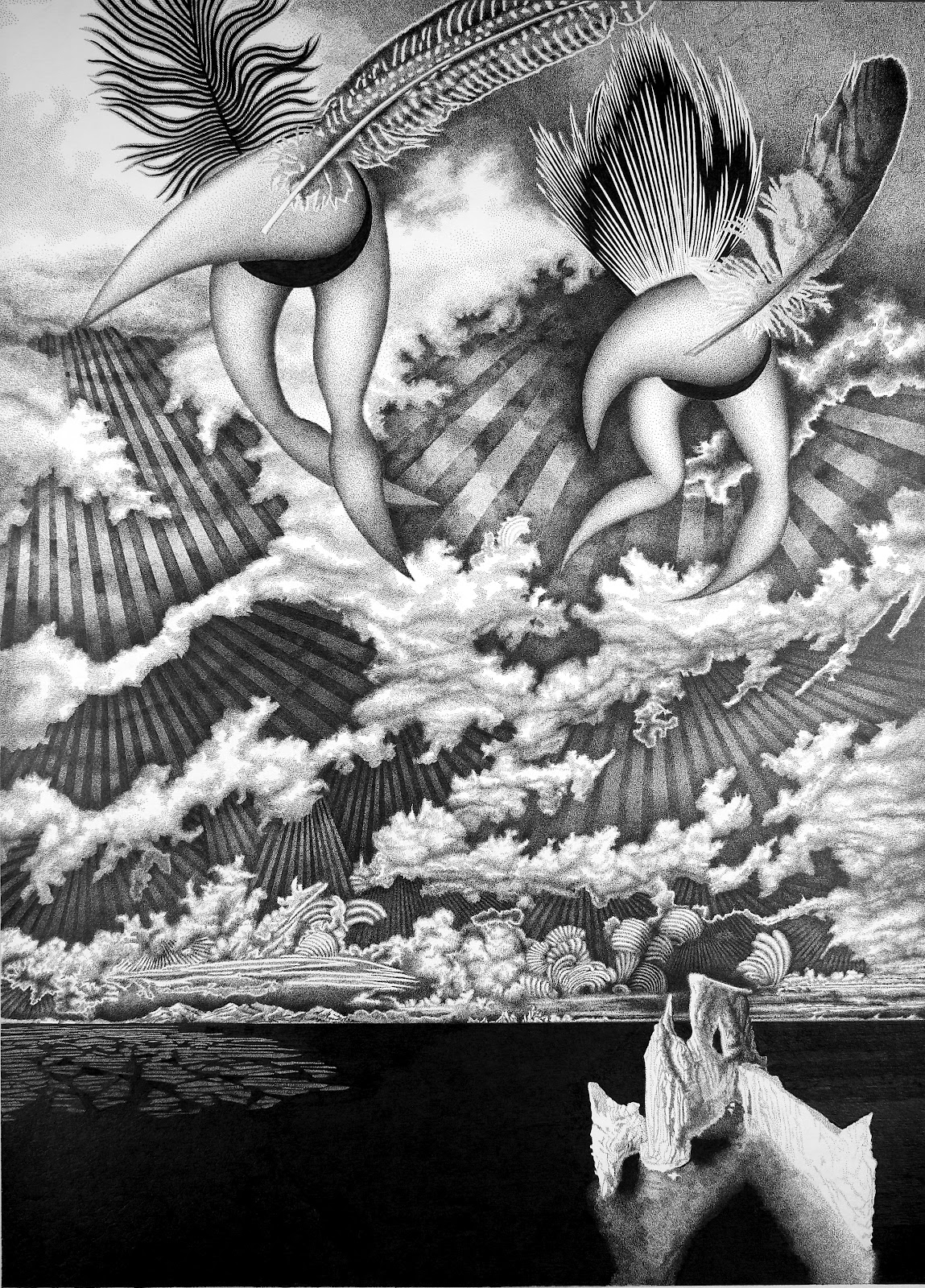
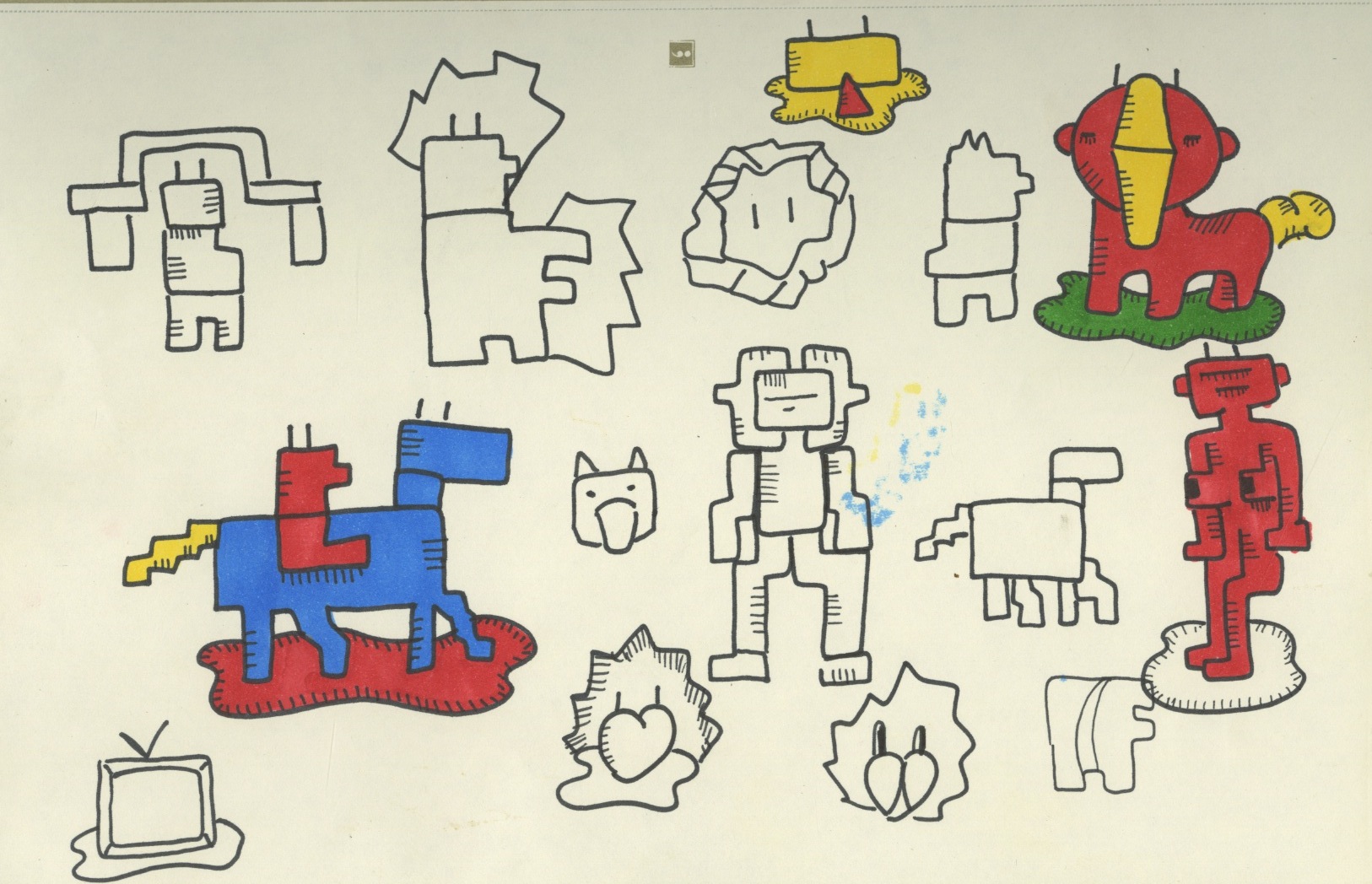
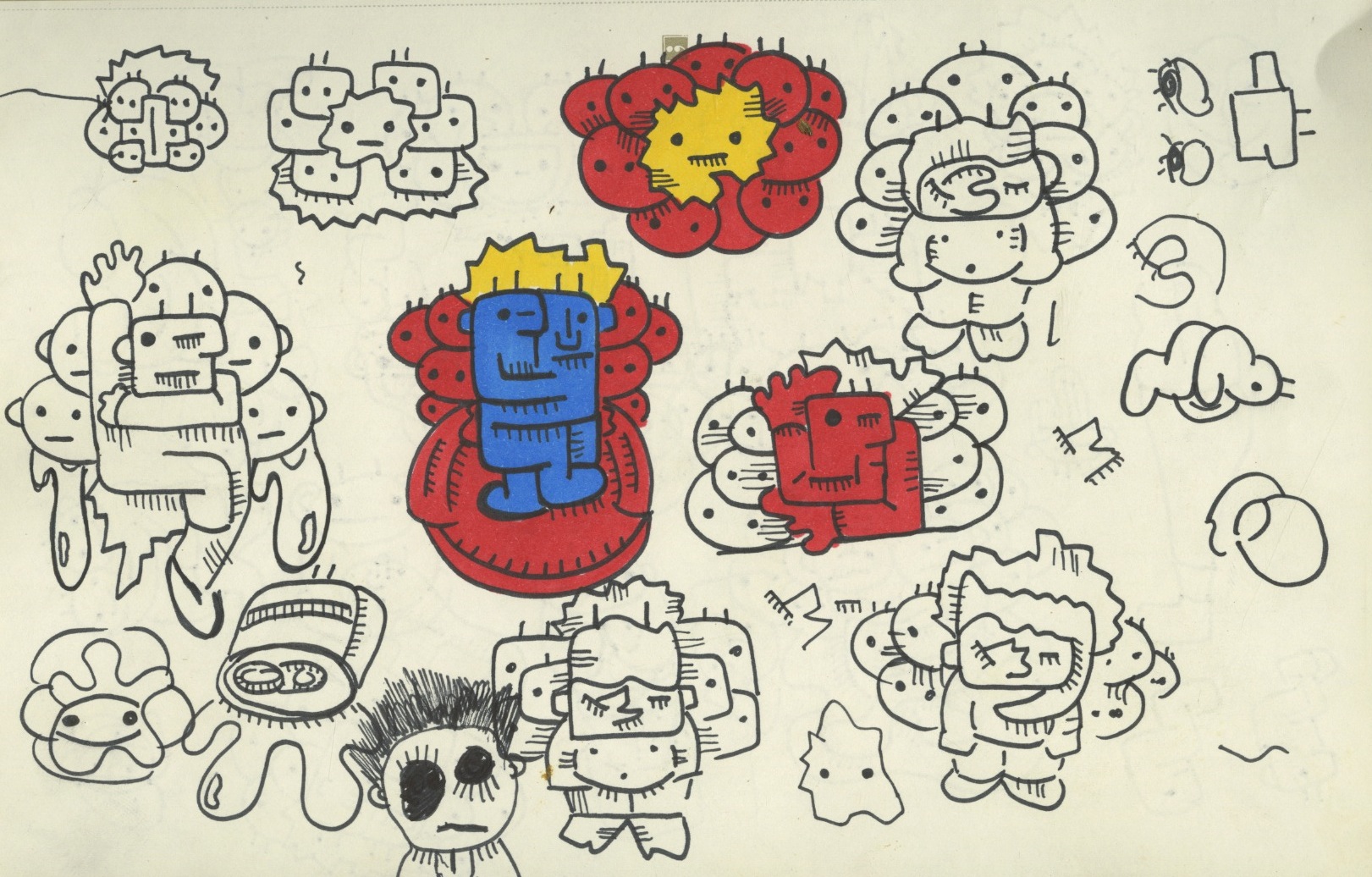
Mark Gregor (born Marek) studied at Falmouth School of Art to gain a BA Hons in Fine Art before working in Bristol taking commissions for reproductions of Old Master paintings for interior designers and architects. In 1990, Mark had major brain surgery for an aneurysm. He continued to produce his work in his flat up until his death in May 2014. His incredible pen drawings bring creatures of the imagination roaring to life and bounding off of the page. Take a look at some of these extraordinary works below.
Pen on paperPen on paperPen on paperPen on paperPen on paper
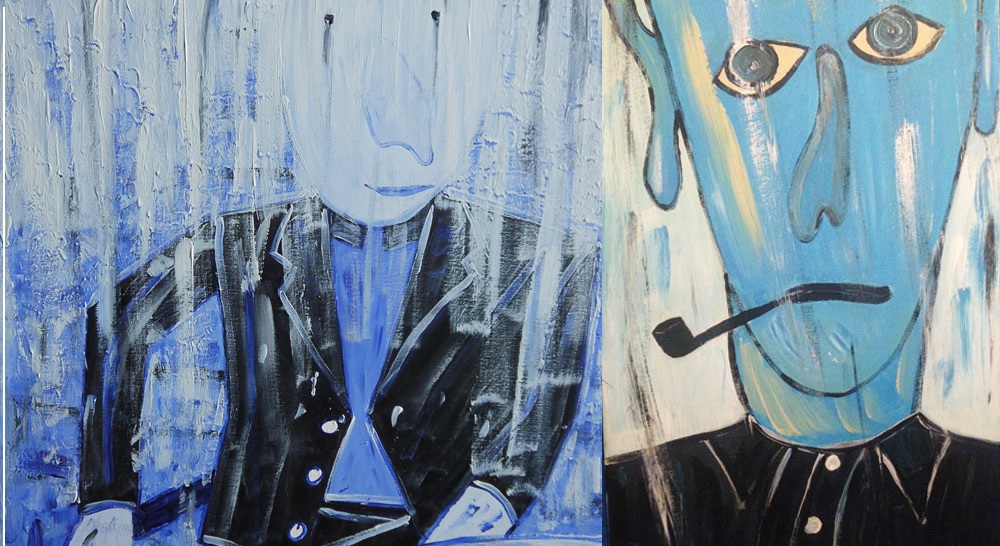
Above images: Jelly Buckingham, Ghost & The Smartest Eye
Jelly Buckingham works with acrylic on canvas. Mister Jellington usually likes to work late at night, and quenches his mind with copious quantities of sweet tea, water mixtures, the endless gurgle of 100m deep whirlpools of paint, and surreal landscapes created by melodic sounds. Sometimes he listens to the same song up to fifty times during one session to maintain mood and momentum. Each painting is a very organic process and Jelly is primarily concerned with capturing not only a certain character but a specific feeling and mood.
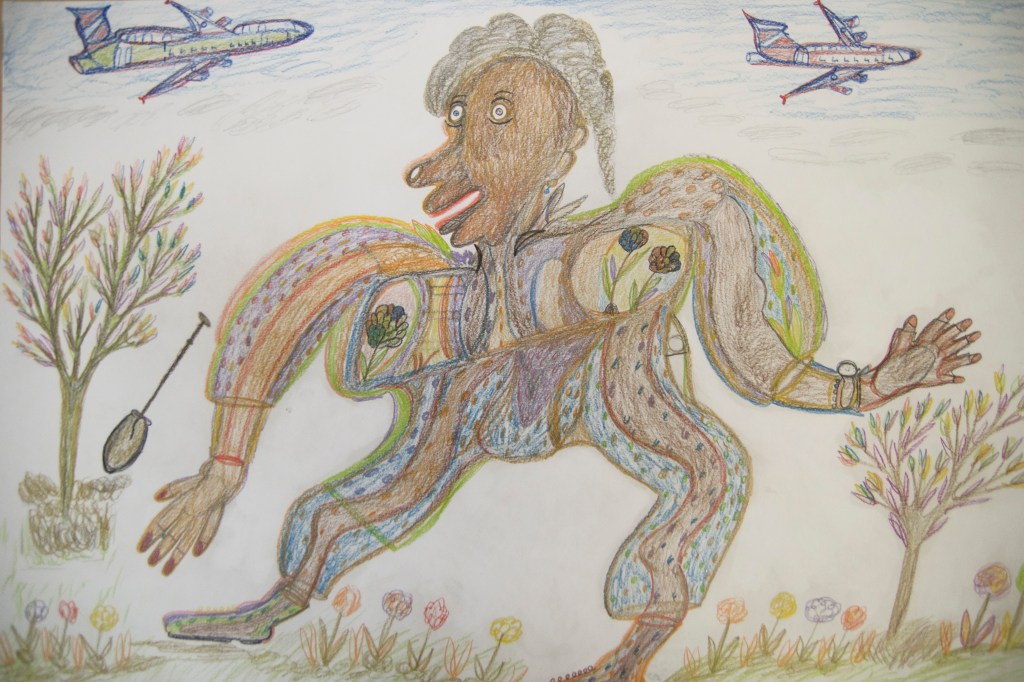
Above image: Manuel Bonifacio, Aeroplanes and Spades
On 29 April, Pallant House Gallery welcomed a new exhibition showcasing the work of Manuel Bonifacio; one of six Outside In 2012 Award Winners. The exhibition is a colourful array of Bonifacio’s imaginative characters and creatures, and is definitely a must-see if you’re down on the south coast in the next month.
Born in December 1947 near Lisbon, Portugal, Bonifacio pursued his interest in drawing and pottery after dropping out of school at the age of eight. His most recent collection of work, which features the award winning ‘Mermaid’ and a selection of pottery, is inspired by his passion for archaeology and animals. Bonifacio paints, draws, sculpts and makes at ArtVenture – a creative day centre for adults with learning difficulties – for four hours every Wednesday and Friday. Since his Award win, Bonifacio has exhibited in Birmingham and London and now has work in collections in Switzerland and New York. In recognition of Bonifacio’s talent, an Outsider Art collector will be travelling over from Switzerland to attend this much-anticipated exhibition.
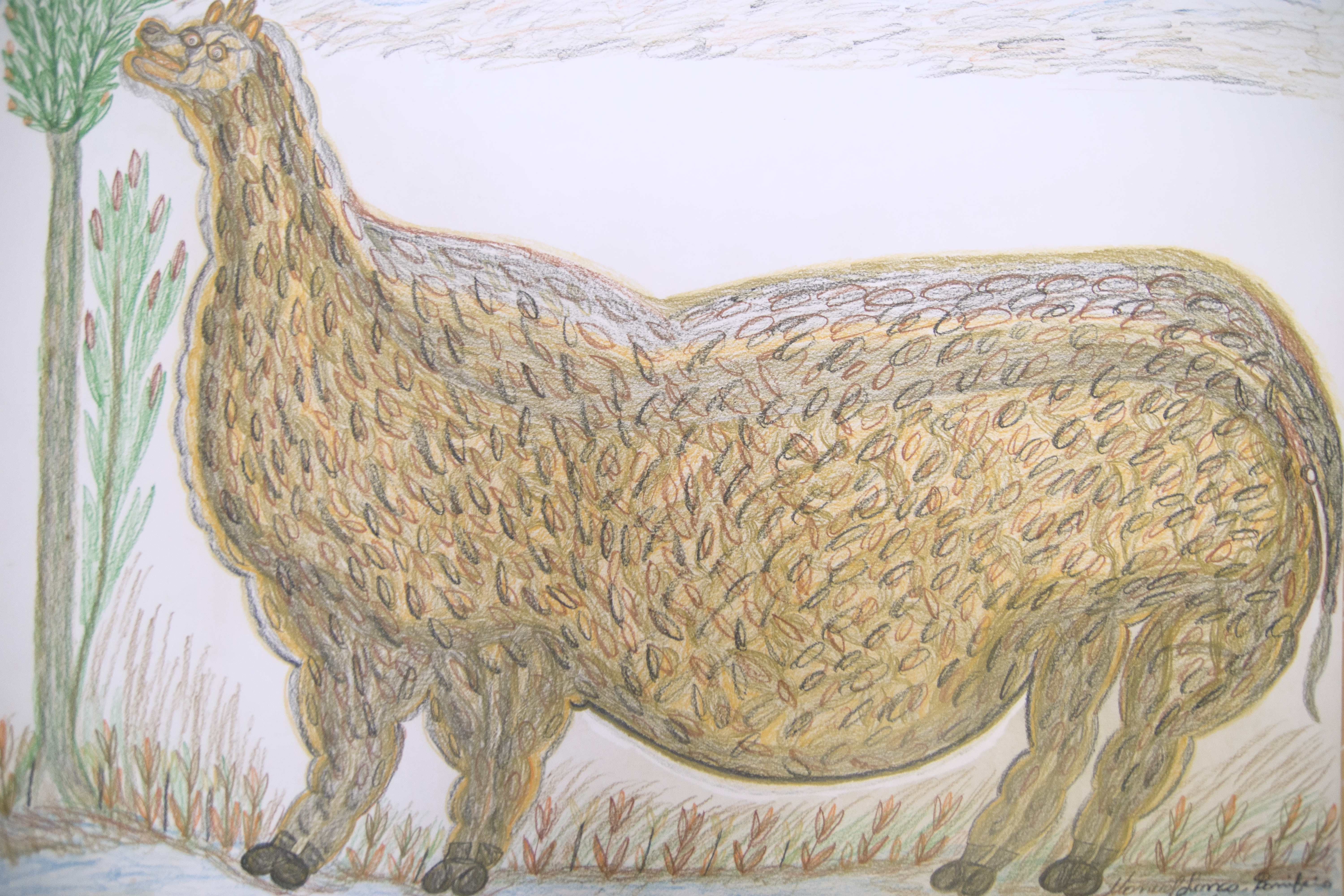
Manuel Bonifacio, Jungle Animal
“Manuel’s thing at the moment is mermaids, but he loves motorbikes,” his niece says. “He likes to do things his own way; he thinks ‘I’m the artist and I know what I’m doing’!” Bonifacio’s mermaids (one of which one him the Award in 2012) have an interesting narrative all of their own. “They live in Lisbon, but they go all over the world,” says Bonifacio. Lisbon is in fact populated with several mermaid statues, including eight in the large fountains in Rossio Square. Bonifacio adds: “All the children used to say ‘Look, there she is – the mermaid!’ She waves to the people, and then goes under water again when the boats pass.”
At a young age, Bonifacio joined the fire brigade as a volunteer and his life’s ambition was to be in the army. Many of his works reflect his passion for army transportation, depicting helicopters, aeroplanes, motorbikes and boats. His work is also inspired by politics and everything he sees on television, but most of it comes straight from his colourful imagination. His sister describes the huge variety of subject matter he depicts: “The birth of Jesus, the circus, the Pope, the Queen, Margaret Thatcher and David Cameron, dancers, Christmas-inspired pieces, motorcycles, musicians, buskers, birds, divers, fish, helicopters, dogs, horses, wolves, mermaids, and always people. There are faces in most of his work.”
Manuel Bonifacio, Motorbike and Man
Keen to explore and take on a challenge, Bonifacio has previously experimented with printmaking and wood carving and he occasionally dabbles in watercolours and oils. His portfolio also includes an array of distinctive ceramic mugs, vessels and faces. Walking from Cobham to Kingston regularly – a 20 minute drive – Bonifacio notes down road names, makes sketches and absorbs nature and life, which are ever present in his work. One of his figures was inspired by a statue on a roundabout in his hometown, but more generally, the characters he so vividly creates come straight from his mind. There is a sense that he could conjure anything; a donkey, a bullfighter, or various forms of transport.
Bonifacio’s sister, Maria Odone, says: “Manuel’s work has been a valuable asset to everyone who knows him as it is also a way he likes to communicate. His ideas and perception of what is going on around him both locally and nationally are very unique. His ambition as an artist is to travel around the world, finding places and people that will inspire him.”
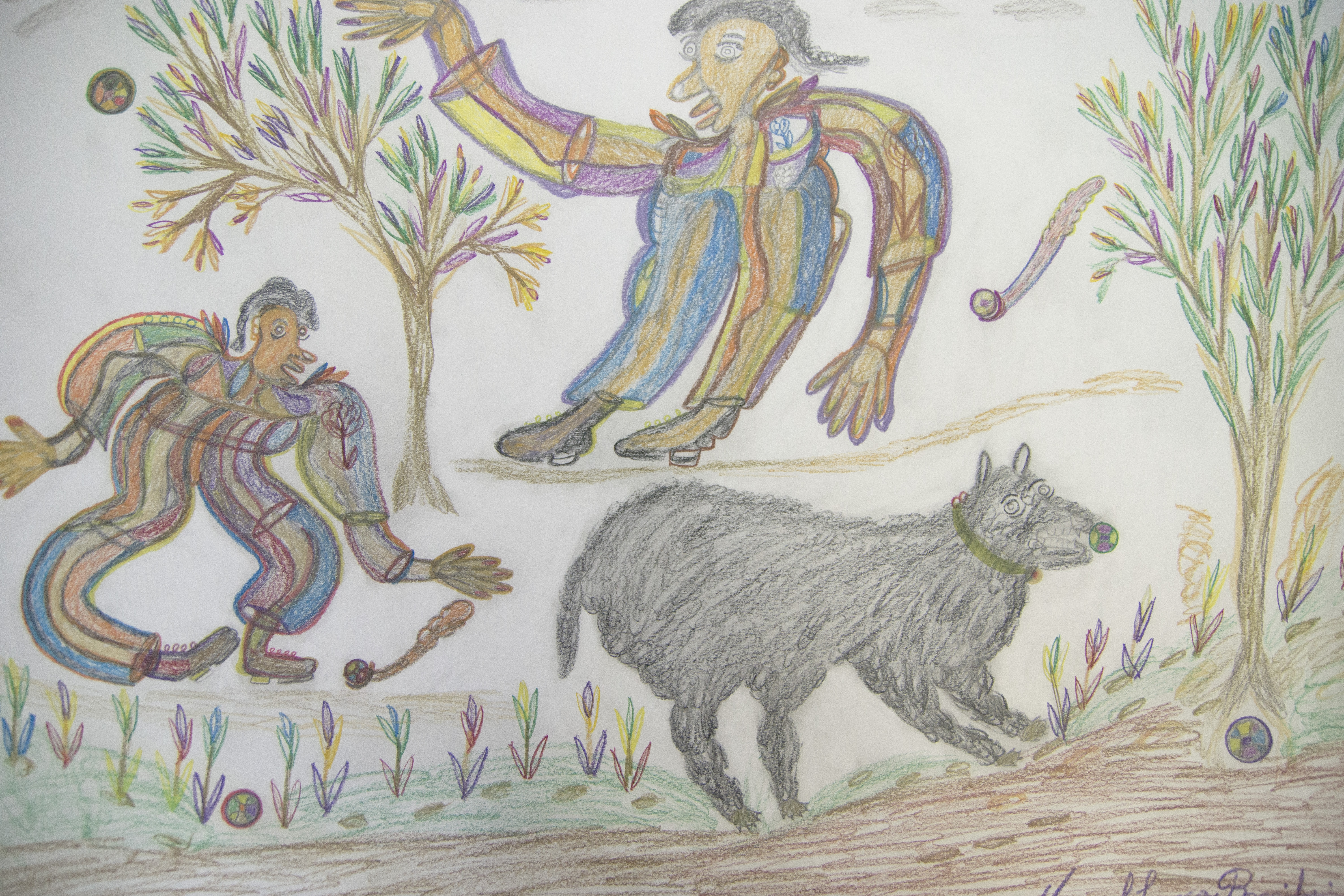
Manuel Bonifacio, Ball Games
Roger Cardinal, who coined the term Outsider Art in 1972 as the English equivalent of Jean Dubuffet’s Art Brut, was one of the Outside In: National judges. He speaks of the moment he first saw Bonifacio’s Mermaid at the Gallery: “It struck me as entirely familiar and made me think of the Frenchman Guillaume Pujolle, an early star of Art Brut whose lyrical images I cherish. This brief and decisive moment established Bonifacio as my top choice. The Mermaid is a perfect reality for him [Bonifacio]. I see her arms and elongated fingers as enacting the motions of swimming, although she can also be said to be flying. Hence she is capable of traversing earth, sea and air, and becomes and emblem of the artist’s unfettered imagination.”
Entry to Manuel Bonifacio: My Imaginary Cave is free. The exhibition continues in the Studio at Pallant House Gallery until 1 June 2014.
“Categorisation is something that we do naturally and unconsciously every day. We recognise one animal as a cat and another as a dog. We organise objects in the world around us in ways that reflect these categories. In our kitchens, we keep baking trays with other baking trays, saucepans with other saucepans and keep food separate from cleaning products. We categorise ideas, people, tasks and objects. Categorisation is fundamental to the way we think.” – James Sinclair, 2006.
As humans, we categorise things to make sense of the world; we link new things to past experiences, and we group similar people or ideas. We group genres of books in the library. We archive our emails in labelled folders. If we did not do this, we would “become inundated by our environment and unable to cope.”[1] This is a poignant theory with regards to the relative ambiguity of Outsider Art.
I am not sure if you have heard of the fictitious taxonomy of animals described by writer Jorge Luis Borges in 1942. It looked at the work of John Wilkins; a 17th-century philosopher who proposed a new language that would parallel as a classification system. Borges wanted to illustrate the arbitrariness of such a way of categorising the world, so used an example of a taxonomy taken from an ancient Chinese encyclopaedia entitled ‘Celestial Emporium of Benevolent Knowledge.’ The list described in the encyclopaedia divides animals into one of 14 categories:
Those that belong to the emperor
Embalmed ones
Those that are trained
Suckling pigs
Mermaids
Fabulous ones
Stray dogs
Those that are included in this classification
Those that tremble as if they were mad
Innumerable ones
Those drawn with a very fine camel hair brush
Et cetera
Those that have just broken the flower vase
Those that, at a distance, resemble flies.
Quite ridiculous, right? It is a similar story for the huge list of terms we have that fall under the umbrella of Outsider Art (not quite so ridiculous, but probably equally as long). Here are just a few that I have come across at some point: self-taught art, visionary art, primitive art, naive art, marginalised art.. etc. etc. Sometimes giving things labels help us make sense of them, but it can also mean we end up generalising about people or situations that, actually, we have absolutely no idea about.
I have written before about my position on the debate with regard to the term Outsider Art. I sit somewhere between thinking we should not need it, and thinking that to have a label means that people recognise it. Particularly people who have not been aware of it before. We have seen, more so in the last year, an exponential increase in awareness of the subject (particularly in the UK, thanks to a number of high profile London-based exhibitions on the subject). Now, when I tell someone what I blog on, they have some idea what I am talking about. And surely, this can only be a good thing. Raising the profile of this art is of course number one on my agenda. But following close behind is number two on the agenda: to eliminate the discriminatory and redundant term used to describe it. It is a double-edge sword, it seems; raising people’s awareness of a term that one day we hope to be rid of.
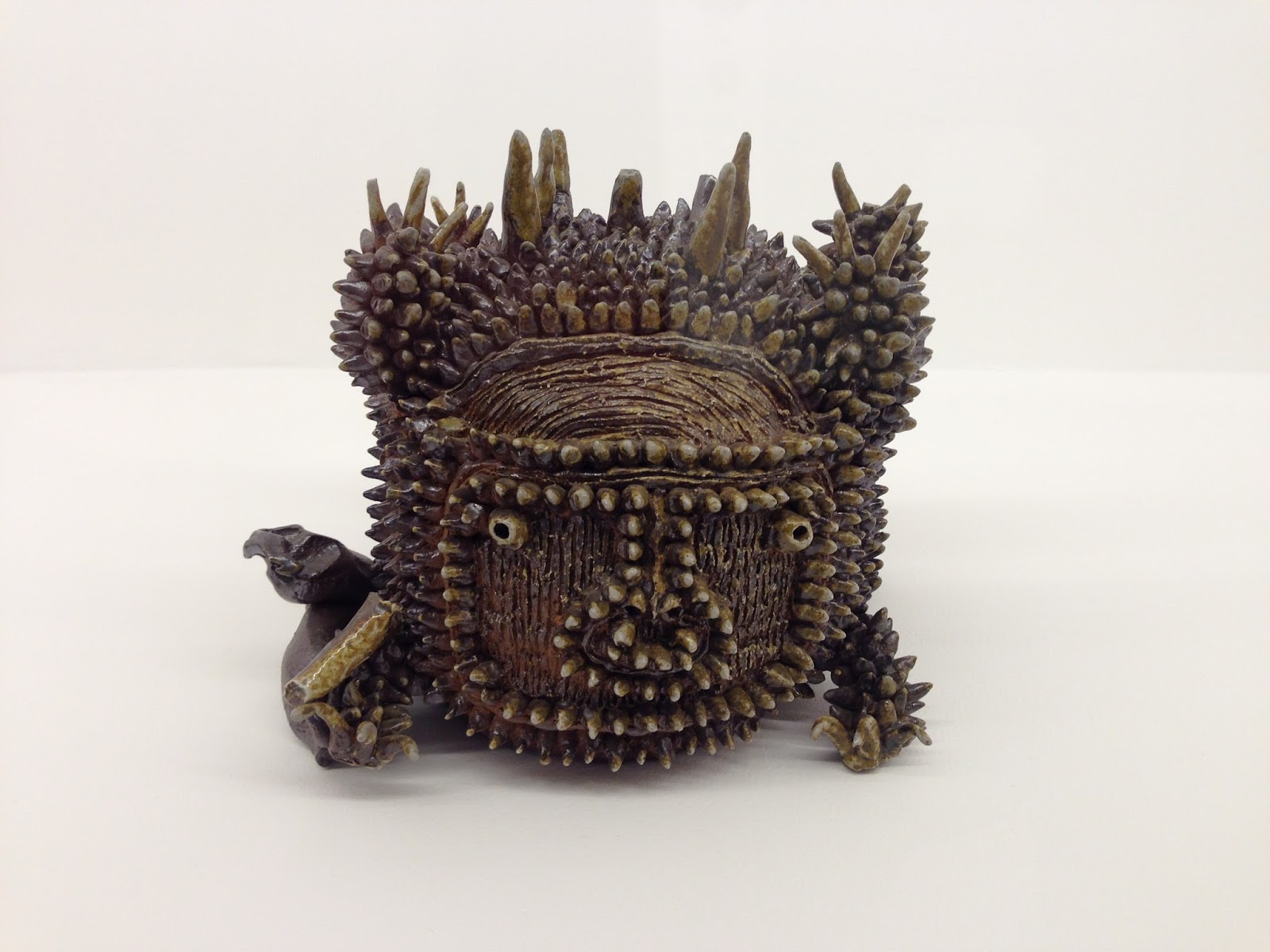
Shinichi Sawada
Outsider Art is one of those terms that would fit into that ‘other’ tick box you get on forms, or your ‘miscellaneous’ email folder. It is where everything that cannot be neatly categorised can be bundled up, and we can smile, thinking we’ve hoovered the dust up. Everything is in its place. But it is this attitude that means that it is becoming increasingly difficult to break open Outsider Art and get people to actually think about what they are grouping together. To put it crudely, we are grouping people diagnosed with mental health issues with ex-offenders, ex-offenders with those who have not been to art school, and those who have not been to art school with artists who paint or draw in a way that is not similar to what we conventionally consider to be art. We are, in essence, grouping people. Is this not the same as those sweeping generalisations that go against our twenty-first century ideas about acceptance, inclusivity, and political correctness? Do all women like the colour pink, all men like cars and sport? I do not recall other types of art being categorised in this way. Surely this in some way goes against our innate need for categorisation, because – like the Chinese encyclopaedia – it does not make any sense.
To move forward, we need to continue to break down the barriers around what we consider to be Outsider Art. We need to have open conversations about what it is, where it is going, and what it all means. But then we need to consciously think about – as humans with innate needs – how we can better categorise the work under this umbrella. I, for one, have not figured this out yet, but I feel like we are making some progress simply by raising awareness about it. It feels like the first step on a ladder that looks a little something like this: Awareness > De-constructing > Re-constructing. And maybe the re-construction of the category will provide evidence that we actually do not need such a term – we will realise that the work of ‘Outsider Artists’ actually fits within the ‘accepted’ canon of art history; after all, all art made in the past is, by its existence,the history of art.
Let me know what you think in the comments below, or on Twitter: @kd_outsiderart
“I produce vibrant works on paper, wood, MDF and canvas in a neo-expressionist style that is often mistaken as ‘outsider’ but I take that as a compliment.
Intense and energetic, rich in vivid colour and heavily covered in text, stencils and bursts of texture, the works are primarily concerned with a universal experience filtered through my life. I suggest dichotomies, wealth vs poverty, primitive vs sophisticated, integration vs segregation, justice vs injustice and inner vs outer experience.
Whilst the majority of my work evidently references pop, neo expressionism and outsider art, I have successfully developed a language of my own. I harness the synergy of appropriation; poetry, drawing and painting which marries text and image, abstraction and figuration, historical information mixed with contemporary critique.
Places that I have visited also directly influence my work — the colours of New Orleans, the Caribbean and Malaysia, and the urban landscapes of New York, Paris, London and Berlin.
Contemporary culture, history, geography, political and corporate worlds, word-play, social commentary and music all get put into the food blender too.
My work has no set agenda, theme or literal subject matter — it is informed by what I am passionate about, what makes me angry and what makes me joyous — how I respond to what I see and hear around me… I try to find beauty in the ordinary, in the mundane, in the over-looked, and in what is commonly regarded as ugly… I am also scathing of what I see as unfair, cruel and brutal in the world. This is also your world.”
– Michael Dawson.
ZaphappyHoly Island (Lust for Life)All Ju Ju Bendy Business Coming To An EndMagic Cat
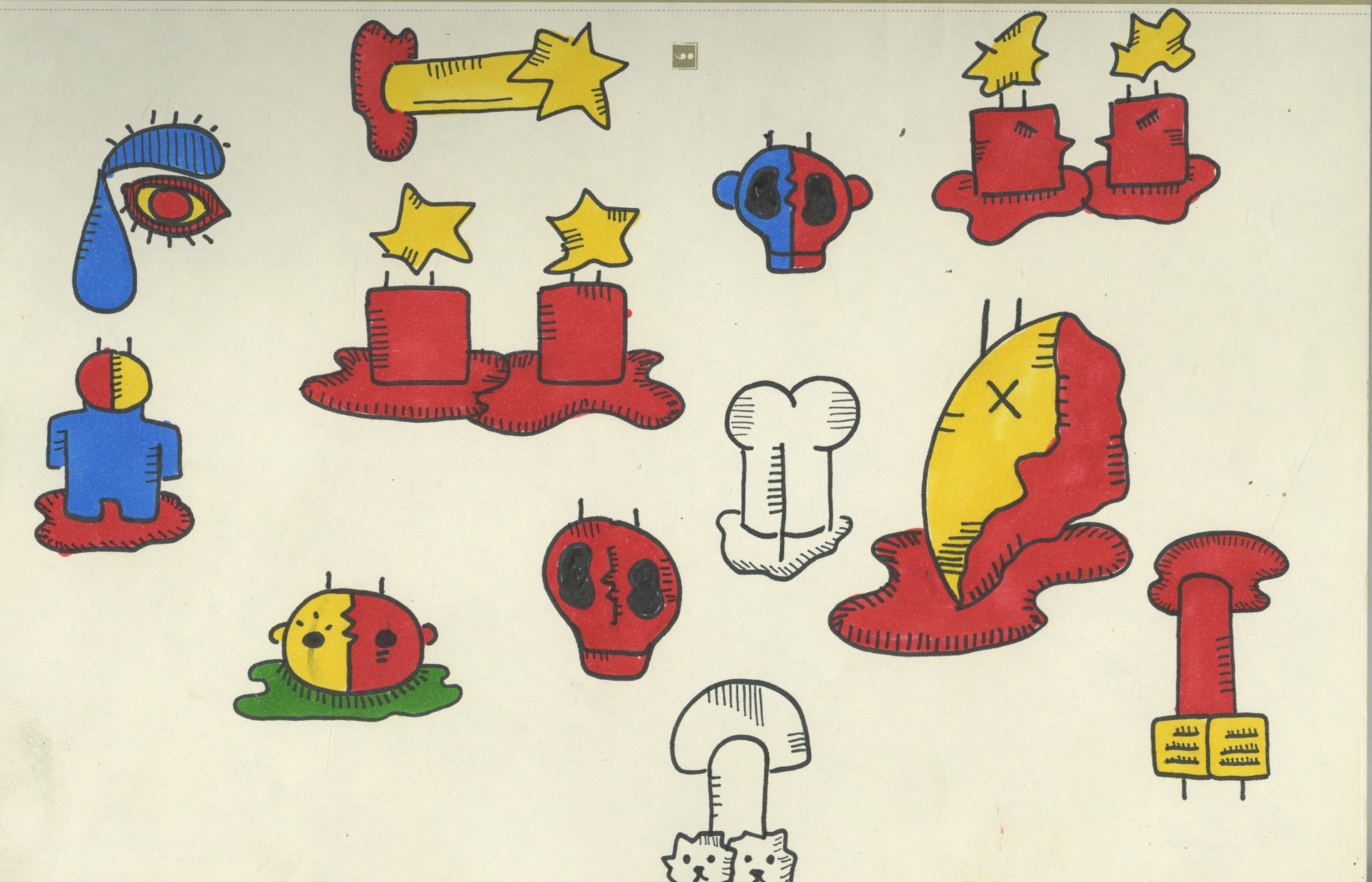
“Images from a yellow book. Where did these come from? I haven’t seen these things. Yet, they appeared as I looked at an empty page. How bizarre. Notice the antenna and the blood. The antenna receive signals from some intangible world of thought and the blood anchors them to the psychical world. Just as I received these images through the spiritual and brought them to the physical. This pleased me, and perhaps it will please you.” – Jumbo Jones.
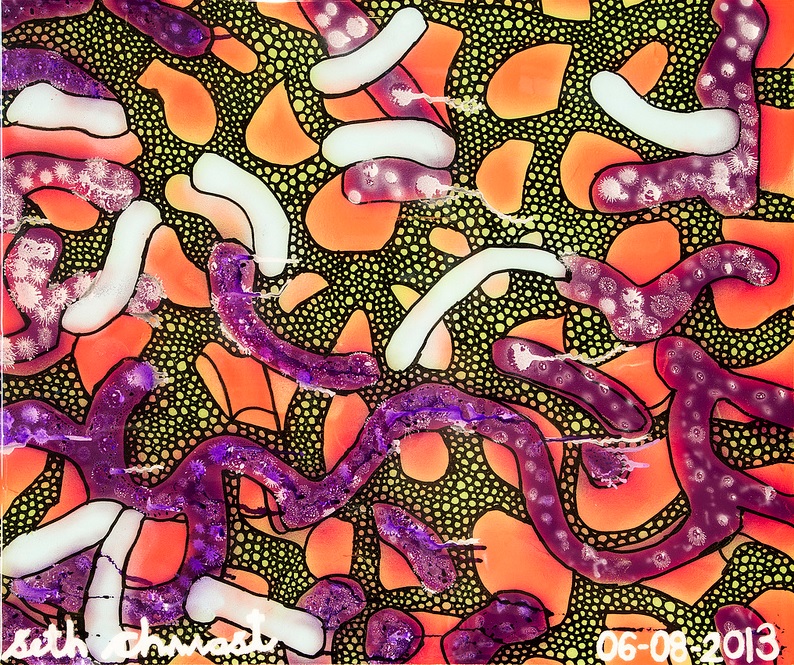
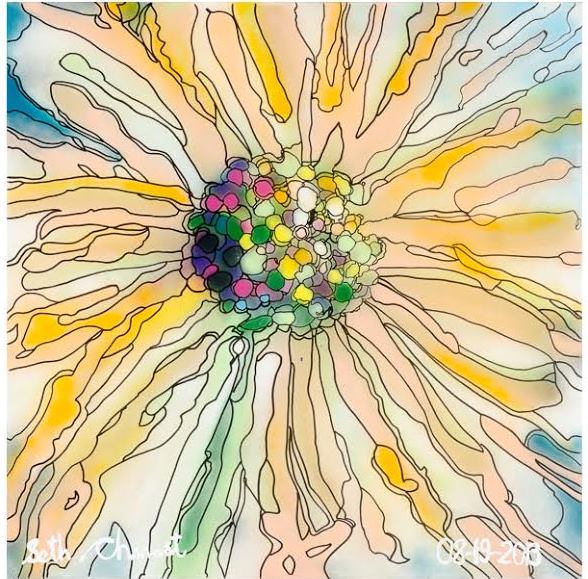
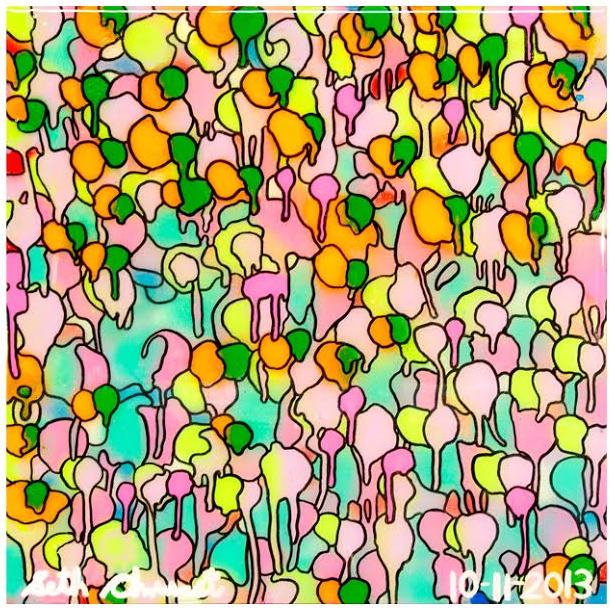
In 2003, at the age of 20, Seth Chwast took an oil painting class at the Cleveland Museum of Art, where he first began describing his world in paint. He displayed an innate ability to mix colours and create amazing works of art that reflect his vision of his world and the world around him. Ten years into his career, Seth has shown his work at numerous locations in the United States including the Time Equities Building in New York City and Penn State College of Medicine. With over 700 paintings, drawings, silkscreens and sculptures to his name, Seth’s subject matter ranges from cityscapes, mythical creatures and portraits to animals and abstract paintings.
Hot Pink EchinaceaThe Big Pink FlowerMulti Coloured Shapes JungleThe Abstract Garden with Multicoloured LeavesThe Clover in my Garden
Thanks to Dr Elaine Argyle from the University of Nottingham for writing a short piece on a fantastic new research project looking at transforming lives through mutual recovery.
Clay Transformations is a project based at the University of Nottingham. It is an innovative research programme that will be investigating the therapeutic effects of working with clay.
It follows a one-year programme focusing on research to support young people who access Nottingham’s mental health services. The Arts & Humanities Research Council has now funded athree year project to investigate the ways in which working creatively with clay can enhance the mental health and well-being of people aged 18 and over. It will engage a wide range of people including those with mental health needs, carers, educators and those working in health and social care. The aim is to promote ‘mutual recovery’ amongst these groups.
The project is run in collaboration with City Arts in Nottingham who have designed and built a new project website. This online platform will act as a place for people to get involved in, and receive regular information about, the project. It will also act as a virtual meeting point for artists, researchers, health and social care professionals and other interested parties to share information about their own practice and experience of working with clay. Once you have become a member you can post a biography, images and information about your work to your profile on the Research Network page. In addition, you can post events, articles and case studies to the shared blog and we have set up an associated Facebook page and Twitter hashtag (#ClayMH) for regular updates. Clay Transformations and City Arts will also be running a free eight week series of workshops exploring basic hand building clay techniques and clay modelling.
Hidekazu Sogabe was born in Osaka and has lived and worked in London since 1997. His early paint work puts together abstract, flattened figures, whilst his more recent sculptural work re-imagines his concerns for embodied experience.
You can see more of Hidekazu’s work by clicking here
Happy New Year everyone – I hope you are all enjoying what 2014 has had to offer so far. I thought I would do a bit of an off the cuff ‘rambling’ blog post talking about a couple of ideas I have recently had relating to the term ‘outsider art’. Hopefully you will share your ideas and opinions on these below.
The festive period brought a bit of a break from blogging and the art world in general, so, as I rekindled old and started new conversations about ‘outsider art’ in the new year, I had some fresh ideas that I wanted to share with you. The first came to me earlier in the week, when I was thinking about how I would now – two years on from starting the blog – describe the term ‘outsider art.’ This is an art that categorically comes from within, an art that (according to Dubuffet) isn’t influenced by art history or external factors. Despite my absolute disagreement with this idea of Dubuffet’s, I do believe that one of the reasons I am so drawn to ‘outsider art’ is because it epitomises raw communication from the heart and soul. Why then, do we call it ‘outsider art’ – shouldn’t it be ‘inside art’ or ‘art from within’? It seems absurd to me, as someone who enjoys using words, that the term itself should be so contradictory to the work caught beneath this umbrella.
Often, when I tell people that I write about ‘outsider art’, they’ll ask: “Is that open-air art?” Hmm, it would make sense, wouldn’t it? I think someone also shared this opinion on BBC Imagine’s recent programme dedicated to ‘outsider art’; ‘Turning the Art World Inside Out’ (I think you can still catch it here on Youtube). So why, I wonder, can’t we give it a more deserving, fitting, and altogether less controversial name? ‘Art from within’ or ‘Inside’ art might go some of the way to distilling visions of the ‘societal outsider’ and alleviate the current separation between ‘outsider art’ and the ‘mainstream’ art world. Or, to play devil’s advocate, do we even need a label at all? I’m not so sure any more… Let me know what you think.
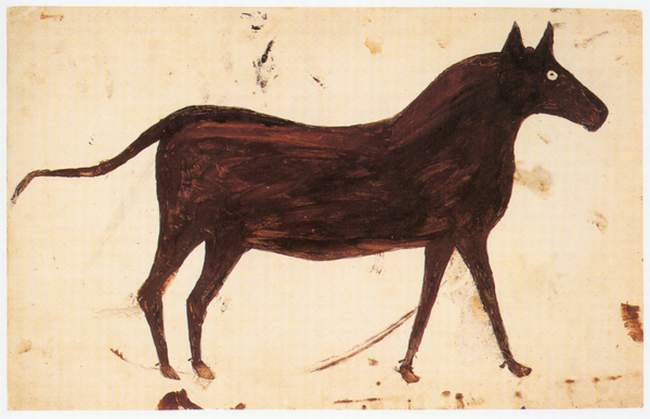
Bill Traylor
The second thing I wanted to write about stems from a conversation I had on a recent visit to a prison. I was asked how artists who are also offenders or ex-offenders could ever shake the label of being an offender or an ex-offender if they are continuously associated with organisations who are known to work with these groups. This is something I have thought about previously, but to have someone who is potentially in that position to voice their concerns made me re-evaluate its importance. I know a lot of fantastic organisations working with ‘marginalised’ groups, but I wonder if perhaps there is something in this idea that people don’t want to be associated with their past or known by one label that doesn’t encompass everything they are or can be. For example, if art is marketed as ‘offender art’, does that mean the creator’s image is tainted; that they are not seen simply as an artist working within the art world?
I have always wanted ‘outsider art’ to be exhibited and publicised in a way that eliminates in-depth biographies, and instead just focusses on the art as a captivating piece of work created by a talented individual. There are plenty of organisations operating across the country that do a fantastic job in supporting artists who are perhaps facing barriers to the ‘mainstream’ art world for whatever reason, and I think that these charities and groups are undoubtedly needed; in particular to encourage and nurture an artist’s first steps into, or a return to, the art world. The conversation in the prison concluded with a suggested solution that these organisations are invaluable as a springboard towards a career as an artist. By becoming an artist unwanted labels can be lost; replaced, if necessary, with more favourable and accurate ones.
I would really value and appreciate your ideas on either of these thoughts, so please post any comments below. Happy New Year!
















 KDOA
KDOA 